Stories of the residents of Jersey, Guernsey, and other Channel Islands and their service and sacrifice during the First World War.
Before the outbreak of the First World War, the Channel Islands were scenic, sunny holiday destinations, where it was possible to briefly escape the hustle and bustle of life. But as soon as the fighting began, worries arose about the threat of a German invasion to the islands, which are much closer to the coast of France than the southern coast of Great Britain.
Both men and women alike played their part. Men joined one of the islands' militia or enlisted in one of the numerous regiments of the British Army, including the 'Jersey Pals' and the Royal Irish Fusiliers, Royal Irish Rifles, and Royal Irish Regiment. This book looks at the commitment and achievements of the Channel Islands' very own Royal Guernsey Light Infantry, formed in December 1916. The Islands' women volunteered in droves to serve with the British Red Cross' Voluntary Aid Detachments, not just throughout the Channel Islands, but in mainland Great Britain and further afield in Belgium, France, and beyond. Ultimately, German soldiers didn't set foot on the islands—except for about two thousand held captive there as prisoners of war. This book tells the story of the people of the Channel Islands and what they did during the First World War—including those who paid the ultimate price.
Includes photos
- 224 pages
- English
- ePUB (mobile friendly)
- Available on iOS & Android
eBook - ePub
The Channel Islands in the Great War
About this book
Information
Topic
StoriaSubtopic
Storia britannicaCHAPTER ONE
1914 – Starting Out
The outbreak of hostilities of the First World War was one of the world’s worst kept secrets, as it had been brewing throughout the early years of the twentieth century. Initially there was shock, surprise and disruption. People were worried, those who had savings in particular. There was panic buying in the shops and men quickly started to leave the islands in large numbers, some to France but most to England to enlist.
With the islands being the closest part of Great Britain to the French coast and easily accessible from the English Channel, they faced the most realistic threat of a German attack or invasion, especially in the early stages of the war. Thankfully such worries and concerns were short lived and normality, or what passed for normality in such times, quickly returned.
Once the fighting had begun in earnest, the Channel Islands certainly did their bit for the British Empire. According to figures compiled from the Commonwealth War Graves website, British and Commonwealth losses during the first five months of the war, August to December 1914, totalled 42,219. Of these, at least twenty-six were from Guernsey, forty-six from Jersey, and two were from Alderney. These figures are derived from the above website, and are therefore only as good, and accurate as the information that was originally entered for each man.
It is interesting to see the different regiments, corps and units, with which men from the Channel Islands served during those first five months of the war:
Royal Navy, Mercantile Marine, Bedfordshire Regiment, South Wales Borderers, Manchester Regiment, Dorsetshire Regiment, Coldstream Guards, East Surrey Regiment, Devonshire Regiment, Royal Marine Light Infantry, Northamptonshire Regiment, Highland Light Infantry, The Buffs (East Kent Regiment), 4th Dragoon Guards, Gloucestershire Regiment, Royal Marine Artillery, King’s Own (Royal Lancaster Regiment), Irish Guards, 59th Scinde Rifles (Frontier Force), South Staffordshire Regiment, Norfolk Regiment, Royal Irish Regiment, Welsh Regiment, Royal Garrison Artillery, Queen’s Own (Royal West Kent Regiment), Leinster Regiment, Leicestershire Regiment, Royal Sussex Regiment, East African Mounted Rifles, Royal Munster Fusiliers.
A theme of the First World War, throughout towns and villages of Great Britain, were civilian Volunteer Corps. The problem with this in the early stages of the war, was a lack of co-ordination. Although well intentioned in their formation, often led by retired Army officers, there was a concern from Government that some men would see joining one of these unofficial corps, as a way of attempting to avoid taking up military service and did not initially support their introduction. Despite their initial trepidation, there was an overwhelming desire by men up and down the country who were either too old, or not fit enough for wartime military service, to do their bit in their country’s time of need. Add to this the real worry and concern in both Great Britain and the Channel Islands of an invasion and it was easy to see how and why these corps sprung up.
Such was the combined enthusiasm for these Volunteer Corps, that in September 1914 a central committee was formed to oversee their running, and on 19 November 1914 it was renamed the Central Association of Volunteer Training Corps and recognised by the War Office. Guernsey was on board with the idea and had her own Volunteer Corps up and running in the early months of the war. Their overall intention was to be able to assist the military authorities should the occasion arise, so to this end they were trained in military duties. Men of the corps had to purchase their own uniforms, which could not be khaki green in colour, and they had to wear a red coloured arm band, with the letters GR (Georgius Rex) emblazoned on it.
With the introduction of conscription, brought in by the British Government in March 1916, came Military Service Tribunals, bodies that were formed to listen to men who had applied for exemption from having to undergo military service. One of the outcomes these bodies could find, was to make an order that an applicant would join their local Voluntary Training Corps (VTC) in lieu of undertaking military service. By the end of the war, 110,000 men had ended up in the VTC via this particular route.
In the first month of the war, August, there were fifteen major battles, only two of which saw British involvement. The Battle of Mons which took place on 23 August 1914, was the first major action that the men of the British Expeditionary Force had seen, when they attempted to hold back forces of the German First Army, at the Mons-Condé Canal. Despite being in relatively strong defensive positions, which were greatly assisted by a canal separating them from their attackers, a spirited defence of their position, and inflicting heavy casualties on their German attackers with rifle and machine-gun fire, they eventually had to retreat due to overwhelming enemy numbers, and the sudden exposure of their right flank, when troops of the French Fifth Army, inexplicably retreated.
The battle saw the death of Guernseyman Private (4834) Patrick John Ryan of the 2nd Battalion, Royal Irish Regiment. A married man, he lived with his wife at 1 Cliff Terrace, St Peter Port, Guernsey. He has no known grave, but his name is commemorated on the La Ferté-Sous-Jouarre Memorial, in the Seine-et-Marne region of France.
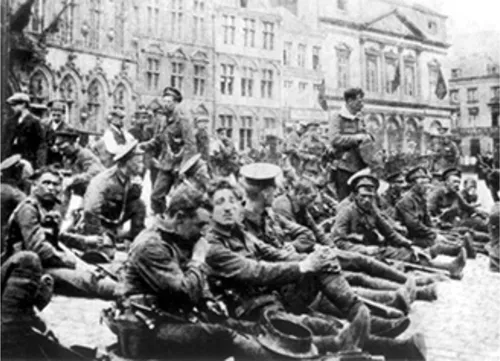
Soldiers resting up after Battle of Mons.
Three days later, on 26 August 1914, during the Allied retreat from Mons, came the Battle of Le Cateau. But this was totally different from the Battle of Mons. The real damage here wasn’t so much down to rifles and machine guns, but artillery.
By the end of the day the battle was over, and the British and French forces, under the command of General Sir Horace Smith-Dorrien, had suffered nearly 8,000 casualties which included 2,600 men who were captured and a further 700 who had been killed. Of these, 36-year-old Company Serjeant-Major (5811) William Sharp, a Scotsman by birth, who was serving with C Company, 1st Battalion, King’s Own (Royal Lancaster Regiment), lived in Jersey. He had initially been reported as missing in action, with the hope that he had been captured by the Germans and taken as a prisoner of war, but sadly, it was not to be.
He had enlisted in the army for twelve years, on 14 October 1898, and served in the Second Boer War, arriving in Natal, South Africa, on 30 December 1899. He had been stationed at Fort Regent in Jersey and is recorded as being there in the 1911 Channel Island Census. William Sharp married Lydia Maud Jolin on 1 June 1911 at St James Parish Church, Jersey. Their witnesses were Mr Albert Allen and Miss Doris Orment. At the time of his death, the family home was at 6 Roseville Street, St Helier, although Lydia, would later move to 2 Torque Villas, Lewis Street, St Helier. The 1911 Channel Island Census, showed Lydia, living with her 72-year-old widowed mother, Martha, at the unusually numbered, thirty-one-and-a-half, Green Street, Jersey. Lydia, later married Laurence George Rowe, and they went on to live at 18 New St John’s Road in St Helier.
September saw no respite from the fighting with a further seven major battles taking place. The first to involve British forces was the Battle of the Marne, between September 6 and 12, which was a counter-attack by French and British forces as the Germans approached the eastern outskirts of Paris at the River Marne near Brasles. It was predominantly a French – German affair with the French pitting thirty-nine of their divisions against twenty-seven German ones. Britain’s support came in the shape of just six divisions. This was reflected in the number of casualties each side sustained. France suffered an estimated 85,000, killed, wounded and missing, whilst Germany suffered 67,700 and Britain, 1,701.
This was immediately followed by the First Battle of the Aisne which took place between 13 and 28 September 1914 and left the British with 13,541 men killed or wounded.
Corporal (8877) William Edward Walsh, of the 2nd Battalion, Welsh Regiment, first arrived in France on 13 August 1914, as part of one of the earliest units of the British Expeditionary Force. Sadly, his war was not destined to last long, as he was killed in action on 14 September 1914. He has no known grave, but his name is commemorated on the La Ferté-Sous- Jouarre Memorial in the Seine-et-Marne region of France.
His father Martin William Walsh, at one time lived at 1 Lower Cottages, Delaney Hill, St Sampson, Guernsey, but when that was is not clear.
In October 1914, there were a further five major battles, which included British involvement.
10 October – 2 November 1914 Battle of La Bassee
12 October – 2 November 1914 Battle of Messines
13 October – 2 November 1914 Battle of Armentières
16 – 31 October 1914 Battle of Yser (Naval support only)
19 October – 22 November 1914 1st Battle of Ypres
During the overall time frame of these battles, twelve men either from, or with, Jersey connections were killed, along with seven from Guernsey. But it wasn’t just on the battlefields of France and Belgium where men from the Channel Islands were dying for king and country. A number of men met the same fate thousands of miles away from their homes and loved ones, off the coast of central Chile, close to the city of Coronel.
On 1 November 1914, the sea Battle of Coronel took place between the East Asia Squadron of the Imperial German Navy, under the command of Vice Admiral Maximilian Graf von Spee, and the British West Indies Squadron, under the command of Rear Admiral Sir Christopher Cradock.
What led to the Allied and German navies being in that part of the world at a time when most of the fighting was taking place on land throughout Europe, especially across France and Belgium? Early in the war, Allied warships had gained control of the previously held German colonies of, Kaiser- Wilhelmsland, Yap, Nauru and Samoa, islands that were dotted throughout different parts of the Pacific Ocean. With the imminent expectation of war with Japan, the German East Asia Squadron, had also abandoned their base at Tsingtao, China.
Rather than return to Germany, Spee took the decision to stay in the area and attack Allied merchant shipping, plying their trade along the west coast routes of South America. It had been guessed by those at the British Admiralty that this might be the course of action Spee had in mind, so the Fourth Cruiser Squadron under the command of Cradock was sent to the area of the Western Pacific Ocean to seek and destroy the German vessels. When the two squadrons did eventually meet, it was more likely down to chance rather than anything else, but once they came into contact with each other there was no avoiding what had to be done.
By the end of the battle Germany had secured a noted victory. All of their ships were intact and their total casualties, were just three wounded men. As for Cradock, he had lost two of his cruisers, HMS Good Hope and HMS Monmouth, along with the lives of 1,570 of his men.
Of those who lost their lives on board HMS Good Hope and HMS Monmouth, the following men were from the Channel Islands:
Leading Telegraphist (J/8529) Bertie Charles Hockey, (21) of HMS Monmouth was born in St Helier, Jersey. His name is commemorated on the Plymouth Naval Memorial.
Leading Seaman (208615) Clarence Gordon Underhill, was on board HMS Good Hope. He was the son of Henry and Esther Underhill, who lived at 10 Val Plaisant, St Helier, Jersey. His name is commemorated on the Portsmouth Naval Memorial.
Petty Officer 1st Class (155565) Alfred Smith (40) was serving on HMS Good Hope. He was a married man who lived with his wife, Edith, at Leap Cottage, Gorey Pier, Jersey. His name is commemorated on the Portsmouth Naval Memorial.
Bombardier (RMA/8476) Charles William Poling, (32) of the Royal Marine Artillery, with which he had served for a number of years, was part of the crew of HMS Good Hope. His name is recorded on both the 1901 and 1911 Census as a member of the Royal Marine Artillery. At the time of his death, and in the 1911 Census, he is shown as a married man, who lived with his wife, Emily, in Southsea, Portsmouth, but who was actually born in Colombo, Ceylon. His connection to the Channel Islands came from his parents who lived in Jersey. His name is commemorated on the Portsmouth Naval Memorial.
Stoker 2nd Class (K/21979) William Francis Journeaux (21) was on board HMS Good Hope. Before enlisting, he lived at 3 St Luke’s Cottages, Plaisance Road, Jersey, with his parents, Richard and Mary Journeaux, although the 1911 Census, shows William living ...
Table of contents
- Cover
- Title
- Copyright
- Contents
- Introduction
- Chapter One 1914 - Starting Out
- Chapter Two 1915 - The Deepening Conflict
- Chapter Three 1916 - The Realisation
- Chapter Four 1917 - Seeing It Through
- Chapter Five 1918 - The Final Push
- Chapter Six Red Cross Nurses From The Channel Islands
- Chapter Seven War Memorials
- Chapter Eight Those Who Died After The Armistice
- Conclusion
- Sources
- About the Author
Trusted by 375,005 students
Access to over 1.5 million titles for a fair monthly price.
Study more efficiently using our study tools.
Frequently asked questions
Yes, you can cancel anytime from the Subscription tab in your account settings on the Perlego website. Your subscription will stay active until the end of your current billing period. Learn how to cancel your subscription
No, books cannot be downloaded as external files, such as PDFs, for use outside of Perlego. However, you can download books within the Perlego app for offline reading on mobile or tablet. Learn how to download books offline
Perlego offers two plans: Essential and Complete
- Essential is ideal for learners and professionals who enjoy exploring a wide range of subjects. Access the Essential Library with 800,000+ trusted titles and best-sellers across business, personal growth, and the humanities. Includes unlimited reading time and Standard Read Aloud voice.
- Complete: Perfect for advanced learners and researchers needing full, unrestricted access. Unlock 1.5M+ books across hundreds of subjects, including academic and specialized titles. The Complete Plan also includes advanced features like Premium Read Aloud and Research Assistant.
We are an online textbook subscription service, where you can get access to an entire online library for less than the price of a single book per month. With over 1.5 million books across 990+ topics, we’ve got you covered! Learn about our mission
Look out for the read-aloud symbol on your next book to see if you can listen to it. The read-aloud tool reads text aloud for you, highlighting the text as it is being read. You can pause it, speed it up and slow it down. Learn more about Read Aloud
Yes! You can use the Perlego app on both iOS and Android devices to read anytime, anywhere — even offline. Perfect for commutes or when you’re on the go.
Please note we cannot support devices running on iOS 13 and Android 7 or earlier. Learn more about using the app
Please note we cannot support devices running on iOS 13 and Android 7 or earlier. Learn more about using the app
Yes, you can access The Channel Islands in the Great War by Stephen Wynn in PDF and/or ePUB format, as well as other popular books in Storia & Storia britannica. We have over 1.5 million books available in our catalogue for you to explore.