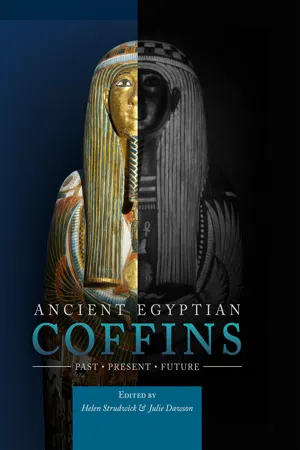
This collection of papers by leading international experts on the subject of ancient Egyptian coffins, builds on a project based at the Fitzwilliam Museum, Cambridge, to study and record in detail its collection. Papers address a series of topics including: the development of coffins in antiquity, including iconographic and text-based studies, providing new insights into ancient Egyptian belief systems at different periods and regional differences in coffin presentation; the post-antiquity history of coffins, including their acquisition and subsequent treatment in museums around the world; developments in technical examination and methods of studying coffins, especially the use of multispectral imaging to provide non-invasive analysis of materials, and what this tells us about construction and decorative techniques at different periods and in response to the availability of different materials and increasing evidence of the re-use of materials and complete re-working of coffins for new owners, leading us to question fundamental attitudes to the purpose of coffins as a containers of human remains and the practices of craftsmen in the funerary industry. The papers stem from a conference held at the Museum to accompany a major new exhibition.
LÄ = Helck, Wolfgang and Wolfhart Westendorf (eds). 1975–1992. Lexikon der Ägyptologie. Wiesbaden: Otto Harrassowitz.
LGG = Leitz, Christian (ed.). 2002–2003. Lexikon der ägyptischen Götter und Götterbezeichnungen.Volumes 1–7 (Orientalia Lovaniensia analecta 110–116) and Lexikon der ägyptischen Götter und Götterbezeichnungen. Volume 8. Register (Orientalia Lovaniensia analecta 129). Leuven: Peeters.
PM = Porter, Bertha and Rosalind L.B. Moss; Ethel W Burney, Jaromír Málek. 1927–. Topographical bibliography of Ancient Egyptian hieroglyphic texts, reliefs, and paintings. Oxford: Clarendon Press.
PN = Ranke, Hermann. Die ägyptischen Personennamen, Bd. 1: Verzeichnis der Namen. Glückstadt: J.J. Augustin.
Wb = Erman, Adolf and Hermann Grapow (eds) 1926–1963. Wörterbuch der Aegyptischen Sprache. Leipzig: J.C. Hinrichs.
Abbas, Eltayeb Sayed. 2014a. Ritual Scenes on the Two Coffins of P3-dj-imn in Cairo Museum (BAR International Series 2603). Oxford: British Archaeological Reports.
——— 2014b. “The Significance of a ritual scene on the floor board of some coffin cases in the Twenty-First Dynasty”. In: Pischikova, Budka and Griffin 2014, 419–438.
Accorsi, Gianluca, Giovanni Verri, Margherita Bolognesi, Nicola Armaroli, Catia Clementi, Costanza Miliani and Aldo Romani. 2009. “The exceptional near-infrared luminescence properties of cuprorivaite (Egyptian blue)”. Chemical Communications 23: 3392–3394.
Altenmüller, Hartwig. 1976. Grab und Totenreich der Alten Ägypter. Hamburg: Hamburgisches Museum.
Ambers, Janet. 2004. “Raman analysis of pigments from the Egyptian Old Kingdom”. Journal of Raman Spectroscopy 35: 768–773.
Amenta, Alessia. (ed.) 2013. Vatican Coffin Project, Protocollo indagini scientifiche. Analysis Protocol. Città del Vaticano: Musei Vaticani.
Amenta, Alessia. 2014 “The Vatican Coffin Project”. In: Thebes in the First Millennium BC, edited by E. Pischikova, J. Budka and K. Griffin, 483–499. Newcastle upon Tyne: Cambridge Scholars Publishing.
Amenta, Alessia and Hélène Guichard (eds). 2017. Proceedings of the First Vatican Conference 19–22 June 2013. Città del Vaticano: Edizioni Musei Vaticani.
Anđelković, B. and Elias, Jonathan. 2015. “Inscriptions on the Interior of the 30th Dynasty Coffin of Nefer-renepet from Akhmim”.Issues in Ethnology and Anthropology (Belgrade), n.s. 10 issue 3.
Andreau, Guillemette. 2002. Les Artistes de Pharaon. Deir el-Médineh et la Vallée des Rois. Paris: Réunion des musées nationaux.
Asensi Amorós, Maria Victoria. 2017. “The wood of the Third Intermediate Period coffins: The evidence of analysis for the Vatican Coffin Project”. In: Amenta and Guichard 2017, 45–50.
Assmann, Jan (ed.). 1991. Das Grab des Amenemope TT 41. Theben 3. Mainz am Rhein: Verlag Philipp von Zabern.
Aston, David A. 1999. Elephantine XIX: Pottery from the Late New Kingdom to the Early Ptolemaic Period. Mainz am Rhein: Verlag Philipp von Zabern.
——— 2004. “Amphorae in New Kingdom Egypt”. Ägypten und Levante 14: 175–213.
——— 2009. Burial assemblages of dynasty 21–25: Chronology, typology, developments (Denkschriften der Gesamtakademie, Bd. 56). Wien: Verlag der Österreichischen Akademie der Wissenschaften.
Aubert, M.-F. 1997. Louvre Guide du visiteur, Les Antiquités égyptiennes II, Egypte romaine, art funéraire Antiquités coptes. Paris: Réunion des Musées Nationaux.
Ayora Cañada, María José, Ana Domínguez Vidal, Yolanda de la Torre and Alejandro Jiménez-Serrano. 2015. “On-site spectroscopic investigation of pigments in archaeological Egyptian funerary artefacts at Qubbet el Hawa necropolis (Aswan)”. Poster presented at the 8th International Conference on Advanced Vibrational Spectroscopy (July 12–17, 2015), Vienna, Austria.
Baba, Masahiro and Ken Yazawa. 2015. “Burial assemblages of the Late Middle Kingdom: Shaft-tombs in Dashur North”. In: Miniaci and Grajetzki 2015, 1–24.
Baba, Masahiro and Sakuji Yoshimura, 2010. “Dahshur North: intact Middle and New Kingdom coffins”. Egyptian Archaeology 37: 9–12.
Balanda, S.Z. 2009. “The title ‘
’ to the end of the New Kingdom”. Journal of the American Research Centre in Egypt 45: 319–348.
Barta, Winfried. 1968. Aufbau und Bedeutung der altägyptischen Opferformel. Glückstadt: Augustin.
Barwik, Miroslaw. 2003. “New data concerning the Third Intermediate Period cemetery in the Hatshepsut temple at Deir el-Bahari”. In: Strudwick and Taylor 2003, 122–130.
Bell, M. 1985. “Gurob 605 and Mycenaean Chronology”. In: Mélanges Gamal Eddin Mokhtar, edited by P. Posener-Kriéger, 64–77. Le Caire: L’Imprimerie de l’Institut français d’archéologie orientale.
Berman, Lawrence M. 1992. “Funerary Equipment”. In: Egypt’s Dazzling Sun: Amenhotep III and his World, edited by Arielle P. Kozloff and Betsy M. Bryan, 305–310. Cleveland: The Cleveland Museum of Art.
Betrò, M. 2013. “Firenze inv. Nr. 9477: the coffin of Qenamon (TT93)”. Egitto e Vicino Oriente 36: 15–20.
Bettum, Anders. 2013. Faces within faces: the symbolic function of nested yellow coffins in Ancient Egypt. Oslo: University of Oslo.
Bettum, Anders and Lucy Skinner. 2015. “The Amarna Coffins Project: Coffins from the South Tombs Cemetery”. In: Kemp, Barry (ed.). “Tell el-Amarna, 2014–15”. Journal of Egyptian Archaeology 101: 337–342.
Bianchetti, P., F. Talarico, M.G. Vigliano and M.F. Ali. 2000. “Production and characterization of Egyptian blue and Egyptian green frit”. Journal of Cultural Heritage 1 (2): 179–188.
Bianchi, Robert S. 1983. “Glass Inlays”. Bulletin of the Egyptological Seminar 5, 9–29.
——— 2011. Ancient Egypt, art and magic: Treasures from the Fondation Gandur pour l’Art. St Petersburg, Florida: Museum of Fine Arts. Published in conjunction with the exhibition of the same name, shown at the Museum of Fine Arts St. Petersburg, Florida, 17 December 2011–20 April 2012.
Bickel, Susanne and Elina Paulin-Grothe. 2014. “KV40: a burial place for the royal entourage”. Egyptian Archaeology 45: 21–24.
Billing, Nils. 2002. Nut: The Goddess of Life in Text and Iconography (Uppsala Studies in Egyptology). Uppsala: Department of Archaeology and Ancient History, Uppsala University.
Biondi, E., T. Cavaleri, M. Nervo, M. Pisani and M. Zucco. 2015 “A hyperspectral imager based on a Fabry-Perot interferometer as a tool in cultural heritage studies”. In: Color and Colorimetry. Multidisciplinary Contributions, Vol. XI B, atti della XI Conferenza del colore, Milan, 10–11 september 2015, edited by M. Rossi and D. Casciani, 173–182. Milan: Gruppo del Colore – Associazione Italiane Colore.
Bleiberg, Edward (ed.). 2008. To Live Forever. New York: D. Giles Limited in association with the Brooklyn Museum of Art.
Boeser, P.A.A. 1916. Beschreibung der Aegyptischen Sammlung des Niederländischen Reichsmuseums der Altertümer in Leiden. Mumiensärge des Neuen Reiches. Milano: Cisalpino-Goliardica.
——— 1917. Beschreibung der Aegyptischen Sammlung des Niederländischen Reichsmuseums der Altertümer in Leiden. Mumiensärge des Neuen Reiches. Zweite Serie., Milano: Cisalpino-Goliardica.
Bogoslovsky, E.S. 1973. “Monuments and documents from Dêr el-Medîna in museums of the USSR. Part VI. 20. Sarcophagus No 1, Voronezh Museum of Fine Arts”. Vestnik Drevnei Istorii 1973/2: 70–102.
Borojevic, K., R. Mountain. 2013. “Microscopic identification and sourcing of ancient Egyptian plant fibres using longitudinal thin sectioning”. Archaeometry 55: 81–112.
Botti, Giuseppe. 1958. Le casse di mummie e i sarcophagi da el Hibeh nel Museo Archeologico di Firenze. Florence: L.S. Olschk.
Bragg, Laura M. 1914. “Exhibits at the museum: Egyptian mummy”. Bulletin of the Charleston Museum 10 (No. 6): 49–51.
Brech, Ruth. 2008. Spätägyptische Särge aus Achmim. Eine Typologische und chronologische Studie. Gladbeck: PeWe-Verlag.
Bresciani, Edda, Sergio Pernigotti and Maria Paola Giangeri Silvis. 1977. La tomba di Ciennehebu, capo della flotta del re (Biblioteca degli studi classici e orientali 7). Pisa: Giardini.
Broekman, Gerard P.F., Robert Johannes Demarée and Olaf E. Kaper (eds). 2009. The Libyan Period in Egypt: Historical and Cultural Studies into the 21st–24th Dynasties: Proceedings of a Conference at Leiden University 25–27 October 2007. Leuven: Peeters.
Brunetto, A. 2004. L’utilizzo della Strumentazione laser per la pulitura delle superfici nei manufatti artistici. Saonara: Il Prato.
Bruno, Lisa. 2014. “On not exhibiting a corpse: the Mummy Chamber, Brooklyn Museum”. Understanding Egyptian Collections: Innovative display and research projects in museums, Ashmolean Museum, Oxford University, 1–2 September 2014. Podcast of a talk given in Septem...
Table of contents
Cover
Title
Copyright
Contents
Introduction
Bibliography
Identifying ancient Egyptian coffin woods from the Fitzwilliam Museum, Cambridge using scanning electron microscopy
Beyond the Visible . Merging scientific analysis and traditional methods for the documentation of the anthropoid coffin of Amenemhat
Middle Kingdom mummy-shaped coffins . Investigating meaning and function
Black coffins with yellow decoration of the New Kingdom. An original iconographic study
The outer coffin of Pa-seba-khai-en-ipet. New insights on manufacture, history and treatment
Multi and hyperspectral imaging and 3D techniques for understanding Egyptian coffins
Noble burials? Notes on the use of black coffins in KV40
Coffins of the Twenty-first and Twenty-second Dynasties: the sacred landscape of Western Thebes
The coffin of Somtus from Abusir el-Meleq (Cairo, Egyptian Museum JE 36806): Egyptological Study
Nesimenjem and the Valley of the Queens’ Coffins
Patterns of coffin reuse from Dynasties 19 to 22
Cartonnages with painted and moulded decoration from the Twenty-second Dynasty
A Libyan singer in the Karnak temple choir. The cartonnage of Shauamunimes (Egyptian Museum Cairo TR 21.11.16.5)
The rediscovery and conservation treatment of Tanetmit’s outer coffin (Louvre N 2588) – Twenty-second Dynasty
Non-invasive diagnostic techniques in the authentication and study of Egyptian coffins. The case of the anthropoid coffin of Pakharu, son of Panehesy and the cartonnage of Asetirdis in the Stibbert Museum, Florence
A coffin lid of an unidentified person from the Late Period. Observations on the wood and construction
The coffin of the Anthropology Museum in Padua and others. A peculiar type of Late to Ptolemaic Period wooden anthropoid coffins
Late Period Coffins from Qubbet el-Hawa Tomb 33
Regional identification of Late Period coffins from Northern Upper Egypt
Further investigation of a Ptolemaic wooden coffin lid from Abusir el-Meleq in the Egyptian Museum, Cairo
Posters
Contributors to this volume
Trusted by 375,005 students
Access to over 1.5 million titles for a fair monthly price.
Study more efficiently using our study tools.
Frequently asked questions
Yes, you can cancel anytime from the Subscription tab in your account settings on the Perlego website. Your subscription will stay active until the end of your current billing period. Learn how to cancel your subscription
No, books cannot be downloaded as external files, such as PDFs, for use outside of Perlego. However, you can download books within the Perlego app for offline reading on mobile or tablet. Learn how to download books offline
Perlego offers two plans: Essential and Complete
Essential is ideal for learners and professionals who enjoy exploring a wide range of subjects. Access the Essential Library with 800,000+ trusted titles and best-sellers across business, personal growth, and the humanities. Includes unlimited reading time and Standard Read Aloud voice.
Complete: Perfect for advanced learners and researchers needing full, unrestricted access. Unlock 1.5M+ books across hundreds of subjects, including academic and specialized titles. The Complete Plan also includes advanced features like Premium Read Aloud and Research Assistant.
Both plans are available with monthly, semester, or annual billing cycles.
We are an online textbook subscription service, where you can get access to an entire online library for less than the price of a single book per month. With over 1.5 million books across 990+ topics, we’ve got you covered! Learn about our mission
Look out for the read-aloud symbol on your next book to see if you can listen to it. The read-aloud tool reads text aloud for you, highlighting the text as it is being read. You can pause it, speed it up and slow it down. Learn more about Read Aloud
Yes! You can use the Perlego app on both iOS and Android devices to read anytime, anywhere — even offline. Perfect for commutes or when you’re on the go. Please note we cannot support devices running on iOS 13 and Android 7 or earlier. Learn more about using the app
Yes, you can access Ancient Egyptian Coffins by Julie Dawson, Helen Strudwick, Julie Dawson,Helen Strudwick in PDF and/or ePUB format, as well as other popular books in Social Sciences & Egyptian Ancient History. We have over 1.5 million books available in our catalogue for you to explore.