eBook - ePub
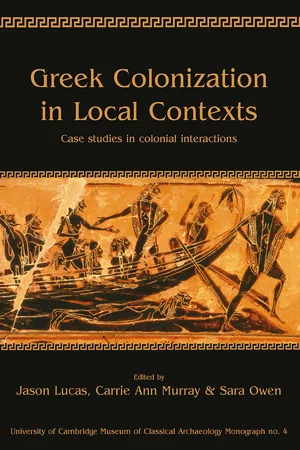
Greek Colonization in Local Contexts
Case studies in colonial interactions
- 248 pages
- English
- ePUB (mobile friendly)
- Available on iOS & Android
eBook - ePub
Greek Colonization in Local Contexts
Case studies in colonial interactions
About this book
Greek Colonization in Local Context takes a fresh look at Greek colonies around Europe and Black Sea. The emphasis is on cultural interaction, transformation and the repercussions and local reactions to colonization in social, religious and cultural terms. Papers examine the archaeological evidence for cultural interaction in a series of case studies from locations around the Mediterranean and Black Sea regions, at a variety of scales. Contributors consider the effects of colonization on urban life and developments in cities and smaller settlements as well as in the rural landscapes surrounding and supporting them. This collection of new papers by leading scholars reveals fascinating details of the native response to the imposition of Greek rule and the indigenous input into early state development in the Mediterranean and adjacent regions.
Information
Subtopic
Greek Ancient HistoryIndex
History1
Introduction
Carrie Ann Murray and Jason Lucas
The Greek Colonization research project at the Faculty of Classics, University of Cambridge was borne out of the idea of shining light on corners of the ancient Mediterranean world that often fell into the shadows of research into Greek colonization. A central aim was to question the roles and agency behind the involved communities, both newcomer and local, and to question how these relationships may have changed over time. We sought to investigate the interplay between cultural and physical landscapes. Integral to these two areas: the Mediterranean Sea and the Black Sea were perceived of as connected and inseparable entities, and Phoenician/ Punic involvement was considered as relevant as Greek involvement in colonization. The members of the project investigated different geographical and cultural areas, focusing on specific case studies. The specific site and regional foci contributed insights, illuminating case-specific developments. Rather than necessarily reflecting potential expectations of patterns, the case studies added points of colour in what sometimes appears to be broad brush overviews that dominate concepts behind Greek colonization.
The project was also the product of a burgeoning time of reconceptualizations of the Mediterranean world, addressing the multiplicity of voices, and an abundance of recent fieldwork. Of course, the Corrupting Sea (2000) caught the imagination of so many scholars of the ancient world, and here too, Peregrine Horden and Nicholas Purcell’s creation of broad-ranging overviews with in-depth insights, questioning whether we should be dealing with the history of the Mediterranean or history in the Mediterranean, was inspirational. Research into areas, including Gocha Tsetskhladze’s (1998) edited volume, Greek Colonization of the Black Sea and Tamar Hodos’ work on cultural interaction in North Syria, Sicily, and North Africa (2006) were seen as important nodes of reference. In addition, Sara Owen, with Henry Hurst, had recently completed a volume on colonization before beginning this new project (2005).
What is there to say regarding the character of interaction amongst newcomers and locals in ancient Greek and Phoenician colonization? The nature and breadth of evidence is overwhelming from the monumental architecture of Posidonia to the incorporation of imported ceramics into local graves, and the insights provided by ancient texts. The development of colonial sites, trade relations, and material culture show us the dramatic changes that occurred in the contexts as frogs around a pond. Looking farther inland at the fascinating indigenous cultures that predated and co-existed with colonizers offers continued progress in this arena. The inscriptions from Pech Maho and Pistiros go some way to illustrating the varied and complex contexts of interaction, touching upon cultural identities, trade relations, and codes of conduct (for readings of the inscriptions Rodríguez Somolinos 1996; Chankowski and Domaradzka 1999, 247–256).
The symposium that forms the core of this volume was organized as part of the Greek Colonization project with the support of the Leverhulme Trust. In keeping with our aims for the project, the remit of the symposium was to explore evidence of cultural interactions amongst colonizers, primarily Greek, and local populations in a number of places across the Mediterranean. The selection of certain areas of study were meant to give keyhole views into a number of separate geographical and cultural areas with different historical contexts, and not act as a foundation for making generalized observations. Of particular note was our interest in bringing together scholars who were from and actively researching colonization in Mediterranean and Black Sea areas. For many of the participants, this was their first opportunity to publish for English language audiences. Additional speakers who contributed greatly to the event but do not appear in the volume are: Michael Dietler, Irad Malkin, Dieter Mertens, Marta Santos (jointly representing Xavier Aquilue, Pere Castanyer, Joaquim Tremoleda), and Gillian Shepherd.
The participants in the symposium drew upon work from across the ancient Greek world; however, the papers fell into different geographic areas, yielding the sections of the present volume. The first five chapters discuss different issues related to areas of the western and central Mediterranean.
In the first paper, Carrie Ann Murray discusses how despite the vast array of variability in the physical remains of Greek colonies, it is the less obvious social action present in the foundation and development of settlement and cemetery space that can reveal a finer picture of the relationship between colonizers and locals.
Adolfo J. Domínguez explores the connectivity of Epizephyrian Locri, that is, by questioning the foundation in terms of the possible ‘mother-cities’ of Eastern Locris and Western Locris, and also exploring the avenues of influence from Euboeans, Corinthians, and the indigenous people on the developing colony.
Sebastiano Tusa dissects the development of Sicily via the different colonial circumstances present in the regions of the island. He focuses particularly on the active role played by the Elymians in interactions with Greeks and Phoenicians.
Jason Lucas explores the patterns of interaction among Greek colonists and the indigenous peoples during the Early Iron Age in southern France. This interaction may be seen in the changing settlements patterns and distribution of ceramics, alongside other evidence of cultural change.
M. Teresa Miró i Alaix considers the complex dynamics of ceramic imports to Empúries, particularly the Attic red-figure material. This involves presenting updated data that includes a restudy of previously considered material, and moreover the importance of the ceramics in terms of the role of Empúries as a redistribution centre in western Iberia.
The next three chapters examine the interaction of Greeks and Thracians, drawing on work in Bulgaria and northern Greece.
Recent work in Bulgaria on several settlements provides the context for Alexei Gotzev’s investigation of the ancient town of Pistiros, tracing the settlement’s history as well as its links into trading networks across the region.
Diamandis Triandaphyllos discusses the cultural and economic landscape of north Aegean Thrace, summarizing studies of Abdera, Stryme, Maroneia, and Zone to understand the impacts between intensive exploitation of wealth-resources and to emphasize the importance of combining geological, geomorphological, archaeological, and historical studies.
Vasilica Lungu documents the Ionian colony of Orgame on the Black Sea coast of Romania, focusing on the necropolis and the changing nature of the burial rites as a reflection of colonial identity. The final third grouping discusses Greek settlement in the Black Sea, focusing on the north coast.
Valeria Bylkova begins this section with a study of the changing patterns of landscape use in the Lower Dnieper region as a manifestation of the interaction among Greeks and natives, which become clearer when considering the differences between inland and coastal settlements.
Sergey Solovyov considers the contact between the Scythian and Greek populations in the northern Black Sea region, particularly as exemplified in the changing urban settlement patterns of Olbia and Berezan.
Sergej Bujskikh and Alla Bujskikh trace the development of the chora around the city of Olbia on the Black Sea coast in southern Ukraine during the archaic period.
Elias K. Petropoulos returns the interaction of Greeks and Scythians, exploring evidence for contact and trade hundreds of kilometres inland from the colonies, before discussing the larger-scale archaeological patterns from the whole of the Black Sea.
David Braund reviews the historical, archaeological, and epigraphic evidence for the colony of Olbia, its inhabitants, and the relation to the two key rivers, Dnieper and Bug. This leads to a discussion of the interplay between the siting of the colony, the interaction between Greeks and locals, and Greek knowledge of the landscape.
The final essay by Alan Greaves examines the idea of colonization from the perspective of the Ionian evidence, as a region of early colonization, which then founded many of the colonies discussed in the previous chapters. A number of overlapping issues recur throughout this volume demonstrating how these scholars have pursued different facets of Greek colonization, a topic central to investigating the ancient world encapsulated in two words but representing an enormous breadth of possibilities. One common thread in many of the chapters is an emphasis on addressing the importance of agency on the part of the locals. There is an importance placed on recognizing the complex relationships at work in these contexts of colonization that can no longer be purposely or inadvertently characterized as simply Greek innovation paired with indigenous passivity.
Various aspects that are woven through the following works display the rich variety of questions at stake. Landscape acting as more than a mere setting is crucial to these works (see especially Braund). A temporal component in many of the chapters provides a crucial perspective for the importance of change over time (for instance Murray). Considerations of broader spatial settings across regions also comes to the fore, placing importance on understanding interactions beyond just one site to include issues such as coastal versus inland dynamics (Bylkova; Petropoulos). In this regard, trade networks are key to considering interactions over considerable distances of direct and indirect interactions (Gotzev; Lucas; Miró i Alaix; Triandaphyllos). Social practices are, of course, central to the discussions, in particular investigations related to settlement development, including urban and rural issues (Bujskikh and Bujskikh; Solovyov), and the significance of burial rites (Lungu). Acknowledging the complex situations of multiple colonizing and indigenous cultures broadens the discussion in many contexts (Tusa). The issues surrounding the relationships amongst colonizers and mother cities are explored too (Domínguez; Greaves). Throughout, a variety of different types of evidence are relied upon from historical sources and epigraphy to ceramics and settlement patterns.
We were delighted to have the opportunity to engage with all of the scholars at the symposium held in the Faculty of Classics, Cambridge in 2007, and we are pleased to collaborate with them on this volume. We thank the contributors for their patience in the delayed production of the volume; we extend our sincere apologies. The volume can provide those working on Greek colonization, or other areas of colonization, with views on distinct case studies, as well as broader regional perspectives. The relevance of local and newcomer groups within colonial contexts are considered on equal footing through material and historical evidence. The volume can also act as a teaching aid for undergraduate and graduate levels. Of course, no single work can be exhaustive; this volume can offer a variety of case studies to spark discussion and contribute to ongoing debates.
Acknowledgments
Sebastiano Tusa died tragically in a plane crash as this volume was going to print. His death has come as a shock to all who knew him. Sebastiano worked tirelessly throughout his long career for the promotion and preservation of archaeology in Sicily. While Sebastiano will be missed tremendously, his legacy will live on.
Abbreviations used in this volume
Str.: Strabo, Geography
Ps.-Scym.: Pseudo-Scymnus, Periegesis ad Nicomedem regem
Euseb. Chron.: Eusebius, Chronicle
Hdt.: Herodotus, The Histories
Dio Chrys.: Dio Chrysostom, Orations
Xen. Anab.: Xenophon, Anabasis
Bibliography
Chankowski, V. and Domaradzka, L. (1999) Réédition de l’inscription de Pistiros et problèmes d’interprétation. Bulletin de Correspondance Hellénique 123.1: 247–271.
Hodos, T. (2006) Local Responses to Colonization in the Iron Age Mediterranean. London, Routledge.
Horden, P. and Purcell, N. (2000) The Corrupting Sea. A study of Mediterranean history. London, Wiley-Blackwell.
Hurst, H. and Owen, S. (eds) (2005) Ancient Colonisations. Analogy, Similarity and Difference. London, Duckworth.
Rodríguez Somolino, H. (1996) The commercial transaction of the Pech Maho lead: A new interpretation. Zeitschrift für Papyrologie und Epigraphik 111: 74–78.
Tsetskhladze, G. R. (ed.) (1998) Greek Colonization of the Black Sea Area. Stuttgart, Franz Steiner Verlag.
2
Constructing colonies: Physical manifestations of social action within Greek colonization
Carrie Ann Murray
Fundamental to investigating Iron Age cultures of the Mediterranean is the recovery of settlement and cemetery remains. The location, dating of phases, construction techniques and burial practices are central to understanding the physical development of a site, or more broadly a culture. The physical remains are not just the tangible finds of stone and terracotta; they are also the result of social action. Decisions and actions made by individuals and groups lie behind the planning, design, and execution of the physical changes to a landscape during the development and lifetime of settlements and cemeteries. This work proposes how investigating the physical remains of settlements and cemeteries can shed light on the social action at work behind the construction and maintenance, and how this analysis may be applied, possibly even more pertinently, when examining the development of some of the Greek colonies in the Mediterranean. What follows here is a discussion of some elements related to the physical development of a number of Greek colonial settlements. The social acts of planning, construction, and maintenance of settlement and cemetery space will be discussed as a starting point for considering how the vast topics of the spatial organization, architecture, and funerary practices at Greek settlements in the West could help reveal changing social circumstances in a variety of ways. The activities of daily life, including archaeologically visible activities, provide insights into the choices made by individuals and groups that can help explain social change even when specific individuals cannot be identified (for a discussion, see Brumfiel 2000, 254; Hodder 2000, 22). Despite the variability in form and development of Greek colonial settlements, understanding the social contexts behind their construction and maintenance can reveal aspects of the nature of interactions between the newcomers and locals.
Interpreting the physical remains of settlements and cemeteries as direct insights into social actions and interactions could help create clearer understandings concerning the early stages and the long-term development of the related communities. How can we understand social interaction at sites just from archaeological evidence of architectural construction within settlement and cemetery space? In particular, examining details of the initial stages of settlement and cemetery creation (or at least the earliest phases of archaeologically visible remains) could reveal the social circumstances at work, including insights into social hierarchy, economic strategies, relationships with neighbouring communities, and ritual practices, including burial rites. These issues take on an added level of relevance when considering Greek colonial settlements, in order to investigate degrees of cooperation and integration, or animosity and isolation between indigenous and foreign inhabitants.
Social action and construction
Experimental archaeology can provide insights into the process of site construction. The social action involved in settlement construction, communication, and movement through the landscape was directly investigated by Sue Hamilton and Ruth Whitehouse as part of ...
Table of contents
- Cover
- Title
- Copyright
- Contents
- Dedication
- Foreword
- 1. Introduction
- 2. Constructing colonies: Physical manifestations of social action within Greek colonization
- 3. Locrian colonization in Magna Graecia: Cities and territories
- 4. Cultural and ethnic dynamics in Sicily during Greek colonization
- 5. Marseilles: Greek settlement on the fringes of Iron Age Provence
- 6. The Attic red-figure pottery of the Greek city of Emporion
- 7. Pistiros: A Thracian emporion in its cultural and natural environment
- 8. The landscape in Aegean Thrace before and after Greek colonization
- 9. Orgame necropolis in the Black Sea area
- 10. Transformations of landscape use in the Lower Dnieper region
- 11. Borysthenes and Olbia: Reflections on the character of contacts between Greeks and Natives during the initial stage of colonization
- 12. Polis, Chora and the development of the colonial landscape in the Lower Bug region
- 13. Colonial landscapes and colonial interactions in Skythia and the Euxeinos Pontos
- 14. Colonial location: Olbia on the Hypanis
- 15. ‘Greek’ Colonization: The view from Ionia
Trusted by 375,005 students
Access to over 1.5 million titles for a fair monthly price.
Study more efficiently using our study tools.
Frequently asked questions
Yes, you can cancel anytime from the Subscription tab in your account settings on the Perlego website. Your subscription will stay active until the end of your current billing period. Learn how to cancel your subscription
No, books cannot be downloaded as external files, such as PDFs, for use outside of Perlego. However, you can download books within the Perlego app for offline reading on mobile or tablet. Learn how to download books offline
Perlego offers two plans: Essential and Complete
- Essential is ideal for learners and professionals who enjoy exploring a wide range of subjects. Access the Essential Library with 800,000+ trusted titles and best-sellers across business, personal growth, and the humanities. Includes unlimited reading time and Standard Read Aloud voice.
- Complete: Perfect for advanced learners and researchers needing full, unrestricted access. Unlock 1.5M+ books across hundreds of subjects, including academic and specialized titles. The Complete Plan also includes advanced features like Premium Read Aloud and Research Assistant.
We are an online textbook subscription service, where you can get access to an entire online library for less than the price of a single book per month. With over 1.5 million books across 990+ topics, we’ve got you covered! Learn about our mission
Look out for the read-aloud symbol on your next book to see if you can listen to it. The read-aloud tool reads text aloud for you, highlighting the text as it is being read. You can pause it, speed it up and slow it down. Learn more about Read Aloud
Yes! You can use the Perlego app on both iOS and Android devices to read anytime, anywhere — even offline. Perfect for commutes or when you’re on the go.
Please note we cannot support devices running on iOS 13 and Android 7 or earlier. Learn more about using the app
Please note we cannot support devices running on iOS 13 and Android 7 or earlier. Learn more about using the app
Yes, you can access Greek Colonization in Local Contexts by Jason Lucas, Carrie Ann Murray, Sara Owen, Jason Lucas,Carrie Ann Murray,Sara Owen in PDF and/or ePUB format, as well as other popular books in History & Greek Ancient History. We have over 1.5 million books available in our catalogue for you to explore.