Using excerpts from contemporary training manuals, this pocket manual is an insight into the preparation of the troops involved in Operation Overlord.
The success of the D-Day landings on June 6, 1944, depended on thousands of troops carrying out their mission and the seamless coordination of the amphibious landings with paratrooper and glider assaults. The troops not only had to be trained up ready for their own roles, but to work alongside other troops, often coordinating activities and communicating with other troops while in unfamiliar terrain and under fire. This pocket manual brings together excerpts from Allied manuals used in the preparation for D-Day, including amphibious landings and managing beachheads, pathfinder, paratrooper, and glider pilot training, and infantry and armored fighting in the bocage countryside.
"Chris McNab is a prolific writer who knows what he is doing, as this book shows; and this volume will fit well with its stable mates." —
War History Online
eBook - ePub
The D-Day Training Pocket Manual, 1944
Instructions on Amphibious Landings, Glider-Borne Forces, Paratroop Landings and Hand-to-Hand Fighting
- 160 pages
- English
- ePUB (mobile friendly)
- Available on iOS & Android
eBook - ePub
The D-Day Training Pocket Manual, 1944
Instructions on Amphibious Landings, Glider-Borne Forces, Paratroop Landings and Hand-to-Hand Fighting
About this book
Information
CHAPTER 1
INTELLIGENCE, PLANNING AND PREPARATION
Most of the planning and preparation for the D-Day invasion was done in the six months between January and June 1944. In this intensive period, the Allied forces not only had to define and collect forces sufficient to accomplish the task in hand, but they also had to gather all available intelligence about the defences that they would face on the Normandy coastline. By spring 1944 the Allies had already made major and successful amphibious landings, especially in the Pacific theatre but also in North Africa (Operation Torch, 8 November 1942), Sicily (Operation Husky, 9 July 1943) and Italy (four separate landings between September 1943 and January 1944). These experiences provided many lessons learned, and their ultimate success was encouraging, but there were plenty of reasons to be cautious. The landings at Anzio on 22 January 1944, for example, were initially successful, but command decisions led to the Allied forces becoming essentially trapped around the beachhead for weeks, under German counterattacks and taking heavy casualties. There was also the sobering lesson of the Dieppe Raid (Operation Jubilee) in August 1942, launched primarily by Canadian forces with the express purpose of testing out German coastal defences. Within just 10 hours, 60 per cent of the raiding force were casualties in a disastrous action.
A priority for the Allied intelligence services was, therefore, to assess properly the level of threat posed by the units and defences along the Normandy coastline. Some of the information gathered is shown in our first source, German Coastal Defenses, publishing by the US military intelligence service in June 1943. Here the analysts present insight into the specific types of obstacles and threats on German beaches and the surrounding areas. Construction of Hitler’s ‘Atlantic Wall’ – a chain of coastal fortifications and defences stretching sporadically from the Netherlands to Spain – began in the summer of 1942. Although it led to some formidable stretches of defences, investment ran behind need for much of 1942 and 1943. In the autumn of 1943, however, the great German Field Marshal Erwin Rommel was given responsibility for accelerating the building process and strengthening the defences, which he did with gusto. By the time that the Allies landed on 6 June 1944, Omaha beach alone had 3,700 beach obstacles.
German Coastal Defenses (1943)
Section III: BEACH OBSTACLES
8. GENERAL
The critical points of Europe’s Atlantic coast are, of course, those beaches which are suitable for major landing operations. Germany’s maximum effort in men, materials, and weapons on her Western Front has been directed toward the fortification of these potential gateways to the interior.
Forbidden zones have been defined by the Germans, and their inhabitants have been evacuated therefrom, not only to facilitate the organization and construction of defenses but also to prevent the native population from joining or assisting any landing forces. Seaside homes and other buildings along the coast have been razed to provide fields of fire, or space for the construction of reinforced concrete forts, ammunition dumps, and gun emplacements.
Those buildings that have been allowed to stand near the beaches have been incorporated in the defenses. Many attractive villas are still deceptively innocent and peaceful in appearance, but only the exteriors remain the same. The interiors of some have been converted into steel-and-concrete emplacements, and they have been armed with guns of varying sizes. Many of the houses have not been fortified so elaborately, but have been turned into effective positions for smaller guns and machine guns by the filling-in of doors and windows with brick or concrete. Passages have been cut through continuous rows of fortified houses so that the occupying troops may pass from one to another without being exposed to observation and fire from the beach. Corner houses which command stretches of roads and intersections have likewise been converted into emplacements for weapons.
The sea walls and the promenades or boardwalks along the beach fronts have also been fortified by the installation of emplacements from which guns could be brought to bear on the beach and the water beyond. In some places the dunes are no longer mere heaps of sand dotted with bunch grass. They have been hollowed out, and reinforced concrete shelters and emplacements have been built within them. Such concrete works are occupied by antiaircraft and heavy gun crews, and by infantry units that would come out to engage landing forces.
As for the beach proper, the Germans have devised a variety of obstacles of more or less conventional type. These will be discussed in detail in this section. [. . .]
9. UNDERWATER OBSTACLES
a. Stakes
In the shallow water off beaches with gentle slopes, the Germans have embedded rows of steel stakes and wooden logs. They are set at an angle, their upper ends pointing outward from the beach. Submerged barbed wire and mines may be used in conjunction with these obstacles, which are intended to trap landing boats, or personnel who may be compelled to leave their boats to wade ashore.
b. Booms
As obstacles against landing craft, light booms of simple construction are placed by the Germans in front of good landing beaches. They consist, usually, of conical buoys, linked by wire rope that runs through the tops and bases of the buoys. Rafts are similarly employed. Explosives and warning devices may be affixed to these booms.
10. BARBED WIRE
a. General
This part of the discussion deals with German wire technique, as observed in The Netherlands, Belgium, and France. On the beaches, barbed wire is usually erected in straight lines, parallel to the shore and in front of fortified areas. In the spaces between fortified areas the lines of wire jut out at right angles toward the sea.
The depth of wire obstacles around emplacements and fortified areas varies with the topography and importance of the site. In some places it may be 30 to 60 yards; in other positions the depth may range from 70 to 130 yards, or may go up to 200 yards. Generally, the distance from the outside edge of wire to the nearest pillbox or other firing position is not less than 30 yards.
Dense entanglements are installed in gullies and in the crevices of cliffs, whence the wire may continue as single fences along the top margin of the cliffs. The entanglements usually begin to thin out half-way up the side of gullies. In front of these obstacles the Germans sometimes erect small-mesh wire, apparently to slow up the employment of bangalore torpedoes.
The Germans often use wire to fence off all sides of a minefield. These fences consist of a single row of pickets with five or six strands of wire. In conjunction with road blocks, a wire entanglement or fence is employed on each side of the road, and the gap between is closed by movable gates of various types. Concrete walls and other more substantial types of barriers are now replacing wire entanglements as road blocks in many places. A thin belt of wire is usually erected outside of antitank ditches. Wire is employed on practically all wall barriers and concrete emplacements, which often have iron staples in them for the stringing of apron and other types of entanglements.
A new type of German barbed wire now in use is thicker than ordinary wire, is made of a noncorrosive metal, and is rectangular in section. It has three-quarter-inch barbs at intervals of 4 inches.
b. Specific Types
Some details of specific types of wire obstacles in The Netherlands, Belgium, and France are listed below. The dimensions are approximate.
(1)Knife rests.—Knife rests, or cheval-de-frise obstacles, strung with wire, have been observed on beaches above high-water mark. Some examples consist of four trestles connected by a cross bar. The dimensions are as follows:
Height _ _ _ _ _ _ _ 4 feet
Span of trestle legs _ _ _ _ _ _ _ 4 feet
Distance between trestles _ _ _ _ _ _ _ 4 to 5 feet
Length of four-trestle unit _ _ _ _ _ _ _ 16 to 20 feet
(2)Apron fences.—These may be single or double aprons. Screw pickets or angle-irons embedded in concrete to a depth of about 18 inches are used to hold them. Sometimes a coil of concertina may be placed under double-apron fences. Another variation is to place a coil of concertina on the tops of such fences. The dimensions are as follows:
Height _ _ _ _ _ _ _ 4 to 5 feet
Height (with coil on top) _ _ _ _ _ _ _ 7 to 8 feet
Width _ _ _ _ _ _ _ Up to 30 feet
(3)Vertical fences.—Vertical fences are invariably installed in two or three lines, 4 to 8 feet apart. Each fence has five or six strands of wire, and is 4 to 6 feet high. Wooden posts, angle-irons, and screw pickets are used as supports. Various types of entanglements and mines are often used in the spaces between fences.
(4)Concertina fences.—Single, double, or triple coils of concertina are used with angle-irons or screw pickets. Triple coils are often affixed to the rails of the promenades that are so common along the beaches of western Europe.
(5)Trip fences.—Trip wires in diagonal or diamond-shaped trace are frequently found in front of major obstacles, usually between the highwater mark and the first barbed-wire entanglement, or they are erected in fields before main defensive positions or obstacles. Their dimensions are as follows:
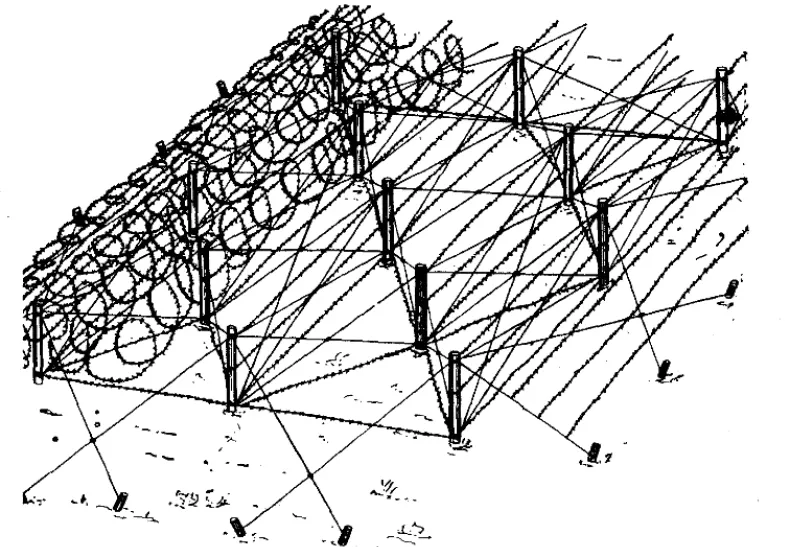
Figure 7. Standard German barbed-wire obstacle in depth.
Height _ _ _ _ _ _ _ 4 to 6 inches
Length of each diagonal or diamond-shaped trace _ _ _ _ _ _ _ 4 to 6 feet
Width of whole obstacle _ _ _ _ _ _ _ 12 to 20 feet
(6)Alarm wires.—There is evidence that many wires have some form of alarm device connected to them, such as grenades, small explosive charges, and insulated live wire, which would ring a bell if cut.
(7)Electrified wire.—Electrified barbed wire, held by insulators to pickets, has been reported, but it is not likely to be encountered on a large scale.
(8)Combined fences.—A typical combined fence may consist of the following units in the order given: a trip wire, a trestle fence or knife rest, and (10 to 20 yards farther back) an apron fence. The total depth of such a combination may be 30 to 60 yards. On the sea fronts of towns, the usual practice is t...
Table of contents
- Cover
- Title
- Copyright
- Introduction
- Chapter 1 Intelligence, Planning and Preparation
- Chapter 2 Naval and Air Support
- Chapter 3 Airborne Assault
- Chapter 4 Amphibious Assault
- Chapter 5 Consolidation
- Sources
Trusted by 375,005 students
Access to over 1.5 million titles for a fair monthly price.
Study more efficiently using our study tools.
Frequently asked questions
Yes, you can cancel anytime from the Subscription tab in your account settings on the Perlego website. Your subscription will stay active until the end of your current billing period. Learn how to cancel your subscription
No, books cannot be downloaded as external files, such as PDFs, for use outside of Perlego. However, you can download books within the Perlego app for offline reading on mobile or tablet. Learn how to download books offline
Perlego offers two plans: Essential and Complete
- Essential is ideal for learners and professionals who enjoy exploring a wide range of subjects. Access the Essential Library with 800,000+ trusted titles and best-sellers across business, personal growth, and the humanities. Includes unlimited reading time and Standard Read Aloud voice.
- Complete: Perfect for advanced learners and researchers needing full, unrestricted access. Unlock 1.5M+ books across hundreds of subjects, including academic and specialized titles. The Complete Plan also includes advanced features like Premium Read Aloud and Research Assistant.
We are an online textbook subscription service, where you can get access to an entire online library for less than the price of a single book per month. With over 1.5 million books across 990+ topics, we’ve got you covered! Learn about our mission
Look out for the read-aloud symbol on your next book to see if you can listen to it. The read-aloud tool reads text aloud for you, highlighting the text as it is being read. You can pause it, speed it up and slow it down. Learn more about Read Aloud
Yes! You can use the Perlego app on both iOS and Android devices to read anytime, anywhere — even offline. Perfect for commutes or when you’re on the go.
Please note we cannot support devices running on iOS 13 and Android 7 or earlier. Learn more about using the app
Please note we cannot support devices running on iOS 13 and Android 7 or earlier. Learn more about using the app
Yes, you can access The D-Day Training Pocket Manual, 1944 by Chris McNab in PDF and/or ePUB format, as well as other popular books in History & Military & Maritime History. We have over 1.5 million books available in our catalogue for you to explore.