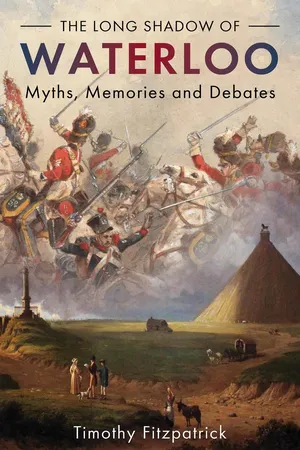
"[A] concise but authoritative narrative of the last action of the Napoleonic Wars" and its influence on French, British, German, and U.S. cultures (
Military History Matters).
The Battle of Waterloo ended a century of war between France and Great Britain and became a key part of their national identity, serving their political needs as the battle was refought throughout the 19th century in politics, books and art to create the myth of Waterloo. For Great Britain, Waterloo became a symbol of British hegemony while the multinational contribution to the battle was downplayed and for France it was remembered as a military disaster.
Through looking at the battle's significance in history, an insight is gained into how cultural myths and legends about a battle are made. Wellington and Napoleon both tried to shape the memory of the battle to their advantage. Wellington propagated the myth that the British won despite being outnumbered by a huge French army, while Napoleon chose to blame his subordinates for the loss, in particular Emmanuel de Grouchy.
This book covers the battle's influence on figures such as Jomini and Clausewitz, military theorists who wanted to find the objective truth of Waterloo and use it as a guide for future wars, as well as Victor Hugo (and
Les Miserables) who challenged the myths of battle to transform it into a win for France from which the Republic would emerge. The way Waterloo was used for entertainment is also explored, as battlefield tourists came from all over the world to vicariously experience the legendary battle through visualizations such as the traveling panoramas in England and poetry of Sir Walter Scott.
- 256 pages
- English
- ePUB (mobile friendly)
- Available on iOS & Android
eBook - ePub
About this book
Information
CHAPTER ONE
Nationalism and Waterloo
Soon after the battle of Waterloo ended, debates started to emerge on exactly what had just happened and why. The political ramification was clear; Napoléon’s defeat ended his bid to re-establish his empire. Debates focused on who, what and why things happened during the ‘Hundred Days’ of Napoléon’s return to power. In 1810, France was at its height of its power, but five years later, it had lost all it had fought for. There was a sense France had lost its honour and its place in the world. If Napoléon won, perhaps France could have regained at least its national honour.
After Waterloo, France was humiliated, the allies occupied Paris and France had to pay the allies for the wars in which they said France started. In 1814, Louis XVIII did not seek revenge for the revolution or Napoléonic era. However, after Waterloo, he was determined to control his own country. He ordered trials for those who rose against him. As for Napoléon, he was finished but not his son – he hoped Napoléon II would return to rule France. From 1815, there were debates, trials and books written to help France cope with what had just happened. The name of what the battle was to be known as became a matter of debate between the major combatants. The British called the battle ‘Waterloo’ after the location where Wellington wrote the dispatch announcing the victory to Britain. The Prussians called the battle ‘La Belle Alliance’ after the place where Blücher and Wellington met at the end of the battle. The French called the battle ‘Mont Saint Jean’ because the village of Mont-Saint-Jean was in the centre of Wellington’s line. The battle became known as Waterloo because Wellington made the case the British won the battle before the Prussians effectively intervened.
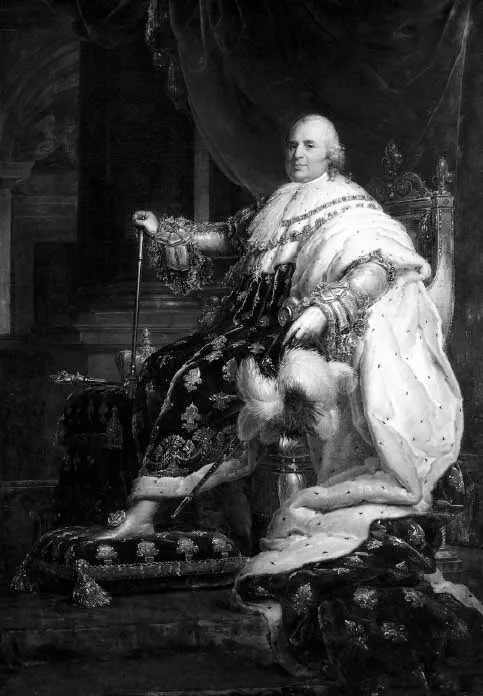
Louis XVIII by François Gérard (unknown, public domain)
In the British version of events, the battle was a ‘near-run thing’, ultimately won by British determination, steadfastness and moral character. The battle was a defensive struggle, but it was not the British who bore the brunt of the fighting. The reality was that on 18 June 1815, the bulk of Wellington’s army consisted of Germans and Dutch-Belgians. Less than half of the Anglo-Allied force consisted of British troops. However, as history proved out, the laurels of victory went to the British. The downfall of Napoléon was popularly portrayed as an act of supreme courage by the British – not of their allies or the Prussians.
Wellington depicted himself as being hopelessly outnumbered but was still able to defeat the French and managed to hold on long enough until the Prussians arrived. Nothing could be further from the truth. Wellington fought the battle of Waterloo in full knowledge the Prussians would arrive on Napoléon’s right flank with at least two, and possibly three, corps. The only reason the battle was, according to Wellington, a ‘near-run thing’ was because Blücher was late. However, even before Blücher’s belated entrance, Wellington slightly outnumbered Napoléon. Wellington’s ‘Waterloo Dispatch’ was a political report to his superiors in London, and he knew it would be the basis for the future interpretation of the battle. Wellington wanted his version to be first in London and the one remembered. It was to be a British victory.
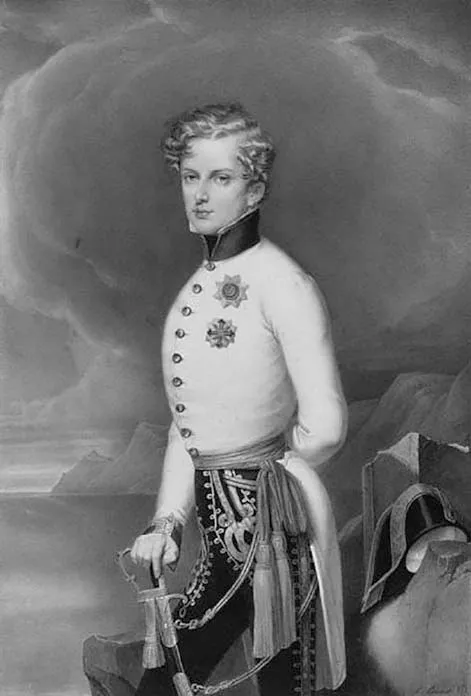
Napoléon II, also known as Franz Duke of Reichstadt by the Austrian painter Leopold Bucher (1797–1858) (Malmaison, Musée national des châteaux de Malmaison et Bois-Préau, public domain)
The British were responsible for blunting Napoléon’s attacks, but it was the Prussians who aggressively attacked and ultimately overwhelmed the French. The Prussian accounts credited Marshal Blücher’s decision to unite with Wellington after his own defeat at Ligny on 17 June as the decisive decision of the campaign. The Prussians credited the arrival of Bülow’s men early in the afternoon on 18 June with preventing the French from launching an all-out assault on the British early in the battle. It was Blücher’s appearance on the battlefield later in the afternoon with two more corps that turned the battle into a stunning victory. Even though Blücher was late, Bülow was early and saved the British from being attacked by the whole of the French army.
The British got the credit for winning the battle and moreover the war; they imprisoned Napoléon on Saint Helena and their version of events spread around the world. The world would call the battle Waterloo. It was now up to the men who fought it – or did not fight in it, as the case may be – to relate how the British and Prussians won the battle and how the French lost it. Judging from the divergent accounts, those causes varied by nationality and personality. When the battle at the village of Mont Saint Jean, 1 near the town of Waterloo, was over early in the morning of 19 June 1815, the exhausted Arthur Wellesley, Duke of Wellington, headed to the Brabant Inn in the town of Waterloo, some miles north of the battle site. His purpose: to write to the British Secretary of State for War and the Colonies, Henry Bathurst, the 3rd Earl of Bathurst, on the victory and present his own version of the battle. When The Times published the contents of Wellington’s dispatch on Thursday 22 June, the British populace burst into celebration.2 The dispatch was read and re-read in The Times and the excitement of the victory was palpable in Britain. The famous moment was captured in David Wilkie’s painting – Chelsea Pensioners Reading the Waterloo Dispatch. The nation was united in relief that Napoléon was defeated.
Wellington’s ‘Waterloo Dispatch’ started with Napoléon’s movements on 15 June at Charleroi, his subsequent crossing of the Sambre River and the action forcing Dutch troops back to Quatre Bras on the same day. On 16 June, Wellington praised the Prussians for holding out against the French, despite being outnumbered.3 He also claimed not to be able to help his allies on 16 June because his men were being attacked and they had too far to march to assist the Prussians under Marshal Gebhard Blücher.4
In his dispatch, Wellington expressed surprise that Napoléon made no attempt to pursue the defeated Prussians on the night of 16 June. He noted the French in his own sector were timid in the face of his patrols and he was able to retire towards Waterloo unmolested on 17 June. Wellington confirmed Blücher’s promise to him of at least one or more corps via the Ohain and Wavre road to aid him against the French. Wellington admitted he made a mistake of believing only the French III Corps (Vandamme’s) followed Blücher towards Wavre.
Wellington’s account in The Times naturally praised his troops. He singled out the defence of Hougoumont as critical to the success of the battle. He wrote that his generals conducted themselves in the most steadfast and distinguished manner. He lauded Major General Sir William Ponsonby for capturing an eagle (a French flag standard) and taking many prisoners. He also praised Generals Cooke, Maitland and Byng of the Grenadier Guards for their handling of their troops.
The dispatch noted Wellington’s army suffered many casualties in the action. He reported with deep regret to the king the loss of his most able generals, Lieutenant General Thomas Picton. Wellington reported the arm wound of His Royal Highness the Prince of Orange and thanked him for his services on the day. Henry Paget, the Earl of Uxbridge, lost his leg at the end of the battle. Wellington reported that Colonel De Lancey was killed in the action by a cannon ball but was mistaken the ball had only wounded the Colonel.
Wellington described the battle during the afternoon as being a piecemeal affair. The cavalry and infantry took turns attacking. According to Wellington, the affair went along like this ‘till seven in the evening, when the enemy made a desperate effort with the cavalry and infantry, supported by the fire of artillery, to force our left centre near the farm of La Haye Sainte, which after a severe contest was defeated’.5 He added the Prussians’ arrival on his left near Ohain was fortunate and General Friedrich von Bülow’s arrival at Plancenoit helped Wellington make up his mind to order a general attack on the French army. The attack by British troops, proved successful and crucial. He met Blücher at La Belle Alliance and let the Prussians continue the pursuit of the enemy because of the extreme fatigue of his own troops. The Prussians captured nearly 60 additional cannons to add to his 150 captured French guns. In symbolic celebration, Wellington sent Sir Henry Percy with the dispatch and two of Napoléon’s eagles and laid them at the Prince Regent’s feet. Wellington’s report finished with two postscript notes: first, General Ponsonby had been killed; and, second, Colonel De Lancey was wounded but still alive.6
In the same edition of The Times, the official report of the British government appeared. This account offered a much harsher interpretation of the battle. It acknowledged the fine abilities of the ‘rebel’ Frenchmen, but they were met on the field of battle by their ‘betters’. Like the battles in the Peninsular campaign, superior British arms once again won the day over the Frenchmen.
Also, on 22 June, Wellington wrote another epistle, this time addressed to the King of the Netherlands. He begged the king’s pardon for not presenting himself in person but explained he was busy following Napoléon. Wellington was careful to stress to the king that the Prince of Orange acted in the best possible manner.7
The British government loathed Napoléon and called him ‘Buonaparte’ in disparagement. They wrote he was a cowardly ‘calculating kind’ of man who chose to run rather than fight. They argued his abdication at Fontainebleau the year before was simply a ploy to fight again and save himself. They wanted to see Napoléon’s officers brought to justice: Marshals Michael Ney and Emmanuel Grouchy, Generals Charles Desnouettes, Bertrand Clausel, Charles and Henri Lallemand, and Charles de la Bédoyère.8 The British government accused these men of helping Napoléon before 20 March 1815, of committing high treason and deserving of the death penalty. Not surprisingly, Louis XVIII’s government followed the advice of the British.
Waterloo resulted in immediate financial gains for many British subjects. The London stock market gained six per cent upon receiving news of the victory. Apparently, a ‘Mr. Sutton’ procured a faster route back to England from Brussels than did Major Percy and conveyed the news to certain businessmen who were able to capitalise on the news.9
The British government rejoiced at the news of the victory; however, it was tempered by the loss of many good men. Two much-admired British Generals, Sir Thomas Picton and the Duke of Brunswick, died in the battle. For the Duke of Wellington, he had nothing but praise for their bravery and skill.
In another letter to Earl Bathurst, Wellington wrote he was continuing into France on 22 June. He mentioned the Prussians took the fortress of Avesnes and the French retreated to Laon in a terrible state. The French forces occupied Wavre until 20 June and then escaped via Namur and Dinant. At the time, Wellington thought this French force was comprised only of III Corps and thus of minor importance.10 Wellington did point out the French state of affairs was so bad following his victory that the French cavalry and artillery drivers were selling their horses to the French peasants and deserting.11 He added Colonel De Lancey was not dead and predicted (incorrectly) that he would recover from his wounds.
News broke on 22 June in London of rumours of an uprising in Paris against Napoléon. By 22 June, Napoléon had abdicated for the second time, but the news had not reached London. The British government knew support for Napoléon would not last long if he was defeated on the battlefield...
Table of contents
- Cover
- Title
- Copyright
- Contents
- Introduction
- 1 Nationalism and Waterloo
- 2 Napoléon’s Myth and Legend of Waterloo
- 3 Grouchy and Waterloo
- 4 Lessons from Waterloo: Military Theorists
- 5 Victor Hugo’s Waterloo
- 6 Imagining Waterloo
- 7 Waterloo During Two World Wars and Beyond
- Conclusion
- Endnotes
- References
Trusted by 375,005 students
Access to over 1.5 million titles for a fair monthly price.
Study more efficiently using our study tools.
Frequently asked questions
Yes, you can cancel anytime from the Subscription tab in your account settings on the Perlego website. Your subscription will stay active until the end of your current billing period. Learn how to cancel your subscription
No, books cannot be downloaded as external files, such as PDFs, for use outside of Perlego. However, you can download books within the Perlego app for offline reading on mobile or tablet. Learn how to download books offline
Perlego offers two plans: Essential and Complete
- Essential is ideal for learners and professionals who enjoy exploring a wide range of subjects. Access the Essential Library with 800,000+ trusted titles and best-sellers across business, personal growth, and the humanities. Includes unlimited reading time and Standard Read Aloud voice.
- Complete: Perfect for advanced learners and researchers needing full, unrestricted access. Unlock 1.5M+ books across hundreds of subjects, including academic and specialized titles. The Complete Plan also includes advanced features like Premium Read Aloud and Research Assistant.
We are an online textbook subscription service, where you can get access to an entire online library for less than the price of a single book per month. With over 1.5 million books across 990+ topics, we’ve got you covered! Learn about our mission
Look out for the read-aloud symbol on your next book to see if you can listen to it. The read-aloud tool reads text aloud for you, highlighting the text as it is being read. You can pause it, speed it up and slow it down. Learn more about Read Aloud
Yes! You can use the Perlego app on both iOS and Android devices to read anytime, anywhere — even offline. Perfect for commutes or when you’re on the go.
Please note we cannot support devices running on iOS 13 and Android 7 or earlier. Learn more about using the app
Please note we cannot support devices running on iOS 13 and Android 7 or earlier. Learn more about using the app
Yes, you can access The Long Shadow of Waterloo by Timothy Fitzpatrick in PDF and/or ePUB format, as well as other popular books in History & 19th Century History. We have over 1.5 million books available in our catalogue for you to explore.