- 130 pages
- English
- ePUB (mobile friendly)
- Available on iOS & Android
eBook - ePub
About this book
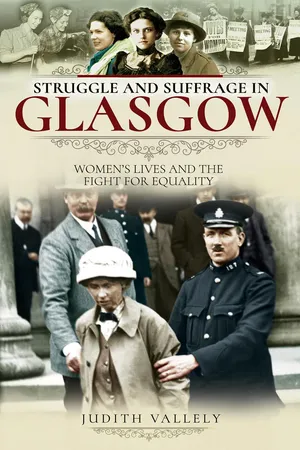
An in-depth history of the fight for women's rights in Scotland's largest city.
On a dark January night in 1914, Glasgow's iconic Kibble Palace at the Botanic Gardens became the target of a bomb attack that shattered 27 large panes of glass. The police concluded it was the work of militant suffragettes after discovering footprints of ladies' shoes…and an empty champagne bottle and cake.
The attack was just one of many incidents as the women of Glasgow battled for the right to vote: marching on the streets, daring escapes from under the nose of police officers, and a meeting which ended in a riot. One hundred years from when some women were finally able to go to the ballot box for the first time, this book examines the inspirational women of Glasgow and their quest for equal rights and improvements in all areas of society. Covering the women who challenged miserable conditions facing workers; who fought for a formal university education and helped improve the health of the nation; who took part in the suffrage movement in Glasgow, from the first meetings to militant action and force feeding; who took on work, from driving trams to staffing hospitals on the frontline, when war broke out; and who went from gaining the right to vote to taking a seat in Parliament for the first time, Struggle and Suffrage in Glasgow uncovers stories of the pioneering women of the city who left a legacy for generations to come.
Information
Topic
StoriaSubtopic
Storia scozzeseCHAPTER ONE
Education: ‘Keep Knocking at the Gates’

More than half of students in higher education in Scotland are now women – accounting for 57 per cent of the overall total.1 So it’s perhaps difficult to imagine that just over a century ago, the doors of such institutions were firmly closed to women. Scotland underwent a boom in educational growth in the nineteenth century, with the introduction of compulsory elementary lessons for all children aged between 5 and 13 years old in 1872. Yet opportunities for female pupils were still very limited¸ with most of the focus in their education being on preparing for work in industry, service or the home.2 The development of secondary schools for girls and advent of serious academic schooling for them, however, encouraged more middle-class families to consider that their daughters might be as academically able as their sons, and not just destined for a life of domesticity.
The Glasgow Ladies’ Higher Education Association was one of the organisations helping to push forward the idea that indeed, women would benefit from participating in education for longer. In an address to the University of Glasgow in 1914, one of the founders, David Murray, a lawyer, noted how Scotland had never been without women of culture – in the form of poetesses, songwriters, dramatists and novelists. But he also pointed out that culture and learning could, for a long time, only be gained through private study – either self-taught or taught by a male relative who had the advantage of an extensive education. ‘A woman’s education ended with school: the gates of the universities were closed to her,’ Murray said. In the address he went on to cite the ‘oft-repeated advice’ of Professor Edward Caird, a member of the Queen Margaret College council and a supporter of the women’s education movement to ‘keep knocking at the gates until they are opened’.3 It is a fitting symbol for the persistent efforts that women had to make, in order to gain access through those university gates.
There had been some notable exceptions to the idea that higher education classes were not a suitable place for women. In the late eighteenth century, Dr Thomas Garnett, the first Professor of Natural Philosophy at Anderson’s Institution – an antecedent of the University of Strathclyde – had thrown open his classes to women. By 1797, nearly 1,000 students, around half of whom were women, had attended lectures on topics such as chemistry and philosophy. By the 1830s and 1840s, female students could take up a number of classes in subjects such as French and mathematics, but crucially it was only done on a very informal basis and they could not proceed to graduation.4
With impetus growing around learning and advances of the day in the sphere of the home, which meant women of higher social classes had more free time, came a growing desire to participate in education. Even the humble sewing machine was instrumental in changing women’s lives, according to Jessie Campbell, who was born in 1827 and was one of the pioneers of education for women in Glasgow.
She noted that:
The sewing machine has been one of the great emancipators of women from the dreary round of household needlework. This was a great occupation for indigent gentlewomen, but the daughters of families had a large share of it, and to make a shirt was considered a necessary accomplishment.5
However, Campbell wryly notes that the freeing up of time brought with it a notion of having ‘more than they knew what to do with’, resulting in what she described as a ‘dreary’ existence.
So the languid invalidish lady became the fashion, and fainting upon all occasions, whether trying to the nervous system, or not, was thought becoming to a gentlewoman! Extreme chaperonage, and the dependence upon their menkind to which women were subjected, made life at that period very dreary. Education beyond a limited amount was discouraged, and to write books was thought most unbecoming to the position of women of rank.6
The idea of admitting women to the University of Glasgow was first mooted in 1868, during a dinner party held at the house of a professor. After dinner the women in the drawing room discussed the idea of having a course of lectures. Campbell describes how she was the one who was volunteered into asking one of the professors to give a course of lectures on English literature to women. The response, she notes, was initially less than promising, and illustrates well the attitude of the time that university education was not befitting for women:
I well remember how he shook back his fine head, and with astonished looks said: ‘I lecture to ladies. No-one would come and listen to me; the thing is preposterous.’ However, by great persuasion, we got him to consider the matter, and the result was a large enthusiastic audience and a most brilliant course of lectures. They were delivered in the Corporation Galleries, and were open to gentlemen as well as to ladies. This was really the introduction to the Higher and University education of women; it was the first time lectures were given by the special request of women, and earnestness was shewn [sic] by having them continued.7
The impetus for this ‘unofficial’ university education, which began later in the same year of the dinner party, was no doubt spurred on by informal lectures for women which had been delivered in Edinburgh the previous year. In addition, there were other places in the world where such an advance had been made decades before; Oberlin College in Ohio, USA, for example, opened its doors to women in 18338, a full half a century before Scotland took such radical steps.
For around a decade, these informal lectures were regularly held, triggering a growing interest in the higher education of women. The cause took a step forward when the Glasgow Association for the Higher Education of Women was formed in 1877. The founders included some prominent women in the west of Scotland and the president was Princess Louise, the daughter of Queen Victoria. It also had the backing of influential men, including the university principal John Caird.9 It had the stated mission of both making courses available and the wider promotion of the higher education of women. The very first session of the association was held in November 1877, with topics including French literature, logic and natural history:
Lectures have been delivered to ladies by several of our University Professors for a number of years, and the association now formed, consisting largely of ladies who have been in the habit of attending those lectures, desire to carry on the work thus begun in a more systematic form and to a greater extent.10
At last, it seemed, attitudes to women’s education as something which was not required and would even impact on their marriage prospects and ‘womanly nature’ appeared to be slowly changing. An account of the annual meeting of the association two years later noted: ‘The notion that education, except of the most flimsy sort, has a hardening and roughening effect on women is now pretty well exploded.’11
It went on:
That it lessens their chances in the marriage market is an idea now confined to a few ignorant mothers, who according to a late Schools’ Inquiry Report, still perplex teachers with injunctions such as – ‘Keep Julia to her music, but never mind the arithmetic; her husband will do her sums for her…’ It may be quite true that the ‘wife and mother’ sphere is the true and natural one for women and it is a sphere which few of them show any disinclination for when the opportunity presents itself; but setting aside the fact that this opportunity does not always present itself, it is now seen that a higher education cannot make them less, but more fit for it.
Lectures offered at that time ranged from the philosophy of religion and German literature to music theory and domestic economy. While distance learning may seem a modern invention, the association offered ‘instruction by correspondence’ so that women living in the countryside could participate in classes.
In 1882, the annual meeting of the association outlined the progress which had been made. There were 283 students enrolled in correspondence classes, with pupils in ‘many parts of the Continent and in India’.12 Bursaries were offered to students by the association, and a Governess Loan Fund was set up to provide grants to women who were teachers, or preparing to be teachers, to pay for classes and examination fees.
Professor John Caird, principal of Glasgow University, however, noted that public support for the association had been but ‘languid and stinted’. He put forward arguments to counteract the prejudices surrounding the higher education of women which still seemed to persist.
He said:
It has, I know, sometimes been alleged that the strain of university studies and examinations under which male students break down would be too severe for the great majority of girls. But the answer is obvious. A system of education which breaks down the health of either boys or girls, would indeed be self-condemned, but the objection here is one which applies not to the use but to the abuse of the studies in question. Work or employment of any kind may run to excess. Social engagements, balls, evening parties may be good enough in moderation, but they may be and sometimes are indulged to such an excess as to do more damage to a girl’s health than any amount of hard study which the average women is likely to engage in.13
Professor Caird went on to dismiss the ‘old and ungallant stock assertions as to the intellectual inferiority of women’. But even the most progressive attitudes of the day only went so far – as he raised doubts about the suitability of women entering a number of ‘male’ professions:
There will always remain a large number of employments and avocations of which the more robust sex will retain a monopoly. I for one never wish to see, nor I believe you wish to see, female attorneys or engineers, or magistrates or members of Parliament. (Applause)… But, on the other hand, as long as the influence of women is what it is and must be, it is the interest of society to make her something more than the domestic drudge or the domestic ornament, the minister to man’s comforts or the plaything of his hours of idleness.14
The association offered courses of study which could be taken over six years and certificates which aimed to meet university standards. In 1883, it was established as Queen Margaret College – after Saint Margaret of Scotland, the eleventh century and first ever Queen of Scots. It was the first women’s college in Scotland, but still a few decades behind England, where the similar institutions had first been set up in the 1840s.15
However, the college still did not have a home. That was to change when Isabella Elder, a wealthy philanthropist who donated much time and money to campaigning for women’s education, gifted the house and grounds of North Park House.
A newspaper report on 10 January 1884 noted that: ‘Mrs John Elder has purchased Northpark House, Hillhead, and has intimated her intention of handing it over…to be used as a college in connection with the Glasgow Association for the Higher Education of Women.’ The report also noted that at that stage around £5,000 had been raised out of £20,000 endowment fund, which Elder had stipulated must be set up to ensure the college was financially independent in the longer term.16
Isabella Elder, born in 1928, was the daughter of a Glasgow lawyer and married John Elder in 1857 at the age of 29. Her husband was a shipbuilder whose work was known throughout the world, with his firm building ships for the Pacific Steam Navigation Company and the British and African Steamship Company. He died at the age of just 45, leaving Isabella to run alone, for a short time, what was one of the biggest shipyards in the world, with a workforce of nearly 5000.17 She subsequently devoted herself to philanthropic projects, which included the setting up of a chair of naval architecture at Glasgow University, establishing a School of Domestic Economy in Govan and creating Elder Park, where a statue stands in her memory; one of only a handful of statues of women in Scotland.
Elder gifted the 37-acre Elder Park to the community of Govan in 1885. It still exists as one of Glasgow’s many ‘green spaces’ today. It stands opposite the site of Govan’s major shipbuilders, and it’s easy to imagine workers throughout the years escaping at the end of the day for a relaxing wander round the paths of the park. The opening ceremony was described in colourful scenes in contemporary reports of the day:
Strangers eager to get the best p...
Table of contents
- Cover
- Title
- Copyright
- Contents
- Dedication
- Introduction ‘The Door is Open’
- Chapter One Education: ‘Keep Knocking at the Gates’
- Chapter Two Work: ‘The Hopes of Tomorrow’
- Chapter Three Health: ‘Smashed Human Lives’
- Chapter Four Suffrage: ‘I Want my Vote!’
- Chapter Five Suffragettes: ‘Fighting for my Liberty’
- Chapter Six War and Work: ‘An Army of Women’
- Chapter Seven Radical Women and the First Politicians: ‘Fulfilling Hopes’
- Acknowledgements
- Select Bibliography
- Notes
- Plate section
Trusted by 375,005 students
Access to over 1.5 million titles for a fair monthly price.
Study more efficiently using our study tools.
Frequently asked questions
Yes, you can cancel anytime from the Subscription tab in your account settings on the Perlego website. Your subscription will stay active until the end of your current billing period. Learn how to cancel your subscription
No, books cannot be downloaded as external files, such as PDFs, for use outside of Perlego. However, you can download books within the Perlego app for offline reading on mobile or tablet. Learn how to download books offline
Perlego offers two plans: Essential and Complete
- Essential is ideal for learners and professionals who enjoy exploring a wide range of subjects. Access the Essential Library with 800,000+ trusted titles and best-sellers across business, personal growth, and the humanities. Includes unlimited reading time and Standard Read Aloud voice.
- Complete: Perfect for advanced learners and researchers needing full, unrestricted access. Unlock 1.5M+ books across hundreds of subjects, including academic and specialized titles. The Complete Plan also includes advanced features like Premium Read Aloud and Research Assistant.
We are an online textbook subscription service, where you can get access to an entire online library for less than the price of a single book per month. With over 1.5 million books across 990+ topics, we’ve got you covered! Learn about our mission
Look out for the read-aloud symbol on your next book to see if you can listen to it. The read-aloud tool reads text aloud for you, highlighting the text as it is being read. You can pause it, speed it up and slow it down. Learn more about Read Aloud
Yes! You can use the Perlego app on both iOS and Android devices to read anytime, anywhere — even offline. Perfect for commutes or when you’re on the go.
Please note we cannot support devices running on iOS 13 and Android 7 or earlier. Learn more about using the app
Please note we cannot support devices running on iOS 13 and Android 7 or earlier. Learn more about using the app
Yes, you can access Struggle and Suffrage in Glasgow by Judith Vallely in PDF and/or ePUB format, as well as other popular books in Storia & Storia scozzese. We have over 1.5 million books available in our catalogue for you to explore.