eBook - ePub
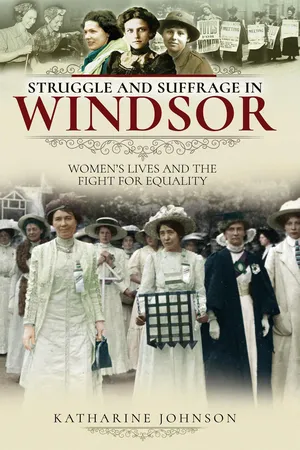
Struggle and Suffrage in Windsor
Women's Lives and the Fight for Equality
- 145 pages
- English
- ePUB (mobile friendly)
- Available on iOS & Android
eBook - ePub
About this book
An in-depth history of women who lived, worked, and fought for the vote in the town surrounding Windsor Castle.
At drawing room meetings, debates, and rallies, suffragists in Windsor—home to Britain's royal family—fought not just for the right to put a cross on a ballot paper but to help put an end to some of the shocking injustices women faced, some of which were especially felt in Windsor at that time.
It was no easy task—they came up against fierce opposition, ridicule, and rage, with one newspaper saying Windsor was the town in which the suffragettes were "most cordially hated." From Queen Victoria to Princess Elizabeth, the women of Windsor have played a major role in shaping this country. But what of the lesser-known women? In this book, the untold and often intertwined stories of the rich and famous are brought together with those of domestic staff, nuns, nurses, school teachers, mothers, shopkeepers, beggars, and prostitutes, who all played a part in a century of extraordinary social changes. What was it like to be a female resident of the workhouse? Or the lady who founded a home for destitute and "fallen" women? The lady who allowed her home to be used as a hospital in WWI and the nurses who worked there? For those who lived in the cholera-infested Victorian slums and the women evacuated to Windsor with their children during WWII? And those who campaigned tirelessly to improve women's rights and get the vote? This book provides a fascinating, behind-the-scenes insight into women's lives above and below stairs in this unique microcosm of Britain.
Information
Subtopic
Modern British HistoryIndex
HistoryCHAPTER ONE
Queen Victoria and Princess Elizabeth

Key dates:
1819 – 24 May: birth of Alexandrina Victoria.
1837 – 27 June: Victoria becomes queen on the death of William IV.
1838 – 28 June: Coronation of Queen Victoria.
1839 – A difficult political year: the Hastings Affair and the Bedchamber Crisis.
1840 – 10 February: marriage of Victoria and Albert.
1901 – 22 January: death of Queen Victoria.
Although this is a story about ordinary women, it wouldn’t be complete without mentioning the two most famous female Windsor residents whose reigns mark the start and finish of the period covered by this book, 1850–1950, and their huge influence on ordinary women in Windsor – Queen Victoria and Princess Elizabeth.
Queen Victoria was the first Windsor queen, choosing the town as her home, while Princess Elizabeth would be given the surname Windsor and spend the war years at the castle, giving local people encouragement and reinforcing the monarchy’s link with the town.
As well as being one of history’s most iconic queens, Victoria in many ways put Windsor on the map. If she hadn’t decided to make Windsor her primary royal residence instead of London, it would be a very different town today and the lives of many women within would also have been different. Having a monarch in residence brought the town employment opportunities, better transport, festivities and tourism. It also gave this once most disreputable town a sense of pride.
Victoria’s sixty-three-year reign, which covers half the period explored by this book, was an era of enormous political, industrial, cultural and scientific change. It saw the invention of the radio, telephone, ‘bone shaker’ bicycle, gramophone, electric light and camera. Railways and the London Underground were built. Darwin published his Origin of Species, votes were extended to most men following the Reform Acts, compulsory free education was made available to children and the suffragette movement was born. By the end of her reign, she was ruler not just of Great Britain but of the largest empire in the history of the world.
But it was no easy ride. This diminutive (4ft 11in) 18-year-old girl who few had expected to become queen had to battle to establish and maintain her authority and independence, deal with thirteen prime ministers and tread a difficult line between maintaining political neutrality and showing concern for social welfare.
In 1839, the young queen’s handling of two situations made her unpopular. Public opinion turned against her when she believed false allegations that Flora Hastings, a popular lady-in-waiting, was pregnant when Flora in fact turned out to be dying. As a result stones were thrown at the queen’s carriage at the funeral.
Victoria was also booed and called Mrs Melbourne at Ascot races following the Bedchamber Crisis. As a condition of accepting the role of prime minister, Robert Peel had requested she replace some of her Whig ladies-in-waiting with Tories. She refused, so Lord Melbourne was reappointed prime minister but this was seen by many as unconstitutional.
She faced a considerable amount of public opposition during her reign and had to cope with at least seven assassination attempts, including one in Windsor when she was an elderly widow. A pistol was fired at her from close range as her coach left Windsor central station.
One of the things she is best remembered for is the way she redefined the British monarchy, restoring its reputation, which had been tarnished by the licentious behaviour of her uncles, and ensuring its survival for future generations. At a time of great political turmoil when other European countries faced revolutions, Queen Victoria presented the royal household as a loving, stable, close-knit family and a model of respectability and stability.
Victoria and Windsor
Windsor suited Victoria partly because she was in some respects an outsider. At her birth on 24 May 1819 few people expected her to become queen. She was only fifth in line to the throne, the daughter of Prince Edward, Duke of Kent (the fourth son of George III) and Princess Victoria of Saxe-Coburg. Both the Duke of Kent and his father George III died in 1820 when she was a baby. It was assumed George IV’s daughter Charlotte would inherit the throne but in 1817 Charlotte died following a stillbirth.
Victoria had just turned 18 when her uncle, William IV, died on 27 June 1837 without an heir. One of the first decisions she took as queen was to assert her independence by refusing to continue sharing rooms with her mother, and to move away from the controlling influence of her mother’s comptroller John Conway.
So it’s no surprise that Windsor appealed to Victoria. It gave her freedom and independence away from the bustle and scrutiny of London but was within a reasonable carriage ride for conducting her regal duties.
The Coronation celebrations in Windsor
The day after her coronation in Westminster Abbey, London, on 28 June 1838, Victoria returned to Windsor. Despite terrible weather she was greeted by tumultuous crowds as her coach drove through the streets decorated with triumphal arches, flowers and lighting. Long tables were set out in the Long Walk and 4,000 poor and old people of the borough sat down to dinner in the pouring rain.
As well as the arrival of the queen, the crowds were treated to the sight of a solo flight by the first female aeronaut Margaret Graham in The Royal Victoria hot air balloon. Mrs Graham’s husband had hoped to accompany her on the flight but due to the appalling weather the balloon wouldn’t take off with the couple’s combined weight so Mr Graham had to get out and watch as his wife took off into the clouds, waving a handkerchief in triumph.
So the ordinary women of Windsor were given two examples that day of bold, independent females, proving that women could be something more than just decorative.
The coronation festivities set a precedent for celebrating royal events in Windsor. Throughout the next century Windsor residents would turn out to celebrate state visits, the birth of the Prince of Wales, the marriage of Prince Edward to Princess Alexandra of Denmark and the queen’s Jubilees.
The huge crowds these occasions brought provided the taverns and shops, seamstresses, bonnet makers and street traders with business and made Windsor into a tourist destination.
Victoria and Albert
It was at Windsor Castle in 1839 that Victoria proposed to Albert. The Royal Wedding took place in London on 10 February 1840, but after the ceremony the couple made the three-hour carriage journey to Windsor to spend their honeymoon. Shortly before 7 p.m. the newlyweds passed through the triumphal arch at Eton where they were met by a fairy-tale scene of gas and oil illuminations and the walls of the houses lit up with crowns and stars. Wealthy Windsor residents enjoyed public dinners and a ball at the town hall while thousands of poor people were given free food and drink.
The backwater market town was a welcome retreat for the royal couple, giving them peace and space in which to bring up their children. Albert also preferred Windsor to London society where he initially struggled to be accepted. Coming from the little-known state of Saxe-Coburg, he was dismissed by some of the aristocracy as being a pauper prince. His reserved manner and lack of enthusiasm for the traditional aristocratic pursuits of gaming, drinking and hunting, did nothing to endear him to them or vice versa.
At Windsor, Victoria and Albert could walk, paint, play the piano, enjoy recitals, play shuttlecock and battledore in the long corridor, and have picnics on the shores of Virginia Water Lake. In winter Albert used to drive the children around the Great Park in a sleigh and they skated on the pond at Frogmore House by the castle when it was frozen.
Model Family
But despite her power and prestige, Queen Victoria represented the model of femininity and respectability. Portraits of the couple in a homely setting with their nine children presented a picture of domestic bliss and Victoria was known as the ‘mother of the nation’. It was also hoped that the children would help to bring harmony and lasting peace to Europe by being married into ruling families.
An illustration of the Royal Family sitting around a decorated tree in Windsor Castle published in the Illustrated London News in 1848 inspired ordinary families to introduce similar celebrations in their homes.
Queen Victoria and the Train
A huge change to women’s lives in Windsor was brought about by Queen Victoria’s decision to grant approval for the building of a railway in the town. In 1842, Victoria had become the first monarch to travel to London by train. The royal party had travelled by horse and carriage to Slough where they boarded the royal saloon carriage, with its padded silk ceiling, blue velvet sofas and silk curtains. A device was fitted to the top of the carriage so they could signal to the driver if they felt they were going too fast and Albert asked them to slow to 30mph because the queen had found the top speed of over 40mph alarming.
Despite her initial misgivings, the queen wrote to her Uncle Leopold afterwards that she was ‘quite charmed’ by this new way of travelling and became a regular train traveller.
The decision to extend the branch line to Windsor was taken only after much deliberation. For one thing, Queen Victoria was afraid the vibrations of the track might cause structural damage to the castle.
Other people in the town objected for different reasons. Dr Hawtrey, the headmaster at Eton, feared that being given such easy access to London might be too much of a temptation for his boys. But the queen finally agreed and in doing so she changed the future of the town.
The faster speed of travelling by train enabled the royal couple to spend more time in Windsor. But it also improved travel and trade for the ordinary townsfolk, giving birth to a tourist industry as Windsor became a destination for days out.
It would also mean in the next century that Windsor women could more easily access the suffrage meetings and marches in London, while visiting speakers from London suffrage societies could come to address meetings in Windsor.
The Widow of Windsor
After Albert’s death Victoria became known as The Widow of Windsor. For several years she retreated from public life, to such an extent that ironic placards were tied to the gates of Buckingham Palace declaring the property for sale or rent. There was talk that she had inherited George III’s madness and growing anger at her apparent disinterest in poverty, hunger and political unrest.
In Windsor, when her son Bertie (the future Edward VII) married Princess Alexandra of Denmark in 1863, the queen had a raised walkway built between the east end of the castle and St George’s Chapel so that she could attend the wedding without being seen.
But Windsor residents regularly saw a small, plump figure driving around the town in her donkey cart, dressed in her widow’s weeds. She was often accompanied by John Brown, her favourite servant with whom she had a very close relationship.
During this period she focused on her family, securing marriages for her children across the continent, as she and Albert had planned, and earning herself the nickname ‘grandmother of Europe’ because of the alliances formed.
However, things didn’t turn out as hoped. After her death, her dream of a united Europe would come to an end when in 1914 three of her grandchildren – King George V, Kaiser Wilhelm II and Tsar Nicholas II – found themselves at war with each other.
With her children, the queen continued Albert’s support of the arts and social welfare. In Windsor in 1880 the Royal Albert Institute was opened in his memory to promote the study of science, literature and the arts which would benefit many women. Plays and concerts would be performed there including in the twentieth century suffragist plays. The Institute has been demolished but the statue of Albert still stands on an office block where it used to be.
The queen was finally coaxed back into public life in 1877 when Prime Minister Disraeli agreed to make her Empress of India as a unifying figurehead. Politics during the 1880s was dominated by the Reform bills and the Irish Question. The rise in Fenian activity targeting the House of Commons, Scotland Yard and the Home Office made the queen nervous of driving around London, especially after a plot to blow up Westminster Abbey was uncovered during the Golden Jubilee.
But at the same time another movement was gaining prominence – women’s suffrage.
Queen Victoria and the suffragists
Windsor women on both sides of the suffrage argument would in due course name Queen Victoria as an example in their campaign for or against women’s rights.
In response to anti-suffrage claims that women shouldn’t be involved in politics because they lacked the intellectual capacity to understand law and were too delicate for the political arena, suffragists often pointed to Windsor’s most famous resident: the queen. Did she not govern as well as any man? Did she not say she wished she had Florence Nightingale in the War Office?1
In many ways the queen provided a role model for ordinary women in Windsor, showing that it was perfectly possible for a woman to not only succeed, but to excel in a traditionally male-dominated arena.
Queen Victoria was no supporter of the suffrage cause however, and was vehemently opposed to women being given the vote. Despite being the richest and most powerful woman in the world, raising her daughters to be strong, highly educated rulers and recognising her eldest daughter’s superior intellect over her eldest son and heir’s, Victoria’s attitude to women’s suffrage seems at first puzzling. She famously described women’s rights as ‘mad, wicked folly’, and on hearing that Lady Amberley was a supporter of women’s suffrage Victoria said the lady deserved ‘a good whipping’.
Reflecting the views of many people at the time, she maintained that men and women were different and should occupy their own spheres: men, the world of business and politics, and women the home. Otherwise, women would lose their femininity and become ‘hateful, heartless and disgusting’ human beings.
This was a few decades before the women’s suffrage movement became militant, and Lady Amberley’s aims were hardly out...
Table of contents
- Cover
- Title
- Copyright
- Contents
- Introduction
- Chapter One: Queen Victoria and Princess Elizabeth
- Chapter Two: Home
- Chapter Three: Education
- Chapter Four: Work
- Chapter Five: Health
- Chapter Six: Active Citizens
- Chapter Seven: First World War
- Chapter Eight: Second World War
- Chapter Nine: Charity and Good Works
- Chapter Ten: Leisure
- Acknowledgements
- Endnotes
- Plate section
Trusted by 375,005 students
Access to over 1.5 million titles for a fair monthly price.
Study more efficiently using our study tools.
Frequently asked questions
Yes, you can cancel anytime from the Subscription tab in your account settings on the Perlego website. Your subscription will stay active until the end of your current billing period. Learn how to cancel your subscription
No, books cannot be downloaded as external files, such as PDFs, for use outside of Perlego. However, you can download books within the Perlego app for offline reading on mobile or tablet. Learn how to download books offline
Perlego offers two plans: Essential and Complete
- Essential is ideal for learners and professionals who enjoy exploring a wide range of subjects. Access the Essential Library with 800,000+ trusted titles and best-sellers across business, personal growth, and the humanities. Includes unlimited reading time and Standard Read Aloud voice.
- Complete: Perfect for advanced learners and researchers needing full, unrestricted access. Unlock 1.5M+ books across hundreds of subjects, including academic and specialized titles. The Complete Plan also includes advanced features like Premium Read Aloud and Research Assistant.
We are an online textbook subscription service, where you can get access to an entire online library for less than the price of a single book per month. With over 1.5 million books across 990+ topics, we’ve got you covered! Learn about our mission
Look out for the read-aloud symbol on your next book to see if you can listen to it. The read-aloud tool reads text aloud for you, highlighting the text as it is being read. You can pause it, speed it up and slow it down. Learn more about Read Aloud
Yes! You can use the Perlego app on both iOS and Android devices to read anytime, anywhere — even offline. Perfect for commutes or when you’re on the go.
Please note we cannot support devices running on iOS 13 and Android 7 or earlier. Learn more about using the app
Please note we cannot support devices running on iOS 13 and Android 7 or earlier. Learn more about using the app
Yes, you can access Struggle and Suffrage in Windsor by Katharine Johnson in PDF and/or ePUB format, as well as other popular books in History & Modern British History. We have over 1.5 million books available in our catalogue for you to explore.