An easy-to-use, straightforward guide for British family historians looking to trace their ancestry using DNA testing.
DNA research is one of the most rapidly advancing areas in modern science, and the practical use of DNA testing in genealogy is one of its most exciting applications. Yet there is no recent British publication in this field. That is why this accessible, wide-ranging introduction is so valuable. It offers a clear, practical way into the subject, explaining the scientific discoveries and techniques and illustrating with case studies how it can be used by genealogists to gain an insight into their ancestry.
The subject is complex and perhaps difficult for traditional genealogists to understand but, with the aid of this book, novices who are keen to take advantage of it will be able to interpret test results and use them to help answer genealogical questions which cannot be answered by documentary evidence alone. It will also appeal to those with some experience in the field because it places the practical application of genetic genealogy within a wider context, highlighting its role as a genealogical tool and suggesting how it can be made more effective.
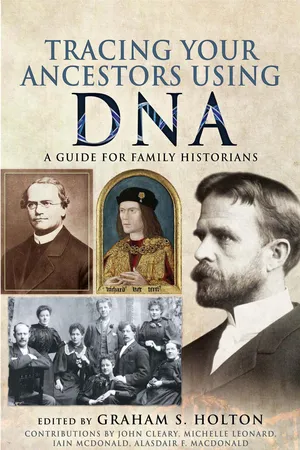
eBook - ePub
Tracing Your Ancestors Using DNA
A Guide for Family Historians
- 256 pages
- English
- ePUB (mobile friendly)
- Available on iOS & Android
eBook - ePub
About this book
Information
Subtopic
Genetics & GenomicsChapter 1
WHY USE DNA TESTING FOR GENEALOGY?
Michelle Leonard, Alasdair F. Macdonald, Graham S. Holton
Direct to consumer DNA testing has brought about a revolution in genealogy and is now a very significant resource available for family history. It is a unique new tool in the genealogist’s toolbox, but it is important to understand both the benefits and the limitations of each type of test, which we will cover in detail in later chapters.
There are three different types of DNA test available on the market: autosomal DNA (atDNA) (which includes the X-chromosome), Y-chromosome DNA (Y-DNA) and mitochondrial DNA (mtDNA). Autosomal DNA testing has exploded in the last few years and is now the most popular of these tests. Over 30 million people have now taken an autosomal DNA test across all of the different testing companies (over 15 million of these at AncestryDNA alone). All three types of test have their own merits and drawbacks, however, so it is necessary to learn how to work with each of them. This book aims to give you a practical guide to using DNA testing as part of your genealogical research.
Here are some of the top reasons to use DNA testing for genealogy.
Connecting with new cousins
One of the most exciting aspects of using DNA for genealogy is identifying and connecting with new cousins. All of the major testing companies supply you with a cousin match list, which contains people who have also tested on the same platform and share some DNA with you. These lists are organised by closest to most distant, so investigating the top of your match list will be one of the most thrilling moments when you first get your results.
It is important to contact your matches, as sharing information with each other could help you work out your cousin connection. Often you will be connecting with cousins who share your love of family history and may wish to collaborate on your shared lines, so getting to know your new cousins can be really rewarding. You will have many thousands of matches with whom you will never be able to find the link and many will not respond, but those that do may have photographs, documents, family stories and memorabilia they are willing to share with you. More and more people are testing all the time and your match list will grow on a daily basis, with more confirmed cousins who may be able to help with your family history research. Can you imagine how many cousin connections we are all going to have a few years from now? Be proactive and contact your cousins if you want to get the most out of your DNA test.
Adding new branches to your family tree
Adding new branches to your tree goes hand in hand with identifying new cousins via DNA. In general these new branches will be from collateral lines: that is, the descendants of the siblings of your direct ancestors. Collateral line brick walls or gaps are very common – many people only research their direct ancestors or get stuck tracing collateral lines forward, especially if emigration is involved. Your new cousin matches are likely to be able to provide information you are missing on collateral lines since they are the direct descendants of those lines. They can help you flesh out your tree in many different ways and focus your research on the right areas.
Breaking down brick walls
We all have them and we all want to break them down! They are frustrating and challenging but DNA can help. Which test can aid you the most will depend on how far back and on which line your brick wall is located. If you have a brick wall within the last 5–7 generations then autosomal testing is definitely worth trying, but it is imperative to identify and test the most valuable family members available. With atDNA that means testing your older generations if at all possible. For example, if your brick wall is a paternal third great-grandfather and your father is alive and willing, then test your father as he possesses double the DNA from that ancestor. You may have to test a number of different relatives to maximize the amount of the mystery ancestor’s DNA you have to work with. Additionally, if the brick wall is on a Y-DNA (paternal) or mtDNA (maternal) line and there is a Y-DNA or mtDNA test-taker available, you could also gain insight from those tests. Cousin matches can aid you in identifying the correct ancestors to break down brick walls and enhance your tree in the process.
Testing hypotheses
If documentation does not exist to provide evidence of a particular relationship, DNA may be able to fill that void. Depending on which line and how far back the relationship falls you could use atDNA, YDNA or mtDNA testing to gain insight. If you are looking for evidence for a hypothesis about a sixth greatgrandparent, for instance, you will likely need to turn to Y-DNA or mtDNA due to the limited reach of atDNA. If the theory is about a direct paternal line you should look to Y-DNA, and if it is on a direct maternal line then explore mtDNA. Notice I do not say ‘your’ direct paternal or maternal lines here; that is because there is no reason to limit yourself to these so long as you can find appropriate test-takers on the Y or mt line the mystery is on. If you have a closer mystery (e.g. grandparent or great-grandparent) for which you want to test a hypothesis, you can use atDNA to assess this. For example, you could test yourself then trace forward to living descendants of the potential grandparent to find one who is willing to test. Their results should prove or disprove your hypothesis depending on whether or not and how well they match you.
Surname studies
Surnames continue to be a primary research interest for genealogists and historians due to their linkage to documentary evidence. There may also be an emotional or cultural significance to bearing a particular surname. Unlike our genome, which cannot be replaced as it is who we are, our surname can be changed. If we are female, it may be by marriage. For males, surname inheritance can be more fickle, as the direct line of transmission down the generations can be interrupted due to illegitimacy, unrecorded adoption and personal choice.
Illegitimacy, formal or informal adoption, remarriage of widows causing children to adopt a different name and change of name due to female inheritance are some of the more common reasons for change of surname. Some of these lead to significant problems with genealogical research, resulting in brick walls that until the introduction of DNA testing appeared insurmountable.
Although atDNA tests are advertised as analysing DNA from all your recent ancestors, including your father, they do not test the Y-chromosome if you are a male. This needs a specific test of its own.
In practical terms, a surname mirrors the transmission of the male specific Y-chromosome that is passed from a father to his son (or sons) who pass it to their sons in an unbroken line of descent. Females do not have a Y-chromosome, so to investigate a surname using a Y-DNA test they must rely on a male relative to test on their behalf.
The parallel progression of a surname with a specific Y-chromosome signature down the generations can in theory be used to corroborate the hypothesis that males bearing the same surname, or a variant, share the same patrilineal ancestor. The exact identity of that shared ancestor might be quite recent or in the distant past, but as a rule cannot be identified from a single Y-DNA test. In certain circumstances it may be possible to identify the common shared ancestor, but only if extensive testing of individuals has been undertaken within the framework of a lineage that has well-documented descents. Similarly, combining Y-DNA testing with other types of evidence, such as an autosomal test result, may identify a candidate for the most recent common ancestor.
There are two types of DNA test used for investigating surnames – Short Tandem Repeats (STRs) and Single Nucleotide Polymorphisms (SNPs). It is important to understand the purpose of each type of YDNA test as they are quite different from one another. Genetic genealogists use both types of test for investigating surnames. Failure to do so can lead to misinterpretation of STR matching. Not all companies offer both types of Y-DNA test and the main vendors of autosomal tests do not offer any.
Surname research using DNA testing is not an individual pursuit.
You need to test with a company that has a relational database and be willing to share details of your most distant known patrilineal ancestor. To gain the most from such testing it is also advantageous to join a surname project such as those hosted at Family Tree DNA.
Mapping your DNA back to your ancestors
This is a more advanced reason for testing, so it is not advisable to attempt it when you are just starting out on your DNA journey, but it is a really interesting exercise to undertake down the line when you have more experience and additional confirmed cousins in the databases. It is a technique known as chromosome mapping, and it basically consists of assigning segments of your DNA to specific ancestors or ancestral couples. In order to map this DNA you have to be able to identify confirmed relationships between yourself and your DNA matches, because it is the segments you share with them that can be mapped back to your common ancestors. It is interesting and exciting to know which bits of your DNA came from which of your ancestors, but it is not just a curiosity, because it is extremely helpful for DNA matching. Whenever you get new matches that match you on any of the segments that you have been able to map back to particular ancestors, you can narrow down how you match that new person enormously.
Confirming the lines of your tree
You might think verifying your direct ancestors using DNA would just be telling you what you already know and thus not very exciting, but that is not the case at all. It is telling you that what you think you already know is actually accurate! It is priceless verification to add to your papertrail evidence. DNA is the only record set that does not and cannot make mistakes or lie – human beings can and do both on occasion. No matter how great a researcher you are and how well-sourced your family tree is, it can always be erroneous for reasons beyond your control. For those of us who have spent many years meticulously researching our family trees, or even for those just starting out on that journey, to have confirmation that you genuinely share segments of DNA with the ancestors you have identified on paper is gold-dust supporting evidence. Of course you have to be aware that instead of confirming your tree is correct, DNA could do the opposite and you may end up having to research ancestors you did not know you had. Thankfully this situation is rare, but there is always that risk and you have to go into DNA testing with your eyes wide open. Verifying ancestors is the one thing that most people are likely to be able to do when they get their results and is one of the very best reasons to DNA test for family history.
Adoption and all unknown ancestor mysteries
There are some genealogical puzzles traditional research can never solve, as the documentation simply does not exist. DNA has opened up a whole new world of possibilities for those with adoption, unknown parentage, donor conception, foundling, unknown grandparentage, illegitimacy, and other unknown ancestor mysteries. Adoptees and those with an unknown parent are increasingly using DNA testing to identify their birth parents and connect with close family members. If you were adopted or have a recent unknown ancestor you have to be aware that you may uncover your birth relatives if you test, and anyone who tests has to be aware they may match with an adoptee or previously unknown close relative. If you have a recent unknown ancestor mystery, DNA may be the only way you can solve it. For example, if you have your grandfather’s birth certificate and on it there is only the mother’s name and a blank space where the father’s name should be, there is nobody alive who can tell you who that mystery man was, and there is no documentation that can inform you either. DNA just might help! Using cousin matching it is possible to solve these puzzles and identify your mystery ancestors. There can never be any guarantee of success in these cases, as they are dependent on the relatives who have already tested or will test from the mystery ancestor’s family, but with more people testing every day more and more answers are coming to light.
Admixture
Uncovering your admixture percentages is the best known and advertised aspect of DNA testing. All of the main DNA testing companies supply admixture reports as part of their autosomal offerings. These are commonly referred to as ‘ethnicity estimates’ but we will be referring to them throughout this book under the more appropriate term of ‘admixture’. For some testtakers, this will be their first foray into genealogy and admixture may be the only information they seek; knowing how Irish, Scandinavian or Native American they are forming part of their ‘identity’. Admixture results are thought to be generally accurate to the continental level, but should not be taken too literally. They can, however, give you a broad idea of your origins and may provide genealogical clues if you were adopted or have a recent unknown ancestor mystery. You have to be aware that they will vary between companies, because each company has its own reference populations. Admixture is an emerging science, and although it will improve over time as more people test and reference populations increase, it is best not to read too much into the percentages you receive. It is the DNA cousin match list that is also supplied with an atDNA test that is the most useful aspect of your autosomal results when it comes to using DNA testing for genealogy.
Early ancestral origins
While admixture results inform about overall genetic make-up by comparison to company reference populations, research into early ancestral origins uses the two types of DNA that do not randomly recombine at fertilisation but remain intact. These are our mitochondrial DNA (mtDNA), inherited by children, both males and females, from their mothers, and the male specific Y-chromosome. These types of DNA have a direct lineal descent with no interference from other ancestral lines, so their migration over time can be plotted. Associating an ethnic or tribal group to a particular genetic marker such as Viking, Pictish or Celtic became fashionable for a time, partly as a marketing ploy by certain test companies. The problem with this approach is that ethnic groups and tribes in Western Europe were not homogenous. They may have had a shared cultural identity, but would have included individuals with distinctly different genetic origins for both their male and female ancestors. Another issue with inferring early ancestral origins is that until recently most data was from the results of self-selecting individuals alive today, with inherent problems of unrepresentative sampling and the simple problem that our ancestors moved about and left no physical trace.
Nevertheless, the wealth of genetic data emanating from Next Generation Sequencing tests (NGS) is enabling significantly improved and more refined branching of both mtDNA and Y-DNA lineages. Together with the influx of genetic data from ancient remains (aDNA), the dating of branching is slowly improving. Better sampling is leading to a much improved and refined genetic tree. The geographical frequency and distribution of specific DNA markers can be overlaid on the genetic tree, potentially providing evidence of the migration routes of particular lineages.
When genetic testing for genealogy first started, early ancestral origins were traditionally thought of as research into ancient origins thousands of years ago. This is certainly a valid area of research, however today we ought to think about the timeframe before documentary evidence was typically used for genealogy. This means the mediaeval period back to the time of early recorded history. With this as a focus, increasingly test-takers are collaborating to research the interrelationships between lineages bearing different surnames or who carry a specific DNA marker. In the vast majority of cases there is no comparative historical evidence with which to complement the emerging new genetic data.
However, there are exciting areas for research to explore if traditional pedigrees and oral tradition mirror the genetic evidence. Here are some examples. Researchers are investigating the provincial kings of Connacht, Munster, Leinster and Ulster as recorded in the Irish Annals using the Y-DNA of Irish men. Further afield the people of the Levant (Eastern Mediterranean) are being researched. One particular project is focused on the Druze people, using Y-DNA along with historical and oral record sources. The Druze community are composed of those who are descendants strictly in the direct patrilineal line from the clans and families that accepted the Druze faith from 1017–43 CE, after which no new adherents to the faith were allowed.
As there is so much more mitochondrial DNA in our cells than DNA found within our cell nucleus, it survives much better in ancient remains. It has therefore been used for many years in studies focusing on the origins and migration of female family groups. If you have your mtDNA sequenced you will be able to track your maternal origins with a ...
Table of contents
- Cover
- Title
- Copyright
- Contents
- Introduction by Graham S. Holton
- Contributors
- Chapter 1 Why use DNA testing for genealogy? : Michelle Leonard, Alasdair F. Macdonald, Graham S. Holton
- Chapter 2 The ethical and legal aspects of genetic genealogy :John Cleary
- Chapter 3 Understanding the principles of DNA testing for genealogy :Michelle Leonard
- Chapter 4 atDNA tests:Michelle Leonard
- Chapter 5 Y-DNA tests :Alasdair F. Macdonald, John Cleary
- Chapter 6 mtDNA tests :Alasdair F. Macdonald
- Chapter 7 Choosing between testing companies :Alasdair F. Macdonald
- Chapter 8 Projects : John Cleary, Iain McDonald
- Chapter 9 An integrated approach to DNA testing for genealogy :John Cleary, Iain McDonald, Graham S. Holton
- Chapter 10 Ancient DNA :John Cleary
- Chapter 11 What does the future hold? :Iain McDonald, Michelle Leonard
- Glossary
- Further Reading
Trusted by 375,005 students
Access to over 1.5 million titles for a fair monthly price.
Study more efficiently using our study tools.
Frequently asked questions
Yes, you can cancel anytime from the Subscription tab in your account settings on the Perlego website. Your subscription will stay active until the end of your current billing period. Learn how to cancel your subscription
No, books cannot be downloaded as external files, such as PDFs, for use outside of Perlego. However, you can download books within the Perlego app for offline reading on mobile or tablet. Learn how to download books offline
Perlego offers two plans: Essential and Complete
- Essential is ideal for learners and professionals who enjoy exploring a wide range of subjects. Access the Essential Library with 800,000+ trusted titles and best-sellers across business, personal growth, and the humanities. Includes unlimited reading time and Standard Read Aloud voice.
- Complete: Perfect for advanced learners and researchers needing full, unrestricted access. Unlock 1.5M+ books across hundreds of subjects, including academic and specialized titles. The Complete Plan also includes advanced features like Premium Read Aloud and Research Assistant.
We are an online textbook subscription service, where you can get access to an entire online library for less than the price of a single book per month. With over 1.5 million books across 990+ topics, we’ve got you covered! Learn about our mission
Look out for the read-aloud symbol on your next book to see if you can listen to it. The read-aloud tool reads text aloud for you, highlighting the text as it is being read. You can pause it, speed it up and slow it down. Learn more about Read Aloud
Yes! You can use the Perlego app on both iOS and Android devices to read anytime, anywhere — even offline. Perfect for commutes or when you’re on the go.
Please note we cannot support devices running on iOS 13 and Android 7 or earlier. Learn more about using the app
Please note we cannot support devices running on iOS 13 and Android 7 or earlier. Learn more about using the app
Yes, you can access Tracing Your Ancestors Using DNA by Graham S. Holton, Graham S Holton in PDF and/or ePUB format. We have over 1.5 million books available in our catalogue for you to explore.