- 265 pages
- English
- ePUB (mobile friendly)
- Available on iOS & Android
eBook - ePub
About this book
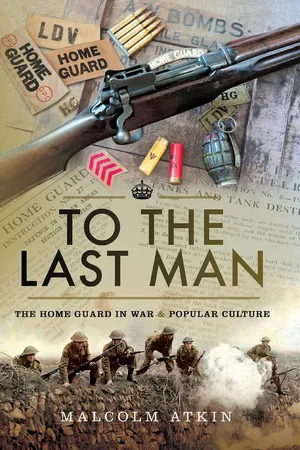
This historical study of the UK's WWII homeland defense service dispels the propaganda and pop culture myths to reveal its true wartime role.
In 1940, Britain formed an armed citizen militia to act as the first line of defense in case of Nazi invasion—an essential, if suicidal, mission intended to buy time for the organization of regular forces. Officially, they were the Home Guard. Later, a British sitcom that ran for nearly a decade in the 60s and 70s dubbed them Dad's Army. That show contributed to a distorted perception of the Home Guard that persists today. But as Malcolm Atkin reveals in this thought-provoking book, the Home Guard's image was manipulated from its earliest days.
Sifting through official documents and contemporary histories, as well as stories, artwork and poetry of the era, and comparing these with postwar films and histories, Atkin explores how the myths of the Home Guard arose and were exploited. He also shows how the strong sense of gallows-humor amongst its volunteers—which fits in with a long tradition of self-deprecating humor in the British army—was taken out of context and became the basis of the TV series.
To the Last Man strips back the myths, analyzing how the modern perception has evolved. The result is a new, gritty, and sometimes shocking appreciation of the role that the Home Guard was expected to play in the Second World War.
Information
Topic
HistoriaSubtopic
Historia británicaChapter One
Forming the Home Guard
The most fantastic and democratic Army ever raised in Great Britain. It was based on individual initiative and improvisation.1
Britain had a long history of volunteer militias ready to counter both foreign invasion and civil disorder. What distinguished the mobilization of the Local Defence Volunteers (LDV) in May 1940 was not only the scale and enthusiasm of the volunteers but also the government’s lack of a clear understanding of their role. At the start of the First World War a spontaneous movement to create volunteer ‘town guards’ had sprung up across the country, coming together as the Volunteer Training Corps (VTC). The government initially tried to suppress the movement as a distraction from securing voluntary enlistment to the armed forces and refused to provide uniforms or weapons (which had to be provided by the volunteers themselves) but in 1916 the organization was recognized as the Volunteer Force, under the Territorial Force Association (predecessor of the Territorial Army Association). Although training explicitly for guerrilla warfare on the model of the Boer commandos, it was mainly used to guard vulnerable points, including armaments factories, then to man the new anti-aircraft batteries, and in the crisis of spring 1918 volunteers from across the country were mobilized for full-time service to help defend the east coast. With some exceptions (to guard against possible Bolshevik revolution), the VTC was formally stood down in September 1919, the notification being announced by Winston Churchill (then Secretary of State for War). Although the VTC was entirely male, it worked closely with the Women’s Volunteer Reserve (WVR), frequently assisting them with weapons training. Neither organization fitted easily into the popular narrative of the conduct of the First World War that the government tried to encourage in the post-war years; both organizations have now almost completely disappeared from popular history. The debt owed by the Home Guard to the earlier VTC was clearer in 1940 than it is to a modern audience and some young volunteers served again in the Home Guard of 1940. In Herefordshire and Worcestershire the ages of such double volunteers in 1940 ranged from 39 to 63 years.2
At the start of the Second World War defence was in the hands of the volunteers of the small professional regular army and the territorial battalions, comprising, in all, just 892,697 men. Limited conscription had been introduced in April 1939. In addition, the National Defence Companies (a successor of the First World War Royal Defence Corps) were a small voluntary reserve to be mobilized on a full-time basis in the event of war but only intended to have a strength of 8,450. Enlistment was limited to former members of the British armed forces between the ages of 45 and 60. The National Defence Companies were mobilized in late August 1939, and in November 1939 were reorganized as Home Defence Battalions of their county regiment, helping to guard vulnerable points and prisoner-of-war camps throughout the war. They never developed into a major force but, nonetheless, in June 1940 General Ironside saw them, rather than the LDV, as a key element in his defence strategy.3
Two visionaries from opposite ends of the political spectrum had unsuccessfully argued in 1939 for the creation of a much larger Home Guard. Tom Wintringham, a founder member of the Communist Party of Great Britain (CPGB) and former editor of the Daily Worker, had been arrested in 1925 for seditious libel and incitement to mutiny. In 1936 he had been a pioneer of the concept of the International Brigades in Spain and was an instructor and then briefly commander of the British Battalion. Although expelled from the CPGB in 1938, Wintringham remained a confirmed Marxist and differed only tactically in believing it was necessary to work with the British government to defeat fascism, rather than waiting for a future workers’ revolution. In April 1939 Tom Wintringham called for twelve divisions:
formed in the same way as the International Brigades, by voluntary enlistment from among ex-servicemen formed in the same way as the International Brigades, by voluntary enlistment from among ex-servicemen and youths. The number of men required of men required is, perhaps, 100,000, which is a smaller number than that of the volunteers who would, in fact, clamour for arms tomorrow if the bombing of our cities began today.4
Wintringham’s proposal was ignored, not least because it was part of his wider proposals to make the army more democratic. In October 1939 the Conservative First Lord of the Admiralty, Winston Churchill, who had been closely connected with the final days of the Volunteer Training Corps, took up Wintringham’s theme, sending a memo to the Home Secretary:
Why do we not form a Home Guard of half a million men over 40 (if they like to volunteer) and put our elderly stars at the head and in the structure of these new formations? … If uniforms are lacking a brassard would suffice, and I am assured there are plenty of rifles at any rate.5
Churchill’s vision was for an expansion of the Home Defence Battalions, with First World War veterans taking over home duties, allowing younger soldiers to go on active service overseas. Equally rebuffed, Churchill then decided to let the matter drop. Until May 1940 there was an unreal ‘phoney war’ atmosphere, with the Chamberlain government dithering on how firmly to press the war effort, believing that the Nazi state was brittle and would collapse of its own accord, with Chamberlain confidently maintaining that Hitler had ‘missed the bus’.6
As in 1914, the first practical steps were taken as a grass roots movement of raw patriotism, tinged with frustration at the government’s complacency. The river-borne Upper Thames Patrol was formed in September 1939 by Sir Ralph Glyn, MP for Abingdon, in conjunction with the Thames Conservancy and War Office to patrol the Thames and its banks from Teddington to Lechlade. At its height, the UTP had up to 6,000 members, mainly Thames water-men, and it was also the first unit to recruit women. In March 1940 the ‘Essex Volunteer Army Force’ was formed, based around the Romford and Hornchurch troop of Essex Volunteer Army Force’ was formed, based around the Romford and Hornchurch troop of the Legion of Frontiersmen and comprising around 400 men. The Daily Mirror described it as the ‘vanguard of Britain’s part-time army’.7 At the same time Lady Helene Gleichen organized the eighty male employees and tenants on her estate near Ross on Wye into the ‘Much Marcle Watchers’. She wrote to the HQ of the Shropshire Light Infantry requesting that it give her 80 rifles with ammunition, adding, ‘I could do with some machine guns, too, if you have any to spare.’8 In April Lord Kemsley offered to fund the creation of rifle clubs as the core of a new defence force and there were widespread demands in the popular press to create a new volunteer defence force; MPs began to be inundated with letters from constituents demanding action and Regional Commands with offers of help. E.R. Lansdale of Petersfinger near Salisbury offered to be part of a body of householders, living on the outskirts of towns and whose properties had a good field of fire, who would be issued with rifles. He cited his military experience as a private in Giggleswick School OTC from 1920 to 1924.9 Following the invasion of the Low Countries in May, paranoia intensified over the fear of German airborne landings and the existence of a ‘fifth column’, bringing with it the risk of a mushrooming of vigilante groups who would be liable to be shot as francs-tireur (terrorists) under international law. One such body was formed on 11 May in Cradley, near Halesowen in the West Midlands, where a unit to watch for German parachutists and saboteurs went on its first patrol on 13 May, the day before Eden’s broadcast announcing the new Local Defence Volunteers (LDV). A government press release on Saturday, 11 May tried to dissuade civilians joining any fighting and the Ministry of Home Security was obliged to send out an urgent telegram on the night of 12 May, requesting confirmation of rumours that ‘bands of civilians were forming all over the country and arming themselves with shotguns etc for the purpose of detecting and dealing with German parachutists’.10
Yet it would be wrong to suppose that the LDV arose purely out of popular insistence. Behind the scenes General Walter Kirke, the then Commander-in Chief, Home Forces, had prudently begun planning a contingency plan (‘Julius Caesar’) in the event of a German invasion in the autumn of 1939 and was particularly concerned that increasingly stretched army resources were being dissipated in having to guard a multitude of local vulnerable points. In March 1940, ignoring Chamberlain’s complacency, he ordered a review of lessons from the VTC in case a similar body was needed again.11 In conjunction with General Sir Guy Williams, GOC, Eastern Command, Kirke began to establish the broadest outline of a plan for a legal local defence force, to take action ‘before civilian residents on the East Coast took the law into their own hands and formed their own private defence bands’.12 The small scale of its First World War predecessor (350,000 men) heavily influenced the concept and was to have long-lasting consequences. The proposed volunteer body would have the same priorities as the VTC in guarding vulnerable points (a cheaper option than the full-time, paid, Home Defence Battalions) and in providing pre-conscription training of youths. They would also help counter the risk of sabotage by a ‘fifth column’ or enemy agents and assist in dealing with any disruption following air raids as what was, in effect, an armed special constabulary. Such a force could also act as a reserve to be employed in the case of invasion, organized in each county by the Lords Lieutenant and operating on a decentralized basis as small groups of guerrillas ‘on the principle of the Boer Commando’.13 The upper age limit would be 55 (as in the VTC). It was also recommended that the force should be administered by the Territorial Army Associations (TAAs), as it had been in the First World War.14
Kirke’s plan was ignored until early May, when confusion in the War Office undermined the C-in-C’s efforts. As a consequence, Lewis Broad over-dramatized the situation only slightly when he claimed that the decision to form the LDV had ‘passed through the stages of suggestion, approval and action within three days’.15 The Army Council finally circulated a letter to all Army Commands on 7 May asking for views on the formation of a new volunteer force.16 With the European situation rapidly deteriorating, hundreds of unarmed Special Constables were having to guard ‘vulnerable points’. The German airborne landings in Holland on 10 May sharply focused government minds and caused paranoia over false press reports of German paratroopers landing in Allied uniforms or even nuns’ clothing, with extravagant claims that the enemy could land up to 100,000 airborne troops. At the Cabinet meeting on Thursday, 9 May the Foreign Secretary (Lord Halifax) raised a suggestion made by Lord Mottistone in the House of Lords that local levies armed with rifles might be found from older men to guard isolated vulnerable points and the Chief of the Air Staff said the suggestion would be considered by the Chiefs of Staff Committee.17 The next day Kirke became head of the new Home Defence Executive, charged as C-in-C Home Forces with coordinating anti-invasion planning. Wasting no time, on the afternoon of Saturday, 11 May he met with General Sir John Dill (the Vice Chief of the Imperial General Staff), General Sir Gordon-Finlayson (the Adjutant General), General Sir Hugh Elles (a former Regional Commissioner now seconded to the Ministry of Home Security) and Oliver Stanley (then Secretary of State for War, on his last day before handing over the role to Anthony Eden) to consider the best ways of dealing with parachutists. Kirke believed the meeting had endorsed his plan for a new volunteer force but when Dill reported first to the Chiefs of Staff Committee and then to the Cabinet that evening he proposed merely attaching six or seven local volunteers to the scatter of searchlight units across the country, under Anti-Aircraft Command. The volunteers would not, therefore, be necessarily sited to defend towns and villages, and it is not clear what the force might have achieved. The Royal British Legion was suggested as possibly organizing the scheme, but it lacked the necessary infrastructure for such a task. Without any mention of consulting the C-in-C Home Forces, the Cabinet gave general approval and asked for a progress report on Monday, 13 May.18 This was occurring even as General Kirke was briefing his GSO1, Brigadier W. Carden Roe, on a meeting scheduled for the following day at the War Office where, he thought, his plan was to be formally approved. Adding to the confusion, Anthony Eden took over as Secretary of State for War on 12 May and had not been party to the earlier discussions.
On the morning of Sunday, 12 May Carden Roe attended the scheduled meeting with the War Office and Anti-Aircraft Command on Kirke’s behalf, believing this was a relatively low-level meeting simply to expand on Kirke’s proposal, which Kirke mistakenly assumed had already been approved by the War Cabinet. Carden Roe was surprised to find himself seriously outranked, with the meeting chaired by the Adjutant-General who announced that he had been instructed to draw up a scheme and presented the plan that had been taken to the War Cabinet by Dill on the previous evening. Gordon-Finlayson tried to prevent Carden Roe from bringing Kirke’s alternative plan to the attention of the meeting but General Pile from Anti-Aircraft Command, who was intended to command the force as envisaged by Gordon-Finlayson/Dill (but who had clearly not yet been consulted), declared the plan ‘nonsense’. Kirke then arrived to have a blazing argument with Gordon-Finlayson and further meetings with the VCIGS. The discussions were private but it can be imagined that Kirke firmly pointed out that the War Office was usurping the authority of Home Forces and the new Home Defence Executive. Gordon-Finlayson and...
Table of contents
- Cover
- Title
- Copyright
- Contents
- List of Plates
- List of Figures
- Abbreviations
- Acknowledgements
- Preface
- Introduction
- 1. Forming the Home Guard
- 2. The Role of the Home Guard, 1940–41
- 3. Integration with the Army, 1942–44
- 4. The Secret Home Guard
- 5. Arming and Equipping the Home Guard
- 6. Aid from the USA
- 7. Training the Home Guard
- 8. A People’s Army?
- 9. Women and the Home Guard
- 10. The 1950s Home Guard
- 11. The Home Guard in Wartime Popular Culture
- 12. The ‘Dad’s Army’ Effect
- Conclusions
- Notes
- Bibliography
- Plate section
Trusted by 375,005 students
Access to over 1.5 million titles for a fair monthly price.
Study more efficiently using our study tools.
Frequently asked questions
Yes, you can cancel anytime from the Subscription tab in your account settings on the Perlego website. Your subscription will stay active until the end of your current billing period. Learn how to cancel your subscription
No, books cannot be downloaded as external files, such as PDFs, for use outside of Perlego. However, you can download books within the Perlego app for offline reading on mobile or tablet. Learn how to download books offline
Perlego offers two plans: Essential and Complete
- Essential is ideal for learners and professionals who enjoy exploring a wide range of subjects. Access the Essential Library with 800,000+ trusted titles and best-sellers across business, personal growth, and the humanities. Includes unlimited reading time and Standard Read Aloud voice.
- Complete: Perfect for advanced learners and researchers needing full, unrestricted access. Unlock 1.5M+ books across hundreds of subjects, including academic and specialized titles. The Complete Plan also includes advanced features like Premium Read Aloud and Research Assistant.
We are an online textbook subscription service, where you can get access to an entire online library for less than the price of a single book per month. With over 1.5 million books across 990+ topics, we’ve got you covered! Learn about our mission
Look out for the read-aloud symbol on your next book to see if you can listen to it. The read-aloud tool reads text aloud for you, highlighting the text as it is being read. You can pause it, speed it up and slow it down. Learn more about Read Aloud
Yes! You can use the Perlego app on both iOS and Android devices to read anytime, anywhere — even offline. Perfect for commutes or when you’re on the go.
Please note we cannot support devices running on iOS 13 and Android 7 or earlier. Learn more about using the app
Please note we cannot support devices running on iOS 13 and Android 7 or earlier. Learn more about using the app
Yes, you can access To the Last Man by Malcolm Atkin in PDF and/or ePUB format, as well as other popular books in Historia & Historia británica. We have over 1.5 million books available in our catalogue for you to explore.