Excerpts from the many unofficial "manuals" avidly bought by members of the British Home Guard desperate to prepare for invasion during World War II.
How would you clear a stoppage on a Bren Gun while in action? What is the most effective way to clear a wood of enemy forces? How best could you counter a landing by enemy airborne forces in your area? What measure can you take to help ensure accurate rifle fire at night? What qualities should you look for when selecting a patrol commander?
Just a few of the practical questions posed—and answered—in the selection of publications included in
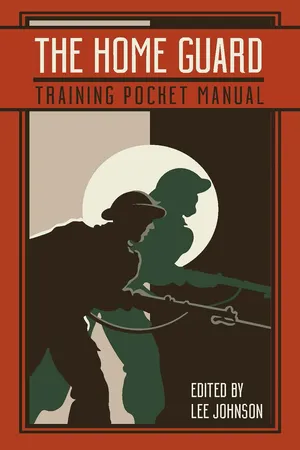
The Home Guard Training Pocket Manual. Numerous manuals and training pamphlets were privately published during World War II to supplement the slim official Home Guard manual produced by the War Office. Covering everything from patrolling, night fighting, drill and small arms proficiency to the legal powers of the Home Guard, these manuals were welcomed by the men of local Home Guard units keen to do everything possible to prepare for possible invasion—when they would be the first line of defense. This pocket manual collates a selection of material from these fascinating publications, often written by serving soldiers and reprinted multiple times due to demand.
- 160 pages
- English
- ePUB (mobile friendly)
- Available on iOS & Android
eBook - ePub
The Home Guard Training Pocket Manual
About this book
Information
CHAPTER 1
THE OBJECT OF THE HOME GUARD
The first two chapters of this book are excerpts from the October 1942 edition of The Home Guard Training Manual written by Major John Langdon-Davies who at the time was Commandant of the South Eastern Command Fieldcraft School at Burwash. Langdon-Davies had reported on the Spanish Civil War for the News Chronicle, where he had expressed admiration for the Anarchists but felt their militias were incapable of mounting an effective defence against Franco’s Nationalists. This undoubtedly influenced his writings on the role of the Home Guard, as did the events of the first ten months of the war. The rapidity with which the defence of both the Low Countries and France collapsed in the face of the Wehrmacht’s blitzkrieg tactics came as a profound shock. It took German forces just ten days to reach the Channel coast.
The Home Guard was never intended to take on the enemy’s main forces. Rather, it was hoped that it would be able to delay and disrupt enemy forces in the early stages of any invasion. As the chapter makes clear, the aim was to fortify men – who at best had not seen action in more than 20 years – with a confidence that, with determination and improvisation, they would be able to throw a sizeable spanner in the cogs of the enemy’s war machine.
The Home Guard Training Manual (1942)
THE OBJECT OF THE HOME GUARD
1. A New Force. The Home Guard is a new kind of armed force, created because the new methods of invasion used by the Nazis cannot be dealt with only by the Army, Navy and Air Force.
The Home Guard is not a spare wheel kept in readiness to be fitted if anything goes wrong with the others. It is an essential part of the machinery with which Britain is being defended.
The Home Guard is not simply a body of veteran soldiers and civilians in reserved occupations, brought together as a last supply of reinforcements. Its duties begin at the very beginning of invasion, and it supplements the other armed forces of the Crown by doing jobs which no one else can do.
For you to understand why your services are vital, you must know something about the Nazi method of invasion. Your duty is to help destroy the smooth working of this method, and particularly to destroy the two chief advantages which the Nazis have so far had on their side, Surprise and Speed.
2. The Experience of Other Countries. The Nazis have invaded Poland, Denmark, Norway, Holland, Belgium, France. In every case the chief reason for their rapid success was that the invaded country had nothing like the Home Guard. The civilian population was not organized to resist, did not know what it could do, was taken unawares, and was terrorized by the Nazi methods.
The chief lesson we can learn from these successful invasions is that, unless the civilian population is organized to take its part in resisting the Nazis, no army or air force, or navy in the world can succeed against them.
But the laws of war, which must be obeyed by every British subject, whether or not they are obeyed by the Nazis, do not permit of civilians offering armed resistance, unless they are organized in a regular corps and wear a recognizable uniform.
That is why people, who would otherwise be civilians, have to join the Home Guard and receive uniform, in order to conform to the rules of war and at the same time to offer the necessary armed resistance to the invader.
The form which this armed resistance will take becomes clear, if we consider how the countries so far invaded met their disasters.
3. How the Nazis Invade. In Norway and Holland, for example, the Nazi method of invasion consisted of four chief parts. If when the Nazis try to invade England they adopt the same method, you must ask yourself what you and your comrades ought to do to frustrate the Nazi plans at each of the four stages.
The four chief parts of the Nazi method are as follows:
(a) The planting of Fifth Columnists, with instructions to help invading forces when the time comes.
Thus, in Norway, when the Nazi ships steamed up Oslo Sound, the electric mines did not go off, because Fifth Columnists had arranged to have their fuses withdrawn: the shore batteries did not open fire, because Fifth Columnists had seen to it that the order to fire should not be given. In the same way Fifth Columnists prepared the way for parachutists and transport planes to land at the airports without meeting with any resistance from the Norwegian armed forces.
(b) Relying upon preparations already made by Fifth Columnists, parachutists dropped on and near Stavangar airport, just as they did a little later on and near the Rotterdam airport in Holland. The duty of these parachutists was to clear away any obstacles to landing, and to prevent any resistance being organized during the fatal few minutes before.
(c) Transport planes landed troops at the rate of several thousand every half-hour.
(d) Having by these three means secured the vital places of landing by sea and air (and crossed land frontiers in the case of Holland); having also brought complete confusion to the armed forces of the victimized nation by carrying the attack into all sorts of places far behind the expected points of danger, the Nazis were able to pour in large and completely equipped forces without any fear of opposition.
Your duty is to consider how far any one of these stages in a plan for invasion might be attempted in your locality; and, from your intimate knowledge of that locality to think out methods of resistance, and to train yourself to resist them.
4. Surprise and Speed. Modern inventions have so increased Surprise and Speed that the attacking force in any war has a tremendous advantage. For the moment we are on the defensive, and therefore the advantages of Surprise and Speed are all on the Nazi side. But we must remember that we shall not always be on the defensive. Sooner or later we shall attack. Wars are won by attack, not by remaining on the defensive. When our turn comes, Surprise and Speed will lead to the destruction of our enemies.
You must realize that very often the best way of defending is to attack. Your job is not simply to prevent yourself and your village from being destroyed. At the right time you can destroy the invading enemy.
5. Surprise. We have a very long coastline; and everything that the Nazis have done on the Continent of Europe, from the successful invasion of Norway to the successful invasion of Northern France, has increased the length of our coastline opposite which they can establish naval and air bases. Their bases are now in some parts, such as the Straits of Dover, only a few minutes flying time away, and only an hour or so sea time away.
No navy or air force that can be imagined could possibly prevent invading forces successfully slipping across to our side of the water somewhere if they tried at a dozen or so different points at once.
The Nazis have already got their plans. They decided, perhaps years ago, what stretches of beach, or what harbours would serve their purpose best when the time came. They have accurate maps of hundreds of flat fields or open downland suitable for the landing of troops by transport plane. They know their plans, or more probably their alternative plans, to the last possible detail: we are in the dark.
To prevent ourselves being surprised, therefore, we must keep a watch on every inch of beach, and on every acre of land suitable for use by transport planes. Unless the Home Guard has been successfully trained to keep all these points under expert observation for twenty-four hours in the day, the Nazis can carry out at least the early stages of an invasion. There is only one way, in fact, of preventing the Nazi’s Surprise and that is by successful, trained Observation.
Your first duty is to meet Surprise with Observation.
6. Speed. The Generals of the defeated armies of the Continent, including the French Generals, have entirely under-estimated the increase of Speed in military operations since the last war. We read of bridges which were not blown up, so that the Nazi tanks thundered over them. Usually this criminal negligence was due to the General Staff imagining that the Nazis could not possibly arrive until next Thursday, when in fact the Nazis did arrive on Monday.
The Speed of the Nazi invasion depends upon two things: first, motor or mechanized transport; second, the very skilful timing of each separate military operation, so that it can take its place exactly where it should in the general time-table of the invasion as a whole.
You must smash the Nazi timetable by reducing the Speed of any units of mechanised forces that happen to come your way; first, by making it difficult or impossible for armoured units to pass along the roads in the district which you are defending (this is done by skilfully prepared and staunchly held roadblocks and obstructions); second, by destroying tanks and motor vehicles.
It is a good thing to be able to hold these up, even for half an hour, because then they will be late in reaching whatever the general Nazi objective may be, and will that far upset the time-table; but it is far better to be able to destroy them, so that they never reach their objective at all.
You must know the right and the wrong way of obstructing roads, and how you and your comrades, even without any help from the military, can destroy formidable adversaries such as tanks, and cars carrying machine-guns.
7. A New Kind of War. The tasks you must carry out in co-operation with the Army and other Armed Forces are many of them quite new to British military experience. No British road or street has had to be barricaded for centuries. No British subject living in Great Britain has had to be called upon to destroy an invader in our own countryside. Moreover, our Army has not hitherto been trained for this sort of war.
This means that to be a Home Guard offers you real opportunity for adventure. We are faced with a menace. There are no answers in the older military text books. We are, in fact, in the same position as the militiamen in Republican Spain, or the Finnish soldiers in the war with Russia. We have to face an exceptionally well-equipped invader, and find out for ourselves the best way of dealing with him.
It is as well for The Home Guard to understand exactly what is meant by “guerrilla fighting.”
The Home Guard will fight not as a piece moved forward in a complicated game of chess, not supported by artillery or helped by reconnaissance planes, or covered by tanks, but as isolated units either preventing the Nazis moving into their desired positions, or making life miserable and impossible for the Nazis when they are trying to occupy a piece of territory which they have temporarily overpowered. At the same time the Home Guard will always as long as possible be under the operational control of the local military commander in direct descent from the Commander-in-Chief, Home Forces.
The Home Guard preparing himself for guerrilla fighting needs therefore, quite different training. He must be even more self-reliant than any other soldier, and whereas the others must be first and foremost skilled technicians, he must be a hunting animal, relying on his own commonsense, his skill in moving and shooting, and his knowledge of the country through which he is hunting.
8. Weapons to Frighten. The weapons of modern mechanized warfare, tanks, dive-bombers, and the rest, are alike in one particular at least; their bark is worse than their bite.
A thirty-ton tank lumbering along an English country lane is a terrifying object: but it is also a helpless one. Treat it right, and it will very soon cease to be a source of danger.
Part of your training, therefore, is to study methods, many of them very strange, of putting out of action even large tanks and the most modern of automatic weapons.
9. Your Weapons. In order to carry out these tasks you must, of course, have the right weapons.
The rifle is the king of weapons, and every Home Guard must practise rifle shooting. Rifle drill is an important, though not the most important, part of his regular training. But in the new kind of warfare which he must learn there is place for all sorts of new weapons. Shot-guns may be as valuable as rifles themselves on many occasions.
Very often the conditions of fighting will be the same as when Chicago gangsters find themselves up against G-men and in these cases the weapons usual on such occasions, especially the Tommy-gun or the bomb, will be better than either a rifle or a shot-gun.
But we must not rely on these alone. Everybody knows that the British Empire is straining every nerve to increase the armament of the men defending it. But there is a great shortage to make up; and you may find yourself supplied last of all.
That does not mean that you must settle down to being ...
Table of contents
- Cover
- Title
- Copyright
- Contents
- Introduction
- Chapter 1. The Object of the Home Guard
- Chapter 2. Organisation
- Chapter 3. Arms Drill
- Chapter 4. Field Exercises
- Chapter 5. Rifles and Rifle Shooting
- Chapter 6. Small Arms
- Chapter 7. Hand Grenades
- Chapter 8. Night Fighting
- Sources
Trusted by 375,005 students
Access to over 1.5 million titles for a fair monthly price.
Study more efficiently using our study tools.
Frequently asked questions
Yes, you can cancel anytime from the Subscription tab in your account settings on the Perlego website. Your subscription will stay active until the end of your current billing period. Learn how to cancel your subscription
No, books cannot be downloaded as external files, such as PDFs, for use outside of Perlego. However, you can download books within the Perlego app for offline reading on mobile or tablet. Learn how to download books offline
Perlego offers two plans: Essential and Complete
- Essential is ideal for learners and professionals who enjoy exploring a wide range of subjects. Access the Essential Library with 800,000+ trusted titles and best-sellers across business, personal growth, and the humanities. Includes unlimited reading time and Standard Read Aloud voice.
- Complete: Perfect for advanced learners and researchers needing full, unrestricted access. Unlock 1.5M+ books across hundreds of subjects, including academic and specialized titles. The Complete Plan also includes advanced features like Premium Read Aloud and Research Assistant.
We are an online textbook subscription service, where you can get access to an entire online library for less than the price of a single book per month. With over 1.5 million books across 990+ topics, we’ve got you covered! Learn about our mission
Look out for the read-aloud symbol on your next book to see if you can listen to it. The read-aloud tool reads text aloud for you, highlighting the text as it is being read. You can pause it, speed it up and slow it down. Learn more about Read Aloud
Yes! You can use the Perlego app on both iOS and Android devices to read anytime, anywhere — even offline. Perfect for commutes or when you’re on the go.
Please note we cannot support devices running on iOS 13 and Android 7 or earlier. Learn more about using the app
Please note we cannot support devices running on iOS 13 and Android 7 or earlier. Learn more about using the app
Yes, you can access The Home Guard Training Pocket Manual by Lee Johnson in PDF and/or ePUB format, as well as other popular books in History & British History. We have over 1.5 million books available in our catalogue for you to explore.