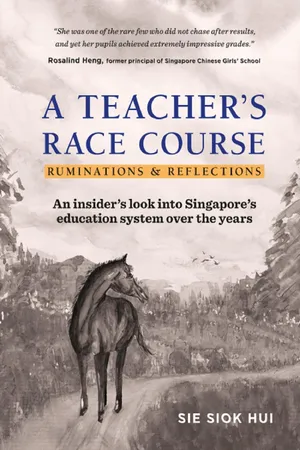
In a frank contemplation as she nears the end of her shortened course of life, educator Sie Siok Hui reveals moments of epiphany while honing her craft and examines critical factors in the curriculum design process. With inimitable candour, she probes education issues and calls for compassionate awareness of the challenges Singapore students and teachers face.
This is a must-read not only for teachers, curriculum designers and educational leaders, but also anyone who wishes to catch a glimpse of the heart and mind of an educator who was intentional in the choice of institutions to teach in because she always wanted to know more.
Contents:
Voices of Meandering:
Of Values and Valuation
A Learning Race Course: Learning and Teaching
Teaching and Learning: Cognitive Development and Learner Awareness
Affective Development
Defining the Race Course:
The Road Less Travelled — My Teaching Pathway
Teachers as Curriculum Designers: Building the Support System
Teachers as Curriculum Designers: What Lies Within
Reflections
Epilogue
Readership: Teachers, curriculum designers, educational leaders, parents and anyone interested in a Singaporean educator's teaching journey. Curriculum;Education;Teachers;Learning;Support System;Students00
To add value to others, one must first value others.
John C. Maxwell
CHAPTER 1
OF VALUES AND VALUATION
The tradition of returning to our alma mater to visit the school and teachers is still prevalent, I am sure, in most schools—albeit due to security reasons and the wish not to interrupt lessons—it is probably confined to special days like Teachers’ Day or festive occasions. We hardly ask ourselves why we do so; it is probably mostly due to nostalgia, a part of ourselves in our childhood and teenage years being inextricably bound to the school, or a sense of belonging. It has to be the good vibes…yet behind all that, my view is that the invisible hand here is values—a sense of not only what is good, but also what is appreciated. The way that this is expressed need not necessarily be confined to physical visits to the school or teachers. In the present age, with the ubiquitous use of social media and other means to maintain links with ease, students are no longer limited to mere cards and letters. The values they have assimilated can be displayed through the bonds built through the years such as inviting their teachers to their weddings, bringing their children to school to introduce the little ones to their mummy’s or daddy’s teacher or even extending their relationships beyond that of teacher-student relationships to personal friendships.
She did not ask more than I was willing to share and merely listened to me. Yet, she seemed to completely understand what I was going through.
I ask myself how these values may be measured or weighed; when a school is evaluated, the values which have been assimilated by its students are not part of the evaluation process. There is a tendency to value visible outcomes like students’ academic results because these can be accredited and honoured as a tangible form of evaluation. We likewise habitually evaluate students based on visible outcomes, be it academic or co-curricular activities, or success in competitions, for the same reasons. Yet, as educators, how do we weigh the worth of a student? Or, to consider it another way, how do we define a valuation of any student? Although I have always felt that there is a lot more to the word “valuation” than just “evaluation”, it was only in recent years that I have been able to crystallise my thoughts. Let me illustrate this anecdotally.
ANECDOTE 1
When I was in Primary Six, groups of ex-students interrupted our lessons when they visited my teachers. They were almost always laughing and telling the teachers of their new secondary school experiences. At that time, I looked forward to graduating from primary school so that I could visit my teachers in a similar fashion. I admit now, what was uppermost in my mind, was probably a sense of self-importance, that I was “grown-up”. I could have made similar group visits after I left my primary school, though I have no recollection of them. In any case, access to school was never an issue, since it was only a short walk across a road and it was also within a church compound and therefore open even on weekends.
But I definitely recall one particular visit to an exceptional teacher, Miss Daisy Wee. During that visit to Miss Wee, I confided that I had difficulty adjusting to my new secondary school environment and felt bewildered. She did not ask more than I was willing to share and merely listened to me. Yet, she seemed to completely understand what I was going through and perceptively identified the source of my anxieties, tracing it to the difficulties I had had at home from young. This helped me very much to understand myself. To this day, I remember her words and my gratitude towards her for her empathy. In that short time with her after I graduated from primary school, she had done what she regarded as only her duty as a teacher. Unbeknownst to her however, her kindness and perception had helped a very sensitive maladjusted child see hope in her little sad world. This teacher touched my life profoundly.
It took me 30 years or so before I understood why she meant so much to me. It is always easy to say, “She is nice, caring, etc.” There always were nice teachers; but not all nice teachers left an impact. She was probably the only teacher who valued me or made me feel I was valued, and the one teacher who made the deepest impact in my life. I was not exactly a well-liked student, not being the typical
(obedient) student, despite being recognised as intelligent. While all the other teachers mercilessly labelled me as a “talkative” girl throughout my primary school years and consistently wrote this in my report book as the only remark they could make on my performance as a student, she looked past all the complaints and made me a prefect, gave me the chance to be part of the level Chinese dance and entrusted me with other responsibilities. Hers was the best year I had in primary school life and the only year without any negative adjectives in my report book. I made it a point as a teacher never to commit a similar offence against any child!
ANECDOTE 2
When it was my turn to be an educator, I had my fair share of visits from past students. Even though the visits came at the expense of time with my present students, I liked to find out how and what my graduated students were doing. In 1990, some of the students from the previous year came to visit me. They were from a very weak class who had only been allowed to do a seven-subject combination: Elementary Mathematics, Human and Social Biology (which was not considered a Science subject), Art, Religious Studies, the two languages and Geography. I never liked the subject combination as it left the students with very few options after secondary school. Some of the subjects were easier to score in but had little value to the students after graduation. The class had had a number of disciplinary issues but they were not bad at all. Thankfully, they all passed my subject, Elementary Maths, fairly well. During that visit, I remember asking how a particular student was doing, and why she was not with them. One of her classmates mentioned that she was working. She had said she was not doing well anyway, and therefore did not see any point in returning to see her teachers. That hit me very hard. I have never forgotten that moment, even to this day some 29 years later. I will never forget the disappointment and sadness I had felt.
I want to see my kids because they had been my kids.
I want to see my students do well. But this is not the reason I want to see them. I want to see my kids because they had been my kids. I value every one of them, whether they achieved straight “A”s or they failed. It does not matter. Each of them is a human being, a person worthy of value. Thereafter, I remember telling every batch of students that I wanted them to return to visit me. I wanted to know how each of them was getting on, regardless of their results or what they were doing. I emphasised that they mattered to me. I hope that this point had hit home for at least some of them.
I had therefore felt the disappointment keenly because I felt the reasons given by that student who had not visited me stems from society’s general definition of success and that I had failed her in not assuring her of her worth as a person. By always emphasising good results, I had inadvertently reinforced society’s message myself, though I definitely value each child. I definitely cared for this child and her welfare and really wanted to know how she was doing. But I realised, with dismay, that I had not given this as much emphasis as I ought while she had been in school. I always reflect on this with regret and so from then on, consciously made the effort to reassure struggling students that they mattered more than the results. To this day, I remember this child who had taught me this precious lesson on valuation.
It is part of our culture to praise students who have attained many distinctions. But among those who had fallen short of the mark, did they all put in less effort than those who had scored well? How often success obfuscates effort! A student whose parent is a surgeon shared that her father had felt that the hardest thing to him was to face the patient’s family’s looks of distress and grief when a surgery did not go well. Does a surgeon put in less effort in a surgery that went awry? Very seldom do we validate effort over outcome. I do not dispute that the outcome is almost always a determining factor of “success”; however, “success” is a word I mentally discard because when assessing for “success”, the idea of valuation is not part of the definition. To me, a person’s worth and efforts are to be far more valued than what “success” could possibly represent.
As teachers, every child is to be valued. Every. Child. Valued.
To me, “valuation” is to see the value of every child, to love the person as he is. As teachers, every child is to be valued. Every. Child. Valued.
ANECDOTE 3
During my adjunct teaching in a neighbourhood school in 2005–2006, I experienced a poignant encounter. I had returned to the school to see how the students had fared when the “O” level results had been released. Generally, most of them had done fairly well, especially in Maths. There would always be casualties, though thankfully, there were not many that year. Most of the students were happy and excitedly planning the next phase in life and they came forward to thank the teachers. Towards the later part of the afternoon I was walking along the corridor on my way out of the school, when I met a student leader from a uniformed group who had been waiting for me. He came up to me saying, “I’m so sorry, I should have listened to you.” The moment that he apologised, I felt very much for him. This encounter had greater impact on me than all the thanks I had received from the students who had done well. To this day, this personal confession that afternoon is the only thing I remember. While I was happy for all the students who had done well, I hold dear such students who showed personal growth during my time with them. I especially cherish this boy’s apology for not realising his potential for the fact that he had waited outside the school just to express that to me. From before, I had told him I believed in him and his ability but that hard work and discipline was indispensable and could overcome weaknesses. After his apology, I had encouraged him to continue to pursue his dreams, told him that he had leadership potential as seen in his uniformed group achievements and that he could go very far in this field. I should have established a point of contact before we parted. Regrettably, I had not.
When we praise certain people for their achievements, is there not an implication that those without achievements are somewhat lacking?
Our focus is too often on the results or the achievements. When we praise certain people for their achievements, is there not an implication that those without achievements are somewhat lacking? Do not wait until a child “fails” before telling him that you love him even if he does not reach those end goals. Unconditional love should be expressed all the time. I hope every teacher (and parent) realises the innate value of each child and that his journey is more important than the destination.
Education is about values. I never felt I belaboured that point with all my kids sufficiently. But so long as one child remembers, being an educator (not a teacher) has not been in vain.
ANECDOTE 4
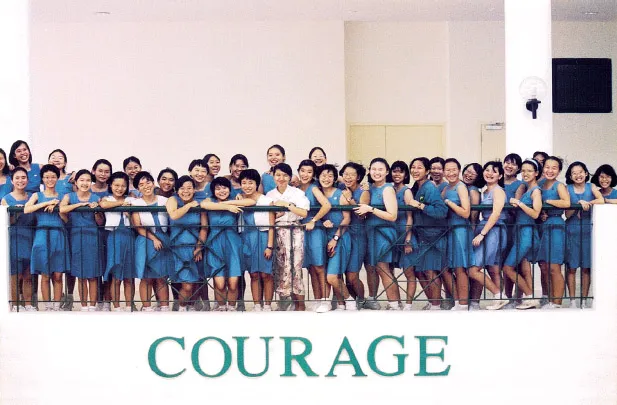
Twenty-four years ago, in 1994, one of my graduating classes had to decide where to pose for the informal class photograph. The school’s motto, “Sincerity, Courage, Generosity, Service”, stood out boldly on each of the four walls in the concourse. Though it was over 20 years ago, I distinctly recall saying, “Let’s take our class photo with the word ‘Courage’, for in life’s journey, you will need a lot of courage.”
Twenty years later, in 2014, I heard this exact story recounted by one of my former students, Chiyin, in her acceptance speech for an award conferred on her. I cannot describe that swell of emotion when I realised how a fleeting moment 20 years back had left a small but definite mark on the life of a young lady who is an internationally acclaimed photographer today. More importantly, she is a young lady who has been beating a pathway through unknown territory to be a voice for the unheard, to tell the story of those who cannot do so themselves. The Guest of Honour had commented to me: “You must be very proud of her.” I had paused momentarily. I could not honestly agree with that statement. After some thought, I replied that I was proud of Chiyin for who she was, not because of the award.
“Let’s take our class photo with the word ‘Courage’, for in life’s journey, you will need a lot of courage.”
Anyone who knows me well would know I avoid social functions, especially those with some degree of aggrandisement. I only attended Chiyin’s award ceremony because she had said it would mean a lot to her. It was for her sake, for her as the person I had known 20 years ago and whose journey I had kept up with from afar. That she had gained international recognition is not the point. I value Chiyin as a person, just as any of my students deserve to be valued. I had respected her from the day she started fighting for the rights of migrant workers as a journalist, long before she started winning awards. I respect her still for choosing to dedicate her life and her gifts to the service of humanity, not without cost to herself.
She remembered values. This is the essence of education.
After that suggestion from the Guest of Honour, I reflected on what makes me proud of my kids. I know I was very proud to be at all the recitals put up by my kids through the years. I know I was very proud to attend the art exhibitions that displayed their works. I know they poured their hearts and lives into their work. I know I was very proud to attend the passing out parade of the boys because they had completed a milestone in their lives and were transitioning into adulthood. I know I have always been very proud of my kids who contact me and tell me of how they are doing, especially those who had shown resilience in overcoming obstacles. I know I am happy when I read internet posts of kids reflecting and growing in depth of thought and character. It is these personal moments and not the moments of glory in achieving “success” as defined by society. That is merely peripheral.
Despite agreeing to be in attendance at Chiyin’s moment of success, I had actually regretted my decision upon reaching the award ceremony venue. The need to be “sociable” never sits well with me. However, her speech had made all the difference to my life as an educator. It was not because of the gratitude she expressed toward me but because she had defined what I truly believe about education. She remembered values. This is the essence of education. She had remembered the motto of her school and her meaningful journey in education in those years that had been the source of her care and concern for humanity. My own primary school had also taught me well. I will never forget the school motto—“Simple in Virtue, Steadfast in Duty” and the words “nobles...
Table of contents
Cover
Curriculum
Title
Copyright
Foreword
Editor’s Note
Prologue
Contents
Part I Voices Of Meandering
Part II Defining The Race Course
Epilogue I shall not live in vain.
Development Of The Book
About Sie Siok Hui
Trusted by 375,005 students
Access to over 1.5 million titles for a fair monthly price.
Study more efficiently using our study tools.
Frequently asked questions
Yes, you can cancel anytime from the Subscription tab in your account settings on the Perlego website. Your subscription will stay active until the end of your current billing period. Learn how to cancel your subscription
No, books cannot be downloaded as external files, such as PDFs, for use outside of Perlego. However, you can download books within the Perlego app for offline reading on mobile or tablet. Learn how to download books offline
Perlego offers two plans: Essential and Complete
Essential is ideal for learners and professionals who enjoy exploring a wide range of subjects. Access the Essential Library with 800,000+ trusted titles and best-sellers across business, personal growth, and the humanities. Includes unlimited reading time and Standard Read Aloud voice.
Complete: Perfect for advanced learners and researchers needing full, unrestricted access. Unlock 1.5M+ books across hundreds of subjects, including academic and specialized titles. The Complete Plan also includes advanced features like Premium Read Aloud and Research Assistant.
Both plans are available with monthly, semester, or annual billing cycles.
We are an online textbook subscription service, where you can get access to an entire online library for less than the price of a single book per month. With over 1.5 million books across 990+ topics, we’ve got you covered! Learn about our mission
Look out for the read-aloud symbol on your next book to see if you can listen to it. The read-aloud tool reads text aloud for you, highlighting the text as it is being read. You can pause it, speed it up and slow it down. Learn more about Read Aloud
Yes! You can use the Perlego app on both iOS and Android devices to read anytime, anywhere — even offline. Perfect for commutes or when you’re on the go. Please note we cannot support devices running on iOS 13 and Android 7 or earlier. Learn more about using the app
Yes, you can access A Teacher's Race Course by Siok Hui Sie in PDF and/or ePUB format, as well as other popular books in Éducation & Biographies d'éducation. We have over 1.5 million books available in our catalogue for you to explore.