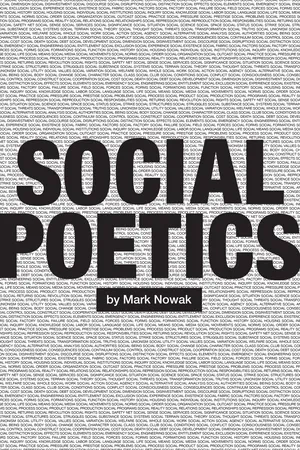
A people’s history of the poetry workshop from a poet and labor activist heralded by Adrienne Rich for “regenerating the rich tradition of working-class literature.”
Social Poetics documents the imaginative militancy and emergent solidarities of a new, insurgent working class poetry community rising up across the globe. Part autobiography, part literary criticism, part Marxist theory, Social Poetics presents a people’s history of the poetry workshop from the founding director of the Worker Writers School. Nowak illustrates not just what poetry means, but what it does to and for people outside traditional literary spaces, from taxi drivers to street vendors, and other workers of the world.
eBook - ePub
Social Poetics
About this book
Information
Notes
Chapter 00. Social Poetics (An Introduction)
1. Langston Hughes, “My Adventures as a Social Poet,” Phylon 8, no. 3 (Third Quarter, 1947), 205.
2. For more on Langston Hughes’s interactions with various leftist organizations of the time, see, for example, James Smethurst, The New Red Negro: The Literary Left and African American Poetry, 1930–1946 (New York: Oxford University Press, 1999), and William Maxwell, New Negro, Old Left: African-American Writing and Communism Between the Wars (New York: Columbia University Press, 1999). For Hughes’s experiences in the former Soviet republics, see Zohra Saed, ed., Langston Hughes: Poems, Photos & Notebooks from Turkestan (New York: Lost & Found [CUNY], 2015). In his final notebook entry, documented in Saed’s volume, Hughes writes on the social(ist) transformations he witnessed in his travels across central Asia: “A present of trial and error, to be sure, good things done and bad things—but what a social change. The land belonging to the poor people, and the palaces belonging to the poor people, and the earth and the whole Soviet sky belonging to the poor people—poor people no longer because they own the world. Of course, if you do not care about poor people, you do not care about these changes” (Saed, 39).
3. Michael Denning, The Cultural Front: The Laboring of American Culture in the Twentieth Century (London: Verso, 1997), xvi.
4. Meridel Le Sueur, Worker Writers (Minneapolis: West End Press, 1982 [1939]), unpaginated.
5. Amiri Baraka, Home: Social Essays (New York: William Morrow, 1966), 167.
6. Baraka, Home, 170.
7. Steve Chawkins, “Amiri Baraka Dies at 79; Provocative Poet Lauded, Chided for Social Passion,” Los Angeles Times, January 9, 2014, http://www.latimes.com/local/obituaries/la-me-amiri-baraka-20140110-story.html.
8. I’ll discuss Ngũgĩ’s prison diary and the play that landed him in prison in more detail in chapter 02.
9. Ngũgĩ wa Thiong’o, Writers in Politics: Essays (London: Heinemann, 1981), xii.
10. Ngũgĩ wa Thiong’o, Barrel of a Pen: Resistance to Repression in Neo-Colonial Kenya (Trenton, NJ: Africa World Press, 1983), 30.
11. Ngũgĩ, Barrel, 41, 44.
12. Ngũgĩ, Barrel, 51.
13. Ngũgĩ, Barrel, 59.
14. Ngũgĩ, Barrel, 65.
15. Ngũgĩ wa Thiong’o, Decolonising the Mind: The Politics of Language in African Literature (Oxford: James Currey, 1981), 3.
16. Ngũgĩ, Barrel, 69.
17. C. L. R. James and Grace C. Lee [Boggs], with Cornelius Castoriadis, Facing Reality (Detroit: Bewick Editions, 1974 [1958]), 5.
18. See, for example, Raúl Salinas, Raúl Salinas and the Jail Machine: My Weapon Is My Pen (Austin: University of Texas Press, 2006).
19. Nikky Finney, “Personal Is Political: Toni Cade Bambara of Simpson Avenue,” The Feminist Wire, November 21, 2014, http://www.thefeministwire.com/2014/11/writing-and-storytelling.
20. See, for example, Tom Woodin, “‘More Writing than Welding’: Learning in Worker Writer Groups,” History of Education 34, no. 5 (2006), 561–78. Also, see Tom Woodin, Working-Class Writing and Publishing in the Late Twentieth Century (Manchester: Manchester University Press, 2018).
21. See, for example, Ryan Wong, “A Brief History of the Art Collectives of NYC’s Chinatown,” Hyperallergic, February 7, 2017, https://hyperallergic.com/330442/a-brief-history-of-the-art-collectives-of-nycs-chinatown.
22. See, for example, Miguel Algarín and Miguel Piñero, eds., Nuyorican Poetry: An Anthology of Puerto Rican Words and Feelings (New York: Morrow, 1975); Miguel Algarín and Bob Holman, Aloud: Voices from the Nuyorican Poets Cafe (New York: Holt, 1994); and Urayoán Noel, In Visible Movement: Nuyorican Poetry from the Sixties to Slam (Iowa City: University of Iowa Press, 2014).
23. Silvia Federici, Revolution at Point Zero: Housework, Reproduction, and Feminist Struggle (Oakland: PM Press, 2012), 29.
24. See, for example, Angela Davis, Women, Race and Class (New York: Vintage Books, 1983); Lise Vogel, Marxism and the Oppression of Women: Toward a Unitary Theory (Chicago: Haymarket Books, 2013 [1983]); and many others.
25. Susan Ferguson, “Capitalist Childhood, Anti-Capitalist Children: The Social Reproduction of Childhood,” unpublished paper cited by Tithi Bhattacharya in her introduction to Social Reproduction Theory: Remapping Class, Recentering Oppression, ed. Tithi Bhattacharya (London: Pluto Press, 2017), 2.
26. Nancy Fraser, “Crisis of Care? On the Social-Reproductive Contradictions of Contemporary Capitalism,” in Social Reproduction Theory, ed. Tithi Bhattacharya, 35.
27. M. M. Bakhtin, “From Notes Made in 1970–71,” in Speech Genres and Other Late Essays, trans. Vern M. McGee (Austin: University of Texas Press, 1986), 155.
28. Boaventura de Sousa Santos, “The World Social Forum and the Global Left,” Politics & Society 36, no. 2 (June 2008): 257.
Chapter 01. A People’s History of the Poetry Workshop: Watts, New York City, Attica
1. E. P. Thompson, “History from Below,” Times Literary Supplement, April 7, 1966, 269–80. This quote originally appeared in Thompson’s preface to his monumental study The Making of the English Working Class (New York: Vintage Books, 1966 [1963]). The “poor stockinger” quote appears on page 12 in Thompson’s book.
2. Howard Zinn, A People’s History of the United States (New York: ...
Table of contents
- Cover
- Title Page
- Copyright
- Contents
- 00. Social Poetics (An Introduction)
- 01. A People’s History of the Poetry Workshop: Watts, New York City, Attica
- 02. People’s Workshops: Kenya, Nicaragua, South Africa
- 03. New Conjunctions
- 04. Imaginative Militancy
- 05. Transnational Poetry Dialogues
- 06. First-Person Plural
- 07. Consonance
- 08. Emergent Solidarities
- Acknowledgments
- Notes
- Permissions
- Index
- Funder Acknowledgments
- The Publisher’s Circle of Coffee House Press
Trusted by 375,005 students
Access to over 1.5 million titles for a fair monthly price.
Study more efficiently using our study tools.
Frequently asked questions
Yes, you can cancel anytime from the Subscription tab in your account settings on the Perlego website. Your subscription will stay active until the end of your current billing period. Learn how to cancel your subscription
No, books cannot be downloaded as external files, such as PDFs, for use outside of Perlego. However, you can download books within the Perlego app for offline reading on mobile or tablet. Learn how to download books offline
Perlego offers two plans: Essential and Complete
- Essential is ideal for learners and professionals who enjoy exploring a wide range of subjects. Access the Essential Library with 800,000+ trusted titles and best-sellers across business, personal growth, and the humanities. Includes unlimited reading time and Standard Read Aloud voice.
- Complete: Perfect for advanced learners and researchers needing full, unrestricted access. Unlock 1.5M+ books across hundreds of subjects, including academic and specialized titles. The Complete Plan also includes advanced features like Premium Read Aloud and Research Assistant.
We are an online textbook subscription service, where you can get access to an entire online library for less than the price of a single book per month. With over 1.5 million books across 990+ topics, we’ve got you covered! Learn about our mission
Look out for the read-aloud symbol on your next book to see if you can listen to it. The read-aloud tool reads text aloud for you, highlighting the text as it is being read. You can pause it, speed it up and slow it down. Learn more about Read Aloud
Yes! You can use the Perlego app on both iOS and Android devices to read anytime, anywhere — even offline. Perfect for commutes or when you’re on the go.
Please note we cannot support devices running on iOS 13 and Android 7 or earlier. Learn more about using the app
Please note we cannot support devices running on iOS 13 and Android 7 or earlier. Learn more about using the app
Yes, you can access Social Poetics by Mark Nowak in PDF and/or ePUB format, as well as other popular books in Literature & Literary Criticism in Poetry. We have over 1.5 million books available in our catalogue for you to explore.