'A grisly, sobering, comprehensively researched new history.' -
The New Yorker
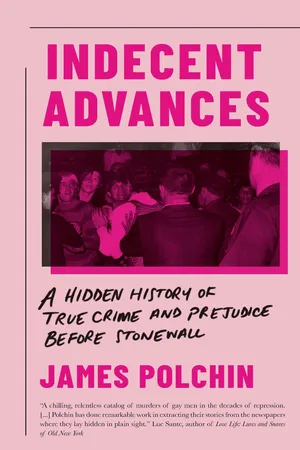
Indecent Advances is a skilful hybrid of true crime and social history that examines the often-coded portrayal of crimes against gay men in the decades before Stonewall.
New York University professor and critic James Polchin illustrates how homosexuals were criminalized, and their murders justified, in the popular imagination from 1930s 'sex panics' to Cold War fear of Communists and homosexuals in government. He shows the vital that role crime stories played in ideas of normalcy and deviancy, and how those stories became tools to discriminate against and harm gay men.
J. Edgar Hoover, Kerouac, Burroughs, Patricia Highsmith, James Baldwin, Allen Ginsberg and Gore Vidal all feature.
Published around the fiftieth anniversary of the Stonewall uprising in 1969,
Indecent Advances investigates how queer men navigated a society that criminalized them. Polchin shows how this discrimination was ultimately transformed by gay rights activists before Stonewall, and explores its resonances up to and including the policing of Gianni Versace's death in 1997.
eBook - ePub
Indecent Advances
A Hidden History of True Crime and Prejudice Before Stonewall
- 256 pages
- English
- ePUB (mobile friendly)
- Available on iOS & Android
eBook - ePub
About this book
Information
Topic
SozialwissenschaftenSubtopic
LGBT-Studien1
When the Men Came Home
Sailors, Scandals, and Mysteries in the 1920s
“MURDERED IN HOTEL ROOM”
On November 4, 1920, the front page of the New York Daily News announced in large block letters a disturbing milestone in the city: the one hundredth murder of the year. The accompanying article detailed the fatal beating of Leeds Vaughn Waters in a room at the Plymouth Hotel on West Thirty-Eighth Street. The tabloid reported that police had found Waters slumped on the floor with “a fractured jaw and skull and a deep wound over his left eye, which was apparently inflicted by a blunt instrument.” Waters was the scion of a wealthy New England family who had made its fortune in piano manufacturing. Since his graduation from Columbia College in 1896, he had lived much of his life in London, England. The Daily News described the forty-eight-year-old victim’s life as “a series of kaleidoscopic glimpses of social activities in North and South America, in England, and on the continent.”
As there was no apparent robbery, New York City detectives were baffled by the motive for the crime. The editors, however, speculated about the murder by casting doubts on the character of the victim himself. “According to friends,” the newspaper reported, Waters “has never been engaged in industry and has never been known to exert himself to labor,” adding “riches and idleness are shown as powerful influences toward his tragic end.” The term “idleness” was often used in the press in the 1920s to hint at moral and criminal duplicities. “How he was lured from his usual haunts along the rosy path of luxury,” the newspaper asked, “to hostelry of the character of that in which he was slain is a point of mystery which no one has been able to solve.”1
In the coming days, newspapers in New York and across the country would pursue this question, with articles that detailed the last hours of Waters’s life. Readers learned he spent the evening at the Delta Kappa Epsilon Club, a thirteen-story, private gentlemen’s club on East Forty-Fourth Street, where he had been a member since his college days. News accounts referring to Waters as a “clubman” signaled his social standing. Inside the brick and stone building, DKE men enjoyed a gymnasium with squash courts, a mahogany-paneled taproom, a rooftop café, and five floors of guest rooms. Waters spent most of the evening playing cards, indulging his love of gambling. Around one in the morning he told his friends he was leaving to return to Bronxville, a suburb north of the city where he was staying with his mother at her hotel.
Instead of going north, however, Waters instructed the taxi driver to take him a few blocks west to Times Square, where, as The New York Times conjectured, he met a “swarthy,” “dark-skinned man, who was believed to be the one who shared the hotel room.” In 1920, Times Square still had the reputation of a genteel theater district, though queer encounters were common in the area. Its seedier nightlife would emerge in the 1930s during the Great Depression. A few blocks west of Times Square was the more notorious Tenderloin neighborhood, known for its overcrowded tenements, crime, and vice. The Tenderloin was also known for its queer men, particularly in the West Forties and Fifties, many of whom worked in the theaters. It was in the Tenderloin, at Ninth Avenue and Forty-Fourth Street, that Waters and his companion allegedly dined at a restaurant in the early morning hours. Witnesses reported that Waters bought a meal for his companion and an apple for himself.2
Eventually they arrived at the Plymouth Hotel at six in the morning as the yellow light of dawn filled the sky. John Carney, the night clerk at the Plymouth Hotel, would tell police that the two men made a strange sight as they entered the lobby. While Waters was “expensively dressed,” his companion “wore shabby clothes and seemed to be of a much inferior social standing.” In a front-page article headlined “Murdered in Hotel Room,” the New York Tribune, never shy in promoting a good crime or a good scandal, gave readers a more detailed image of the contrast between the two men. While Waters wore a “light overcoat, a fashionably cut blue suit, patent leather shoes, and carried a silver-headed walking stick,” his companion “wore a cheap cap which he kept well pulled down over his eyes.”3
At the front desk, both men registered under aliases. Waters claimed to be J. Talbot from Milwaukee, Wisconsin. His companion signed his name James Dunn, also from Milwaukee. Carney assigned the men to room 805 on the top floor of the hotel with a view of West Thirty-Eighth Street. They didn’t need the service of a bellhop because neither man had luggage. But at the Plymouth Hotel, this was not unusual.
Within an hour, guests in an adjoining room called the front desk to complain about the shouting and loud noises coming from room 805. Carney and a bellhop took the elevator to investigate. When Carney knocked on the door, Waters’s companion opened it with a sudden rush and Carney asked if everything was all right. As one account described it, both men were then “bowled over by a man who dashed out and disappeared down the stairway.” Carney and the bellhop ran after him down eight flights of stairs and out the side entrance, chasing him eastward toward Seventh Avenue, where the assailant disappeared amid the early morning crowds.4
A doctor arrived minutes before the police and declared Waters dead. From letters and personal items found in the room, detectives learned his real identity. “Robbery was not the motive for the crime,” the New York Daily News declared, “as money and jewelry including a massive gold ring” were found in the room. The newspaper also noted that a friend of Waters claimed that he “knew of no acquaintance of Waters by the name of Dunn.”5
Lacking a clear motive, the mystery of Waters’s murder hinged precisely on the relationship between the two men. The press offered up a number of clues and speculations about why a shabbily dressed man and his well-dressed, wealthy friend ended up in room 805 at the Plymouth Hotel that day. “Silk Underwear Clew to Slayer” ran a front-page headline in The Washington Post, which related that a pair of underwear with the initials “W. H. A.” were traced “to a laundry in Fifty-ninth street, where it was recently cleaned.”6 Such a detail pointed to the fact that the companion must have been naked at some point in the early morning hours. “There are mysteries all around the crime,” the St. Louis Post-Dispatch declared, hinting at the sexual subtexts of the encounter. “The act,” the article concluded, “was clearly the work of a person with an abnormal mind.”7
But as news accounts made clear, it was not only the killer who had an “abnormal mind.” The victim’s own normality was also put into doubt. Reporters had learned that Waters had been secretly married over twenty years earlier to a woman named Baroness Blanc. Born Elizabeth Nicholson in Philadelphia, Baroness Blanc was, by one account, a “woman who streaks across society once in a generation.” The press described her as charming and beautiful, an actress who had performed on stage in opera and vaudeville. In the late nineteenth century she had entertained in “unconventional sections of metropolitan society,” as one article noted, adding that she moved between bohemian circles and European royalty with ease. She also had a succession of failed marriages that began at the age of sixteen. Her second marriage, which conveyed with it the unofficial title of baroness—a title that most news reports placed in quotation marks—lasted only as long as the honeymoon in Europe. Her third marriage, to Waters, nearly a decade her junior, would also end abruptly. The two had wed secretly in 1896, the year Waters graduated from college. A Philadelphia newspaper reported that the two had “lived together thirty-one days. Mrs. Waters then went to France, returning to this country later. She obtained a divorce in Chicago.”8 Waters’s mother, either forgetting or deliberately ignoring the Baroness Blanc, told police and reporters that her son had never been married and lived as a bachelor.
One interpretation of the crime the press offered up concerned Waters’s love of gambling. The wealthy cosmopolitan bachelor might have been “lured to the scene of his death by the promise of a game of chance,” noted the New York Daily News. The Washington Post described Waters as having “suffered from heavy gambling losses.”9 The assistant district attorney furthered this explanation in a convoluted statement to the press, where he claimed that the murder was most likely not premeditated. Rather, he suggested, Waters, “who is said to have been a gambler and who might have been in a habit of picking up strangers, took the man who registered under the name of ‘James Dunn’ to the Plymouth Hotel; that this man became infuriated when he discovered Waters only had the change from a ten dollar bill and the fight which ended in murder followed.” As the Daily News speculated, Waters’s killer surely inhabited a “morass of gambling, thieving, and murder, the haunts of sin and crime.” Such speculations hinged on the image of the assailant as a working-class thief and killer. One report declared detectives were working on the theory the killer was a “notorious character of the Tenderloin district,” adding that he most likely was one of a gang of “leeches” who worked the “White Light district and are known to prey on wealthy idlers.”10
Two weeks after Waters’s body was found in the Plymouth Hotel, another violent murder made headlines in the New York press when a forty-eight-year-old chauffeur named Frank Barbor was shot and killed in Central Park near the West Seventy-Second Street entrance. Barbor visited the park nightly because of his “poor health,” wrote the Daily News, and on the night of his murder, he had been walking along a pathway with a sailor from the USS Arizona named Charles Becker when three men with “caps pulled down over their faces” approached them and one asked Barbor for a match. According to the newspaper, as Becker offered a match, “the tallest of the three drew the revolver” and shot Barbor. Becker added that he didn’t see any of the three men physically strike Barbor—a deta...
Table of contents
- Cover
- Praise
- Title Page
- Dedication
- Contents
- Introduction: Criminalizing Queer Men
- 1: When the Men Came Home
- 2: War on the Sex Criminal
- 3: Behind the Headlines
- 4: Terror in the Streets
- 5: The Homosexual Next Door
- 6: Stories of Prejudice and Suffering
- Conclusion: Politics of Violence
- Acknowledgments
- Plates
- About the Author
- Copyright
Trusted by 375,005 students
Access to over 1.5 million titles for a fair monthly price.
Study more efficiently using our study tools.
Frequently asked questions
Yes, you can cancel anytime from the Subscription tab in your account settings on the Perlego website. Your subscription will stay active until the end of your current billing period. Learn how to cancel your subscription
No, books cannot be downloaded as external files, such as PDFs, for use outside of Perlego. However, you can download books within the Perlego app for offline reading on mobile or tablet. Learn how to download books offline
Perlego offers two plans: Essential and Complete
- Essential is ideal for learners and professionals who enjoy exploring a wide range of subjects. Access the Essential Library with 800,000+ trusted titles and best-sellers across business, personal growth, and the humanities. Includes unlimited reading time and Standard Read Aloud voice.
- Complete: Perfect for advanced learners and researchers needing full, unrestricted access. Unlock 1.5M+ books across hundreds of subjects, including academic and specialized titles. The Complete Plan also includes advanced features like Premium Read Aloud and Research Assistant.
We are an online textbook subscription service, where you can get access to an entire online library for less than the price of a single book per month. With over 1.5 million books across 990+ topics, we’ve got you covered! Learn about our mission
Look out for the read-aloud symbol on your next book to see if you can listen to it. The read-aloud tool reads text aloud for you, highlighting the text as it is being read. You can pause it, speed it up and slow it down. Learn more about Read Aloud
Yes! You can use the Perlego app on both iOS and Android devices to read anytime, anywhere — even offline. Perfect for commutes or when you’re on the go.
Please note we cannot support devices running on iOS 13 and Android 7 or earlier. Learn more about using the app
Please note we cannot support devices running on iOS 13 and Android 7 or earlier. Learn more about using the app
Yes, you can access Indecent Advances by James Polchin in PDF and/or ePUB format, as well as other popular books in Sozialwissenschaften & LGBT-Studien. We have over 1.5 million books available in our catalogue for you to explore.