'A history that makes perfect sense when the sky is falling down.' -
The Sunday Times
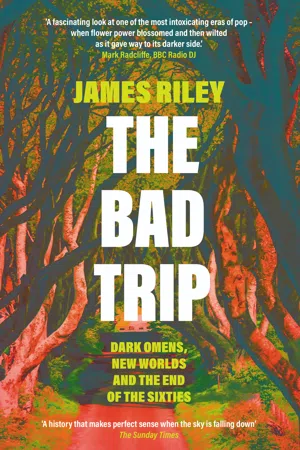
Beneath the psychedelic utopianism of the sixties lay a dark seam of apocalyptic thinking that seemed to rupture into violence and despair by 1969.
Literary and cultural historian James Riley descends into this underworld and traces the historical and conspiratorial threads connecting art, film, poetry, politics, murder and revolt. The Beatles and the Rolling Stones, the Manson Family and Roman Polanski, ley-line hunters and Illuminati believers, Aldous Huxley, Joan Didion and the Beat poets, radical protest movements and occult groups all come together in Riley's gripping narrative.
Steeped in the hopes, dreams and anxieties of the late 1960s and early '70s,
The Bad Trip tells the strange stories of some of the period's most compelling figures as they approached the end of an era and imagined new worlds ahead.
- 352 pages
- English
- ePUB (mobile friendly)
- Available on iOS & Android
eBook - ePub
About this book
Information
Topic
HistoireSubtopic
Histoire socialePART I
Demons Descending
CHAPTER I
The Devil’s Business
On 9 August 1969, the actress Sharon Tate hosted a small party at 10050 Cielo Drive, the Los Angeles home she shared with her film director husband, Roman Polanski. With Polanski working in London, Tate, who was eight and a half months pregnant, had gathered her friends and house guests for the weekend. Present on the night were the celebrity hairdresser Jay Sebring who was Tate’s long-term confidant and former boyfriend, Abigail Folger, heiress to the Folger Coffee Company, and her partner, the actor Wojciech Frykowski. Tate had met Polanski in 1966 and it was while working with him on The Fearless Vampire Killers (1967) that they became close. They had married in London in January 1968, just as Polanski was completing his second American feature: the Satanic horror movie Rosemary’s Baby (1968). Based on Ira Levin’s 1967 novel of the same name and featuring Mia Farrow as the young New Yorker Rosemary Woodhouse, the film charts her nightmarish pregnancy in the shadow of an occult conspiracy emanating from the city’s sinister Bramford Building. For the newly-wed Polanskis, life could not have been more different. The expected arrival of their baby was a source of great joy and, far away from the noise of New York, 10050 Cielo Drive had become Tate’s ‘love house’. Since moving in in February 1969, much effort had gone into preparing the nursery.
Cielo Drive is an affluent residential area on the west side of Los Angeles. A classic retreat for the wealthier members of the city’s entertainment industry, the drive has always been verdant, quiet and isolated. It’s also close enough to Beverly Hills to enjoy the area’s bustling social life. On the evening of the ninth, Tate and her friends had dined at El Coyote, a Mexican restaurant on Beverly Boulevard. Returning to the house, they spent the rest of night talking before retiring to bed. Everyone in the party would have drifted to sleep with every reason to feel safe in that house. In 1969 the villa at 10050 had the security that came with money and influence. It occupied a gated, three-acre site the entrance to which was at the peak of the drive, nestled into a cul-de-sac. Perfect for all the relaxed, celebrity gatherings the Polanskis had hosted since moving in. The perfect place, it seemed to Tate, to raise a child. Perfect, precisely because it was not the kind of place that you might wander by of an afternoon: you would only be there if you had a reason to be there. Which is why the night-time appearance of a carload of black-clad young people carrying ropes, knives, wire cutters and a gun should have caused concern. It should have, but it didn’t. The privacy of Benedict Canyon was also its downside. People mind their own business in the LA hills.
It was shortly after midnight when Frykowski woke to the sound of movement in his room. He found a tall man looming over him. This was Charles ‘Tex’ Watson and he had arrived at the party with his friends: Susan Atkins, Patricia Krenwinkel and Linda Kasabian. They were members of the Family, a commune-cum-cult held together by the con man, criminal and sometime musician, Charles Manson. ‘Who are you?’, asked Frykowski, confused and disorientated. ‘I’m the devil,’ replied Watson. ‘I’m here to do the devil’s business. Give me all your money.’1

Towards the climax of Rosemary’s Baby there’s a scene in which Rosemary – exhausted from an apparent miscarriage and months of psychological distress – begins to hear a baby crying through her bedroom wall. She realises it is coming from the neighbouring apartment, the home of Minnie and Roman Castevet, the weird old couple who had been supportive at the start of her pregnancy but whose behaviour in the latter, traumatic, days had become sinister and threatening. Rosemary follows the noise and finds a strange partition in the hallway closet: a door that joins the two apartments. Brandishing a knife Rosemary creeps through and comes upon a dark gathering. Her husband Guy, the Castevets and the rest of the coven that populate the Bramford attend the presence of a baby: her baby. To Rosemary’s horror it is put to her that the baby was born safely but Guy is not the father. The child has a more ominous parentage: he is the son of Satan, the devil born on Earth. It’s a terrifying reveal but there’s something about that partition door that carries a greater, more intimate horror and which goes some way to describing the horror that Frykowski must have felt when he encountered Watson. All the terrible things that have happened to Rosemary in the film have happened because of that door, because her private space has not been private. Finding the door confirms all of Rosemary’s worst fears: your house is not your own, your body is not your own, your child is not your own. The devil has dominion everywhere.
Unfortunately for Frykowski and the rest of Tate’s party, ‘the devil’s business’ was not merely an act of theft. Watson, Atkins and Krenwinkel heeded Manson’s order to ‘destroy the house and everyone in it’. They had already killed Steven Parent, a young man who had come to see William Garretson, the caretaker at Cielo Drive. Garretson had spent the summer living in a cottage on the property: tending the garden, looking after the dogs, smoking weed. Parent had hung out with Garretson that evening, and when he left after midnight he ran right into Watson. They faced each other on the driveway for a few seconds before Watson raised the gun he was holding and shot Parent four times. Garretson apparently heard none of this, nor did he hear the gunfire, screams and sounds of struggle that later came from the main house. Manson-lore has him listening to ‘The End’ (1967) by the Doors late into the night.2
Frykowski, Folger, Sebring and Tate were lined up in the living room. Frykowski had been bound in nylon rope. Watson told them all to get down on their stomachs. He was still asking for money at this point. Sebring made a lunge for him, received a gunshot to his side and was later beaten and stabbed to death. Meanwhile Tate, Folger and Frykowski were trussed with a rope that had been thrown over the ceiling beam, as if they were about to be hung. Frykowski struggled free and attacked Atkins before running for the front lawn to shout for help. He was stabbed and shot multiple times by both Atkins and Watson. Folger also got free and made for the back-porch door that led to the swimming pool but was killed by Krenwinkel. Multiple stab wounds. That left Tate who had witnessed the deaths of her three friends. She was stabbed sixteen times by Atkins, Watson and Krenwinkel. Watson then tied a joint noose around the necks of Tate and Sebring’s bodies while Atkins used some of Tate’s blood to smear ‘PIG’ on the wall.
The carnage at Cielo Drive was matched only by the deaths of Leno and Rosemary LaBianca the following night, 10 August. Manson decided to personally lead the death squad of Watson, Krenwinkel, and fellow Family member Leslie Van Houten. ‘Doing’ the Tate house had been far too disorganised, he thought. This time the proceedings would have some discipline. After setting out from their base of operations, the dilapidated Spahn Ranch on the Santa Susana Pass Road, they prowled the streets of central Los Angeles for an hour or two. Following Manson’s lead Watson drove to the wealthy district of Los Feliz, close to Griffith Park, finally alighting outside 3301 Waverly Drive, the LaBianca residence.
Dispensing with the inconvenience of unreliable firearms, Manson entered the house armed with a cutlass, as if leading a pirate raiding party. Sitting in his lounge, enjoying a beer in the early hours of Sunday morning, Leno looked up from his newspaper and found Manson – short, bearded and intense – looking at him, sword by his side. Leno looked at Manson, Manson stared back at Leno. Rosemary pottered in the bedroom. Another diabolical encounter, but this time there was no introduction, just a curt instruction from Manson: ‘Be calm, sit down and be quiet.’ Leno watched, in shock, as Manson went to the bedroom and retrieved Rosemary. She struggled and protested as Manson tied them together with long leather cords. ‘Everything will be okay. You won’t be hurt,’ he said to them both as he took Rosemary’s purse and walked back out the front door. A short time later, Watson and the others entered the house. They greeted the couple and quickly made it clear that this was not just a robbery.
The LaBiancas were separated, Leno remained in the front room, Rosemary was taken back to the bedroom. Using a carving knife taken from the kitchen, Watson killed Leno with multiple wounds to his chest and body. Rosemary, face down on the bedroom floor was killed next, stabbed by Krenwinkel and Van Houten. Leno’s corpse was then mutilated. Watson cut a large ‘X’ into his chest before adding ‘WAR’. Krenwinkel went at both bodies with a fork and then shoved it into Leno’s abdomen. Emblazoned, and with the fork still sticking out, Leno was hooded with a pillow case. Just as they had done with Tate, the murderers then began to write in the blood of their victims, scrawling ‘DEATH TO PIGS’, ‘RISE’ and, most enduringly, ‘HEALTER SKELTER’ (sic) around the living room and the kitchen.3
Savagery. It is difficult to describe the Tate–LaBianca killings in any other terms. They speak of the violent loss of loved ones and murder at its most senseless. That said, as unpalatable as it seems, there was a certain kind of logic informing the deaths, albeit an extremely twisted logic. The motive had little to do with theft, despite the small amounts taken from each scene. Manson knew the house at Cielo Drive and had something of a grudge against its former resident, the music producer Terry Melcher, but killing Tate and her friends had little to do with revenge.4 Instead, as was revealed during his protracted trial of 1970–71, the key was in the writing left behind. ‘HEALTER SKELTER’ was a reference to ‘Helter Skelter’, a Lennon and McCartney song from the ‘White Album’ which Manson had heard shortly after its release in November 1968.
‘Helter Skelter’ along with Lennon’s ‘Happiness is a Warm Gun’ and George Harrison’s ‘Piggies’ became touchstones for Manson and the Family. As he listened to the songs on a daily basis, Manson got a clear message of imminent societal breakdown. ‘Look out’, says ‘Helter Skelter’, things are ‘coming down fast’. Life’s ‘getting worse’, says ‘Piggies’, because the ‘bigger piggies’ in their ‘starched white shirts’ are ‘Stirring up the dirt’. They need ‘a damn good whacking’, the realisation of which would lead to the empowerment, satisfaction and ‘happiness’ of the ‘warm gun’. The aggression of these songs would have made it easy for someone like Manson to ‘receive’ an invitation to violence, and he came to believe that the Beatles were using their music to communicate with him directly. That said, Manson was neither a survivalist-in-waiting nor an earnest class warrior seeking a validation of his politics. Instead, the event he called and prepared for as ‘Helter Skelter’ was one part of a weirdly messianic personal narrative which far exceeded the themes and ideas dealt with on the ‘White Album’.5
Whether he really believed this pitch or not, the outline, as prosecutor Vincent Bugliosi discovered during Manson’s trial proceedings, went as follows. The modus operandi of the Family was to incite an apocalyptic race war between black and white America. They would do this by committing atrocious acts of murder in the homes of affluent white people, leaving suggestive evidence that the perpetrators were black. In the ensuing street battles and general chaos as decades of racial tension and mutual distrust came to the fore, the Manson Family would retreat to the desert of Death Valley in a convoy of high-powered dune buggies and descend into a secret subterranean world. There, in the imagined company of the Beatles themselves, the Family would sit out the destructive black revolution. They would remain hidden until the members of newly sovereign black nation inevitably faltered in their unfamiliar role as leaders. At which point Manson, his multiplied disciples and the Beatles would re-emerge from ‘the bottomless pit’ and assume their rightful place as rulers of the new dawn. This was ‘Helter Skelter’: the moment when the world as we, the squares and the straights, knew it would end and all that remained would come down to Manson as his rightful inheritance.6
The writer and journalist Joan Didion was living in Los Angeles at the time of the Tate–LaBianca murders. Her house on Franklin Avenue, in a once-opulent part of Hollywood, was large and roomy. She lived there with her husband and daughter; she played music there; held parties there and often hosted Sunday lunches that ran on into Monday. Rock bands lived across the street, Janis Joplin would drop by, and during the long weekend gatherings there was much talk of auras, zen and philosophy. The perfect sixties household: a space of togetherness, communality and free thinking. But for Didion this ...
Table of contents
- Cover
- Title Page
- Contents
- About the Author
- Prologue: Apotheosis
- PART I: DEMONS DESCENDING
- PART II: LUCIFER RISING
- Epilogue: Apotheosis No. 2
- Bibliography
- Acknowledgements
- Index
- Copyright
Trusted by 375,005 students
Access to over 1.5 million titles for a fair monthly price.
Study more efficiently using our study tools.
Frequently asked questions
Yes, you can cancel anytime from the Subscription tab in your account settings on the Perlego website. Your subscription will stay active until the end of your current billing period. Learn how to cancel your subscription
No, books cannot be downloaded as external files, such as PDFs, for use outside of Perlego. However, you can download books within the Perlego app for offline reading on mobile or tablet. Learn how to download books offline
Perlego offers two plans: Essential and Complete
- Essential is ideal for learners and professionals who enjoy exploring a wide range of subjects. Access the Essential Library with 800,000+ trusted titles and best-sellers across business, personal growth, and the humanities. Includes unlimited reading time and Standard Read Aloud voice.
- Complete: Perfect for advanced learners and researchers needing full, unrestricted access. Unlock 1.5M+ books across hundreds of subjects, including academic and specialized titles. The Complete Plan also includes advanced features like Premium Read Aloud and Research Assistant.
We are an online textbook subscription service, where you can get access to an entire online library for less than the price of a single book per month. With over 1.5 million books across 990+ topics, we’ve got you covered! Learn about our mission
Look out for the read-aloud symbol on your next book to see if you can listen to it. The read-aloud tool reads text aloud for you, highlighting the text as it is being read. You can pause it, speed it up and slow it down. Learn more about Read Aloud
Yes! You can use the Perlego app on both iOS and Android devices to read anytime, anywhere — even offline. Perfect for commutes or when you’re on the go.
Please note we cannot support devices running on iOS 13 and Android 7 or earlier. Learn more about using the app
Please note we cannot support devices running on iOS 13 and Android 7 or earlier. Learn more about using the app
Yes, you can access The Bad Trip by James Riley in PDF and/or ePUB format, as well as other popular books in Histoire & Histoire sociale. We have over 1.5 million books available in our catalogue for you to explore.