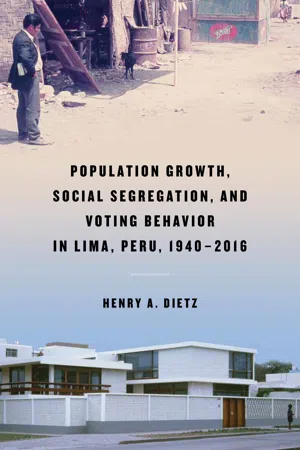
eBook - ePub
Population Growth, Social Segregation, and Voting Behavior in Lima, Peru, 1940–2016
- 228 pages
- English
- ePUB (mobile friendly)
- Available on iOS & Android
eBook - ePub
Population Growth, Social Segregation, and Voting Behavior in Lima, Peru, 1940–2016
About this book
As one of South America's larger capital cities, Lima, Peru, is remarkably understudied as a demographic and economic entity unto itself. In this important book, Henry Dietz presents an in-depth historical, sociological, and political analysis of a major Latin American city in the post–World War II period. Dietz examines electoral data for Lima's districts from six censuses conducted between 1940 and 2007, framed against a backdrop of extensive demographic data for the city, to trace the impact of economic collapse and extended insurgency on Lima and its voters. Urbanization in Lima since World War II has at times been rapid, violent, and traumatic, and has resulted in marked social inequalities. Dietz looks at how equity across the city has not in general improved; Lima is today segregated both spatially and socially. Dietz asks if and how a high degree of segregation manifests itself politically as well as socially and spatially. Do urban dwellers living under profound and enduring social segregation consistently support different parties and candidates? As institutional political parties have faded since the 1990s and have been replaced by personalist movements, candidacies, and governments, Dietz explores how voters of different social classes behave. The result is a vital resource for researchers seeking well-contextualized information on elections and economics in Peru. This book will be of interest to scholars of politics or economics, especially in Latin America, but also to a much wider audience interested in how the developments in Lima, Peru, affect the global sociopolitical climate.
Information
Topic
HistoriaINDEX
Page numbers followed by t indicate tables. Page numbers in italics indicate illustrations.
Acción Popular (AP, Popular Action), 9, 49, 62, 69–70, 88, 153, 167–70, 181
AP/DC coalition, 65–68, 66t, 170
support for, 103–11, 127–32, 147–50, 153, 170–73, 177
administration labor, 18
adobe construction, 58, 121–22, 143, 160–61
Age of the Oligarchy/Aristocracy (República aristocrática), 10, 12–13, 16
agriculture, 15, 18, 22, 37, 55–56, 159–60
alanistas (supporters of Alan García), 190n1
Alarcón, Daniel, 87
Alianza 2000, 127–28
Alianza Popular (APRA/PPC coalition), 153–54
Alianza Popular Revolucionaria Americana (APRA), 9, 16, 88, 181
APRA/PPC coalition (Alianza Popular), 153–54
APRA/UNO coalition, 65–68, 66t, 170
emergence, 30
feud with military, 70
leadership, 135–36
support, 49, 101–11, 124–32, 146–52, 166–79, 185n2, 190n2
supporters (apristas), 166, 190n1, 192n2
alma limeña (soul or spirit of Lima), 1
Amazonas, 131
analytic framework, 1–28
Ancón
1876 population, 11, 11t
1940 population, 32–33
1993 population, 113
creation, xiii
education levels, 139
housing, 122
labor force, 142
map, xi
voting behavior, 44, 46t
Andrade, Alberto, 128–32, 155, 168, 175, 179
AP. See Acción Popular
AP/DC coalition, 65–68, 66t,
170
170
apartments (departamentos), 79–81, 96, 120, 161
APRA. See Alianza Popular Revolucionaria Americana
APRA/PPC coalition (Alianza Popular), 153–54
APRA/UNO coalition, 65–68, 66t, 170
apristas (supporters of APRA), 166, 190n1, 192n2
APS, 188n1
Arequipa, Peru, 11, 15, 31
ARS, 101, 189n9
Artola, Armando, 76
Ate
1876 population, 11t
1940 population, 32
1961 population, 52, 54–55, 185n1, 187n3
1972 population, 74–75, 85
1993 population, 119–20
2007 population, 137, 141–42
creation, xiii
electricity, 121
housing, 80, 121–22
labor force, 54–55, 119–20, 141–42, 160, 185n1
map, xi
population growth, 92, 137
pueblos jóvenes, 60
SES ranking, 61, 85, 99, 123, 145, 165
voting behavior, 44, 46t, 62–65
Ayacucho, 89
Balta, José, 10
Bambarén, Luís, 76
Barranco, 26, 32
1876 population, 11t
1908 population, 13
1931 population, 17
1981 population, 92
1993 population, 115
2007 population, 136–37
creation, xiii, 19
electricity, 82–83
housing, 57–58, 81, 97, 121, 143
labor force, 38, 54–55
map, xi
population growth, 74
SES ranking, 43, 61, 85–86, 99, 123, 145, 165
voting behavior, 44, 46, 62–63
Barrantes, Alfonso, 105–8, 172
barriadas (slums), 48, 50, 59
barrios marginales (marginal neighborhoods), 59
Bedoya Reyes, Luís, 66
behavioral options, 7–8
Belaúnde Terry, Fernando, 9
1956 presidential election, 62–63
1963 presidential election, 63–65, 103
presidencies, 49, 69–70, 87–89, 107, 110–11, 180
support for, 62–67, 103–6, 166, 169–70, 187n9
Belmont Cassinelli, Ricardo, 124–30, 155, 168, 172–75, 179
Benavides, Oscar, 16, 30
Benedict XV (pope), 76
Billinghurst, Guillermo, 12
blue-collar workers (obreros), 21–22, 186n4
1920 labor force, 15
1931–40 labor force, 37–38
1940 labor force, 159–60
1961 labor force, 54–55
1972 labor force, 78
1981 labor force, 93–95
1993 labor force, 118–19
2007 labor force, 140–42, 160
voting behavior, 187n9
Breña
1961 population, 51
2007 population, 136–37
creation, xiii, 51
electricity, 82–83
housing, 57–58, 80–81, 97, 121
map, xi
population density, 92
SES conditions, 51
SES ranking, 61, 85, 99, 123, 145
voting behavior, 62–63, 150
brick-and-mortar construction, 121, 143–44, 160–61
building heights, 92
Bustamante y Rivero, José Luís, 45, 46–47, 49, 169–70, 189n11
Cajamarca, Peru, 32
calamina (ribbed metal or synthetic sheeting), 121
Callao, Peru, xi, 31, 50, 83, 184n11
callejones (alleyway housing), 23, 40–...
Table of contents
- Half Title
- Title Page
- Copyright
- Table of Contents
- List of Tables
- Acknowledgments
- Map of Lima with District Names and Boundaries
- Dates of Creation for Lima’s Districts
- ONE Lima, 1940–2007: An Analytic Framework and 1Some Background to 1940
- TWO Lima in 1940
- THREE Lima in 1961
- FOUR Lima in 1972
- FIVE Lima in 1981
- SIX Lima in 1993
- SEVEN Lima in 2007
- EIGHT Discussion and Conclusions
- Notes
- References
- Index
Trusted by 375,005 students
Access to over 1.5 million titles for a fair monthly price.
Study more efficiently using our study tools.
Frequently asked questions
Yes, you can cancel anytime from the Subscription tab in your account settings on the Perlego website. Your subscription will stay active until the end of your current billing period. Learn how to cancel your subscription
No, books cannot be downloaded as external files, such as PDFs, for use outside of Perlego. However, you can download books within the Perlego app for offline reading on mobile or tablet. Learn how to download books offline
Perlego offers two plans: Essential and Complete
- Essential is ideal for learners and professionals who enjoy exploring a wide range of subjects. Access the Essential Library with 800,000+ trusted titles and best-sellers across business, personal growth, and the humanities. Includes unlimited reading time and Standard Read Aloud voice.
- Complete: Perfect for advanced learners and researchers needing full, unrestricted access. Unlock 1.5M+ books across hundreds of subjects, including academic and specialized titles. The Complete Plan also includes advanced features like Premium Read Aloud and Research Assistant.
We are an online textbook subscription service, where you can get access to an entire online library for less than the price of a single book per month. With over 1.5 million books across 990+ topics, we’ve got you covered! Learn about our mission
Look out for the read-aloud symbol on your next book to see if you can listen to it. The read-aloud tool reads text aloud for you, highlighting the text as it is being read. You can pause it, speed it up and slow it down. Learn more about Read Aloud
Yes! You can use the Perlego app on both iOS and Android devices to read anytime, anywhere — even offline. Perfect for commutes or when you’re on the go.
Please note we cannot support devices running on iOS 13 and Android 7 or earlier. Learn more about using the app
Please note we cannot support devices running on iOS 13 and Android 7 or earlier. Learn more about using the app
Yes, you can access Population Growth, Social Segregation, and Voting Behavior in Lima, Peru, 1940–2016 by Henry A. Dietz in PDF and/or ePUB format, as well as other popular books in Historia & Historia de Latinoamérica y el Caribe. We have over 1.5 million books available in our catalogue for you to explore.