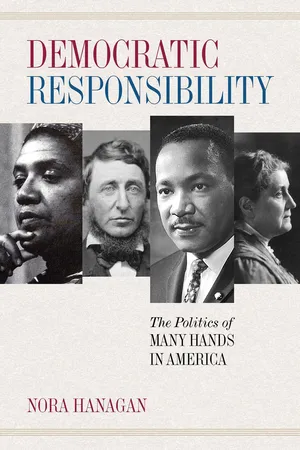
American society is often described as one that celebrates self-reliance and personal responsibility. However, abolitionists, progressive reformers, civil rights activists, and numerous others often held their fellow citizens responsible for shared problems such as economic exploitation and white supremacy. Moreover, they viewed recognizing and responding to shared problems as essential to achieving democratic ideals. In Democratic Responsibility, Nora Hanagan examines American thinkers and activists who offered an alternative to individualistic conceptions of responsibility and puts them in dialogue with contemporary philosophers who write about shared responsibility. Drawing on the political theory and practice of Henry David Thoreau, Jane Addams, Martin Luther King Jr., and Audre Lorde, Hanagan develops a distinctly democratic approach to shared responsibility. Cooperative democracy is especially relevant in an age of globalization and hyperconnectivity, where societies are continually threatened with harms—such as climate change, global sweatshop labor, and structural racism—that result from the combined interactions of multiple individuals and institutions, and which therefore cannot be resolved without collective action. Democratic Responsibility offers insight into how political actors might confront seemingly intractable problems, and challenges conventional understandings of what commitment to democratic ideals entails. This book will be of interest to scholars and students of political science, especially those who look to the history of political thought for resources that might promote social justice in the present.
- 238 pages
- English
- ePUB (mobile friendly)
- Available on iOS & Android
eBook - ePub
About this book
Information
NOTES
INTRODUCTION
1. “Enough Blame to Go Around: A Democratic Financial Crisis,” Economist, September 20, 2008, https://www.economist.com/democracy-in-america/2008/09/30/enough-blame-to-go-around.
2. Ibid.
3. Here, and elsewhere, I am influenced by Larry May’s description of shared responsibilities as resulting from “the combined interactions of multiple individuals.” See May, Sharing Responsibility (Chicago: University of Chicago Press, 1992), 38.
4. Dennis F. Thompson, “Moral Responsibility of Public Officials: The Problem of Many Hands,” American Political Science Review 74, no. 4 (1980): 905–16.
5. Michael Hout and Erin Cumberworth, The Labor Force and the Great Recession (Stanford, CA: Stanford Center on Poverty and Inequality, 2012).
6. There is some controversy about whether Thoreau should be labeled a “reformer.” In The Political Thought of Henry David Thoreau: Privatism and the Practice of Philosophy (Lexington: University of Kentucky Press, 2016), Jonathan McKenzie argues that Thoreau was not a reformer because he had little interest in promoting social change. While I agree with McKenzie that Thoreau was primarily focused on private pursuits like literature, philosophy, and the study of nature, I believe that he deserves to be labeled a “reformer” because he engaged in activities—defending John Brown and lecturing on his own act of civil disobedience—that were intended to encourage resistance to slavery.
7. In Responsibility for Justice (New York: Oxford University Press, 2011), Iris Marion Young uses the term liability model to describe the dominant approach to responsibility in Western societies. See 96–97.
8. Marion Smiley, Moral Responsibility and the Boundaries of Community: Power and Accountability from a Pragmatic Point of View (Chicago: University of Chicago Press, 1992).
9. As William E. Connolly observes, the idea that “for every evil there must be an agent (or set of agents) whose level of responsibility is proportionate to the seriousness of the evil” is appealing because it allows humans to take comfort in the idea that suffering is not embedded in the natural order of things but is rather the result of deviant human actions. See Connolly, Identity/Difference: Democratic Negotiations of Political Paradox (1991; repr., Minneapolis: University of Minnesota Press, 2002), 103.
10. Jean-Paul Sartre, Being and Nothingness: An Essay in Phenomenological Ontology, trans. Hazel Barnes (New York: Citadel Press, 1968), 530.
11. Hannah Arendt, “Collective Responsibility,” in Responsibility and Judgment, ed. Jerome Kohn (New York: Schocken Books, 2003), 147–59.
12. May, Sharing Responsibility, 18–23.
13. Ibid., 48–49.
14. Ibid., 40.
15. Young, Responsibility for Justice, 111–12. For a summary of similar critiques of May’s account of shared responsibility, see Barbara Applebaum, Being White, Being Good: White Complicity, White Moral Responsibility, and Social Justice Pedagogy (Lanham, MD: Lexington Books, 2010), 12–15.
16. Young, Responsibility for Justice, 109.
17. Ibid., 109–11.
18. Ibid., 105.
19. Ibid., 109.
20. Ibid.
21. Jade [Jacob] Larissa Schiff, “Confronting Political Responsibility: The Problem of Acknowledgment,” Hypatia 23, no. 3 (2008): 102.
22. Ibid., 100–117.
23. Schiff describes responsiveness as necessary if political actors are to accept responsibility for harmful structures in Burdens of Political Responsibility: Narrative and the Cultivation of Responsiveness (Cambridge: Cambridge University Press, 2014). She borrows the term responsiveness from William Connolly, but redefines it to mean “the acknowledgment and experience of connections between our everyday activities and the suffering of others.” See Schiff, Burdens of Political Responsibility, 40.
24. Political theorists have observed, however, that citizens bear responsibility for decisions made by democratically elected governments. See Eric Beerbohm, In Our Name: The Ethics of Democracy (Princeton, NJ: Princeton University Press, 2012); and Anna Stilz, “Collective Responsibility and the State,” Journal of Political Philosophy 19, no. 2 (2011): 190–208. My argument about democratic responsibility is influenced by these theorists in that I conclude that political actors generally bear more responsibility for outcomes that can be influenced by collective political action; thus American citizens bear more responsibility for their government’s foreign policy mistakes than do citizens of nondemocratic regimes like Saudi Arabia. At the same time, I insist that democratic ideals require political actors to take responsibility for economic and social processes that are not directly controlled by democratically accountable states.
25. Sharon R. Krause, Freedom beyond Sovereignty: Reconstructing Liberal Agency (Chicago: Chicago University Press, 2015), 81–97.
26. In calling for greater attention to the relationship between democracy and shared responsibility, I echo Antonio Y. Vázquez-Arroyo’s critique of the tendency of philosophers to focus on “ethical and individualistic meanings of responsibility” as opposed to the political responsibility associated with a genuinely democratic order. See Vázquez-Arroyo, Political Responsibility: Responding to Predicaments of Power (New York: Columbia University Press, 2016), 113. In contrast to Vázquez-Arroyo, however, I do not conclude that democratic responsibility is only possible within a radical democratic framework.
27. Beerbohm, In Our Name, 2.
28. Thucydides, The Peloponnesian War, trans. Steven Lattimore (Indianapolis, IN: Hackett, 1998), 411.
29. For an overview of authoritarian approaches to environmentalism, see Bruce Gilley, “Authoritarian Environmentalism and China’s Response to Climate Change,” Environmental Politics 21, no. 2 (2012): 287–307.
30. Jeffrey Stout, Democracy and Tradition (Princeton, NJ: Princeton University Press, 2004), 3.
31. Thomas A. Spragens Jr., Civic Liberalism: Reflections on Our Democratic Ideals (Lanham, MD: Rowman and Littlefield, 1999), 121.
32. See Thomas Jefferson, “To Samuel Kercheval,” The Portable Thomas Jefferson, ed. Merrill D. Peterson (New York: Penguin Books, 1975), 556.
33. See Hannah Arendt, The Human Condition (Chicago: University of Chicago Press, 1957), esp. 175–207; John Dewey, The Public and Its Problems, in The Later Works of John Dewey, 1925–1953, vol. 2, 1925–1927, Essays, Reviews, Miscellany, and The Public and Its Problems, ed. Jo Ann Boydston (Carbondale: Southern Illinois University Press, 1984), esp. 351–72; and Jean-Jacques Rousseau, On the Social Contract, trans. Donald A. Cress (Indianapolis, IN: Hackett Publishing, 1987), esp. 23–24.
34. In describing self-rule, equality, and solidarity as democratic values, I am influenced by Spragens’s argument in Civic Liberalism that democrats have generally regarded autonomy, equality, and fraternity as essential to human flourishing.
35. Walt Whitman, Leaves of Grass, in Whitman: Poetry and Prose, ed. Justin Kaplan (New York: Library of American College Editions, 1996), 414.
36. For this approach to equality, see Iris Marion Young, “Polity and Group Difference: A Critique of the Ideal of Universal Citizenship,” Ethics 99, no. 2 (1989): 250–74.
37. Thomas Jefferson, “To Roger C. Weightman,” in The Portable Thomas Jefferson, 585.
38. The idea that self-rule requires effort on the part of individuals is often associated with liberal political thought. According to Spragens, a review of liberal political thought ...
Table of contents
- Half Title
- Title
- Copyright
- Dedication
- Contents
- Preface
- Introduction
- ONE: Resisting the Machine: Henry David Thoreau on Responsibility and Individual Autonomy
- TWO: Sharing Responsibility: Jane Addams's Social Ethics
- THREE: Choosing Justice over Order: Martin Luther King Jr. on Responsibility, Extremism, and Democratic Politics
- FOUR: Transforming Silence: Audre Lorde on Responsibility, Self-Expression, and Bearing Witness to One Another
- FIVE: Democratic Responsibility in the Twenty-First Century
- Notes
- Bibliography
- Index
Trusted by 375,005 students
Access to over 1.5 million titles for a fair monthly price.
Study more efficiently using our study tools.
Frequently asked questions
Yes, you can cancel anytime from the Subscription tab in your account settings on the Perlego website. Your subscription will stay active until the end of your current billing period. Learn how to cancel your subscription
No, books cannot be downloaded as external files, such as PDFs, for use outside of Perlego. However, you can download books within the Perlego app for offline reading on mobile or tablet. Learn how to download books offline
Perlego offers two plans: Essential and Complete
- Essential is ideal for learners and professionals who enjoy exploring a wide range of subjects. Access the Essential Library with 800,000+ trusted titles and best-sellers across business, personal growth, and the humanities. Includes unlimited reading time and Standard Read Aloud voice.
- Complete: Perfect for advanced learners and researchers needing full, unrestricted access. Unlock 1.5M+ books across hundreds of subjects, including academic and specialized titles. The Complete Plan also includes advanced features like Premium Read Aloud and Research Assistant.
We are an online textbook subscription service, where you can get access to an entire online library for less than the price of a single book per month. With over 1.5 million books across 990+ topics, we’ve got you covered! Learn about our mission
Look out for the read-aloud symbol on your next book to see if you can listen to it. The read-aloud tool reads text aloud for you, highlighting the text as it is being read. You can pause it, speed it up and slow it down. Learn more about Read Aloud
Yes! You can use the Perlego app on both iOS and Android devices to read anytime, anywhere — even offline. Perfect for commutes or when you’re on the go.
Please note we cannot support devices running on iOS 13 and Android 7 or earlier. Learn more about using the app
Please note we cannot support devices running on iOS 13 and Android 7 or earlier. Learn more about using the app
Yes, you can access Democratic Responsibility by Nora Hanagan in PDF and/or ePUB format, as well as other popular books in Politics & International Relations & Political Philosophy. We have over 1.5 million books available in our catalogue for you to explore.