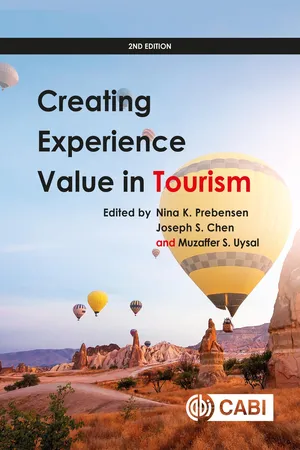
Research delivers a multitude of approaches to value creation, represented here as a set of definitions, perspectives and interpretations of how tourists, as customers, create value alone and with others. Now updated throughout, Creating Experience Value in Tourism, 2nd Edition provides a clarification of these approaches as well as a practical translation as to how they can work within industry.Including a framework to distinguish among key resources or antecedents of customer value, this new edition: - Introduces the concept of co-creation of value in the tourist experience, looking at the definitions, structures and models available;- Provides a new chapter addressing value creation and resource configuration;- Considers consumer behaviour and factors affecting value creation from both physiological and psychological perspectives;- Introduces a new full colour internal design to aid understanding.Concluding with a summary of the areas for future research, this is a key resource for researchers, particularly those interested in experience value and co-creation, as well as a useful read for students of tourism and related industries.
eBook - ePub
Creating Experience Value in Tourism
- English
- ePUB (mobile friendly)
- Available on iOS & Android
eBook - ePub
Creating Experience Value in Tourism
About this book
Information
Chapter 1
Co-creation of Tourist Experience: Scope, Definition and Structure
Nina K. Prebensen1, Joseph S. Chen2 and Muzaffer S. Uysal3
1UiT, The Arctic University of Norway, Norway; 2Indiana University at Bloomington, USA; 3University of Massachusetts, Amherst, USA
1UiT, The Arctic University of Norway, Norway; 2Indiana University at Bloomington, USA; 3University of Massachusetts, Amherst, USA
Tourist Experience
A vacation trip is more often voluntarily and willingly performed to meet personal and hedonic needs; not because the tourists have to, but because they want to. Tourists participate in producing their vacation, before, during and after the journey, through their time, effort and money, because the process of doing so is highly valued, by themselves and relevant others. This simple but very important issue in tourist experience creation denotes a foundational difference compared with traditional products and services people buy in order to complete a task or for other instrumental reasons, i.e. to be transported, to have their apartment cleaned or to get medical help to get well from an illness. When tourists choose to spend money, time and effort to engage in activities of interest, they do so to produce an enjoyable moment of time, whatever their primary aims, motivation, interest, involvement, experiences and skills. Tourists then search for authentic experiences, to learn from and to partake (more or less) physically and psychologically in various types of activities. The traditional hedonic perspective reflecting experiences such as relaxation and indulging within tourist consumption is therefore accompanied with knowledge regarding the tourists’ search for eudaimonic experiences (Ryff, 1989), calling for new knowledge in terms of how value is created in tourism settings.
Experiences and their meanings usually appeal to tourists’ high-order needs, such as novelty, excitement and enjoyment, prestige, socialization and learning, and contribute to the enhancement of a sense of wellbeing. Ongoing research in academia and the popular press indicates that today’s travellers are gaining more power and control over what goes into the nature of tourism products as experience, with which travellers also construct their own narratives (Binkhorst and Dekker, 2009). The construction of narratives may be influenced by the extent to which the interaction takes place between tourists and the setting (or tangible place or the experience environment), as well as the interaction between local inhabitants and fellow tourists (Prebensen and Foss, 2011). The nature of this interaction provides the core of tourist experiences (Walls and Wang, 2011) and denotes enhanced experience value for the tourist handling various situations and people (Prebensen and Foss, 2011).
As implied, the experience environment, setting or sphere is more than the physical stage. It includes consumers, producers and the right to use amenities for a period of time (Bitner, 1992; Walls and Wang, 2011). Binkhorst and Dekker (2009) refer to this as a tourism experience network away from the home environment where the tourist as a participant is surrounded by a unique experience network of all stake-holders. This approach places the human being in the centre and considers tourism as an experience network in which various stakeholders co-create in order to engage in tourism experiences. This signifies the importance of the setting in which tourism activities take place to create value and produce experiences. Readiness of the individual, in terms of physical ability and capability, competency, willingness to work with others and the opportunity to participate, is also a significant variable that may affect the extent to which a prospective tourist as consumer may take part in creating value in the setting as much as the setting is conducive to facilitating and creating value (Mathis, 2013).
Tourist Experience and Co-creation
Creating value in tourism experiences is greatly focused on the role of tourist as consumer and the destination setting and the service company as the producer or provider in the co-creation process. Grönroos (2006, p. 324) stresses that it is not the tourists who get opportunities to engage themselves in the service provider’s process, but the service provider who can create opportunities to engage itself with the tourists’ value-generating process. Thus, the elements of the setting or experience dimensions should involve the tourist emotionally, physically, spiritually and intellectually (Mossberg, 2007). Another important point that needs to be mentioned is about how experiences appeal to higher-order needs of satisfaction and motivation. If the setting and producer create an environment where the tourist becomes co-producer, then the perceived value that arises is likely to improve the quality of the vacation experiences, thus contributing to tourist wellbeing ( Prenbensen and Xie, 2017).
Tourists may perceive their vacation experiences differently based on a number of antecedents, as indicated above, and subsequent variations in their ability and desire to cope and co-create in the experience moment depending on situational aspects (Prebensen and Foss, 2011).
When discussing creating or co-creating value in tourism experiences, one may also like to see some brief discussion on definitional issues. We may start by using Frondizi’s (1971) question: ‘Are things valuable because we value them, or do we value them because they are valuable?’ The simple reaction may be that things are valuable because we value them. This is because different people value different things.
The idea that value is something that someone produces for the consumer to buy and value afterwards is strongly debated by Vargo and Lusch (2004, 2006). Vargo and Lusch claim that ‘The customer is always a co-creator of value. There is no value until an offering is used – experience and perception are essential to value determination’ (2006, p. 44). Value is perceived as ‘value-in-use’, and consumer experiences are fundamental to the co-creation of value.
This perspective, delineated as the new service dominant logic of marketing (Vargo and Lusch, 2004, 2006, 2008; Grönroos, 2006), claims the consumer, i.e. the tourist role in creating experience value, is vital. This logic embraces the idea that in the process of co-creating value, the consumers, in addition to firms and organizations, act as resource integrators (Arnould et al., 2006; Vargo and Lusch, 2006), and that value is centred in the experiences of consumers (Prahalad and Ramaswamy, 2004b). Consequently, the foundational idea in the service-dominant (S-D) logic is that the service encounter is an exchange process of value between the customer and the service provider. This perspective holds that the consumers and their skills and knowledge, depicted as operant resources, add to value creation by integrating physical, social and cultural resources (Arnould et al., 2006).
Experience value becomes an integrated process between host and guests in a certain atmosphere where their respective meanings of value are shared and recognized. The meanings of value for different actors have been rooted in the foundations of economics and the study of market exchange; in particular, two broad meanings, ‘value-in-exchange’ and ‘value-in-use’, which reflect distinct ways of noting value and value creation. Vargo and Lusch (2004) describe these as the goods-dominant logic and service-dominant logic. The goods-dominant logic is based on the meaning of value-in-exchange and that value is produced by the firm in the market, usually by an exchange of goods and money (Vargo and Lusch, 2004; Vargo et al., 2010). This perspective holds the roles of ‘producers’ and ‘consumers’ as separate and value creation is frequently thought of as a series of activities performed by the firm. The alternative view, S-D logic, relates to meaning of value-in-use (Vargo and Lusch, 2008). In the S-D logic the roles of producers and consumers are not separate, signifying that value is always co- created, jointly and reciprocally, in interactions among providers (including the setting) and customers or between customers through the integration of resources and application of competences.
The discussion points presented implicitly suggest that things have both exchange value and value-in-use. This distinction becomes more obvious in the context of hedonic consumption such as tourism goods and services. Exchange values are those values that measure the relative worth of something when compared with something else. This to a large extent is determined as a function of supply and demand forces. For example, the cost of a trip to London vs Tokyo from Washington DC is determined by market factors. Or, a 24-carat gold bracelet is more expensive than a 14-carat bracelet when using cost or money to compare the two. The 24-carat bracelet is going to be significantly more expensive than the 14-carat bracelet simply because we as consumers believe that the higher the carat, the higher the cost of it, thus, more valuable. Value-in-use is essentially holding the sentimental value between the consumer and the consumed item. Value-in-use is the subjective and perceived benefit of an item that has been consumed. In this sense, value-in-use is created during usage, where value is socially constructed through experiences (Grönroos and Voima, 2013). For example, a week-long hike in the Amazon rainforest may be perceived differently in value by one person compared with another. If someone has ‘value-in-use’ for an object, it is a personal feeling or connection with that item that makes it important.
Vargo and Lusch (2008) eloquently put it that value creation refers to customers’ creation of value-in-use; co-creation is a function of interaction. The degree to which interactions with spheres take place may also lead to different forms of value creation and co-creation. Tourism experience must be experienced and the customer has to be present. In this regard one can easily argue that value is subjective and determined by the consumer. Thus, co-creation is tied to usage, consumption and value-in-use; value that occurs at the time of use consumption or experience (Vargo and Lusch, 2008; Chathoth et al., 2013).
Whatever name we use – the experience environment, servicescape, experiencescape, spheres or setting – on-site value creation processes are core foundations that the tourism industry must acknowledge in order to plan, develop, involve and accommodate tourists so that they are able to actively partake in such practices. The setting is also influenced by context, target, duration and goals of tourists. Tourists as consumers bring in various types of personal resources such as time, money, knowledge, past experience and learned skills. The setting and its characteristics also influence the interaction between provider sphere and customizer. The aesthetic of the setting or ambience and the functionality of the setting as a facilitator of experience creation are essential for the tourist to become part of the production system.
In order to understand value creation, antecedents of such processes should be recognized; these include the tourist’s motivation, information provided, knowledge and skills, and the tourist’s interest and involvement in the trip to come. Additionally, revealing the consequences and effects of value creation such as satisfaction, loyalty and subjective wellbeing should be acknowledged. During the journey and arriving back home, intentions concerning re-visitation and recommendation of the journey and the destination to others may be evoked. After the trip, the tourists may remember and tell others about their experiences, which all comprise value magnitudes for themselves as well as the service firms and destination visited. Therefore, understanding the value chain of tourist travel, before, during and after the trip, will help tourism businesses become competitive by enhancing tourist experience value.
The perception and valuation of an experience is relative (regarding cognitive images) and dynamic (changing within individuals over time) (Ulaga, 2003). Co-creation of value for tourists happens during the process of travelling in time and space, before, during and after the journey, and will subsequently affect tourism firms and destinations in various ways, in addition to the effects on the tourists’ perception of experience value. Recent research reveals that a tourist more actively involved in the creation and co-creation of an experience evaluates that experience more positively (Arnould et al., 2002; Prebensen and Foss, 2011). Studies have shown that consumers utilize personal resources actively in co-creating value (Bowen, 1986; Kelley et al., 1990; Rodie and Kleine, 2000; Johnston and Jones, 2003). Researchers have suggested classifications of such resources, i.e. mental, physical and emotional (Rodie and Kleine, 2000), might vary in terms of the level of consumer involvement and role performance (Bitner et al., 1997). The consumer literature has also put forward the importance of previous experience and knowledge in order to create value in various consumption situations and environments (McGrath and Otnes, 1995; Harris and Baron, 2004).
Despite an increased focus on value creation and co-creation in marketing literature (e.g. Holbrook, 1999, 2006; Prahalad and Ramaswamy, 2004a, 2004b; Vargo and Lusch, 2004) and in tourism research (Arnould et al., 2002; Prebensen and Foss, 2011), there is a lack in understanding of the tourist as a resource provider and integrator, as mediator and moderator, in value co-creation processes.
Even though the subject of customer value has been addressed by a number of researchers (e.g. Holbrook, 1996; Woodruff, 1997; Sweeney and Soutar, 2001; Williams and Soutar, 2009), and further in the context of S-D logic (e.g. Berthon and Joby, 2006; Holbrook, 2006), the discussions on how and why tourists engage in co-creation are rather limited. Consequently, this book aims to explore and outline the concept of tourist experience value, and subsequently divulge important antecedents and consequences of the experience value construct. Specifically, the book strives to complement current theories regarding value co-creation in tourist experiences.
Phases of Tourist Experience Creation
It has been well documented that travellers usually go through different phases of a travel journey. Clawson and Knetsch (1971) provided five phases of a travel experience: pre-trip (planning and information gathering), travel to site, on-site activities, return trip and post-trip. Regardless of the number of phases, whether three (travel to site, onsite experience and return) or five, as put forward by Clawson and Knetsch (1971), the interaction between the tourist and the service provider (the industry) may occur with each phase of travel at the boundary of the tourist and provider spheres. Pre-trip activities may use personal resources to influence and create planning and finding motivation for the trip, and tourists use some form of transportation en route to the selected travel destination. Often tourists turn to travel and tourism service providers (e.g. airlines, bus companies) to help them reach their destination. Subsequently, when tourists reach their destinations they often rely on travel/tourism service providers to supply the accommodations, restaurants, entertainment and encounters of the traveller at the final destination. Then, tourists make their return trip, during which they may interact with travel carriers and personnel. After the travel experience is over and...
Table of contents
- Front Cover
- Title Page
- Copyright Page
- Contents
- Preface
- Contributors
- Chapter 1 Co-creation of Tourist Experience: Scope, Definition and Structure
- Chapter 2 Dynamic Drivers of Tourist Experiences
- Chapter 3 Tourist Experience Value: Tourist Experience and Life Satisfaction
- Chapter 4 Conceptualization of Value Co-creation in the Tourism Context
- Chapter 5 Why, Oh Why, Oh Why, Do People Travel Abroad?
- Chapter 6 Self-congruity Theory in Travel and Tourism: Another Update
- Chapter 7 Moving People: A Conceptual Framework for Understanding How Visitor Experiences can be Enhanced by Mindful Attention to Interest
- Chapter 8 Co-creation of Experience Value: A Tourist Behaviour Approach
- Chapter 9 Authenticity as a Value Co-creator of Tourism Experiences
- Chapter 10 Experience Co-creation Depends on Rapport-building: Training Implications for the Service Frontline
- Chapter 11 Approaches for the Evaluation of Visitor Experiences at Tourist Attractions
- Chapter 12 Storytelling in a Co-creation Perspective
- Chapter 13 Tourist Information Search: A DIY Approach to Creating Experience Value
- Chapter 14 Co-creation of Value and Social Media: How?
- Chapter 15 Prices and Value in Co-produced Hospitality and Tourism Experiences
- Chapter 16 Value Creation: a Tourism Mobilities Perspective
- Chapter 17 Guide Performance: Co-created Experiences for Tourist Immersion
- Chapter 18 Value Creation and Co-Creation in Tourist Experiences: an East Asian Cultural Knowledge Framework Approach
- Chapter 19 Perspectives on Value Creation – Resource Configuration
- Chapter 20 Value Co-creation: Challenges and Future Research Directions
- Index
- Back Cover
Trusted by 375,005 students
Access to over 1.5 million titles for a fair monthly price.
Study more efficiently using our study tools.
Frequently asked questions
Yes, you can cancel anytime from the Subscription tab in your account settings on the Perlego website. Your subscription will stay active until the end of your current billing period. Learn how to cancel your subscription
No, books cannot be downloaded as external files, such as PDFs, for use outside of Perlego. However, you can download books within the Perlego app for offline reading on mobile or tablet. Learn how to download books offline
Perlego offers two plans: Essential and Complete
- Essential is ideal for learners and professionals who enjoy exploring a wide range of subjects. Access the Essential Library with 800,000+ trusted titles and best-sellers across business, personal growth, and the humanities. Includes unlimited reading time and Standard Read Aloud voice.
- Complete: Perfect for advanced learners and researchers needing full, unrestricted access. Unlock 1.5M+ books across hundreds of subjects, including academic and specialized titles. The Complete Plan also includes advanced features like Premium Read Aloud and Research Assistant.
We are an online textbook subscription service, where you can get access to an entire online library for less than the price of a single book per month. With over 1.5 million books across 990+ topics, we’ve got you covered! Learn about our mission
Look out for the read-aloud symbol on your next book to see if you can listen to it. The read-aloud tool reads text aloud for you, highlighting the text as it is being read. You can pause it, speed it up and slow it down. Learn more about Read Aloud
Yes! You can use the Perlego app on both iOS and Android devices to read anytime, anywhere — even offline. Perfect for commutes or when you’re on the go.
Please note we cannot support devices running on iOS 13 and Android 7 or earlier. Learn more about using the app
Please note we cannot support devices running on iOS 13 and Android 7 or earlier. Learn more about using the app
Yes, you can access Creating Experience Value in Tourism by Nina K Prebensen, Joseph S Chen, Muzaffer Uysal, Nina K Prebensen,Joseph S Chen,Muzaffer Uysal in PDF and/or ePUB format, as well as other popular books in Business & Hospitality, Travel & Tourism Industry. We have over 1.5 million books available in our catalogue for you to explore.