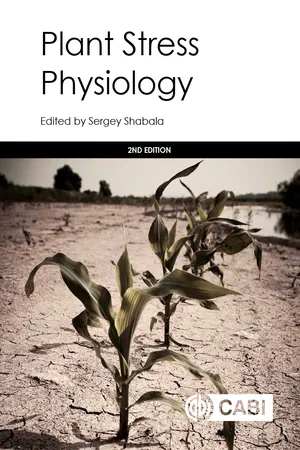
Completely updated from the successful first edition, this book provides a timely update on the recent progress in our knowledge of all aspects of plant perception, signalling and adaptation to a variety of environmental stresses. It covers in detail areas such as drought, salinity, waterlogging, oxidative stress, pathogens, and extremes of temperature and pH. This second edition: Presents detailed and up-to-date research on plant responses to a wide range of stresses Includes new full-colour figures to help illustrate the principles outlined in the text Is written in a clear and accessible format, with descriptive abstracts for each chapter Written by an international team of experts, this book provides researchers with a better understanding of the major physiological and molecular mechanisms facilitating plant tolerance to adverse environmental factors. This new edition of Plant Stress Physiology is an essential resource for researchers and students of ecology, plant biology, agriculture, agronomy and plant breeding.
- English
- ePUB (mobile friendly)
- Available on iOS & Android
eBook - ePub
Plant Stress Physiology
About this book
Information
1 Drought Tolerance in Crops: Physiology to Genomics
Division of Plant Sciences, University of Missouri,Columbia,USA
* Corresponding author: [email protected]
Abstract
More frequent and severe drought combined with high temperatures have been recognized as a potential impact of global warming on agriculture. Improving crop yield under water stress is the goal of agricultural researchers worldwide. Direct selection for yield under drought has been the major breeding strategy and was successful in some crops. Drought modifies the structure and function of plants. An understanding of the impact, mechanisms and traits underlying drought tolerance is essential to develop drought-tolerant cultivars. Identification and evaluation of key physiological traits would aid and strengthen molecular breeding and genetic engineering programmes in targeting and delivering traits that improve water use and/or drought tolerance of crops. There is an overlap between different osmotic stresses and the selection of appropriate drought evaluation methods. The benefits of genetic engineering have been realized in crop improvement for quality traits, and several promising genes have emerged in the last decade as candidates for drought tolerance. Combining the physiological traits that would sustain yield under drought, and incorporating elite quantitative trait loci (QTL) and genes underlying these traits into high-yielding cultivars, would be a successful strategy.
1.1 Introduction
Food production worldwide is affected by periodic droughts. Drought is an extended abnormal dry period that occurs in a region consistently receiving a below-average rainfall. Globally, agriculture is the biggest consumer of water, accounting for almost 70% of all withdrawals, and up to 95% in developing countries (FAO, 2007). Out of 1474 million hectares (ha) of cultivated land in the world, 86% comes under rain-fed cultivation (Kumar, 2005). Drought is classified into three major categories (Dai, 2010): (i) agricultural drought; (ii) meteorological drought; and (iii) hydrological drought. Meteorological drought is a period with less-than-average precipitation, and is often associated with above-normal temperatures that precede and cause other types of drought. Meteorological drought is caused by constant changes in large-scale atmospheric circulation patterns such as high pressure. Agricultural drought is a period with below-average precipitation, less frequent rain events or above-normal evaporation, resulting in reduced crop production and plant growth. Hydrological drought occurs when there is a reduced supply of water or water levels from river streams and other water storage structures such as aquifers, lakes or reservoirs fall below long-term mean levels. A lack of rainfall triggers agricultural and hydrological droughts; but other factors, including high temperature, poor irrigation management and external factors like overgrazing and erosion, also cause drought. The proportion of the land surface globally in extreme drought is predicted to increase from 1% to 3% at present to 30% by the 2090s. The number of extreme drought events per 100 years and mean drought duration are likely to increase by factors of two and six, respectively, by the 2090s (Burke et al., 2006). According to the World Bank, drought is the world’s most expensive disaster, destroying the economic livelihood and food source for those dependent on the agricultural sector. Much effort is being made by agricultural researchers around the globe to reduce water use by crops to address the challenges that especially affect farmers in drought-prone environments across the developing world.
1.2 Global Impact of Drought On Crop Production
Global climate change, in the form of increasing temperature and fluctuating soil moisture conditions including drought and floods, is projected to decrease the yield of food crops over the next 50 years (Leakey et al., 2006). By 2025, around 1800 million people will be living in countries or regions with absolute water scarcity, and two-thirds of the world population could be under stress conditions (FAO Water; www.fao.org/nr/water/issues/scarcity.html). It has been reported that 2000–2009 was the warmest decade since the 1880s (http://www.nasa.gov/topics/earth/features/temp-analysis-2009.html). Over the past 10 years, large-scale periodic regional drought and a general drying trend over the southern hemisphere have reduced global terrestrial net primary production (Zhao and Running, 2010).
The United States Department of Agriculture classified risk in agriculture into seven categories. Among them, yield risk is the most common and has a direct impact on agriculture, which is mostly influenced by water supply and temperature (Motha and Menzie, 2007). Drought has an extensive impact on agriculture as it disrupts cropping programmes, reduces breeding stock, and reduces the assets and farm inputs. The National Climatic Data Center (NCDC) of the US Department of Commerce estimated that, from 1980 to 2010, a combination of drought and heatwaves caused a total loss of around US$1825 million (http://www.ncdc.noaa.gov/img/reports/billion/state2010.pdf). It has been reported that about 50% of world rice production is affected by drought (Bouman et al., 2005). Most of the 160 million ha of maize grown globally is rain-fed. The average annual yield losses to drought are around 15% of potential yield on a global basis and, as temperatures rise and rainfall patterns change, additional losses of maize grain may approach 10 million t/year, currently worth almost US$5 billion (Edmeades, 2008). Total wheat production in the wider drought-affected regions of the Middle East and Central Asia is currently estimated to have declined by at least 22% in 2009 compared to 2008 (de Carbonnel, 2009). Drought stress after flowering is one of the most common and serious environmental limitations to yield in pearl millet, resulting in 50% yield loss (Mahalakshmi et al., 1987). Drought is the most damaging abiotic stress to soybean production and, in the USA, dry-land soybeans yield approximately 60–70% less than irrigated systems (Egli, 2008).
Other than the socio-economic impacts, nearly every plant physiological process is directly or indirectly affected by water deficit. Cell enlargement depends on the level of cell turgor; photosynthesis is directly inhibited by insufficient water; and stomatal control of transpiration and CO2 absorption rely on the water status of guard cells (Giménez et al., 2005). The adverse effect of drought on plant structure and function such as xylem embolism, reduced carbohydrate pool size, leaf and fine root production, on the ability of plants to resist pathogen attacks, the impacts on soil microbial dynamics, decomposition and nutrient-supply processes, and shifting competitive abilities between plant species cannot be underestimated (Ciais et al., 2005). While the negative impact of drought on crop yields is obvious, the adverse effects on crop quality are less recognized. Severe drought can result in a loss in food quality in terms of feed value, starch and lipid concentration, or physical/sensory traits (Wang and Frei, 2011). Crop improvement through conventional breeding and modern biotechnology both offer potential for substantial progress (Cominelli and Tonelli, 2010).
1.3 Drought Resistance Mechanisms
Understanding the concept and components of drought resistance is a key factor for improving drought tolerance of crops. Drought resistance mechanisms for different crops have been extensively reviewed and summarized from crop physiology, plant breeding and molecular perspectives (Nguyen et al., 1997; Turner et al., 2001; Manavalan et al., 2009; Shao et al., 2009; Mittler and Blumwald, 2010; Todaka et al., 2015). Drought resistance can be classified broadly into three categories (Taiz and Zeiger, 2002): (i) desiccation postponement (the ability to maintain tissue hydration or drought tolerance at high water potential); (ii) desiccation tolerance (the ability to function while dehydrated or drought tolerance at low water potential); and (iii) drought escape where the plants avoid drought by completing life cycles before the onset of a dry period to sustain some reproduction. These drought resistance mechanisms vary with the geographical area, based on soil and climatic conditions. For example, tolerance to extreme drought conditions (air < 0% relative humidity) exhibited by desert-adapted resurrection plants such as Craterostigma plantagineum (Bartels et al., 1990) and Tortula ruralis (Oliver and Bewley, 1997), is achieved by limiting their metabolic functions. In contrast, most cultivated plants cannot withstand a water deficit less than 85% of relative humidity during the vegetative period (Bartels and Salamini, 2001), and these plants adapt to drought by either dehydration avoidance or dehydration tolerance mechanisms to maintain biological functions. Dehydration avoidance (a plant’s capacity to sustain high water status by water uptake or a reduction of water loss in dry conditions) is achieved through the development of a large and deep root system to acquire water from the soil, as well as through the closure of stomata or a non-permeable leaf cuticle to reduce transpiration. Physiological traits such as leaf osmotic adjustment, proportion/quantity of ABA, chlorophyll, proline and soluble sugars; and toxic removal mechanisms such as peroxidase or superoxide dismutase activity contribute to dehydration tolerance (Luo, 2010).
1.4 Physiological Traits Affecting Crop Response to Drought
Effects of water deficit at the whole-plant level are manifested by effects on plant phenology, growth and development, source–sink relations and plant reproduction processes. An understanding of the various physiological traits controlling/regulating crop responses to drought is required for identifying natural genetic variation for drought tolerance. These traits can be broadly classified as shoot- and root-related traits.
1.4.1 Phenology
Plant developmental traits such as early vigour or phenology may be particularly significant in water‐limiting conditions (Cairns et al., 2009). Faster phenological development is particularly useful in drought situations where late season drought is prominent. The early planting system of soybeans in the USA is an example where short season cultivars are planted during March–April. The early maturing cultivars start flowering in late April and set pods in late May, thus completing the reproductive stage before the period of possible drought during July–August (Heatherly and Elmore, 2004). Seed size and early seedling vigour were found to be associated with drought tolerance in pearl millet (Manga and Yadav, 1995), wheat (Rebetzke and Richards, 1999), sorghum (Harris, 1996), cotton (Basal et al., 1995), and rice (Cui et al., 2008). While plants could potentially escape ...
Table of contents
- Cover
- Half Title
- Title
- Copyright
- Contents
- Contributors
- Stress: The Way of Life
- 1 Drought Tolerance in Crops: Physiology to Genomics
- 2 Salinity Stress: Physiological Constraints and Adaptive Mechanisms
- 3 Reactive Oxygen Species and Their Role in Plant Oxidative Stress
- 4 Plant Responses to Chilling Temperatures
- 5 High-temperature Stress in Plants: Consequences and Strategies for Protecting Photosynthetic Machinery
- 6 Flooding Stress Tolerance in Plants
- 7 Adaptations to Aluminium Toxicity
- 8 Plant Stress under Non-optimal Soil pH
- 9 Desiccation Tolerance
- 10 Ultraviolet-B Radiation: Stressor and Regulatory Signal
- 11 Freeze Tolerance and Avoidance in Plants
- 12 Heavy-metal Toxicity in Plants
- 13 Biotic Stress Signalling: Ca2+-mediated Pathogen Defence Programmes
- Index
- Back Cover
Trusted by 375,005 students
Access to over 1.5 million titles for a fair monthly price.
Study more efficiently using our study tools.
Frequently asked questions
Yes, you can cancel anytime from the Subscription tab in your account settings on the Perlego website. Your subscription will stay active until the end of your current billing period. Learn how to cancel your subscription
No, books cannot be downloaded as external files, such as PDFs, for use outside of Perlego. However, you can download books within the Perlego app for offline reading on mobile or tablet. Learn how to download books offline
Perlego offers two plans: Essential and Complete
- Essential is ideal for learners and professionals who enjoy exploring a wide range of subjects. Access the Essential Library with 800,000+ trusted titles and best-sellers across business, personal growth, and the humanities. Includes unlimited reading time and Standard Read Aloud voice.
- Complete: Perfect for advanced learners and researchers needing full, unrestricted access. Unlock 1.5M+ books across hundreds of subjects, including academic and specialized titles. The Complete Plan also includes advanced features like Premium Read Aloud and Research Assistant.
We are an online textbook subscription service, where you can get access to an entire online library for less than the price of a single book per month. With over 1.5 million books across 990+ topics, we’ve got you covered! Learn about our mission
Look out for the read-aloud symbol on your next book to see if you can listen to it. The read-aloud tool reads text aloud for you, highlighting the text as it is being read. You can pause it, speed it up and slow it down. Learn more about Read Aloud
Yes! You can use the Perlego app on both iOS and Android devices to read anytime, anywhere — even offline. Perfect for commutes or when you’re on the go.
Please note we cannot support devices running on iOS 13 and Android 7 or earlier. Learn more about using the app
Please note we cannot support devices running on iOS 13 and Android 7 or earlier. Learn more about using the app
Yes, you can access Plant Stress Physiology by Sergey Shabala in PDF and/or ePUB format, as well as other popular books in Biological Sciences & Botany. We have over 1.5 million books available in our catalogue for you to explore.