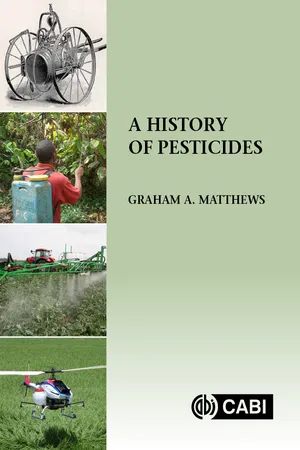
In this fascinating book, Graham Matthews takes the reader through the history of the development and use of chemicals for control of pests, weeds, and vectors of disease and then discusses their future.
- English
- ePUB (mobile friendly)
- Available on iOS & Android
eBook - ePub
History of Pesticides, A
About this book
1 Pesticides in the Early Part of the 20th Century
After the many different attempts to develop pesticides during the 19th century, efforts over the early decades of the 20th century concentrated on two main areas – the use of extracts from plants, notably pyrethrum and tobacco, and certain inorganic chemicals, mostly containing arsenic, sulfur or copper. Then, from the 1940s onwards, chemists started to develop organochlorine and organophosphate insecticides as well as new herbicides and fungicides. A brief overview of the pesticides used from 1900–1960 is given in this chapter.
Botanical Insecticides
In grasslands and forests, plants are able to survive, as they contain chemicals that enable them to combat attacks from insects and diseases. The main plants that man has selected over the centuries as food plants generally have very low levels of toxins. The earliest insecticides were essentially dried leaves of some plants, and, ultimately, modern science has played an important role in identifying these botanical insecticides and subsequently developing similar chemicals that are more effective, photostable and economical to market to farmers. One important food crop, Cassava (Manihot esculenta), is very poisonous unless the roots are well cooked. Farmers often prefer the bitter varieties because they deter pests.
Pyrethrins
Pyrethrum was known as far back as 400 BC in Persia (now Iran) and it was thought to have been used in stores, but interest in pyrethrum in Europe increased early in the 19th century, apparently due to an Armenian who learnt about the powder. In Europe it was initially referred to as ‘Dalmatian powder’ obtained from the flower heads of Pyrethrum cinerariaefolium (now called Chrysanthemum cinerariaefolium), grown in the Balkans. An interesting story is that a German woman in Dubrovnik, Dalmatia, picked the flowers to have in her house, and having discarded the withered flowers in the corner of a room she noticed later that the plants were surrounded by dead insects, and apparently associated this with insecticidal properties of the plants. By 1850 the powder was used to kill insects in houses in France. Bales of dried flowers and seeds were exported to the USA where the powder was used in dwellings and glasshouses. The main source of disruption in supply of pyrethrum, caused by World War I, was Japan, where the crop had been grown since 1886; but after World War II, Kenya took over the main production (Fig. 1.1). In 1917, the US Navy mixed a pyrethrum extract with kerosene to produce a space spray to control house flies and mosquitoes (Glynne-Jones, 2001). Globally, there are over 2000 registered products containing pyrethrins, used mostly in homes and for controlling mosquitoes, for example in mosquito coils and domestic sprayers such as the Flit gun, used prior to aerosols.

Fig. 1.1. Chrysanthemum flowers for extraction of pyrethrum.
Studies on pyrethrum around 1910–1916 by Staudinger and Ruzucka (1924) separated and partially identified the two primary active principles of pyrethrum – Pyrethrin I and Pyrethrin II. This led to considerable research on these actives (Gnadinger, 1936). Pyrethrin I was considered to be more toxic than Pyrethrin II, but the latter was far superior in causing ‘knock-down’ of house flies (Sullivan, 1938). Studies by Tattersfield (1931) and others continued, as its use had proved to be very effective indoors, enhanced later by the development of piperonyl butoxide (PBO) as a synergist in the late 1930s and early 1940s, but it was not photostable, so research continued until the first photostable permethrin was developed (Elliott et al., 1973), followed by other pyrethroids, discussed later.
Piperonyl butoxide was developed in the late 1930s and early 1940s to enhance the performance of the naturally derived insecticide pyrethrum. As a synergist, it inhibited the natural defence mechanisms of the insect, especially the mixed-function oxidase system (MFOs) also known as the cytochrome P-450 system. It was not considered necessary to use PBO when the synthetic pyrethroids were developed, but when Helicoverpa armigera, the cotton bollworm in Australia, became resistant to pyrethroids, following their extensive use, studies on using PBO revealed that esterase inhibition did not occur until 3–4 hours after PBO had been applied, suggesting a need for a pre-treatment prior to the pyrethroid spray (Young et al., 2005). More recently, PBO has been added to bed nets treated with pyrethroids to increase the mortality of the mosquitoes resistant to pyrethroids.
Rotenone
Rotenone is another botanical insecticide, known for centuries. The Chinese had extracted the insecticide from the roots of a vine growing wild in Asia, known as derris (Derris elliptica), but it is also found in devil’s shoe string (Cracca virginiana) (Roark, 1933) and other plants – Tephrosia, Millettia, Mundulea and Pachyrhizus (Brown, 1951). It had also been used as a poison dip for arrows in Borneo, but was best known as a fish poison. In 1902, a Japanese chemist isolated the most potent insecticidal substance in derris and called it rotenone. The neurotoxin had been regarded as harmless to human beings but 15 times more toxic to aphids than nicotine. Derris, supplied as a liquid or dust, was generally available for gardeners and ‘organic’ vegetable growers in the UK until October 2009 when it ceased following an EU Directive. Rotenone has been used for the management of invasive fish species, but there is concern, as this also affects non-targeted organisms including amphibians and macro-invertebrates (Dalu et al., 2015).
Nicotine
The alkaloid nicotine is found in many solanaceous plants, notably in the leaves of Nicotiana rustica, in amounts of 2–14%, in the tobacco plant Nicotiana tabacum, the Australian pituri (Duboisia hopwoodii) and common milkweed (Asclepias syriacaas). Its use as an insecticide started with tobacco leaves. As Lodeman (1896) mentioned, two handfuls of Virginia tobacco mixed with a handful of wormwood and a handful of rue in two pailfuls of water, boiled for half an hour and then strained, was ready to be sprayed. Tobacco alone was good, but not as good as the mixture. Later it was usually marketed as nicotine sulfate, which is non-volatile but becomes so in proportion as it is changed to nicotine by the addition of an alkali to neutralize the combining acid. Its toxicity was mainly due to the ‘fumigation’ effect (de Ong, 1924). In 1880, a Mr G.H. Richards set up a company to market a standardized product, XL Nicotine, suitable for gardeners to use as it was successful in controlling sucking pests including mealybugs, woolly aphids and certain scale insects with a waxy cuticle, due to the penetration of the vapour. It was more effective if the ambient temperature exceeded 16oC.
As nicotine, like other botanical extracts, is not persistent, recent interest has been in the use of nicotinoid insecticides (Ujváry, 1999), generally referred to as the neonicotinoids, which are discussed later (see Chapter 3).
Ryania
The botanical insecticide ryania is the ground stem wood and roots of the salicaceous plant Ryania speciosa, a plant originally recorded as found in Trinidad (Brown, 1951). The insecticidal activity of ryania extract was attributed to ryanodine but later shown to be due to the combination of ryanodine and the equipotent and more abundant 9,21-dehydroryanodine (Jefferies et al., 1992). It was very effective in controlling European corn borer and the sugar cane borer. As with other botanical insecticides, there are now modern synthetic ryanoids, which include chlorantraniliprole, cyantraniliprole and flubendiamide.
Inorganic Chemicals
Arsenicals
The use of arsenical poisons for crop protection was initiated by the arrival of major insect pests in the USA, for example the potato beetle, which arrived from Mexico according to some reports; but Lodeman (1896) refers to it as a native of the Rocky Mountains, which spread eastwards when growing potatoes had spread west into territory occupied by the beetle. It is now referred to as the Colorado beetle (Leptinotarsa decemlineata). It was such a vigorous feeder that farmers had to apply an insecticide. Paris green appeared around 1860 and became a standard insecticide, its use extending to other crops. It was also used to kill mosquito larvae. The name Paris green originates from its use as a rodenticide to kill rats in the sewers of Paris, competing with another arsenical, London purple, a less expensive by-product of the dye industry, which was exported in considerable quantities to the USA from 1878 by Messrs Hemingway & Co., London (Ordish, 1952). At that time, Paris green, referred to as emerald green, was also a popular pigment used in artists’ paints.
According to Lodeman (1896), Paris green, a copper acetoarsenite, could be prepared by boiling a solution of white arsenic in one vessel and a similar one of acetate of copper (verdigris) in another. These two boiling solutions were combined and Paris green precipitated. The fine crystalline powder with a clear green colour was practically insoluble in water.
In the USA, dusting cotton with calcium arsenate to control the boll weevil (Anthonomus grandis) and the cotton leafworm (Alabama argillacea) began in the 1920s and was soon carried out in all the cotton growing states. Dusts were used instead of sprays, as arsenicals used were insoluble in water. They wanted the deposit on the foliage, so that it was ingested by insects and phytotoxicity was minimized (Brown, 1951). Nicotine dust was added to control the cotton aphid (Aphis gossypii) in 1926, and by 1930 the technique was used by the Russians in central Asia, although they applied calcium arsenite and then sulfur to control mites (Tetranychus telarius).
The quantities needed to control gypsy moth (Lymantria dispar) with Paris green proved very phytotoxic, so a change was made to lead arsenate, which was less soluble. Lead arsenate had been prepared as an insecticide much earlier, in 1892, for use against gypsy moth, but its use in forests began with aerial spraying, which commenced in Massachusetts in 1926. It was also aerially applied in the UK, as a dust, in 1922 on an orchard near Sevenoaks. Lead arsenate (LA) was the most extensively used of the arsenical insecticides but, for some pests, was replaced by the less expensive calcium arsenate, until DDT became widely available in 1948.
When the malaria vector Anopheles gambiae spread to north-east Brazil in the 1930s, Paris green was widely used as a larvicide (Killeen et al., 2002). Similarly, in Palestine, considerable efforts at improving drainage were supplemented by applying Paris green, the larvicide of choice from 1926 until 1948 (Kitron and Spielman, 1989), when DDT was used. In the Tennessee valley, in 1938, 95,000 acres of Wheeler Reservoir were dusted from the air with Paris green, and 4800 miles were oiled from the surface. Paris green was heavily sprayed by plane in Italy, Sardinia and Corsica during 1944, and in Italy in 1945, to control malaria.
Sulfur
Sulfur has been known to be effective against diseases such as rust on wheat since the Greek poet Homer described the benefits of ‘pest-averting sulphur’ 3000 years ago. Farmers continue to use sulfur dust to control plant diseases such as powdery mildew. In Tanzania, sulfur dust was recommended to treat cashew nut, a major cash crop, to control the powdery mildew disease caused by Oidium anacardii Noack. The standard recommendation in the 1980s was to apply 1.25 kg of sulfur dust per tree per season, so that with a tree spacing of 12×12 m, 90 kg of dust was applied per hectare spread over 4–5 applications using a motorized duster. To minimize the possible impact of acidification of the soil, Smith and Cooper (1997) proposed that the current dusting strategy could be improved by treating only a portion of the trees at each dusting round and spreading the applications over the mildew control season.
The effectiveness of sulfur as a fungicide could be increased by adding lime, which helped the sulfur penetrate plant tissues, as noted in 1851 by Monsieur Grison at Versailles, where he needed a product that was better than sulfur dust to combat the vine powdery mildew in his greenhouses. The mixture was prepared by heating an aqueous suspension of one part lime (calcium hydroxide) with two parts by weight of elemental sulfur (S). The mixture produced contained mostly calcium polysulfides with some calcium thiosulfate and some unchanged elemental sulfur. Many apple growers applied lime sulfur to control apple scab, often as a ‘winter’ spray before the buds opene...
Table of contents
- Cover
- Half Title
- Title
- Copyright
- Contents
- Preface
- Acknowledgements
- Prologue – Before Pesticides
- 1 Pesticides in the Early Part of the 20th Century
- 2 Application of Pesticides
- 3 Insecticides Post-1950
- 4 Herbicides
- 5 Fungicides
- 6 Other Pesticides
- 7 Resistance to Pesticides
- 8 Integrated Pest Management
- 9 Health Issues
- 10 Regulations and the Manufacturers of Pesticides and Related Organizations
- 11 Pesticides – the Future
- Annex
- Index
- Back Cover
Trusted by 375,005 students
Access to over 1.5 million titles for a fair monthly price.
Study more efficiently using our study tools.
Information
Publisher
CAB InternationalYear
2018Print ISBN
9781786394873
Subtopic
Environmental ManagementeBook ISBN
9781786394903
Frequently asked questions
Yes, you can cancel anytime from the Subscription tab in your account settings on the Perlego website. Your subscription will stay active until the end of your current billing period. Learn how to cancel your subscription
No, books cannot be downloaded as external files, such as PDFs, for use outside of Perlego. However, you can download books within the Perlego app for offline reading on mobile or tablet. Learn how to download books offline
Perlego offers two plans: Essential and Complete
- Essential is ideal for learners and professionals who enjoy exploring a wide range of subjects. Access the Essential Library with 800,000+ trusted titles and best-sellers across business, personal growth, and the humanities. Includes unlimited reading time and Standard Read Aloud voice.
- Complete: Perfect for advanced learners and researchers needing full, unrestricted access. Unlock 1.5M+ books across hundreds of subjects, including academic and specialized titles. The Complete Plan also includes advanced features like Premium Read Aloud and Research Assistant.
We are an online textbook subscription service, where you can get access to an entire online library for less than the price of a single book per month. With over 1.5 million books across 990+ topics, we’ve got you covered! Learn about our mission
Look out for the read-aloud symbol on your next book to see if you can listen to it. The read-aloud tool reads text aloud for you, highlighting the text as it is being read. You can pause it, speed it up and slow it down. Learn more about Read Aloud
Yes! You can use the Perlego app on both iOS and Android devices to read anytime, anywhere — even offline. Perfect for commutes or when you’re on the go.
Please note we cannot support devices running on iOS 13 and Android 7 or earlier. Learn more about using the app
Please note we cannot support devices running on iOS 13 and Android 7 or earlier. Learn more about using the app
Yes, you can access History of Pesticides, A by Graham A. Matthews in PDF and/or ePUB format, as well as other popular books in Technology & Engineering & Environmental Management. We have over 1.5 million books available in our catalogue for you to explore.