Intended as an introduction for veterinarians and other animal health professionals interested in and wishing to apply epidemiological methods in their day-to-day work, this book provides a practical guide for those new to the field. Its applied focus covers the principles of epidemiology in real world situations and practical implementation of disease outbreak investigation, for both emerging and endemic diseases. Techniques and methods are discussed, supported by case studies and practical examples to illustrate their application. The book is clearly written and accessible, providing readers with practical information and encouraging the development of problem-solving skills. It is an essential handbook for veterinary surgeons and students and those involved in animal health, food safety and epidemiology.
- English
- ePUB (mobile friendly)
- Available on iOS & Android
eBook - ePub
About this book
Information
Topic
MedicineSubtopic
Veterinary Medicine 1 What is Epidemiology?
1.1 Introduction
This book provides an introduction to the application of epidemiological methods, including the investigation and resolution of disease problems in animal populations. Different methods are required depending on the problem under investigation and involve the collection, analysis and interpretation of data, as well as the synthesis and interpretation of information arising from data and other sources.
As an epidemiologist, you will often be asked to investigate disease incidents or evaluate and make recommendations on policy or disease management issues. These situations are often complicated by practical, political, economic or management considerations resulting in constraints on the quality of the information and data available for analysis and interpretation, the ability to collect additional data and the time-frame in which a response is required. It is essential that an objective and transparent approach is used in such situations, and that it is flexible enough to make the most of the available data.
This chapter provides an introduction to epidemiology, how it relates to other disciplines, its role in decision making and a brief description of important epidemiological study types. Chapter 2 introduces the concept of an epidemiological approach to thinking and problem solving. Chapter 3 covers the specific application of this approach to the investigation of disease outbreaks and subsequent chapters describe in more detail concepts and methods introduced in earlier chapters.
1.2 Epidemiology and Where it Fits
As animal production systems have intensified, the interaction of disease agents with other factors such as the physical environment, nutrition and genetics has become more complex. This complex interplay among a variety of factors sits in delicate balance while the goal of increasingly efficient production is sought. In such a system, even small changes in some factors can facilitate expression of disease. Resultant morbidity and mortality translate into lost production and reduced profitability.
Increasing urbanization, with consequent encroachment on natural environments, over the last century has contributed to emergence of new diseases, many of which are zoonoses, affecting people as well as animals. Of 335 emerging infectious diseases identified between 1940 and 2004, 60% were zoonoses and more than 71% originated from wildlife populations (Cutler et al., 2010).
The traditional response to emergence of new disease entities is to identify the pathogen and seek interventions that will prevent or cure disease at the individual animal level. This traditional perspective requires developing an understanding of disease processes at the individual animal, organ, tissue, cellular and molecular level. Such an inside-the-animal approach largely ignores the complex interplay between animals, particularly when animals are aggregated in suboptimal environments that favour spread and expression of disease.
Epidemiology provides a complete set of tools for investigating disease occurrence in populations and for developing control and prevention strategies at the population level, often before the biology of the causal organism is clearly understood. A population of animals has attributes beyond the mere summation of its constituent animal units in the same way that the individual animal is more than just the sum of its individual organ systems. In addition, epidemiology looks at higher levels of populations. For example, the aggregation of pens, mobs or ponds on a particular farm may be regarded as a population, as could all the farms in an area such as a province or country. The different perspectives of traditional and population medicine approaches are shown in Fig. 1.1. At the same time, epidemiology often uses information collected as part of more detailed investigations on groups of individuals to make inference about the population from which they arise.
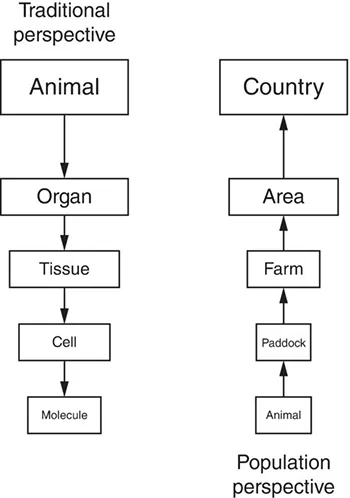
Fig. 1.1 Representation of the relationship between the traditional perspective of investigating disease and a population perspective.
1.3 Diseases in Populations
Epidemiology is the study of patterns and causes of disease in populations. Understanding these issues will in turn contribute to identification of options for control and prevention of diseases. At its simplest, epidemiology is about supporting better decision making to ensure appropriate response or preventative measures for population health.
Suboptimal animal health and production in livestock systems may be approached as a type of disease. It is common to see epidemiologic principles and methods applied to livestock systems to ensure optimal health, welfare and production outcomes.
Most diseases do not occur at random in a population – they follow distinct patterns according to exposure of individuals in the population to various factors associated with the host, agent and environment (see Fig. 1.2). Epidemiologists rely on this non-random nature of disease events to generate and test hypotheses about likely causes and risk factors for disease.
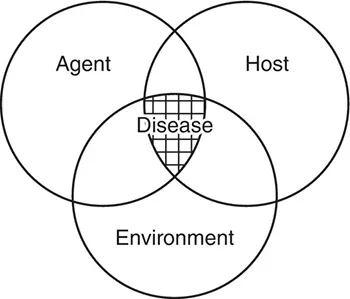
Fig. 1.2 Epidemiology studies the relationships between agent, host and environment resulting in disease occurrence.
Epidemiological studies provide insight not only into those factors operating at the population level but can also raise hypotheses worth exploring further at the individual animal, organ, cellular and genetic level. Thus, the understanding of disease processes operating at the population level requires both a downward (towards the molecular level) and upward (towards the population level) approach to investigation. By using such a bidirectional approach, fresh insights into the mechanisms and control of disease can be obtained.
1.4 Where Does Epidemiology Fit?
Epidemiology is an integrating science with close links to clinical and laboratory medicine as well as biostatistics and health economics. In addition, it is the basic science that underpins state veterinary medicine, biosecurity, preventive veterinary medicine and herd health programmes. Epidemiologists usually use the word disease in its broadest sense to include any health-related condition or event of interest, in addition to clinical illness.
Epidemiology is concerned with (adapted from Thrushfield, 2005, p. 16):
•detecting the existence of a disease or other production problem;
•identifying the causes of disease;
•estimating the risk of becoming diseased;
•obtaining information on the ecology and natural history of the disease;
•defining and quantifying the impact and extent of the problem;
•planning and evaluating possible disease control strategies and biosecurity measures;
•monitoring and surveillance to prevent further disease episodes; and
•assessing the economic impact of disease and control programmes.
1.5 The Role of Epidemiology in Policy Development
Effective animal health policy development requires not only a sound scientific basis, but also a clear understanding of the social and political context in which policy is being made. Successful interventions need to be politically, socially and economically acceptable if they are to be acted upon. Epidemiologists are in an excellent position to take a lead role in providing not only scientific input to policy, but also for integrating the broader ‘macro-epidemiological’ issues required for successful policy (Hueston, 2003).
Hueston (2003) uses the example of bovine tuberculosis (TB) in white-tailed deer in Michigan, USA. Despite bovine TB being close to eradication in the USA, increased deer populations in areas of north-east Michigan were providing a reservoir of infection that was jeopardizing progress with eradication in the region. The situation was compounded by poor farming conditions and low returns resulting in an increase in feeding of deer for hunting clubs as an alternative source of income. This led to increased deer density and congrega...
Table of contents
- Cover
- Half Title
- Title
- Copyright
- Contents
- Contributors
- Preface
- Acknowledgements
- 1 What is Epidemiology?
- 2 The Epidemiological Approach
- 3 Investigating Disease Outbreaks
- 4 Causality
- 5 Patterns of Disease
- 6 Measuring Disease Frequency
- 7 Diagnosis and Screening
- 8 Sampling Populations
- 9 Data Collection and Management
- 10 Exploratory Data Analysis
- 11 Introduction to Statistical Principles
- 12 Animal Health Surveillance
- 13 Regional Animal Health Programmes
- 14 Introduction to Risk Analysis
- 15 Spatial Epidemiology
- Glossary
- Index
- Back
Trusted by 375,005 students
Access to over 1.5 million titles for a fair monthly price.
Study more efficiently using our study tools.
Frequently asked questions
Yes, you can cancel anytime from the Subscription tab in your account settings on the Perlego website. Your subscription will stay active until the end of your current billing period. Learn how to cancel your subscription
No, books cannot be downloaded as external files, such as PDFs, for use outside of Perlego. However, you can download books within the Perlego app for offline reading on mobile or tablet. Learn how to download books offline
Perlego offers two plans: Essential and Complete
- Essential is ideal for learners and professionals who enjoy exploring a wide range of subjects. Access the Essential Library with 800,000+ trusted titles and best-sellers across business, personal growth, and the humanities. Includes unlimited reading time and Standard Read Aloud voice.
- Complete: Perfect for advanced learners and researchers needing full, unrestricted access. Unlock 1.5M+ books across hundreds of subjects, including academic and specialized titles. The Complete Plan also includes advanced features like Premium Read Aloud and Research Assistant.
We are an online textbook subscription service, where you can get access to an entire online library for less than the price of a single book per month. With over 1.5 million books across 990+ topics, we’ve got you covered! Learn about our mission
Look out for the read-aloud symbol on your next book to see if you can listen to it. The read-aloud tool reads text aloud for you, highlighting the text as it is being read. You can pause it, speed it up and slow it down. Learn more about Read Aloud
Yes! You can use the Perlego app on both iOS and Android devices to read anytime, anywhere — even offline. Perfect for commutes or when you’re on the go.
Please note we cannot support devices running on iOS 13 and Android 7 or earlier. Learn more about using the app
Please note we cannot support devices running on iOS 13 and Android 7 or earlier. Learn more about using the app
Yes, you can access Epidemiology for Field Veterinarians by Evan Sergeant,Nigel Perkins in PDF and/or ePUB format, as well as other popular books in Medicine & Veterinary Medicine. We have over 1.5 million books available in our catalogue for you to explore.