Visual Soil Evaluation provides land users and environmental authorities with the tools to assess soil quality for crop performance. An important tool for ensuring food security, this book appraises the use of visual soil evaluation in determining the potential of different land types for carbon storage, greenhouse gas emissions and nutrient leaching. Providing a guide to diagnosing and rectifying soil problems, it includes: - Full colour illustrations throughout to show variation of soil quality and aid evaluation- A broad range of land types, from abandoned peats to prime arable land- Assessment of soil structure after quality degradation such as compaction, erosion or organic matter lossEssential reading for students, researchers and scientists interested in soil science and crop production, this book is also a valuable tool for policy makers and environmental authorities. A useful handbook assessing yield potential across a range of scales, it places visual soil evaluation in the context of the future sustainable intensification of agriculture.
eBook - ePub
Visual Soil Evaluation
Realizing Potential Crop Production with Minimum Environmental Impact
- English
- ePUB (mobile friendly)
- Available on iOS & Android
eBook - ePub
Visual Soil Evaluation
Realizing Potential Crop Production with Minimum Environmental Impact
About this book
Information
1 Describing Soil Structures, Rooting and Biological Activity and Recognizing Tillage Effects, Damage and Recovery in Clayey and Sandy Soils
1Center of Expertise and Technology Transfer in Organic Agriculture and Local Food Systems (Centre d’expertise et de transfert en agriculture biologique et de proximité – CETAB+), Cégep de Victoriaville, Québec, Canada; 2Department of Agroecology – Soil Physics and Hydropedology, Aarhus University, Tjele, Denmark

*E-mail: [email protected]
Soil compaction and erosion have emerged as major threats to global agriculture as they negatively affect plant production and have detrimental impacts on the environment. Soil compaction is responsible for decreased crop yield and quality, emissions of greenhouse gases and increased water runoff (Hamza and Anderson, 2005; Ball et al., 2008). Unless severe, it is often unrecognized because plant growth can appear normal, especially when mineral fertilizers are used liberally. The major cropping factors affecting soil compaction are the weight of machinery, poor timing of field operations with respect to soil water content and intensification of crop production. Soil erosion is responsible for losses of soil particles, nutrients and agrochemicals resulting in decreased soil fertility as well as eutrophication of rivers and lakes (Rasouli et al., 2014). Site characteristics (rainfall quantity and intensity, slope and soil texture) have strong effects on soil erosion; in addition, important cropping factors related to soil erosion are crop rotation, percentage soil cover and management practices affecting soil structure and compaction (Pimentel et al., 1995; Morgan, 2005). Erosion deposits are mostly silt and fine sand with little structure and porosity and thus resemble soil damaged by compaction. Because compaction plays a central role in soil degradation and yield losses, it has to be properly diagnosed in the field. This can be done by observing soil structure, root development, aeration and evidence of biological activity.
This chapter will therefore focus on describing and illustrating important soil structural features associated with compaction and anaerobic conditions. It will cover the evaluation of soil structure and compaction status for both clayey and sandy soils. Since tillage is often responsible for the creation of a number of anthropic layers, each having a different structure, the identification of the different soil layers will be explained. The use of other indicators of soil compaction such as root development (density, deformation, concentration in cracks or between layers), aeration (soil colour) and biological activity (soil macroporosity of biological origin, rapidity of residue turnover, presence of earthworms) will also be covered.
A quick, preliminary evaluation of soil structure can be done using a spadeful of soil, allowing rapid verification of soil structure over the entire field. Since agricultural practices can often affect soil conditions to a depth of 30–50 cm, and sometimes more, soil condition may have to be investigated to such depths, depending on the situation.
Different tools can be used to assess soil structural quality, either using spade methods (e.g. the visual evaluation of soil structural quality, VESS, Ball et al., 2007; Guimarães et al., 2011), visual soil assessment (VSA, Shepherd et al., 2008; Shepherd, 2009), or profile methods (e.g. Cultural Profile, Manichon,1987; or the SoilPAK method, Mckenzie, 2001). These tools are described by Batey et al., Chapter 2, this volume.
Some helpful information for soil compaction diagnosis should also be collected by checking soil maps and interviewing farmers. The following information should be gathered:
• The origin and characteristic of the soil;
• The field situation; for example, surface and sub-surface drainage situation, crop rotation, yield variation in the field, size of the equipment for manure spreading and timing for spreading, harvesting strategy, tillage and number of passes, depth of tillage, etc.
For the purposes of this chapter a soil is considered to be in good condition if it has good structure, is well aerated and contains a sufficient amount of organic matter in the A horizon to be capable of supporting microbial activity and optimum plant growth.
1.1 Evaluation of Soil Structure
Soil structure is best evaluated considering soil texture because the criteria for assessing structure depend on the clay content. The pressure exerted on the soil by machinery forces aggregates to stick to each other and to form clods. Texture is important because the clods resulting from compacted clayey soil are often hard and difficult to break down, while clods resulting from compacted sandy soils are fairly easy to break. Although the relationship between soil characteristics and clay content lies on a continuous spectrum, the evaluation of soil structure will only be described here for two main, discrete groups labelled as follows: clayey soils (more than 25–30% clay) and sandy soils (less than 25–30% clay). Soil having 20–30% clay content will sometimes behave more like a clayey soil and sometime more like a sandy soil, depending on clay type and the organic matter content.
1.1.1 Evaluation of the structure of clayey soils
The structure of clayey soils can mostly be evaluated by observing the shape of aggregates and clods. When describing structure, soil horizonation needs to be taken into account because organic matter content, root density, aeration and biological activity tend to be much higher in the A horizon and these foster aggregation. This section aims at describing typical good and typical poor structure for clayey soils for both topsoil (A horizon) and subsoil layers (B and C horizon). The structure of naturally recovered clay soil is also described.
1.1.1.1 Soil structure of clayey soils in good condition
TOPSOIL (A HORIZON).
Aggregates of a well-structured clayey topsoil are small, in the 1–10 mm range, and well separated (Fig. 1.1a). They can be observed in some grasslands, some non-cultivated soils and in some areas that are not trafficked (permanent beds, controlled traffic systems). They are also common in intensively tilled top layers of recently cultivated soils.
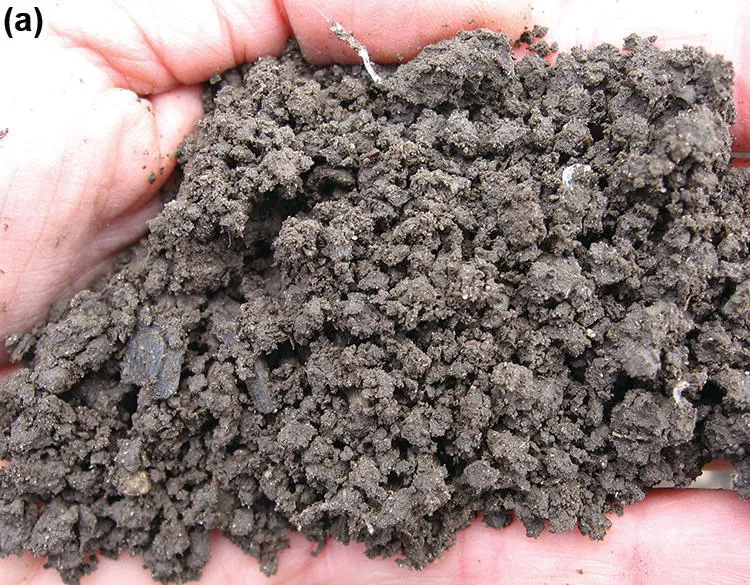
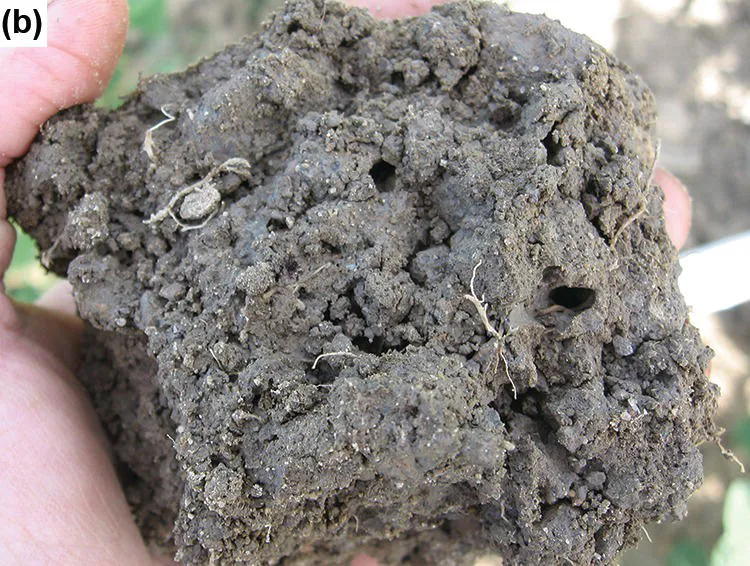
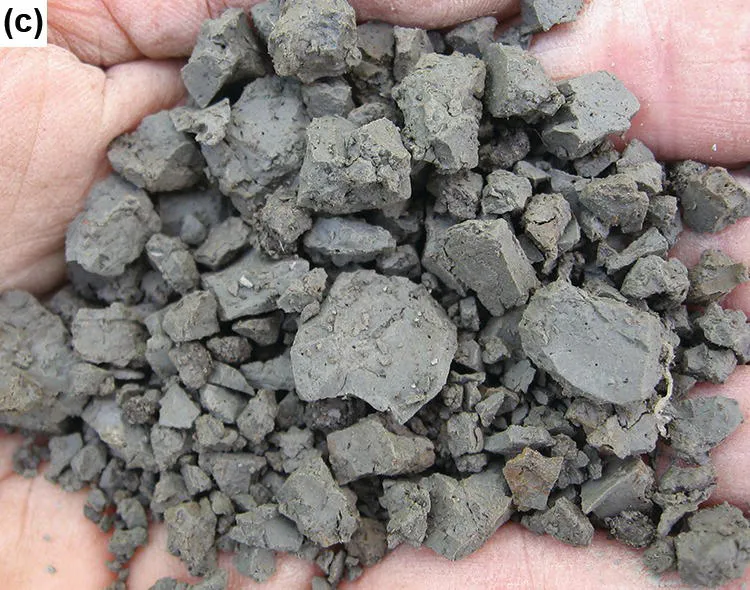
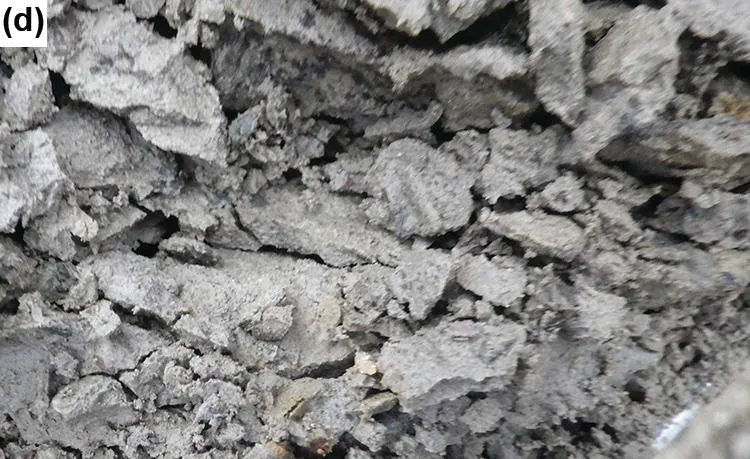
Fig. 1.1 Aggregates and clods in well-structured clayey soils. (a) Topsoil: small round aggregates, 1–5 mm in size, coming from a healthy A horizon. (b) Topsoil: very rough and porous clod coming from a very biologically active soil. The aggregates should detach from each other when the clod is squeezed. (c) Subsoil: small non-porous, angular, 2–10 mm aggregates. (d) Subsoil: lamellar structure, usually found in soil that contain less clay and more silt.
If the compaction pressure is light enough, the clods that are formed have a rough surface because the aggregates that constitute them keep their individual shapes (Fig. 1.1b). They are porous because of the space between the aggregates (not always visible with the naked eye) and the biological activity which creates pores.
In a non-compacted soil it should be very easy to separate the aggregates in the clod by simply squeezing the clod in the fist. However, to do this the clod must be fairly moist. Clay becomes very hard when it dries, which can give a false impression of being highly compacted.
When examining a spadeful of healthy soil, it is often possible to see an excellent structure with aggregates well separated from each other in the seedbed layer because of the effect of harrowing. Below the seedbed, the clods are rough and easy to break (Fig. 1.2).
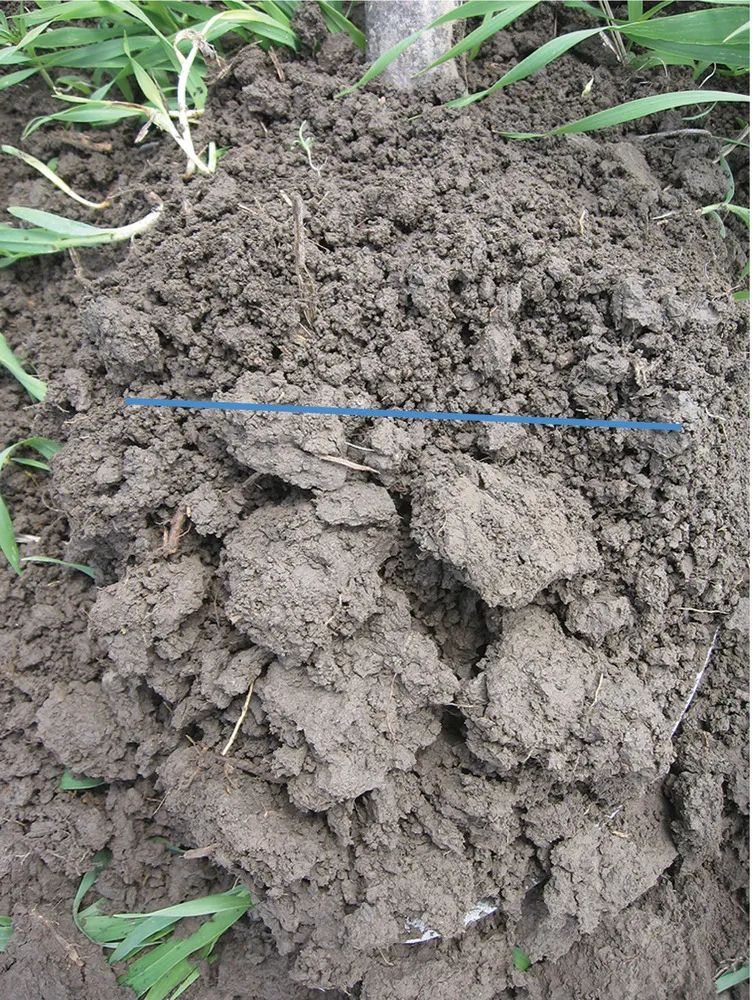
Fig. 1.2 Healthy clay soil with mostly aggregates in the top part (seedbed) and rough and porous clods in the bottom part (below seedbed).
SUBSOIL (B AND C HORIZONS).
In a well-structured subsoil the aggregates are small (2–10 mm) and can either be rounded (Fig 1.1a) or more angular in shape (Fig. 1.1c)....
Table of contents
- Cover
- Half Title
- Title
- Copyright
- Contents
- List of Contributors
- Preface
- 1 Describing Soil Structures, Rootingand Biological Activity and Recognizing Tillage Effects, Damage and Recovery in Clayey and Sandy Soils
- 2 Assessing Structural Quality for Crop Performance and for Agronomy (VESS, VSA, SOILpak, Profil Cultural, SubVESS)
- 3 Reduction of Yield Gaps and Improvement of Ecological Function through Local-to-Global Applicationsof Visual Soil Assessment
- 4 Visual Evaluation of Grasslandand Arable Management Impactson Soil Quality
- 5 Choosing and Evaluating Soil Improvements by Subsoiling and Compaction Control
- 6 Valuing the Neglected: Lessons and Methods from an Organic, Anthropic Soil System in the Outer Hebrides
- 7 Evaluating Land Quality for Carbon Storage, Greenhouse Gas Emissions and Nutrient Leaching
- 8 Soil Structure under Adverse Weather/Climate Conditions
- 9 The Expanding Discipline and Role of Visual Soil Evaluation
- Index
- Back
Trusted by 375,005 students
Access to over 1.5 million titles for a fair monthly price.
Study more efficiently using our study tools.
Frequently asked questions
Yes, you can cancel anytime from the Subscription tab in your account settings on the Perlego website. Your subscription will stay active until the end of your current billing period. Learn how to cancel your subscription
No, books cannot be downloaded as external files, such as PDFs, for use outside of Perlego. However, you can download books within the Perlego app for offline reading on mobile or tablet. Learn how to download books offline
Perlego offers two plans: Essential and Complete
- Essential is ideal for learners and professionals who enjoy exploring a wide range of subjects. Access the Essential Library with 800,000+ trusted titles and best-sellers across business, personal growth, and the humanities. Includes unlimited reading time and Standard Read Aloud voice.
- Complete: Perfect for advanced learners and researchers needing full, unrestricted access. Unlock 1.5M+ books across hundreds of subjects, including academic and specialized titles. The Complete Plan also includes advanced features like Premium Read Aloud and Research Assistant.
We are an online textbook subscription service, where you can get access to an entire online library for less than the price of a single book per month. With over 1.5 million books across 990+ topics, we’ve got you covered! Learn about our mission
Look out for the read-aloud symbol on your next book to see if you can listen to it. The read-aloud tool reads text aloud for you, highlighting the text as it is being read. You can pause it, speed it up and slow it down. Learn more about Read Aloud
Yes! You can use the Perlego app on both iOS and Android devices to read anytime, anywhere — even offline. Perfect for commutes or when you’re on the go.
Please note we cannot support devices running on iOS 13 and Android 7 or earlier. Learn more about using the app
Please note we cannot support devices running on iOS 13 and Android 7 or earlier. Learn more about using the app
Yes, you can access Visual Soil Evaluation by Bruce C. Ball, Lars J. Munkholm, Bruce C. Ball,Lars J. Munkholm in PDF and/or ePUB format, as well as other popular books in Technology & Engineering & Agronomy. We have over 1.5 million books available in our catalogue for you to explore.