This book is contemporary, topical and global in its approach, and provides an essential, comprehensive treatise on bovine tuberculosis and the bacterium that causes it, Mycobacterium bovis. Bovine tuberculosis remains a major cause of economic loss in cattle industries worldwide, exacerbated in some countries by the presence of a substantial wildlife reservoir. It is a major zoonosis, causing human infection through consumption of unpasteurised milk or by close contact with infected animals. Following a systematic approach, expert international authors cover epidemiology and the global situation; microbial virulence and pathogenesis; host responses to the pathogen; and diagnosis and control of the disease. Aimed at researchers and practising veterinarians, this book is essential for those needing comprehensive information on the pathogen and disease, and offers a summary of key information learned from human tuberculosis research. It will be useful to those studying the infection and for those responsible for controlling the disease.

eBook - ePub
Bovine Tuberculosis
- English
- ePUB (mobile friendly)
- Available on iOS & Android
eBook - ePub
About this book
Information
Topic
MedicineSubtopic
Veterinary Medicine1 Bovine Tuberculosis: Worldwide Picture
World Organisation for Animal Health (OIE), Paris, France
1.1 Introduction
Bovine tuberculosis caused by Mycobacterium bovis is a disease of livestock and wildlife and causes global economic losses, including those resulting from trade barriers (OIE, 2015), estimated at several billion USD annually despite widespread control efforts (Schiller et al., 2010).
The objective of this chapter is to provide information on the worldwide bovine tuberculosis situation, using data from the OIE. The OIE’s World Animal Health Information System (WAHIS), is a reference for conducting global analyses in this field.
1.1.1 The World Organisation for Animal Health and the World Health Information System
The dissemination of rinderpest in Europe in 1920, resulting from a shipment of infected zebu cattle originating from India and destined for Brazil transiting through the Belgium port of Antwerp, alerted a group of countries to the need to organize themselves to notify the sanitary status of their animals and animal products prior to commercialization. The resurgence of rinderpest in Europe, from whence it had been eradicated, highlighted the need for international collaboration to control major infectious animal diseases. Concern over the resulting international spread of rinderpest led to an international conference of Chief Veterinary Officers from various countries in May 1921 in Paris. This eventually led to the creation in 1924 of the Office International des Epizooties (OIE), founded by 28 Member Countries, under the terms of the International Agreement signed on 25 January 1924 (OIE, 2011). The exchange of information on animal diseases between countries was one of the prime reasons for creating the OIE, with the ultimate aim of ensuring transparency of the animal health situation worldwide.
In May 2003 the Office became the World Organisation for Animal Health but kept its historic acronym ‘OIE’. The OIE is the intergovernmental organization responsible for improving animal health worldwide. It is recognized as the reference organization by the World Trade Organization (WTO) in this domain and in 2016 had a total of 180 member countries. The OIE maintains permanent relations with 71 other international and regional organizations and has regional and sub-regional offices on every continent. The missions of the OIE are as follows:
* Email: [email protected]
© CAB International 2018. Bovine Tuberculosis (eds M. Chambers, S. Gordon, F. Olea-Popelka, P. Barrow)
• Ensuring transparency in the global animal disease situation.
• Collecting, analysing and disseminating veterinary scientific information.
• Encouraging international solidarity in the control of animal diseases.
• Safeguarding world trade by publishing health standards for international trade in animals and animal products.
• Improving the legal framework and resources of national Veterinary Services for a good sanitary governance.
• Providing a better guarantee of the safety of food of animal origin and promoting animal welfare through a science-based approach.
Within the framework of the OIE’s first mandatory mission (‘ensuring transparency in the global animal disease situation’), each member country undertakes to report the animal diseases, including those transmissible to humans, that it detects on its territory. This applies both to naturally occurring and deliberately caused disease events. The OIE then disseminates the information to other countries, which can then take any necessary preventive actions. Information is sent out immediately or periodically depending on the seriousness of the disease.
In 2006, to help its member countries fulfil their reporting obligations, the OIE launched the WAHIS, a secure computer system accessible via the Internet that enables member countries to enter, store and view data on animal diseases, including zoonoses, in the OIE’s three official working languages (English, French and Spanish). WAHIS replaced the former system (Handistatus), which was the first online reporting system. Access to this secure system is only available to authorized users, namely the delegates of OIE member countries and their authorized representatives. After this information has been verified and validated by the OIE, it is published on the public WAHIS portal (OIE, 2016a).
WAHIS consists of four inter-related components (see OIE, 2015):
• The early warning system, the main component dedicated to animal health events notifiable within 24 hours of confirmation, which allows other countries to take appropriate measures to prevent the spread of animal diseases with a significant impact. The early warning system includes the notification of more than 100 OIE-listed diseases and other emerging diseases in domestic animals and wildlife.
• The monitoring system, which enables countries to notify every 6 months the presence or absence of more than 100 diseases listed by the OIE, and includes several types of reports on terrestrial and aquatic animal diseases in domestic animals and wildlife.
• The annual report, through which important additional information on the national veterinary services and other relevant details about the country are collected once a year (zoonotic diseases transmitted to humans, animal population figures, veterinary staff, vaccine production, etc.).
• The ‘Wild’ annual report, which enables countries to notify information on more than 50 diseases in wildlife that are not listed by the OIE. This report is submitted by member countries on a voluntary basis.
1.2 Bovine Tuberculosis Notification Since the Creation of the OIE
At the creation of the OIE and as per its Organic Statutes (OIE, 1924), signed on 25 January 1924, member countries had a legal obligation to forward to the Organisation information on the presence and distribution of the following nine diseases: anthrax, contagious pleuropneumonia, dourine, glanders, foot and mouth disease, rabies, rinderpest, sheep pox and swine fever.
However, even though animal tuberculosis (including both bovine and avian tuberculosis) was not listed at that time, information that had been provided for this disease was published in 1927 in the Bulletin of the Office International des Epizooties. This issue of the OIE Bulletin contained statistics on animal health status worldwide (Fig. 1.1). This is the first notification of animal tuberculosis recorded in the OIE archives.
Bovine tuberculosis was included among the OIE-listed diseases in May 1964, when the list of notifiable diseases was revised by the International Committee1 of the OIE. This revision took into consideration changes in the national zoosanitary legislation of member countries during the previous 40 years, the large number of different diseases that were now included in national sanitary legislation, and the specific request by some international organizations, such as the Food and Agriculture Organization of the United Nations (FAO), the Organisation for Economic Co-operation and Development and the European Economic Community, that the OIE establish a new list of diseases.2
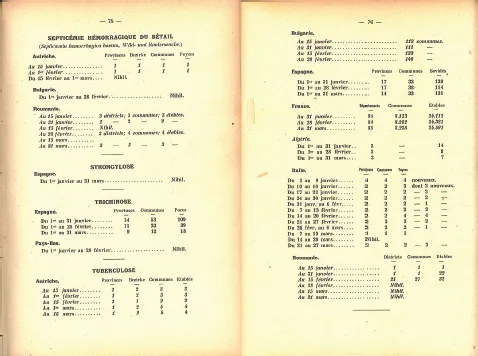
Fig. 1.1. Statistics on animal tuberculosis published in the Bulletin of the Office International des Epizooties, July 1927–June 1928.
Bovine tuberculosis was initially included in List B,3 comprising diseases reportable annually to the OIE. This list included all the transmissible diseases that were considered to be of socio-economic or public health importance within countries and that were significant in the international trade of animals and animal products. In contrast, List A4 comprised compulsorily notifiable diseases to be reported monthly or fortnightly to the OIE. This list included all the transmissible diseases that were potentially able to spread across national borders very rapidly with serious socio-economic or public health effects and that are of major significance for international trade in animals and their products. In 1996, the launch of the OIE Handistatus online reporting system enabled member countries to provide information in a digital form.
In 2004, the International Committee of the OIE passed resolutions that, together with the recommendations of the Regional Commissions of the OIE, instructed OIE Headquarters to establish one list of notifiable terrestrial and aquatic animal diseases that would replace Lists A and B produced formerly, which included 15 and 93 diseases, respectively. The OIE developed criteria to identify diseases that would be included in this OIE single list. These criteria were approved in May of that year and in 2005 this first single list came into effect (see OIE, 2015). The criteria relate to the risks of spread of the infectious microorganism inter nationally, together with the consequences for humans, for domestic livestock and wildlife and the of reliable methods for diagnosis and detection.
In parallel with the implementation of this list, the launch of WAHIS meant that member countries could now generate information on diseases on this OIE list in a standardized format. Several improvements to WAHIS then enabled member countries to provide more detailed information on OIE-listed diseases, in particular for wildlife. Thus, since 2009 it has been possible to report the occurrence of diseases in domestic animals and in wildlife separately and, since 2012, to provide both the scientific and common names of the wildlife species affected. Bovine tuberculosis has been listed by the OIE since 1964.
1.3 Trend in the Presence of Bovine Tuberculosis over the Past 30 Years
This section presents the results of an analysis of changes in the presence of bovine tuberculosis over the past 30 years, based on data collected by the OIE. From 1986 to 1995, the annual occurrence of bovine tuberculosis in member countries was compiled in the annual OIE publication World Animal Health. Thereafter, the data were digitized and from 1996 to 2004 they were recorded in the ‘Handistatus’ information system. Since 2005, they have been collected through WAHIS.
For each year between 1986 and 2015, the annual percentage of affected countries among those providing the OIE with information was calculated, as well as the 95% confidence interval (Fig. 1.2).
The number of OIE member countries varied during the period of the analysis, increasing from 103 in 1986 to 180 in 2015. The historical trend in the presence of bovine tuberculosis is therefore influenced by the variation in the number of reporting member countries throughout the years.
The percentage of reporting countries that notified bovine tuberculosis present decreased between 1986 and 2015, from 84% (CI95% = 80%–88%) to 50% (CI95% = 46%–54%) (Spearman’s rank correlation = 8764, p < 0.001; rho = −0.95), indicating a general improvement in the global situation over the past 30 years. This trend followed a simple linear model (R2 = 0.9; p < 0.001). Even if the data present a high degree of variability among the different years, the overall tendency is clearly shown by the regression model. Variability in the observed trend can be explained by different levels of accuracy and quality of the information provided to the OIE by member countries. The diagnostic capabilities and the degree of preparedness of the veterinary services may vary from month to month during the year and among the countries. These differences should be considered when assessing historical trends in disease.
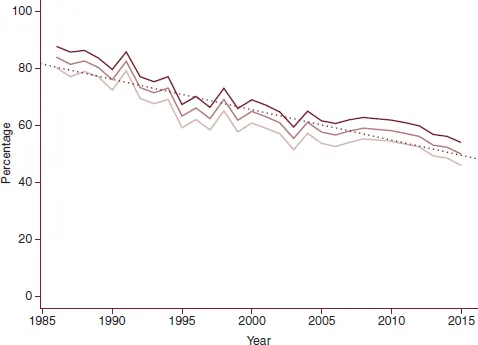
Fig. 1.2. Percentage of the reporting countries for each year between 1986 and 2015 that notified bovine tuberculosis present, with the 95% confidence interval, and simple linear regression trend line.
In order to analyse and compare regional differences, reporting countries are categorized by geographical region and the trend was calculated by each region. Regional trends are presented in Fig. 1.3. In all regions, the percentage of reporting countries notifying bovine tuberculosis decreased significantly from 1986 to 2015.
The most rapid decrease was observed in O...
Table of contents
- Front Cover
- Title Page
- Copyright Page
- Contents
- Preface
- Contributors
- List of Figures
- 1 Bovine Tuberculosis: Worldwide Picture
- 2 Mycobacterium bovis as the Causal Agent of Human Tuberculosis: Public Health Implications
- 3 Economics of Bovine Tuberculosis: A One Health Issue
- 4 The Epidemiology of Mycobacterium bovis Infection in Cattle
- 5 Mycobacterium bovis Molecular Typing and Surveillance
- 6 Bovine Tuberculosis in Other Domestic Species
- 7 Role of Wildlife in the Epidemiology of Mycobacterium bovis
- 8 Molecular Virulence Mechanisms of Mycobacterium bovis
- 9 The Pathology and Pathogenesis of Mycobacterium bovis Infection
- 10 Innate Immune Response in Bovine Tuberculosis
- 11 Adaptive Immunity
- 12 Immunological Diagnosis
- 13 Biomarkers in the Diagnosis of Mycobacterium tuberculosis Complex Infections
- 14 Vaccination of Domestic and Wild Animals Against Tuberculosis
- 15 Managing Bovine Tuberculosis: Successes and Issues
- 16 Perspectives on Global Bovine Tuberculosis Control
- Index
- Back Cover
Trusted by 375,005 students
Access to over 1.5 million titles for a fair monthly price.
Study more efficiently using our study tools.
Frequently asked questions
Yes, you can cancel anytime from the Subscription tab in your account settings on the Perlego website. Your subscription will stay active until the end of your current billing period. Learn how to cancel your subscription
No, books cannot be downloaded as external files, such as PDFs, for use outside of Perlego. However, you can download books within the Perlego app for offline reading on mobile or tablet. Learn how to download books offline
Perlego offers two plans: Essential and Complete
- Essential is ideal for learners and professionals who enjoy exploring a wide range of subjects. Access the Essential Library with 800,000+ trusted titles and best-sellers across business, personal growth, and the humanities. Includes unlimited reading time and Standard Read Aloud voice.
- Complete: Perfect for advanced learners and researchers needing full, unrestricted access. Unlock 1.5M+ books across hundreds of subjects, including academic and specialized titles. The Complete Plan also includes advanced features like Premium Read Aloud and Research Assistant.
We are an online textbook subscription service, where you can get access to an entire online library for less than the price of a single book per month. With over 1.5 million books across 990+ topics, we’ve got you covered! Learn about our mission
Look out for the read-aloud symbol on your next book to see if you can listen to it. The read-aloud tool reads text aloud for you, highlighting the text as it is being read. You can pause it, speed it up and slow it down. Learn more about Read Aloud
Yes! You can use the Perlego app on both iOS and Android devices to read anytime, anywhere — even offline. Perfect for commutes or when you’re on the go.
Please note we cannot support devices running on iOS 13 and Android 7 or earlier. Learn more about using the app
Please note we cannot support devices running on iOS 13 and Android 7 or earlier. Learn more about using the app
Yes, you can access Bovine Tuberculosis by Mark Chambers, Stephen Gordon, Francisco Olea-Popelka, Paul Barrow, Mark Chambers,Stephen Gordon,Francisco Olea-Popelka,Paul Barrow in PDF and/or ePUB format, as well as other popular books in Medicine & Veterinary Medicine. We have over 1.5 million books available in our catalogue for you to explore.