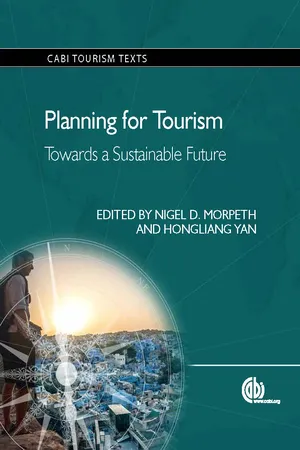
This text provides an innovative approach to the pedagogy of contemporary planning processes within different cultural contexts globally. It adopts an innovative multi-disciplinary social science approach and through the inclusion of international case studies, considers the extent to which intelligent design has enabled the needs of disabled residents and visitors to have universal access to social spaces and facilities. In incorporating the consideration into the fabric of the book it will encourage the mainstreaming of universal design and accessible tourism, as keystones of planning processes within the C21st.
eBook - ePub
Planning for Tourism
Towards a Sustainable Future
- English
- ePUB (mobile friendly)
- Available on iOS & Android
eBook - ePub
Planning for Tourism
Towards a Sustainable Future
About this book
Information
PART I
Processes and Approaches to Planning and Tourism
The chapters in Part I review different conceptual aspects of planning, tourism and sustainability, explored from different interdisciplinary perspectives. These perspectives preface and underpin four practitioner-based chapters in Part II, and then in Part III, seven applied case study chapters, written by academics from diverse cultural contexts in different parts of the globe. The three chapters comprise:
• Chapter 1: Approaches to Planning and Tourism – Hongliang Yan and Nigel D. Morpeth provide a thorough academic overview of the key conceptual and theoretical aspects of classical approaches to tourism planning, in the first instance discussing the relationship between policy and planning. The characteristics and techniques of different planning traditions are reviewed and a case study focuses on how an integrated planning approach is related to sustainable tourism development.
• Chapter 2: Sustainability: From Theory to Practice – Nigel D. Morpeth and Hongliang Yan initially consider different discourses of sustainability from both Eastern and Western perspectives. The chapter then considers distinctions between sustainable development and sustainability and the emergence of these concepts, politically, and in pedagogy and policy. Finally, a case study of the UK considers how principles of sustainability have informed planning and policy agendas.
• Chapter 3: Critical Approaches to Spatial Analysis – Nigel D. Morpeth and Hongliang Yan use interdisciplinary approaches to review different perspectives of the natural environment and to consider dualist thinking between the natural and the social environment. This chapter then considers how critical theory can be used to create insights as to how spatial analysis can be applied to planning, for the needs of different intersectional groups, in diverse cultural localities. A case study on mega-events, and specifically the Brazil 2014 soccer World Cup, contextualizes the conceptual aspects of spatial analysis.
chapter 1
Approaches to Planning and Tourism
LEARNING OBJECTIVES
• To develop an understanding of the importance of tourism planning and the relationship between tourism planning and policy.
• To recognize the characters of different planning traditions and the planning techniques and methods employed by each tradition.
• To outline the different elements in the integrated planning approach and relate them to sustainable tourism development.
INTRODUCTION
The aim of this chapter is to provide an intro-duction and discussion on the topic of tourism planning, with three main tasks. First, it -explores the theoretical scope of -planning and policy studies and the relationship between tourism planning and policy. Secondly, it discusses the traditions of tourism planning approaches in tourism development and highlights the main issues, methods, strengths and limitations of each tradition. Finally, a case study explains how integrated tourism planning and processes might be used as a planning approach which exemplifies the principles of sustainability, which can be -applied at national, regional and local levels.
UNDERSTANDING TOURISM PLANNING
Tourism
What exactly is meant by the term tourism? Tourism is a complex field of study and -difficult to define as an industry and as Leiper (1993) emphasizes from both an academic and an industrial perspective, it is a concept that is subject to a diversity of meanings and interpretations. Additionally, both he and Mathieson and Wall (1982) suggest that tourism can be described as a ‘system’. Historically, it is a phenomenon that is well researched by researchers from varied disciplines, such as geography, sociology, anthropology, economics and business studies and as such is interdisciplinary in its scope. The United Nations World Tourism Organization (UNWTO) provides a commonly accepted definition of tourism, as a social, cultural and economic phenomenon, which entails the movement of people to countries or places outside their usual environment for personal or business and professional purposes (UNWTO, 2013). What is without ambiguity is that tourism is an important global activity, generating employment, revenue and general economic, environmental and socio-cultural impacts. UNWTO emphasizes that it is an important economic force for many countries and regions: in 2013, international tourism receipts reached an estimated US$1159 bn worldwide, up 5% in real terms from US$1078 bn in 2012 (UNWTO, 2014). Arguably, planning policies and processes have an important role in harnessing the benefits of tourism and mitigating externalities which have blighted communities in a range of physical environments globally. In the process there have been intensifying calls for greater synergies between tourism and sustainability.
Tourism and sustainability
As far back as 1975, Turner and Ash exploded the myth that rapid tourism development would inevitably provide economic and societal benefits for destinations, regions and countries. The prominent negative impacts that they highlighted to society (the social–physical environment, exacerbated by an age of mega-mass tourism) provide a seemingly insoluble challenge in achieving the goal of long-term sustainability (Fayos-Sola, 1996). Those challenges have been gradually but inconsistently recognized by governments, community and other stakeholders in tourism and stimulated by global engagement in recognizing the challenge of sustainable development through the Brundtland Report (Our Common Future) (WCED, 1987) and United Nations Conference on Environment and Development (UNCED) global conferences to set in train initiatives to work towards -sustainability. Brundtland and UNCED, as we will see in detail in the next chapter, highlight the importance of sustainability to enable future world economic development to continue. Representatives of many authors that have applied an analysis of sustainability are Bramwell and Lane (1993, p. 2) who define sustainable tourism as ‘a positive approach intended to reduce the tensions and friction created by the complex interactions between the tourism industry, visitors, the environment and the communities which are host to holidaymakers’. Later, Bramwell et al.’s (1996) book Sustainable Tourism Management: Principles and Practice is considered as a milestone in the development of a theoretical framework for sustainable tourism. It recognized the need for tourism to respect the environment so as not to aid its own disappearance (Bramwell et al., 1996).
Although the concept of sustainable tourism has evolved from a narrowly defined term, to embrace all aspects of tourism over the past few decades, stakeholders may still have different views and inevitable contrasting interpretations of this term. Unsurprisingly what is viewed as the basis of sustainability is often difficult to determine, and as will be discussed in the next chapter, global blueprints must be cognizant of the discussion on sustainable tourism which has to take place in the context of the cultural and physical environments where tourism occurs (McCool, 1994). These contrasting localities form the focus of this book in the narratives of planning and sustainability. The challenge of sustainable tourism is that it is often difficult to implement at different levels as there are many stakeholders in the complex system of tourism. Later in the chapter the concept of sustainability will be applied to integrated forms of planning but initially the concept of tourism planning is explored in depth.
Tourism planning
Planning is usually about developing a vision and setting up objectives for the future. It is an ordered sequence of operations and actions that are designed to realize either a single goal or a set of interrelated goals and objectives (Williams, 2009). Murphy (1985, p. 156) suggests ‘planning is concerned with anticipating and regulating change in a system, to promote orderly development so as to increase the social, economic, and environmental benefits of the development process’. It is a series of activities that try to predict the future situation, based on the current understanding of tourism at a destination.
Tourism planning is a complex phenomenon with different types of social, cultural, economic and political implications and as with the concepts of tourism and sustainability, the definition and scope of tourism planning is ambiguous (Tosun and Jenkins, 1998). Tourism authors apply their emphasis and concerns on different aspects of tourism planning processes (Getz, 1987; Inskeep, 1991, 1994; Gunn, 1994; Hall et al., 1997; Timothy, 1998, 1999; Tosun and Jenkins, 1998; Dredge and Jenkins, 2007; Hall, 2008). A popular definition given by Getz (1987) suggests that tourism planning is a process which seeks to optimize the potential contribution of tourism to human welfare and environmental quality.
An important consideration of studying tourism planning is to consider the concept of tourism development, with its impacts on destinations and local communities which must be closely studied. Not least, carefully planned developments are likely to experience the most success in terms of high tourist satisfaction level, positive economic benefits, and minimal negative impacts on the local social, economic, and physical environments (-Timothy, 1998). On the contrary, it is also widely accepted that places adopting unplanned or insufficiently planned tourism development, provide host communities with environmental and social problems. To those destinations, they often have low destination competitiveness and high conflict resolution costs (Inskeep, 1991; Yuksel et al., 1999). Ironically, the demand of planning for tourism development is a direct response to unwanted effects brought by tourism development (Hall, 2008).
Therefore, there is an inescapable case for effective tourism planning in tourism destinations, if there is to be a likelihood of providing positive socio-cultural and economic benefits, as a prerequisite of realizing the goal of sustainability. Williams (2009) indicates that tourism planning is a mechanism for -delivering a range of more specific outcomes. Furthermore, he provides a list of the positive outcomes of tourism planning (Williams, 2009, p. 157), as below:
• the integration of tourism alongside other economic sectors;
• the direction and control of physical -patterns of development;
• the conservation of scarce or important resources;
• the active promotion and marketing of destinations; and
• the creation of harmonious social and cultural relations between tourists and locals.
Early studies of tourism planning have a significant focus on the economic benefits and the physical environmental concerns of tourism development. In the past several decades, there has been a growing awareness and emphasis on the socio-cultural aspects and the local community benefits in the study of tourism planning. For instance, Gunn and Var (2002) indicate that tourism must be planned towards goals of enhanced visitor satisfaction, community integration and greater resource protection.
Tourism policy
In the tourism sphere, policy is generally considered as a public policy which is designed to achieve specific objectives, relevant to tourism development at different levels. Tourism policy is an important area for study because of its practical and theoretical importance (Scott, 2011). As with other public policies, Hall and Jenkins (1995) argue that tourism policy is a political activity which reflects society’s values and ideologies, economic conditions reflecting the distribution of power institutions, and decision-making processes. A definition given by Goeldner and Ritchie (2012 p. 326) for this term is that ‘tourism policy is a set of regulations, rules, guidelines, directives, and development/promotion objectives and strategies that provide a framework within which the collective and individual decisions directly affecting long-term tourism development and the daily activities within a destination are taken’. Tourism policy is significantly influenced by the economic, social and cultural characteristics of society, as well as by the formal structures of government and other features of the political system (Hall, 2008).
Tourism policies are generally created as a mechanism for managing the development of the tourism sector. They should reflect the political attitude on tourism and the overall development policy of the country, region or locality. It has an important role in the promotion of a successful tourism destination. Goeldner and Ritchie (2012,...
Table of contents
- Cover
- Half Title
- Series
- Title
- Copyright
- Contents
- Contributors
- Preface
- Acknowledgements
- List of Figures
- List of Tables
- Part I Processes and Approaches to Planning and Tourism
- Part II Practitioner Approaches in Planning and Tourism
- Part III Global Approaches to Planning and Tourism
- Index
- Back Cover
Trusted by 375,005 students
Access to over 1.5 million titles for a fair monthly price.
Study more efficiently using our study tools.
Frequently asked questions
Yes, you can cancel anytime from the Subscription tab in your account settings on the Perlego website. Your subscription will stay active until the end of your current billing period. Learn how to cancel your subscription
No, books cannot be downloaded as external files, such as PDFs, for use outside of Perlego. However, you can download books within the Perlego app for offline reading on mobile or tablet. Learn how to download books offline
Perlego offers two plans: Essential and Complete
- Essential is ideal for learners and professionals who enjoy exploring a wide range of subjects. Access the Essential Library with 800,000+ trusted titles and best-sellers across business, personal growth, and the humanities. Includes unlimited reading time and Standard Read Aloud voice.
- Complete: Perfect for advanced learners and researchers needing full, unrestricted access. Unlock 1.5M+ books across hundreds of subjects, including academic and specialized titles. The Complete Plan also includes advanced features like Premium Read Aloud and Research Assistant.
We are an online textbook subscription service, where you can get access to an entire online library for less than the price of a single book per month. With over 1.5 million books across 990+ topics, we’ve got you covered! Learn about our mission
Look out for the read-aloud symbol on your next book to see if you can listen to it. The read-aloud tool reads text aloud for you, highlighting the text as it is being read. You can pause it, speed it up and slow it down. Learn more about Read Aloud
Yes! You can use the Perlego app on both iOS and Android devices to read anytime, anywhere — even offline. Perfect for commutes or when you’re on the go.
Please note we cannot support devices running on iOS 13 and Android 7 or earlier. Learn more about using the app
Please note we cannot support devices running on iOS 13 and Android 7 or earlier. Learn more about using the app
Yes, you can access Planning for Tourism by Nigel Morpeth, Hongliang Yan, Nigel D Morpeth,Hongliang Yan in PDF and/or ePUB format, as well as other popular books in Business & Industria dell'ospitalità e del turismo. We have over 1.5 million books available in our catalogue for you to explore.