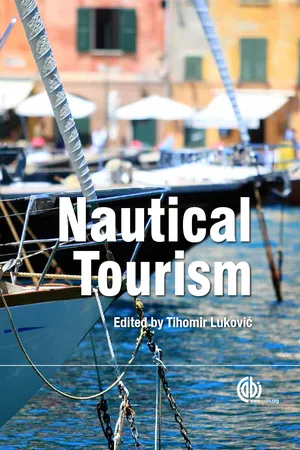
Nautical tourism encompasses aspects of marine tourism such as sailing, yachting, cruising and diving, as well as harbour-side developments, coastal water sports such as jet skiing, boat shows, port tours, and marine heritage destinations. Nautical tourism as an industry has been developing rapidly in scope and economic status and continues to do so. This book provides a timely analysis of nautical tourism in Europe, examining the provision and expansion of nautical tourism in economies at different stages of development. The book also covers nautical tourism in The Pacific, providing an analysis of two very different markets, and addresses the perceived North American take-over of cruising in Europe to provide insight into the global issues affecting nautical tourism. The book covers matters of current concern such as the role of nautical tourism in economic growth, sustainable development, international policy, consumer demand and the world market, development strategies, arctic tourism and the future potential of nautical tourism. Written by an international team of contributors the book also includes fascinating case studies to further explain and explore current concepts in nautical tourism.
eBook - ePub
Nautical Tourism
About this book
Information
Part 1
The Phenomenon of Nautical Tourism
Europe, the ‘old continent’, is the source of all development processes of the ‘new era’ and of urban culture, including tourism as a phenomenon and a lifestyle.
Tourism, the worldwide phenomenon, developed on the Mediterranean coast, which became the largest unique mega-destination and a meeting point of global tourist demand and supply. For every country, coasts are generally a highly valuable resource, especially in tourism. Nautical tourism, defined in theory as maritime or yachting tourism, has developed as the result of advanced demand and human needs, conditioned by the presence of natural resources. The dynamic of growth of nautical tourism is especially significant in all its subtypes or industries and is constantly increasing. However, the recession and global economic crisis during the end of the first decade of the third millennium have been evident in growth rates that are significantly lower than during earlier years. The development of economic subjects of nautical tourism and the method of their organization have all the characteristics of corporate business.
From macro- and micro-aspects, the need to study the growth and the management of nautical tourism development has become necessary for all countries, not only in the Mediterranean market but also in other global markets. Where to direct such development is the essential question in each market, and management is increasingly orienting the concept towards local and regional levels, a trend that contributes to the sustainable development that has become a sine qua non condition. In order to achieve proper development and its management it is necessary to study the market and its current characteristics. In recent years, there have been a number of studies in nautical tourism: this book will make a further contribution to this research.
The subject of our study is the European nautical tourism market, which will later be contrasted with research into cruising as a well-organized industry at a global level. In particular, it will be compared to the developed world cruise markets in the Pacific. The European nautical tourism market still has a number of insufficiently studied specific aspects in all nautical tourism sub-industries that will be included in this research, thus adding some important new perspectives.
The supply and the demand in the European nautical tourism market and its physical aspect, have, besides the characteristics of emitting and receiving markets, very specific development factors that need to be studied. Due to prominent differences in sub-markets of the European nautical tourism market, the research will be conducted selectively, taking into consideration market peculiarities.
The scientific and research goal set in this study is based on the field research conducted by a larger group of European, Canadian and Australian researchers, studying over 40,000 km of the Mediterranean coast, about 46,600 km of the European west Atlantic coast (excluding Norway), 9300 km of the Baltic Sea coast and several thousand kilometres of the European inland waterways (The World Factbook). Numerous new specific aspects of development have been observed, as well as patterns of development, cyclic changes and differences and similarities among various European markets. In view of the main characteristics of the market, leaving aside considerations of development level, the global European nautical market may be treated as an integral market, though with many internal differences. The integral European nautical tourism market is based on the differences of its sub-markets that make it distinctive. These observed differences are the results of a number of important factors, primarily climatic, natural and cultural factors and of the level of development. The goal set for this research may be defined by the following questions:
1. How to divide the European market in view of the specific aspects of the nautical tourism market and the goal of the research?
2. What are the main factors in the emergence and development of the European nautical tourism market?
3. What are the main characteristics of the European nautical tourism market and how is it organized?
4. What is the demand/supply ratio, how is it formed in each market and in each of the main types of nautical tourism?
5. How to organize the nautical tourism market in Europe so that development continuity is maintained and thus can contribute to an end of the economic crisis?
6. How to apply the concept of sustainable development of nautical tourism in all European markets, taking into account their specific aspects?
7. What is indicated by the development of nautical tourism and cruising in the developed markets of the Pacific, Australia and New Zealand?
8. Can the positive experience of nautical tourism markets of the Pacific be applied in European markets and if so, how?
9. What are the development possibilities of European nautical tourism markets and developed global markets?
Nautical tourism should be considered in terms of its variously manifested forms and subtypes, but a primary consideration should be its market-specific features that create supply and demand. Within the various types of nautical tourism, it is necessary to define and categorize market formation and development factors for each market. The functioning of a market has its regularities that will be studied and defined in this book.
The subject of this research is nautical tourism in the five main European markets, and the aim is to analyse their basic supply and demand characteristics, market verification, specific aspects of its types, the methods of market-oriented management at local and macro-levels and definitions of relations between economic subjects. The purpose of the research is to demystify the development possibilities of nautical tourism as a whole, primarily aimed at practical implementation and development support.
The main European markets have their distinguishing characteristics that should be taken into account when designing a supply in order to ensure effective development. Additional goals of this research are to study the limits of sustainable development of each European market and to analyse how the issue of sustainable development has been resolved in the nautical tourism markets of the Pacific.
Although the developed European countries, in contrast to transition countries, show development that follows the laws of free market, such development still requires some measure of control and regulation. Therefore, expert and scientific studies are necessary and are supported by each economy. Quality research contributes to better forecasts of nautical tourism strategic development and thus to reducing the business risk of active subjects in the industry.
The book is divided into 11 thematic chapters and consists of four main research sections.
Part 1 gives a theoretic study of nautical tourism, its sources, definitions, and classification of nautical tourism industries. Subjects are explained, European nautical tourism markets are specified and defined and sustainable development is explained and modelled.
Part 2 studies supply markets according to the basic classification of the European nautical tourism markets. For each market studies are conducted separately for each country and for the main industries of nautical tourism. The study of nautical tourism supply is conducted on the basis of available data, though some markets have remained effectively inaccessible for research. The main characteristics of demand are studied in the following market-oriented section.
Part 3 discusses nautical tourism in the Pacific, specifically in the areas of marinas and cruising.
Part 4 discusses and estimates the future development of nautical tourism, taking into account the specific characteristics of the market. In Chapter 10 the authors of this book give their informed opinions on the possibilities for development of nautical tourism, and thereby contribute to the comprehensive breadth of this study.
Web Resources
The World Factbook: http://www.cia.gov
1 Tourism and Nautical Tourism
T. Luković*
Department of Nautical Tourism, University of Dubrovnik, Croatia
Department of Nautical Tourism, University of Dubrovnik, Croatia
Nautical tourism is becoming a significant part of many national economies and it is necessary to study its role in the overall system. Since nautical tourism is present in each tourist market worldwide, it is necessary to provide answers to numerous questions: how and why did it occur? What is its role and significance in the European economy and in the economy of the Pacific, Australia and New Zealand, considered from mega-, macro-, regional and local perspectives? This study seeks to find the answers to these questions.
1.1 Tourism as a Phenomenon
In order to determine the role of nautical tourism in global and national economies, its emergence needs to be explained, including the regularities in the emergence of its selective sub-types. Nautical tourism is a complex concept that is still not sufficiently defined; such a definition is a necessary starting point for a comprehensive study.
In its essence, the concept of tourism refers to the phenomenon of travel and a period of stay away from the place of permanent residence. The subject of such travel is a tourist, who, by changing for a time their place of stay, satisfies their need for a change. The need for ‘a change’ is a part of human nature, which, in addition to a basic need to belong to one locality, has also a general need for the discovery of new places.
In that way, a tourist satisfies one of the important human characteristics: the need for a change and for discovering the new. However, the crucial difference between the phenomenon of tourism and the human desire for exploring new localities relates to organized travel. Hence it can be concluded that the difference between travel for the purposes of entertainment, pleasure and new experiences and distinctively tourist travel, is in the degree of organization involved. We can conclude that tourism is organized travel and change of locality through which a tourist satisfies their need for rest, entertainment and other various needs arising from various motivations. This definition does not include travel related to professional obligations. This definition, however, still does not define sufficiently the phenomenon of tourism.
The entries for ‘tourism’ and ‘tourist’ quoted in the Oxford Dictionary and in Wikipedia show that etymologically they are derived from the root word ‘tour’, which, freely translated, means enjoying travelling with occasional stays at various places. However, the main concepts that relate to tourism were defined earlier. The ancient Greek language used the word ‘tornos’ (axis, lathe), while the Romans used the Latin synonym ‘tornum’ (tour).
Organized travel, motivated for example by the desire to satisfy religious needs, has existed since antiquity, so it would appear that religious tourism is one of the oldest selective tourism types. However, all authors agree that modern organized tourist travel started in the mid-19th century, relating particularly to the Mediterranean. There are records of organized visits to works of art of great masters found in the archives of developed late-Mediaeval countries such as Italy, Greece, England, Spain and others. English travellers were particularly engaged in such travels aimed at satisfying the wish to see treasures of art and culture, known as the ‘Grand Tour’, so that the expression ‘tour’ remains one of the important etymologic roots of the concept of tourism.
From a methodological aspect, tourism may be studied and defined in various ways, in accordance with the particular research goal. In this study, methods leading to a prescriptive definition of tourism and nautical tourism will be followed, using statistical and legislative definitions and methodology and other prescriptive definitions. A legislative definition of tourism and nautical tourism is particularly characteristic of transition economies. When defining European tourism and tourist markets, it is necessary to clarify important differences between developed countries and transition countries. Developed countries base their economies on the regularities of free markets, while transition countries, being former socialist countries, base their economic development on administrative organization used for managing the market. For example, Germany does not have a special law on tourism but it has a developed self-government at lower levels, through which it regulates, administers and develops all segments important for local and regional development. In order to regulate particular tourist activities, when necessary, additional enactments are adopted as, for instance, regulations relating to tourist agencies. Such legislation is usually applied at lower administrative level, regional or local, for easier implementation. Developed European countries do not have declared national strategies for the development of tourism, or development strategies for selective types of tourism. The reason lies in their distinctive tourism orientation and developed local self-government, which transition countries have not yet achieved.
The only general definition of tourism as such is to be found in a general dictionary of economics, as follows: ‘In general, tourism refers to all activities related to travelling, which are not regular travelling from a customary living locality to another locality and a stay there’ (Gabler Wirtschafts Lexikon, 1994). The definition makes further distinctions in terms of the motive, for private or business purposes, but not business purposes related to permanent employment. The rest is left to the effects of the market and to regional and local regulation of tourism, since it is local government that knows its aspirations best and how to realize them in relation to the environment. On the other hand, the transition countries define tourism and its selective types by ‘lex specialis’, ...
Table of contents
- Cover Page
- Title Page
- Copyright Page
- Contents
- Contributors
- Preface
- Part 1 – Introduction: The Phenomenon of Nautical Tourism
- Part 2 – The Markets of Nautical Tourism in Europe
- Part 3 – Nautical Tourism in the Pacific
- Part 4 – Development Opportunities for Nautical Tourism
- References
- Index
- Footnotes
Trusted by 375,005 students
Access to over 1.5 million titles for a fair monthly price.
Study more efficiently using our study tools.
Frequently asked questions
Yes, you can cancel anytime from the Subscription tab in your account settings on the Perlego website. Your subscription will stay active until the end of your current billing period. Learn how to cancel your subscription
No, books cannot be downloaded as external files, such as PDFs, for use outside of Perlego. However, you can download books within the Perlego app for offline reading on mobile or tablet. Learn how to download books offline
Perlego offers two plans: Essential and Complete
- Essential is ideal for learners and professionals who enjoy exploring a wide range of subjects. Access the Essential Library with 800,000+ trusted titles and best-sellers across business, personal growth, and the humanities. Includes unlimited reading time and Standard Read Aloud voice.
- Complete: Perfect for advanced learners and researchers needing full, unrestricted access. Unlock 1.5M+ books across hundreds of subjects, including academic and specialized titles. The Complete Plan also includes advanced features like Premium Read Aloud and Research Assistant.
We are an online textbook subscription service, where you can get access to an entire online library for less than the price of a single book per month. With over 1.5 million books across 990+ topics, we’ve got you covered! Learn about our mission
Look out for the read-aloud symbol on your next book to see if you can listen to it. The read-aloud tool reads text aloud for you, highlighting the text as it is being read. You can pause it, speed it up and slow it down. Learn more about Read Aloud
Yes! You can use the Perlego app on both iOS and Android devices to read anytime, anywhere — even offline. Perfect for commutes or when you’re on the go.
Please note we cannot support devices running on iOS 13 and Android 7 or earlier. Learn more about using the app
Please note we cannot support devices running on iOS 13 and Android 7 or earlier. Learn more about using the app
Yes, you can access Nautical Tourism by Tihomir Lukovic in PDF and/or ePUB format, as well as other popular books in Business & Hospitality, Travel & Tourism Industry. We have over 1.5 million books available in our catalogue for you to explore.