Rhizosphere biology is approaching a century of investigations wherein growth-promoting rhizomicroorganisms (PGPR) have attracted special attention for their ability to enhance productivity, profitability and sustainability at a time when food security and rural livelihood are a key priority. Bio-inputs - either directly in the form of microbes or their by-products - are gaining tremendous momentum and harnessing the potential of agriculturally important microorganisms could help in providing low-cost and environmentally safe technologies to farmers.One approach to such biologically-based strategies is the use of naturally occurring products such as PGPR.Advances in PGPR Research explores recent developments and global issues in biopesticide research, presented via extended case studies and up-to-date coverage of: · Low input biofertilizers and biofungicides used for sustainable agriculture.· Molecular techniques to enhance efficacy of microbial inputs.· Intellectual property issues in PGPR research. Written by an international team of experts, this book considers new concepts and global issues in biopesticide research and evaluates the implications for sustainable productivity. It is an invaluable resource for researchers in applied agricultural biotechnology, microbiology and soil science, and also for industry personnel in these areas.
eBook - ePub
Advances in PGPR Research
- English
- ePUB (mobile friendly)
- Available on iOS & Android
eBook - ePub
Advances in PGPR Research
About this book
Information
1 Mechanisms of Growth Promotion by Members of the Rhizosphere Fungal Genus Trichoderma
1Bio-Protection Research Centre, Lincoln University, Canterbury, New Zealand; 2Unidad Académica de Agronomía, Universidad Autónoma de Zacatecas, Zacatecas, México; 3CONACYT- Campo Experimental Zacatecas, Instituto de Investigaciones Forestales, Agrícolas y Pecuarias, Calera de V. R. Zacatecas, México; 4SCION, Rotorua, New Zealand
*E-mail: [email protected]
1.1 Introduction
Trichoderma species are cosmopolitan filamentous fungi found in agricultural, native prairie, forest, salt marsh, and desert soils of all biomes (rainforests, savannas, deserts, grasslands, temperate deciduous forest, temperate, conifer forest, Mediterranean scrub, taiga and tundra), as well as in lake water, dead plant material, living roots of virtually any plant species, seeds and air (Atanasova et al., 2013; Mukherjee et al., 2013; Waghund et al., 2016). The ability of Trichoderma spp. to thrive in such a wide range of habitats is linked to their capability to produce a number of bioactive molecules, such as lytic enzymes, antibiotics and multiple other secondary metabolites.
Rhizosphere competency is widespread among the Trichoderma and many strains are considered opportunistic plant endophytes frequently found in symbiotic relationships with diverse crops (including maize, tomato, cucumber, cotton, cocoa, etc.), ornamental flowers, grasses, palms, ferns, trees, etc. (Harman, 2000; Harman et al., 2004; Sobowale et al., 2007; Hohmann et al., 2011; Keswani et al., 2013; Cripps-Guazzone, 2014; Singh et al., 2016). Successful rhizosphere competence and endophytism are subject to host specificity and changes in abiotic environmental factors (Cripps-Guazzone, 2014).
Trichoderma spp. induce plant growth by direct and indirect mechanisms. Direct mechanisms include the facilitation or increment of nutrients uptake such as phosphate solubilization, iron sequestration and production of secondary metabolites, including phytohormones and volatile or non-volatile compounds (Vinale et al., 2012; Qi and Zhao, 2013; Saravanakumar et al., 2013; Zhao et al., 2014; Borges Chagas et al., 2015; Lee et al., 2015; Li et al., 2015; Bisen et al., 2016; Garnica-Vergara et al., 2016). Indirect mechanisms include biocontrol activity against plant pathogens (bacteria, fungi and nematodes) and the ability to impart abiotic stress tolerance within the plant (Bruce et al., 1984; Bae et al., 2009; Shukla et al., 2012; Yang et al., 2012; Qi and Zhao, 2013; Vinale et al., 2013; Contreras-Cornejo et al., 2014; Stewart and Hill, 2014; Zhao et al., 2014; Kottb et al., 2015; Shukla et al., 2015; Pandey et al., 2016; Zachow et al., 2016) (Fig. 1.1).
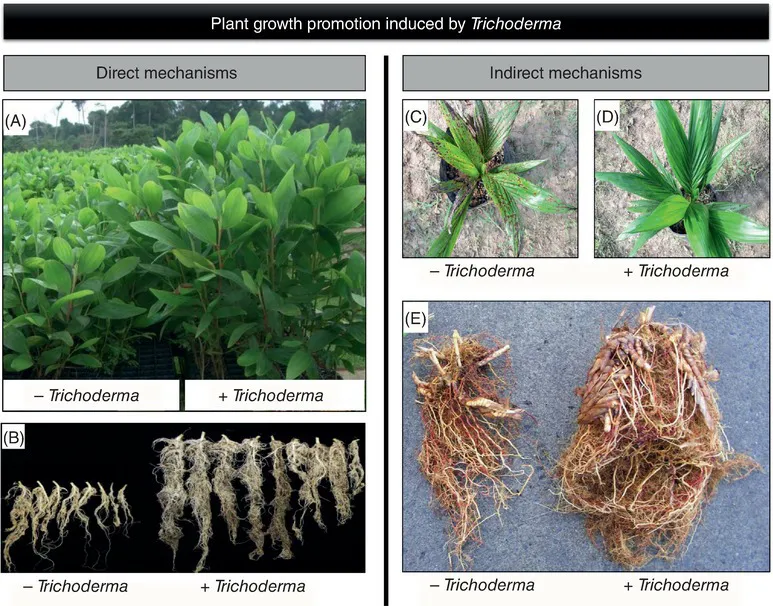
Fig. 1.1. Plant growth promotion induced by Trichoderma spp. (A-B) Direct mechanisms of induction (A). Plant growth promotion induced by Trichoderma (+) in Acacia mangium in comparison to control plants (–). In this experiment plants were free of any chemical pesticide or fertilizer. (B) Root growth promotion induced by Trichoderma in canola. Roots of plants untreated (left) and roots of plants inoculated with a mixture of T. atroviride (right). (C-E) Indirect mechanisms of induction (C), effect of leaf spot disease on untreated oil palm seedlings (D) and treated with endophytic Trichoderma spp. (E). Silvergrass roots grown in soil infested with Rhizoctonia solani (left) and treated plants with commercial product based on a mixture of Trichoderma isolates (right).
1.2 Trichoderma Plant Growth Promotion: Direct Mechanisms
1.2.1 Nutrient acquisition
Phosphorus and iron are the key elements for plant growth and, although these nutrients are abundant in nature, they are poorly accessible to plants (de Santiago et al., 2013). Microbial communities modify nutrient cycling in the rhizosphere, affecting nutrient availability to plants. Trichoderma spp. secrete diverse molecules, including siderophores, organic acid compounds and proteins that contribute to the solubility of inorganic phosphate and iron (Kapri and Tewari, 2010; Khan et al., 2010; de Santiago et al., 2013; Saravanakumar et al., 2013; Borges Chagas et al., 2015).
Phosphate solubilization
Phosphorus (P) is the second most limiting nutrient to plant growth behind nitrogen (N) (Condron, 2004) and, as a result, pasture and crops require the input of organic P through fertilizers (Koning et al., 2008; Simpson et al., 2014; Desmidt et al., 2015) to reach the growth levels needed for sustainable farming. Phosphate fertilizers contain phosphate rock which is mined from natural deposits and is therefore non-renewable (Desmidt et al., 2015). The uptake of organic P by plants is low, somewhere between 5% and 30% depending on the soil alkalinity (Condron, 2004). The rest forms insoluble inorganic compounds with aluminium (Al), iron (Fe) and calcium (Ca), unavailable for plant uptake (Ward et al., 1996; Heffer and Prud'homme, 2008). Phosphate-solubilizing micro-organisms, such as fungi and bacteria, play a major role in the transformation of insoluble soil P into soluble available forms (Rodriguez and Fraga, 1999; Khan, 2009), and therefore are potential bio-fertilizers. Trichoderma spp. have known P solubilizing activity (Kapri and Tewari, 2010; Mukherjee et al., 2013; Borges Chagas et al., 2015). The potential mechanism for phosphate solubilization might be acidification either by proton extrusion or association with ammonium assimilation.
Siderophores
Iron (Fe) is one of the most abundant elements on earth, however it is present as ferric ions in the soil which are not very soluble and are consequently inaccessible to plants (Lehner et al., 2013). Siderophores are molecules that solubilize Fe and as a consequence alter nutrient availability in soil environments for microorganisms and plants (Vinale et al., 2013). Lehner et al. (2013) analysed eight different strains of Trichoderma, including T. atroviride IMI206040, T. asperellum, T. gamsii, T. hamatum, T. virens Gv29.8, T. harzianum, T. polysporum and T. reesei QM6a and observed that on average Trichoderma spp. produced 12 to 14 siderophores, with six common to all species. In Trichoderma spp., intracellular siderophores are synthesized by three non-ribosomal protein synthases (NRPs), which are present as a cluster in the genome (Mukherjee et al., 2012a; Zeilinger et al., 2016). The role of the NRP6 from T. virens has been related to the biosynthesis of 10 of 12 extracellular secreted siderophores. Harzianic acid is a secreted siderophore molecule synthesized by T. harzianum and this molecule has plant growth-promoting and antifungal activity (Vinale et al., 2013). The role of siderophores in aiding competition with other microbes in the rhizosphere or in providing Fe to the plants has not been completely explored and there is still much work to be done to understand the role of these molecules in the plant–microbe–rhizosphere interaction and its relation to plant growth promotion.
Synthesis of secondary metabolites
Secondary metabolites produced by plant-associated microbes change the chemical and physical properties of soil, increasing iron, nitrogen or phosphorus availability (Bitas et al., 2013). Moreover, beneficial microorganisms are able to manipulate hormone signalling pathways in the host plant and as a consequence enhance plant growth (Kunkel and Brooks, 2002; Sofo et al., 2011; Spaepen and Vanderleyden, 2011). The chemical composition of secondary metabolites produced by Trichoderma is diverse (Vinale et al., 2012; Keswani et al., 2014; Bansal and Mukherjee, 2016; Zeilinger et al., 2016). Trichoderma metabolites directly influence plant physiology by modulating hormone activity in the plant, affecting nutrient solubility or by combating plant pathogens (Keswani et al., 2014).
HORMONES. Trichoderma synthesizes 3-indoleacetic acid (IAA), the major auxin in plants (Yue et al., 2014; Enders and Strader, 2015), acting as a plant growth promoter (Contreras-Cornejo et al., 2009). T. virens synthesizes indolic compounds, viz. IAA, indole-3-acetaldehyde (IAAld), indole-3-ethanol (tryptophol) and indole-3-carboxaldehyde (ICAld) (Contreras-Cornejo et al., 2009; 2011). IAA, IAAld and ICAld synthesized by T. virens have auxin activity in A. thaliana; however tryptophol did not show significant auxin activity in this model plant (Contreras-Cornejo et al., 2009; 2011). The exact mechanism and enzymes involved in the synthesis of IAA ar...
Table of contents
- Cover
- Half Title
- Title
- Copyright
- Contents
- Contributors
- Foreword
- Preface
- 1 Mechanisms of Growth Promotion by Members of the Rhizosphere Fungal Genus Trichoderma
- 2 Physiological and Molecular Mechanisms of Bacterial Phytostimulation
- 3 Real-time PCR as a Tool towards Understanding Microbial Community Dynamics in Rhizosphere
- 4 Biosafety Evaluation: A Necessary Process Ensuring the Equitable Beneficial Effects of PGPR
- 5 Role of Plant Growth-Promoting Microorganisms in Sustainable Agriculture and Environmental Remediation
- 6 Pseudomonas Communities in Soil Agroecosystems
- 7 Management of Soilborne Plant Pathogens with Beneficial Root-Colonizing Pseudomonas
- 8 Rhizosphere, Mycorrhizosphere and Hyphosphere as Unique Niches for Soil-Inhabiting Bacteria and Micromycetes
- 9 The Rhizospheres of Arid and Semi-arid Ecosystems are a Source of Microorganisms with Growth-Promoting Potential
- 10 Rhizosphere Colonization by Plant-Beneficial Pseudomonas spp.: Thriving in a Heterogeneous and Challenging Environment
- 11 Endophytomicrobiont: A Multifaceted Beneficial Interaction
- 12 Contribution of Plant Growth-Promoting Bacteria to the Maize Yield
- 13 The Potential of Mycorrhiza Helper Bacteria as PGPR
- 14 Methods for Evaluating Plant Growth-Promoting Rhizobacteria Traits
- 15 The Rhizosphere Microbial Community and Methods of its Analysis
- 16 Improving Crop Performance under Heat Stress using Thermotolerant Agriculturally Important Microorganisms
- 17 Phytoremediation and the Key Role of PGPR
- 18 Role of Plant Growth-Promoting Rhizobacteria (PGPR) in Degradation of Xenobiotic Compounds and Allelochemicals
- 19 Harnessing Bio-priming for Integrated Resource Management under Changing Climate
- 20 Unravelling the Dual Applications of Trichoderma spp. as Biopesticide and Biofertilizer
- 21 Genome Insights into Plant Growth-Promoting Rhizobacteria, an Important Component of Rhizosphere Microbiome
- 22 Plant Growth-Promoting Rhizobacteria (PGPR): Mechanism, Role in Crop Improvement and Sustainable Agriculture
- 23 PGPR: A Good Step to Control Several of Plant Pathogens
- 24 Role of Trichoderma Secondary Metabolites in Plant Growth Promotion and Biological Control
- 25 PGPR-Mediated Defence Responses in Plants under Biotic and Abiotic Stresses
- Index
- Back Cover
Trusted by 375,005 students
Access to over 1.5 million titles for a fair monthly price.
Study more efficiently using our study tools.
Frequently asked questions
Yes, you can cancel anytime from the Subscription tab in your account settings on the Perlego website. Your subscription will stay active until the end of your current billing period. Learn how to cancel your subscription
No, books cannot be downloaded as external files, such as PDFs, for use outside of Perlego. However, you can download books within the Perlego app for offline reading on mobile or tablet. Learn how to download books offline
Perlego offers two plans: Essential and Complete
- Essential is ideal for learners and professionals who enjoy exploring a wide range of subjects. Access the Essential Library with 800,000+ trusted titles and best-sellers across business, personal growth, and the humanities. Includes unlimited reading time and Standard Read Aloud voice.
- Complete: Perfect for advanced learners and researchers needing full, unrestricted access. Unlock 1.5M+ books across hundreds of subjects, including academic and specialized titles. The Complete Plan also includes advanced features like Premium Read Aloud and Research Assistant.
We are an online textbook subscription service, where you can get access to an entire online library for less than the price of a single book per month. With over 1.5 million books across 990+ topics, we’ve got you covered! Learn about our mission
Look out for the read-aloud symbol on your next book to see if you can listen to it. The read-aloud tool reads text aloud for you, highlighting the text as it is being read. You can pause it, speed it up and slow it down. Learn more about Read Aloud
Yes! You can use the Perlego app on both iOS and Android devices to read anytime, anywhere — even offline. Perfect for commutes or when you’re on the go.
Please note we cannot support devices running on iOS 13 and Android 7 or earlier. Learn more about using the app
Please note we cannot support devices running on iOS 13 and Android 7 or earlier. Learn more about using the app
Yes, you can access Advances in PGPR Research by Harikesh Bahadur Singh, Birinchi Sarma, Chetan Keswani, Harikesh Bahadur Singh,Birinchi K Sarma,Chetan Keswani in PDF and/or ePUB format, as well as other popular books in Biological Sciences & Biotechnology. We have over 1.5 million books available in our catalogue for you to explore.