Insects, being poikilothermic, are among the organisms that are most likely to respond to changes in climate, particularly increased temperatures. Range expansions into new areas, further north and to higher elevations, are already well documented, as are physiological and phenological responses. It is anticipated that the damage to crops and forests by insects will increase as a consequence of climate change, i.e. increasing temperatures primarily. However, the evidence in support of this common "belief" is sparse. Climate Change and Insect Pests sums up present knowledge regarding both agricultural and forest insect pests and climate change in order to identify future research directions.
eBook - ePub
Climate Change and Insect Pests
- English
- ePUB (mobile friendly)
- Available on iOS & Android
eBook - ePub
Climate Change and Insect Pests
About this book
Information

1 Climate Change and Insect Pest Distribution Range
Abstract
There is a pressing need to understand better the dynamics of species’ distribution, in particular when it comes to predicting the outcomes of climate change-inflicted variations in the range distributions of insect pests. Several insect life history traits, such as survival, growth rate and voltinism, are likely to change in a warmer environment, and it is to be expected that at least some changes will contribute to altered range edges. For many insect taxa, range expansions are not easy to detect, simply because their presence remains undetected in habitats at range edges, where they are likely to occur at low densities. Insect pests are a group for which information on range expansion is beginning to accumulate, for the obvious reason that their effects on managed ecosystems often require action. Thus, increasingly managers of agriculture and forestry are concerned with the predicted range expansions of important insect pests.
This chapter offers an update on the range expansions of insect pests in agriculture and forestry, native and alien. We summarize information from the literature where climate change has been interpreted as, or predicted to become, the driver of range expansion. We discuss the type of evidence for the expansion, ongoing or predicted to occur, and aim to classify according to its empirical nature.
A critical read of the database of the literature on climate change resulted in surprisingly few documented examples of climate change-induced range expansion. Of course, long-term trends in the distribution and abundance of insect pests are notoriously difficult to document. Thus, it is possible that more insect pests could have responded to climate change, or are likely to do so in the near future, than can be detected in our literature search. It is also possible, however, that biological systems, including insect pests, are less sensitive to direct climate effects than previously thought (due to the buffering effects of trophic interactions). Future research needs to focus more on the mechanisms of responses to changed climate in order to understand better, and predict more accurately, the likelihood that insect pests will expand their outbreak range.
1.1 Introduction
The geographical distribution of organisms is, in principle, easy to define; namely, the area under which, at any given point, population growth is positive (e.g. Gaston, 2003). Unfortunately, in practice, species distribution areas are difficult to determine in any detail; in fact, Gaston (2009) argues that for no single species do we have a complete understanding of its distribution. Despite these obvious difficulties, there is a pressing need to understand better the dynamics of species’ distribution, in particular when it comes to predicting the outcomes of climate change-inflicted variations in range distributions.
Insects are highly sensitive to increases in temperature because of their ectothermic lifestyle, in particular species inhabiting high-latitude environments (Deutsch et al., 2008). Several life history traits, such as survival, growth rate and voltinism, are likely to change in a warmer environment. Thus, even though we are far from understanding the details in range expansion dynamics, we would still expect climate-induced changes in life history traits to result in altered range edges under certain circumstances. Research over the past three decades has shown convincingly that such range shifts have indeed occurred for a number of taxa, with respect to latitude as well as elevation (Parmesan and Yohe, 2003; Chen et al., 2011).
For many insect taxa, range expansions are not easy to detect, simply because their presence remains undetected in habitats at the range edge, where they are likely to occur at low densities. It is not surprising, therefore, that our best understanding of range expansion following warming refers to taxa that are particularly conspicuous and of special interest to collectors, such as Lepidoptera (e.g. Mair et al., 2012). Economically important species (‘pests’) is another group for which information on range expansion is beginning to accumulate, for the obvious reason that their effects on managed ecosystems often require action. Thus, managers of agriculture and forestry increasingly are concerned with the predicted range expansions of important insect pests (e.g. Weed et al., 2013). In addition, accidental introductions of insects into novel geographic areas where they subsequently acquire pest status, i.e. become invasive (Blackburn et al., 2011), have increased in numbers during the last decades, and at least partly because of changes in climate (e.g. Robinet and Roques, 2010).
This chapter offers an update on the range expansions of insect pests in agriculture and forestry, native and alien. We summarize information from the literature where climate change has been interpreted as, or predicted to become, the driver of range expansion. We discuss the type of evidence for the expansion, ongoing or predicted to occur, and aim to classify according to its empirical nature.
1.2 Concepts and Definitions
In recent decades, much has been said about climate warming and increasing threats from insect pests to forestry and agriculture. In a very general way, such claims seem to be based on good logic; weather, and in particular temperature, does have a strong impact on insect growth and survival. However, a fair amount of these claims lack scientific support. It should be remembered that almost all insect populations are part of organism communities where trophic interactions play a crucial role. This means that extrapolating from climate-induced effects on insect individuals, or populations in isolation, to real insect populations in complex food webs must be viewed with caution.
Here, we present the state-of-the-art when it comes to understanding climate change-induced range expansion; intensified dispersal to novel geographic areas is an expected consequence of climate change. It is notoriously difficult to obtain good data on the dynamics of the distribution range of insects because of the large spatial scale, the timescale over which range changes take place and the difficulty in observing insect individuals (often at low density) that have extended outside of their previous range. The complex spatio-temporal dynamics taking place at the range edge (latitudinal and elevational) in need of consideration when determining insect range expansion are outlined schematically in Fig. 1.1.
Our interest here is on the range expansion of insect pests in forestry and agriculture, i.e. insect populations that occur at densities high enough to cause economic damage. This type of insect is likely to be discovered by managers, and scientifically reported by applied entomologists, at the early stage of an expansion (a ‘true’ expansion, however, might have taken place earlier through the dispersal of pioneer insects that have remained undetected). Consequently, this means that the literature is likely to cover most of the insect pests that have expanded into novel areas. For the purpose of this chapter, we compiled a database on pest expansion by conducting keyword searches using Web of Science and by examining the literature-cited sections of the papers.
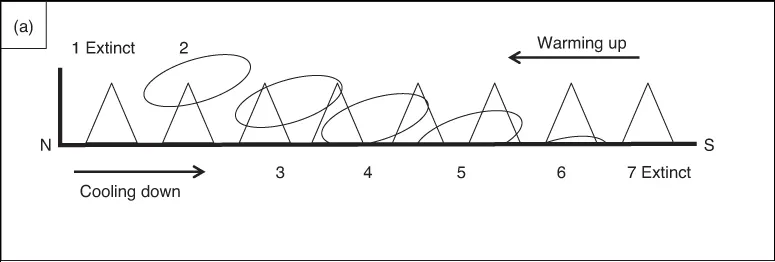
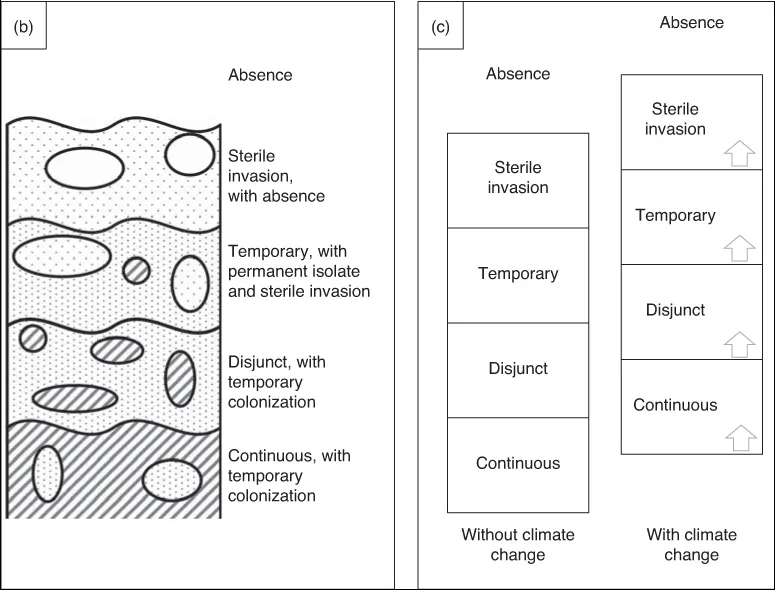
Fig. 1.1. Schematic representation of the dynamics of distribution range and effects of changes in climate. (a) Effects of changing climate on the distribution of organisms in the northern hemisphere (modified from Gorodkov, 1985). The horizontal axis represents the latitude and the vertical axis the elevation. The triangles along the horizontal line identify mountains occurring at different latitudes. The oblique lenses represent the potential range of the organism as determined by climate (both inclination and width of the lens may vary depending on the reaction norms of the individual species). The potential range may shift from south to north and from low to high elevation, and vice versa, depending on warming and cooling of the climate. Gorodkov exemplified different types of distribution that could be observed in relation to the position of the lens along the gradient, i.e. 2: montane local (endemic), 3: montane wide, 4: disjuncted plain–montane, 5: continuous plain–montane, 6: plain local (endemic). Types 1 and 7 drive to extinction. Types 4 and 5 are the most common and are associated with wider geographic distribution. (b) Spatial dynamics of hypothetical populations at the range edge (modified from Gorodkov, 1986). (c) Expected effects of climate change on the spatial occurrence of populations as detailed in b.
When putting together the database, we discovered very soon that the quality of the empirical support for range expansion varied substantially among publications. We classified publications reporting evidence of climate change-induced range expansion into three categories: (i) studies where recent expansion has been observed and documented, and where there are plausible causal explanations linking expansion to climate change; (ii) studies documenting recent changes in range distribution possibly associated with climate change, but with little or no mechanistic support; and (iii) studies reporting the outcomes of modelling attempts, most often in the form of species distribution models (also referred to as envelope models), with the primary aim of predicting future changes in species ranges but with little or no evidence of actual range change occurring.
One could perhaps argue that it is only the first category that presents evidence allowing conclusions about causal relationships between climate change and range expansion. For the other two categories of studies, firm conclusions about the role of climate change are more problematic. In particular, results from the third category, envelope modelling, have commonly been discussed despite the fact that the approach is entirely correlative, resting on past and expected future relationships between spatial variation in climate and species occurrence. Thus, envelope models allow predictions about potential future distributions, but whether or not these will be realized depends on a number of unknown conditions, in particular novel trophic interactions.
1.3 Database
The literature survey resulted in 50 species whose range have been observed to be affected by climate change, or predicted to be so in the future (Table 1.1). The number of species with observed range expansion and with a plausible causal explanation (Category 1) was, however, much smaller (eight cases). For 17 species, range expansions have been documented, but without clear empirical support for the hypothesized link to climate change (Category 2). For the remaining 25 species, range expansions were predicted based on modelling data (Category 3), either climate matching alone or climate matching combined with insect physiology data. Cases refer mainly to pests from the temperate and boreal region.
Category 1 includes seven forestry pests and only one agricultural pest. There are six native and two alien species. A latitudinal range expansion was observed in all species, while elevational and longitudinal expansions were also observed in four and one species, respectively. The most frequent mechanism of range expansion is reduced winter mortality in the novel areas. In the following, we summarize first the key findings for the Category 1 species, starting with the most known examples of native forest defoliating moths and bark beetles, and then proceed with other native and alien species in forestry and agriculture.
The pine processionary moth (Thaumetopoea pityocampa) is one of the best examples of an insect responding to climate change, documented in a number of publications during recent years (e.g. Battisti et al., 2005; Buffo et al., 2007; Robinet ...
Table of contents
- Cover Page
- Title Page
- Copyright Page
- Contents
- Contributors
- Foreword
- Part I General Issues and Patterns
- Part II Agricultural Pests
- Part III Forest Pests
- Index
- Footnotes
Trusted by 375,005 students
Access to over 1.5 million titles for a fair monthly price.
Study more efficiently using our study tools.
Frequently asked questions
Yes, you can cancel anytime from the Subscription tab in your account settings on the Perlego website. Your subscription will stay active until the end of your current billing period. Learn how to cancel your subscription
No, books cannot be downloaded as external files, such as PDFs, for use outside of Perlego. However, you can download books within the Perlego app for offline reading on mobile or tablet. Learn how to download books offline
Perlego offers two plans: Essential and Complete
- Essential is ideal for learners and professionals who enjoy exploring a wide range of subjects. Access the Essential Library with 800,000+ trusted titles and best-sellers across business, personal growth, and the humanities. Includes unlimited reading time and Standard Read Aloud voice.
- Complete: Perfect for advanced learners and researchers needing full, unrestricted access. Unlock 1.5M+ books across hundreds of subjects, including academic and specialized titles. The Complete Plan also includes advanced features like Premium Read Aloud and Research Assistant.
We are an online textbook subscription service, where you can get access to an entire online library for less than the price of a single book per month. With over 1.5 million books across 990+ topics, we’ve got you covered! Learn about our mission
Look out for the read-aloud symbol on your next book to see if you can listen to it. The read-aloud tool reads text aloud for you, highlighting the text as it is being read. You can pause it, speed it up and slow it down. Learn more about Read Aloud
Yes! You can use the Perlego app on both iOS and Android devices to read anytime, anywhere — even offline. Perfect for commutes or when you’re on the go.
Please note we cannot support devices running on iOS 13 and Android 7 or earlier. Learn more about using the app
Please note we cannot support devices running on iOS 13 and Android 7 or earlier. Learn more about using the app
Yes, you can access Climate Change and Insect Pests by Christer Björkman, Pekka Niemelä, Christer Björkman,Pekka Niemelä in PDF and/or ePUB format, as well as other popular books in Biological Sciences & Environmental Science. We have over 1.5 million books available in our catalogue for you to explore.