Islands are special places; they can be havens for unique plants and animals and refuges for wildlife. This book investigates the biogeography of butterfly species over the British islands, particularly the factors that influence their presence on the islands and that have made each island's butterfly fauna distinctive. The book contains a full log of records of species on the islands and much supporting information. The first three chapters set the scene, illustrating the basics of island biogeography theory, their changing circumstances during the current Holocene interglacial, and studies of natural history of British butterflies that mark the islands as the most intensively studied region for wildlife in the world. The book advances by increasing resolution downscale from a European continental perspective, through patterns and changes on the British mainland, a comparison of the two dominant islands of Britain and Ireland, to a close inspection of the dynamics of species on the multitude of offshore islands. Detailed investigations include contrasts in species' richness on the islands and then of the incidences of each species. Case studies highlight the continual turnover of species on islands. Attention is then given to evolutionary changes since the time that glaciers enveloped Europe. A powerful message is conveyed for the maintenance of butterfly species on the smaller British islands now experiencing population losses at a rate unprecedented since the spread of the last ice sheets: the incontrovertible importance of maintaining populations of species on nearby mainland sources for islands as pools for future migrants.
- English
- ePUB (mobile friendly)
- Available on iOS & Android
eBook - ePub
About this book
Information
1 Basics of Island Biogeography
It is one thing to make recordings or collections of butterflies from islands. Collecting has a long history but even so records for butterflies on British and Irish islands were, until recently, scattered in the journal literature (Dennis and Shreeve, 1996). However, it is another matter to make sense of the records. It was not until the early 1960s that sound scientific principles were established for island faunas. The present chapter provides an introduction to modern concepts in island biogeography, factors that affect the presence of butterflies, and other organisms, on British and Irish islands.
The Basic Model of Island Biogeography
In the 1960s, one of the most important breakthroughs in the ecological sciences was achieved; it was the publication of The Theory of Island Biogeography by Robert H. MacArthur and Edmund O. Wilson (1963, 1967). Although it was previously well understood that numbers of species on islands relate to island area and isolation, they demonstrated that the number of species could well reflect a dynamic equilibrium between two ongoing processes: (i) the immigration (viz. colonization) of species to an island; and (ii) their extinction ( Fig. 1.1a); as such, it is referred to as the equilibrium theory. It was a theory already foreseen by Eugene Gordon Munroe (1948) working on the butterflies of the West Indies. This was an astonishingly important breakthrough because, then, even mobile organisms such as butterflies were thought to have long occupied islands – including those comprising Britain and Ireland – on which they were found; as such, overseas transfers, apart from by known long-distance seasonal migrants (e.g. Vanessa cardui, Vanessa atalanta), were considered to be rare events. This dichotomy in perception must now seem very strange to modern readers; after all, if one species can with facility make the journey in numbers, then surely all others must have some capability of achieving the journey! In fact, this very belief was one of the stumbling blocks for challenging the long-held view that British butterflies survived the last major glaciation (Devensian, 20 k years (20 ka) BP) (Dennis, 1977). Yet, even then, sufficient evidence existed in the amateur journals that very small butterflies, including many sedentary butterflies, were capable of sea crossings (Dennis and Shreeve, 1996).
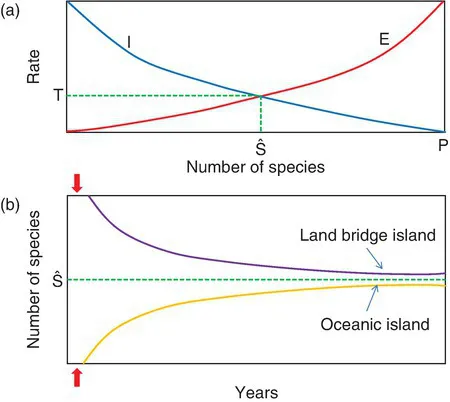
Fig. 1.1. Equilibrium island biogeography theory. (a) The equilibrium state in numbers of species for a single island based on the rate of immigration and extinction. I, immigration rate; E, extinction rate; Sˆ, equilibrium number of species on island; T, Turnover rate; P, size of the mainland source pool for the island. (b) The approach to an equilibrium for two distinct kinds of island: (i) ocean island; (ii) land bridge island. Once the number of species on the land bridge fauna have reached equilibrium, this is known as the relaxation fauna. The red arrows indicate the period of delay before the first species is lost (land bridge island) and gained (‘oceanic’ island). Oceanic islands here are used in the sense of a newly created island starting with zero species. Note how equilibrium is unlikely ever to match the number of species on the source mainland.
The mathematical model for a single island off a mainland source beautifully illustrates the basis for equilibrium in species numbers on islands (Schoener, 2010); a ‘steady state’ in numbers of species occurs where the gross extinction rate in species equals the immigration rate of new species. In Fig. 1.1, the rates are typically shown to be curvilinear, owing to the limit in the number of species at mainland sources: as numbers on an island grow, so does the probability of extinction; similarly, the probability of immigration and colonization will decline, as there are fewer new species left in the transfer pool. This observation is supported by ecological observations, for instance by: (i) the saturation of the species community with an increase in numbers of island species, leading to increased interactions (i.e. competition, predation, parasitization), thus smaller populations and extinctions (Wilson, 1969); and (ii) declining immigration rates as poorer dispersing species trail behind better dispersers (MacArthur and Wilson, 1967). Moreover, poorer dispersers are likely to be more vulnerable to extinction, owing to the link-up of colonization ability and migration capacity (Gilpin and Armstrong, 1981) (see also Chapter 3).
Equilibrium theory of numbers of species on islands, then, envisages a perpetual turnover in species; both immigration of new species and extinction of current species will have a characteristic mean rate and variance (unless conditions change significantly, i.e. through climate warming). It is perhaps useful to imagine the basic process taking place at an individual level. Consider that an island is being continually bombarded by individual butterflies and is simultaneously experiencing a continual loss of individuals (at all stages of development) (Simberloff and Wilson, 1971). Every so often an individual of a new species will arrive on the island and colonize it, or the population of a species will crash to zero and become extinct. Together, these processes describe the relative turnover rate (T) for an island’s species:

where t0, t1, t2 ... tm are time intervals (years), ne is the number of species extinctions on an island, ni the number of novel colonizations on an island, and N the total number of species at different times. T can be made into a percentage by multiplying by 100. Later, attention will be given to two types of island: (i) an oceanic island; and (ii) a land bridge island. Although Britain and Ireland do not have typical oceanic islands, they do have islands that simulate the conditions on a typical oceanic island, with an initial ‘start-from-scratch’ condition of zero species as in the case of Hawaiian islands emerging as volcanic mounds over an oceanic mantle ‘hot spot’ (Funk and Wagner, 1995). In the case of some British islands a number emerged offshore with deglacial isostatic rebound (see Chapter 2) of ice-laden land, their fauna wiped out by glacial tabula rasa and/or marine inundation during the last major ice advance (c. 20 ka BP). In the case of these two types of islands, very different patterns of colonization emerge, continuous gains towards an equilibrium with an ‘oceanic’ island and continuous losses to an equilibrium in the case of a vicariant land bridge island ( Fig. 1.1b). These conditions describe extremes of what is found in nature; it will become evident that Britain displays more complex scenarios.
The intriguing picture of equilibrium theory is that large and small islands, near-to-source and isolated islands, have very different equilibria ( Fig. 1.2); the curve for extinctions is higher for small islands than large islands, and the curve of immigration for isolated islands is lower than that for near islands. This has consequences for both the number of species and absolute turnover rates: (i) near islands (having the same area) and large islands (experiencing the same degree of isolation) have more species than far, small islands; and (ii) absolute turnover (not relative turnover) is greater for near than far islands (of the same area) and for small than large islands (of the same degree of isolation) ( Fig. 1.2). Altogether, this puts isolated small islands at a huge disadvantage in terms of comparative numbers of species. In fact, the two processes of colonization and extinction have far more profound implications for their island faunas, ones that affect the communities, adaptation and evolution of their faunas (see Chapter 8).
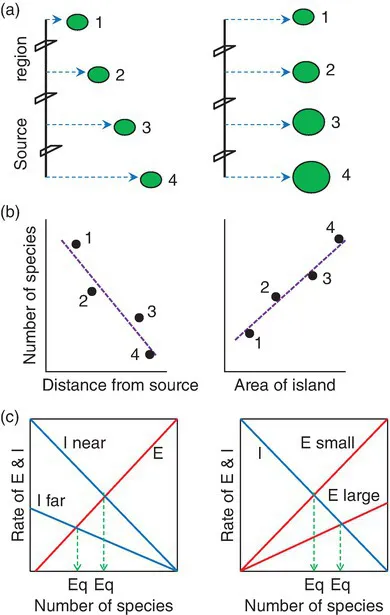
Fig. 1.2. The effect of differences in island isolation and island area on the equilibrium number of species on islands. (a) Imaginary plot of islands varying in size and isolation. (b) Scattergrams of number of species for the islands in plot (a) against isolation and area. (c) Equilibrium models for the islands shown in plot (a). E, extinction; I, isolation; Eq, equilibrium number of species. (Adapted from Dennis, 1992, 2010, using linear rather than curvilinear relationships.) Near, far, small and large refer to islands varying in isolation and size.
The picture of single islands lying offshore a mainland is, of course, a simple one. Often there are archipelagos (e.g. Isles of Scilly; Outer Hebrides), and these too may be close to a mainland shore or isolated. It is at this level that one can appreciate not just how complicated island biogeography can be, but also how important equilibrium island biogeography theory has become: archipelagos lie at the root of metapopulation biology (habitat islands simulating islands lacking a mainland source); the equilibrium models for them were developed by the remarkable scientist Ilkka Hanski and his team (Hanski, 1994; Hanski and Gilpin, 1997). A variety (gradient) of metapopulation models may be conceived from patchy populations to mainland–multiple island situations and extinction debt metapopulations (Dennis, 2010); all these models are relevant for different butterfly species on groups of small offshore islands in Britain and Ireland ( Fig. 1.3).
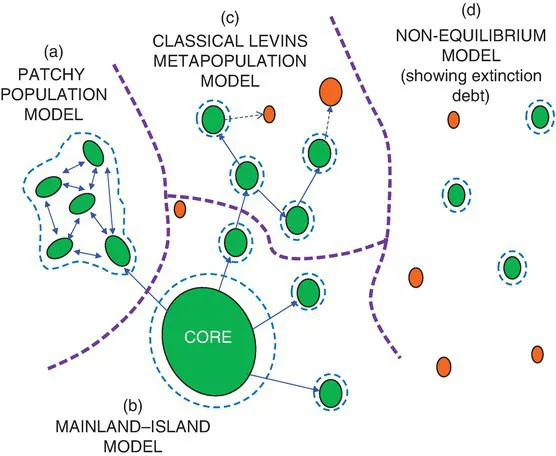
Fig. 1.3. Some basic metapopulation models for habitats on a mainland. (a) Patchy population model (e.g. Pieris napi). (b) Mainland–island or Boorman–Levitt model (e.g. Aricia agestis). (c) Classical Levins metapopulation (e.g. Melitaea cinxia on Isle of Wight). (d) Non-equilibrium model (showing distinct signs of extinction debt with populations becoming extinct and not replaced) (e.g. Coenonympha tullia in lowland UK). Green patches, colonized; red patches, vacant; dashed blue lines, boundary of a local population; arrows, transfers. Species on offshore islands which are part of archipelagos may behave in the way described by these models. No scale is provided; the scale of a metapopulation is established by the mobility of the organism. Thus islands in an archipelago may act as a patchy population to one species and as a non-equilibrium population with gradual extinction and the loss of another species. (Adapted from Dennis, 2010.)
A Broader View of Island Faunas
The equilibrium model, in providing such a neat picture of species numbers and turnover, is highly seductive; but it has been the subject of long and heated debate (Lomolino et al., 2010). When reviewing papers that deal with this subject it is important to distinguish two related issues: (i) the balance of immigrations (colonizations) and extinctions which defines a steady state (equilibrium) in species numbers ( Fig. 1.2c); and (ii) the relationship of numbers on islands in any study region to island area and isolation, on which an equilibrium view is based ( Fig. 1.2b).
The critical property of equilibrium theory is that extinction rate equals colonization rate. This has to be the case for every island in a study region (i.e. herein, British and Irish islands). It is not difficult to envisage circumstances that generate a non-equilibrium condition for a specific island or islands. Non-equilibrium may occur owing to: (i) relatively too few extinctions (i.e. extinction debt); (ii) a sudden extinction event affecting the island’s fauna; (iii) relatively low colonization rate (i.e. an immigration backlog or lag in immigration rate; e.g. following glacial tabula rasa); (iv) a surfeit of immigration (i.e. increased rate of immigration; e.g. owing to an external stimulus such as climate change or a weather event); and (v) a relatively high species accumulation, i.e. autochthonous speciation (e.g. molluscs on Madeira) (Cook, 2008; Kier et al., 2009).
A linear (semi-log, or log-log) relationship between species numbers on islands and island area and/or island isolation ( Fig. 1.2b) is typically advanced as an indication of an equilibrium condition. In fact, the absence of a neat linear relationship is not evidence of the absence of an equilibrium, but it is evidence that island area and/or isolation are compromised by other factors affecting inter-island extinction rates and colonization rates on some or all of the islands. It is well to bear in mind that an island’s ‘resources’ may supplant area in importance, as has been found to be the case with butterfly metapopulations (Dennis and Eales, 1997, 1999), ...
Table of contents
- Cover
- Half Title
- Online Supplementary Appendices
- Title
- Copyright
- Contents
- Dedication
- List of Figures
- List of Plates
- Preface
- Acknowledgements
- 1. Basics of Island Biogeography
- 2. The British Islands: a Geological and Historical Outline
- 3. Island Butterflies: Understanding and Interpreting Records
- 4. British and Irish Butterfly Species: Links and Gradients
- 5. Island Associations and Species Affinities: Geographical Influences
- 6. Assessing the Status of Individual Species on Islands: from Geography to Ecology
- 7. Changing Patterns of Species Incidences on Islands
- 8. British and Irish Islands: an Evolutionary Vantage
- 9. Island Studies: a Glance Back and the View Ahead
- Plates
- Appendices: Records of Butterflies from British and Irish Islands
- Glossary of Terms
- Bibliography
- Index
- Back Cover
Trusted by 375,005 students
Access to over 1.5 million titles for a fair monthly price.
Study more efficiently using our study tools.
Frequently asked questions
Yes, you can cancel anytime from the Subscription tab in your account settings on the Perlego website. Your subscription will stay active until the end of your current billing period. Learn how to cancel your subscription
No, books cannot be downloaded as external files, such as PDFs, for use outside of Perlego. However, you can download books within the Perlego app for offline reading on mobile or tablet. Learn how to download books offline
Perlego offers two plans: Essential and Complete
- Essential is ideal for learners and professionals who enjoy exploring a wide range of subjects. Access the Essential Library with 800,000+ trusted titles and best-sellers across business, personal growth, and the humanities. Includes unlimited reading time and Standard Read Aloud voice.
- Complete: Perfect for advanced learners and researchers needing full, unrestricted access. Unlock 1.5M+ books across hundreds of subjects, including academic and specialized titles. The Complete Plan also includes advanced features like Premium Read Aloud and Research Assistant.
We are an online textbook subscription service, where you can get access to an entire online library for less than the price of a single book per month. With over 1.5 million books across 990+ topics, we’ve got you covered! Learn about our mission
Look out for the read-aloud symbol on your next book to see if you can listen to it. The read-aloud tool reads text aloud for you, highlighting the text as it is being read. You can pause it, speed it up and slow it down. Learn more about Read Aloud
Yes! You can use the Perlego app on both iOS and Android devices to read anytime, anywhere — even offline. Perfect for commutes or when you’re on the go.
Please note we cannot support devices running on iOS 13 and Android 7 or earlier. Learn more about using the app
Please note we cannot support devices running on iOS 13 and Android 7 or earlier. Learn more about using the app
Yes, you can access British and Irish Butterflies by Roger L H Dennis,Peter B Hardy in PDF and/or ePUB format, as well as other popular books in Biological Sciences & Entomology. We have over 1.5 million books available in our catalogue for you to explore.