"This text is long overdue and timely. Carr and Broom have placed the issues firmly in the broader context of the relationship between our species and the others which share this planet with us...As they argue it is possible for tourists and the travel and tourism sector to take and exercise responsibility to drive change, Carr and Broom's text helps us to understand the issues and the context and to make better-informed choices."Harold GoodwinResponsible Tourism PartnershipAnimals are among the most sought after tourist attractions and the impact on them is a matter of concern to an increasing number of people. Tourism and Animal Welfare uniquely addresses the issue of animal welfare within the tourism experience. It explores important foundations such as the meaning of 'animal welfare' and its relation to ethics, animal rights and human obligations to animals. It also explores the nature and diversity of the position and role of animals within tourism.'Tales from the front line' is the section of the book that provides the reader with the views and experiences of animal welfare organisations, individual leaders, tourism industry organisations and operators, and academic experts. These case studies and opinion pieces will encourage the reader to consider their own position regarding animals in tourism and their welfare. The book: · is written by an authoritative author team that draws from the fields of tourism studies (Neil Carr) and animal welfare science (Donald Broom);· contains 14 case studies written by internationally recognised experts and iconic individuals in the field of animal welfare;· is written in an engaging style and features full colour illustrations.From students and academics to vets and those working within the tourism industry, this book will provide an engaging and thought-provoking read. It will also appeal to those with an interest in animal welfare, particularly in relation to the tourism industry.
- English
- ePUB (mobile friendly)
- Available on iOS & Android
eBook - ePub
Tourism and Animal Welfare
About this book
Information
1 Introduction
Most of us are tourists at times and many of us would like to think that we are responsible tourists. Animals are among the most sought-after tourist attractions, so the impact of tourism on them is a frequent matter of concern to tourists and to those who seek to conserve animals or to ensure that their welfare is good. Sustainable practices are sought by national and local government agencies, commercial organizations with a reputation to preserve and those who live in areas frequented by tourists. This book provides answers to some of the questions posed as a result of the impacts of tourism.
While a large proportion of the text in the book is based on carefully evaluated information, this is not a traditional academic book. The references in the chapters have been kept to a minimum to prevent them getting in the way of the reading of and engagement with the text. For anyone who wishes to find the sources of the ideas in this book and how they have evolved, a bibliography is provided at the end of the book. This list is not comprehensive and we apologize in advance to anyone who feels we have erroneously missed a particular reference. We hope that the book will appeal to academics who are either researching in the field or undertaking related courses as part of their degree. However, we expect that it will appeal to the wider community because animal welfare in tourism should be of concern to all of us.
Throughout this book, we emphasize the responsibility of everyone to do all they can to ensure that the welfare of animals in relation to tourism is as good as possible. As a step in this direction, the book incorporates a series of opinion pieces from tourism operators, industry bodies and animal welfare organizations, as well as academics working at the coalface of concerns regarding animal welfare in the tourism experience. These pieces are designed to add context and weight to the earlier chapters of the book, as well as the final one, and to enliven debate on issues of animal welfare. They are an integral part of the book but can also be read as stand-alone pieces if the reader prefers. In this way the book is designed to be what academics have in recent years been told they must be: relevant to the ‘real’ world, and capable of aiding change and innovation outside the education environment.
The main authors of the book are dyed-in-the-wool academics. Neil is ostensibly a tourism studies or leisure studies academic, while Don is an animal welfare specialist. Our collaboration in producing this book is a reflection of the diverse issues at play in relation to animal welfare and tourism and the benefits for all of bringing together those who have worked in these separate though interconnected areas.
This chapter provides an introduction to the key concepts dealt with in the book, namely tourism and animal welfare, offering a brief overview of the foundations of each field without going into detail. Some readers may be knowledgeable about one of these fields and may prefer to spend more time on the sections with which they are not already well-versed.
The State of Tourism and Animal-Related Tourism
The first question needing addressing is: What is tourism? This is a question that is asked in every first-year undergraduate course on tourism and in every associated introductory textbook (see Lickorish and Jenkins (1997) and Hall (2003)). It is also a question that many academics working in tourism seem to love to debate. Resultant definitions tend to focus on tourism being composed of people travelling, temporarily, outside their home environment to engage in leisure-oriented activities. This is the dry academic terminology utilized to define a holiday. Those who take part in this activity are said to be tourists and the industry that facilitates this experience is the tourism industry. Within this context we must recognize that tourism is both a social phenomenon that people seek and desire and an industry that caters to these desires and also creates new ones and helps to drive demand. The result is a continual feedback loop that is a wonderful example of societal and industrial interrelationships in a neo-liberal capitalist reality.
Problems begin to creep into definitions of tourism that talk of the points noted here when we attempt to quantify what exactly ‘temporarily’ means. How long do you have to be away before you become a migrant? Can you be a tourist for an hour? If so, what minimum time must be surpassed before you become a tourist? In addition, there is the issue of whether it is only those people who travel solely for leisure purposes who can be defined as tourists or whether those travelling primarily for other purposes but engaging in some touristic activities during their time away from home can also be defined as tourists. There is also, of course, the problem of what actually constitutes ‘leisure’. If discussions about the precise definition of tourism have a long and tortuous history, they are as nothing compared to debates about what leisure is. Is leisure a measure of time free from outside obligations; is it related to the nature of the activity undertaken; or is it about the search for self or the freedom to be what you wish to be away from external restrictions and impositions? (See Carr, 2017a,b; Godbey, 2003; Bramham and Wagg, 2014 for a discussion of the meaning of leisure.)
There is also the problem that when we begin to examine the so-called tourism industry, we can see that it actually overlaps and borrows from a variety of other distinct industries. This can be seen to occur to such an extent that it has been asked, somewhat mischievously, whether there really is such a thing as the tourism industry. To travel to a tourism destination requires access to the travel and transportation industry. This is distinct from the tourism industry in that the infrastructure associated with it is often used for distinctly non-tourism purposes. Furthermore, roads, railway networks and ports are generally constructed primarily for reasons other than tourism. Even airports and airlines are not only used for tourism purposes. Once a tourist is at a destination, they will engage with the hospitality industry. Again, there is an overlap between this and the tourism industry but the former is a distinct industry in its own right that caters to more than just tourists. For example, restaurants will cater to local people as well as tourists and even hotels do not cater solely to tourists. Indeed, in some locations that are not dominated by tourism, hotels may cater primarily to business people, sometimes with an under-the-counter side where prostitutes rent rooms on an hourly basis either without the knowledge of management or as a result of management turning a blind eye. Finally, even so-called tourist attractions are not really accurately named, as they are generally open to all those leisured people who wish to and can afford to visit them irrespective of whether they are still within their home environment or are visiting from elsewhere. As such, these attractions may be more accurately defined as leisure attractions than tourism attractions. Thus, it may be suggested that tourism is merely a component of leisure.
While we may quibble over definitions of tourism, the tourist, and the tourism industry, it is clear that tourists do exist and that there is a tourism industry, even if components are borrowed from other industries. If we employ our definition of tourism and tourists, it is clear that tourism today is a global phenomenon of considerable size. The concept of tourism is nothing new, but since the end of the Second World War and the associated economic boom it has grown significantly into something that touches all parts of the planet. The growth of international tourist numbers at the global level is depicted in Fig. 1.1.
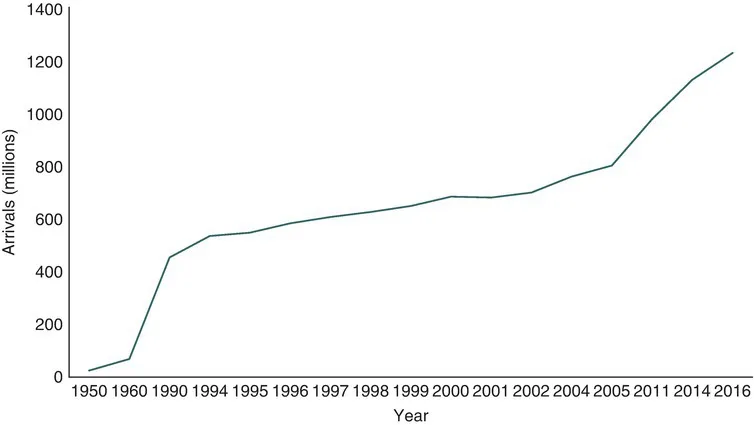
Fig. 1.1. Global international tourist arrivals (1950–2016).
While the definitional issues, noted earlier in this section, and a plethora of concerns regarding the difficulties associated with collecting data affect calculations of the number of tourists the world sees each year it is clear that tourism is a huge phenomenon. In 2016 it is estimated by the United Nations World Tourism Organization that there were 1235 million international tourist arrivals in the world (UNWTO, 2017). Purchases by these tourists are said to have generated US$1.5 trillion in exports and generated one in every ten jobs on the planet. Furthermore, it is important to note that these figures only take into account international tourism. They do not consider domestic tourism, mainly because it is much harder to obtain accurate figures for this as tourists do not need to be processed through international gateways, such as airports. Yet, all the indications are that domestic tourism is, in terms of tourist numbers and spending, far larger than its international counterpart. For example, in New Zealand in the year ending March 2016 it was estimated that while international tourism expenditure in the country amounted to NZ$14.5 billion, domestic tourism generated NZ$20.2 billion (Ministry of Business, Innovation and Employment, 2017).
The tourism industry, and the tourists it attracts and serves, is not spread evenly over the planet and consequently its impact (both positive and negative) is likewise not evenly distributed. Furthermore, tourism tends to be highly seasonal, with the result that these impacts are not consistent even over a single year. It is also clear that tourism comes in a great variety of flavours, though arguably all have the same foundations. These foundations, as noted earlier, revolve around the idea of leisure. This can be distilled slightly further to note that all tourists are, to varying degrees, interested in escaping from the mundane reality of their day-to-day existence and exploring the ‘other’ (i.e. something exotic that cannot be found in their home environment). Doing so offers the potential for satisfaction of desires, enjoyment and pleasure. Among the varieties of tourism on offer to anyone seeking to take a holiday there is of course the sun, sand and sea experience. This is potentially the quintessential mass tourism experience; think of the beaches of the Spanish and Greek Mediterranean islands for example. Yet to this we can add rural tourism, adventure tourism, urban tourism, cruise tourism, sex tourism, winter sports tourism, ecotourism and, potentially, space tourism. These encompass types of tourism defined by the nature of the destination and the primary activity. As such, there is clearly scope for overlap between them.
Some destinations and activities associated with tourism are chosen because of interest in, or exploitation of, animals. This book is concerned, not just with tourism focused on animals but also how all types of tourism have potential implications for animals and hence animal welfare. The position and experiences of animals in tourism will be discussed in detail later in the book. Suffice for now to say that animals of all types are influenced by and impacted upon by tourism in a wide variety of ways. One distinction that it is important to make now though is the difference between animal tourism and animals indirectly impacted on by and through tourism. The former is focused on animal experiences that tourists deliberately seek while on holiday and that the tourism industry provides. This encompasses everything from zoos to horse riding, bird and whale watching, and big game hunting. The latter is concerned with instances where animals are impacted by tourism and tourists, both directly and indirectly, but are not a focus of the tourist gaze. Examples include everything from pest control operations in hotels and restaurants to the controlling of birds in and around airports, the destruction of wild animals’ natural habitat and the international spread of invasive species.
Animal Welfare
The evolution of thinking around animal welfare is discussed in detail in the following chapter, so it is sufficient here to give just a brief description of welfare and how it applies to animals. In essence, the concept of welfare is no different for humans and for non-human animals. Human welfare, or well-being, encompasses mental and physical health. In this way it is related to practices aimed at proactive health management. The fundamental issue that scientists, social scientists and, increasingly, society in general have been dealing with is whether animals have needs that extend beyond their conceptualization as objects owned by humans. This leads us to the question of animal sentience and whether or not it exists. If it does, then there are implications for how we view and treat animals and their welfare. It is becoming increasingly clear that a large number of kinds of animals are sentient. These debates about animal sentience and welfare are paralleled by discussions about animal rights. The divide between those who concern themselves with animal rights and those who talk of animal welfare is in some ways blurred but in some instances very distinct. At their most extreme, animal rights proponents think that animals should not be used in any way by humans, to the extent that they view pets and animal companions as inappropriate. Those concerned with animal welfare, on the other hand, may not have any problem with the reality of animals’ lives being intertwined with those of humans as long as sufficient consideration is given to the welfare of the animals.
As noted later in this book, while we may be able to scientifically assess sentience it is always done using human metrics. Furthermore, the very notion of sentience is a human construct. Following on from this, animal welfare and animal rights must be recognized as human constructs that, as a result, are situated in human societies and cultures. These in turn are spatially and temporally specific. As will be seen, this all has implications for how animal welfare is seen and presented within tourism; especially as tourism inherently involves the meeting of different cultures as tourists move across space. It also has implications for our ability to enhance animal welfare within tourism around the world.
The position adopted in this book is clearly a welfarist one. It is based on a clear belief that animals are sentient beings, capable of feeling and thinking for themselves. Based on this sentience we stand with those who believe that animals have needs that it is beholden on humans, as the creatures in the position of power relative to animals, to meet and deal with. In other words, as discussed in detail in Chapter 2, the book is based on the notion that humans have obligations to all animals. The emphasis placed on ‘all’ is important, as it acknowledges the obligations we have to animals irrespective of whether we like them or not. This builds on the notion that humans tend to divide animals up between those we love, those we hate, those we eat, and those we simply ignore. A true animal welfare perspective must cover all of these animals, as it adopts an animal-centric rather than a human-centric perspective.
As will be discussed later in the book, there is also a need to recognize the differences and overlaps between animal welfare and conservation. The primary focus of the former is on the individual while the latter has traditionally been focused on the species level, largely ignoring the welfare of the individual. As discussed later, these perspectives arguably need to shift and recognize that species survival without individual welfare is insufficient as is individual welfare without attention to long-term species survival. This speaks to the issue of sustainability, something that will also be discussed later in the book.
Why Is This Book Needed?
As has already been noted in this chapter and will be discussed in more detail in the following chapters, animals play a central role in much of tourism and are influenced by tourism in a multitude of ways. If we only saw them as automated objects devoid of sentience, then the ...
Table of contents
- Cover
- Half Title
- Title
- Copyright
- Contents
- List of figures
- List of tables
- List of boxes
- Acknowledgements
- 1 Introduction
- Part I A Conceptual and Historical Foundation
- Part II Tales from the Front Line: Animal Welfare Organizations and Animal Tourism Providers
- Part III
- Bibliography
- Subject and Author Index
Trusted by 375,005 students
Access to over 1.5 million titles for a fair monthly price.
Study more efficiently using our study tools.
Frequently asked questions
Yes, you can cancel anytime from the Subscription tab in your account settings on the Perlego website. Your subscription will stay active until the end of your current billing period. Learn how to cancel your subscription
No, books cannot be downloaded as external files, such as PDFs, for use outside of Perlego. However, you can download books within the Perlego app for offline reading on mobile or tablet. Learn how to download books offline
We are an online textbook subscription service, where you can get access to an entire online library for less than the price of a single book per month. With over 1.5 million books across 990+ topics, we’ve got you covered! Learn about our mission
Look out for the read-aloud symbol on your next book to see if you can listen to it. The read-aloud tool reads text aloud for you, highlighting the text as it is being read. You can pause it, speed it up and slow it down. Learn more about Read Aloud
Yes! You can use the Perlego app on both iOS and Android devices to read anytime, anywhere — even offline. Perfect for commutes or when you’re on the go.
Please note we cannot support devices running on iOS 13 and Android 7 or earlier. Learn more about using the app
Please note we cannot support devices running on iOS 13 and Android 7 or earlier. Learn more about using the app
Yes, you can access Tourism and Animal Welfare by Neil Carr,Donald M Broom in PDF and/or ePUB format, as well as other popular books in Business & Hospitality, Travel & Tourism Industry. We have over 1.5 million books available in our catalogue for you to explore.