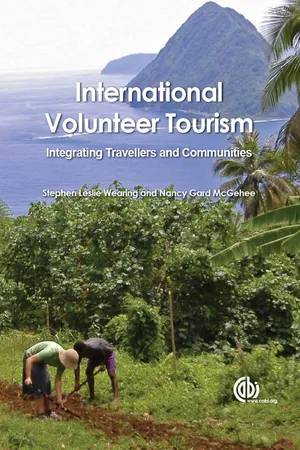
Volunteer tourism has increased in popularity and prevalence and is no longer considered only a small section of alternative tourism. It is now part of the mainstream tourism industry and tourism experience for many people. Concentrating on the experience of the volunteer tourist and the host community, this new book builds on the view of volunteer tourism as a positive and sustainable form of tourism to examine a broader spectrum of behaviours and experiences and consider critically where the volunteer tourist experience both compliments and collides with host communities, using multiple case studies.
eBook - ePub
International Volunteer Tourism
Integrating Travellers and Communities
- English
- ePUB (mobile friendly)
- Available on iOS & Android
eBook - ePub
International Volunteer Tourism
Integrating Travellers and Communities
About this book
Information
1 Introduction
Beyond Experiences that Make a Difference
Despite the considerable growth in tourism and its many achievements, it has become clear that it has not always been able simultaneously to meet the needs of communities and those who visit them. Evidence that tourism often privileges visitors’ needs over host communities is well documented in the literature (Torres & Momset, 2005; Jamal et al., 2006; Meyer, 2007). In part, this has been attributed to a social, economic and political order that places profits ahead of people, which has dominated the globe and worsened over the past decade. The dominance of neoliberal politics, both generally and within tourism, continues to broaden the gap between wealthy and poor nations and, more broadly, between the Global North and Global South (Steinbrink, 2012). In response to this continued inequity, alternative ways of tourism development are being championed.
In addition to the obvious focus on volunteer tourism, a number of other forms of tourism will be introduced and discussed in this chapter (and throughout the book) as well, including mass tourism, sustainable tourism, ecotourism, alternative tourism and pro-poor tourism (PPT). Mass tourism refers to the mainstream, well developed and highly commodified form of tourism most commonly experienced, which involves an exchange of discretionary income for an experience that takes place away from the normal sphere of life. Sustainable tourism has received a great deal of attention (and an equal amount of controversy) and refers to tourism that is developed in a way that focuses on the long-term, economic, socio-cultural and environmental viability of a community. Ecotourism is often used interchangeably with sustainable tourism, but in fact has a stronger focus on the environmental protection of a destination. Alternative tourism emerged in the 1990s as a more radical form of sustainable tourism (Pearce, 1992). Alternative tourism sought to challenge increasingly commodified mass tourism and at the very least sidestep, but ideally disrupt, the consumptive practices that underpinned it. Finally, PPT is an approach to the industry that aims to provide opportunities for the poor. Over the past decade, volunteer tourism can trace its roots in alternative and ecotourism, but now can be found in virtually every sector and type of tourism, including mass tourism.
As a result of the growth of volunteer tourism, this book examines how volunteer tourism acts as an alternative form of tourism while struggling with its own commodification. The rise of commodified and packaged forms of volunteer tourism raises important questions about whether volunteer tourism really remains ‘alternative’. However, before addressing such critical considerations, we first turn to a discussion of the history and pedigree of volunteer tourism and the alternative ‘turn’ that we claim gave rise to it.
Historical Foundations of Alternative Tourism
Historically, the prohibitive costs, transport difficulties and perceived dangers prevented many from experiencing other countries and cultures outside of their own. From the beginning of recorded history to as late as the 18th century, leisure travel was largely the province of the privileged and even then, something that was not particularly easy. In the Middle Ages for example, a time of mass Christian pilgrimages, ‘travel was still generally considered to be a dangerous and uncomfortable experience that was best avoided if at all possible’ (Weaver & Opperman, 2000: 61).
It was the phenomenon of the ‘Grand Tour’, which became popular in the 16th century, that best represents the initial developments of international tourism (Towner, 1985). Aristocratic young men from ‘the United Kingdom and other parts of Europe undertook extended trips to continental Europe for educational and cultural purposes’ (Weaver & Opperman, 2000: 61). High social value was placed on these expeditions; however, it was here that travel motives began to shift: travelling for religious pilgrimage, education and social status slowly gave way to travelling for pleasure and sightseeing. The industrial revolution saw a growing need for recreation opportunities and, subsequently, the transport systems to allow them to occur (Goeldner & Ritchie, 2012). Following the introduction of improvements in transport such as railroads, sealed roads and even ocean liners, the nature of travel began to change rapidly. Notably, the widespread application of air travel for leisure purposes and the growing economies of scale meant that travel soon became a commodity to be sold to a growing number of potential tourists. As Hall (1995: 38) observes:
Mass tourism is generally acknowledged to have commenced on 5 July 1841, when the first conducted excursion train of Thomas Cook left Leicester station in northern Britain. Since that time tourism has developed from the almost exclusive domain of the aristocracy to an experience that is enjoyed by tens of millions worldwide.
As mass tourism advanced into the 19th century, it became more and more insulated from the real world and treated as an escape to extraordinary places, offering an experience that had little to do with the reality surrounding it (Larsen, 2008). In opposition to its origins, where travellers sought the unknown, mass tourism was fast becoming a home away from home where participants no longer had to expose themselves to the dangers of having to meet and associate with the host community, as they were now able to ‘gaze’ (Urry, 2002) from the safety and comfort of coaches, trains and hotel rooms without self-immersion into the cultural milieu surrounding them. Group sizes and frequency of excursions increased, thus giving literal weight to the term ‘mass tourism’.
Tourism has become the world’s largest industry. The 10-year annualized growth (2007–2016) forecast is 4.2% per annum. The number of international arrivals shows an evolution from a mere 25 million in 1950 to an estimated 980 million in 2011, corresponding to an average annual growth rate of 4.4%, even in the current economic environment (UNWTO, 2012). Tourism is directly responsible for 5% of the world’s GDP, 6% of total exports, and employs one out of every 12 people in advanced and emerging economies alike (UNWTO, 2012).
In accounting for tourism as a global phenomenon, much of the initial sociological work was concerned with the individual tourist and the part that vacations play in establishing identity and a sense of self. This self was predominantly posited as a universal and tourism, like leisure, was seen in an opposing relationship with the ‘workaday world’. Cohen and Taylor (1976), for example, drew on Goffman’s (1974) concern with the presentation of self in everyday life, to argue that holidays are culturally sanctioned escape routes for Western travellers. One of the problems for the modern traveller, in this view, is to establish an identity and a sense of personal individuality in the face of the morally void forces of a technological world. Holidays provide a free area, a mental and physical escape from the immediacy of the multiplicity of impinging pressures in technological society. Thus, holidays provide scope for the nurture and cultivation of human identity; as Cohen and Taylor (1976) argue, overseas holidays are structurally similar to leisure because one of their chief purposes is identity (re)establishment and the cultivation of one’s self-consciousness. The tourist, they claim, uses all aspects of the holiday for the manipulation of well-being.
However, in the tourist literature, these arguments became diverted into a debate about the authenticity or otherwise of this experience (e.g. MacCannell, 1976; Cohen, 1987), serving to focus attention on the attractions of the tourist destination. Such a shift objectified the destination as place — a specific geographical site was presented to the tourist for their gaze (Urry, 2002). Thus the manner of presentation became all important and its authenticity or otherwise the focus of analysis: ‘It will also be suggested that objects of the tourist gaze can be effectively classified in terms of three key dichotomies, of which the romantic/collective is one (others are authentic/inauthentic and historical/modern)’, says Urry (2002: 75). The tourists themselves became synonymous with the Baudelarian flaneur (French for ‘gazer’: ‘the strolling flaneur was a forerunner of the 20th century tourist’) (Urry, 2002: 127). This flaneur was generally perceived as escaping from the workaday world for an ‘ephemeral’, ‘fugitive’ and ‘contingent’ leisure experience (e.g. Rojek, 1993: 216).
Similarly to the way in which this type of ‘flanerie’ (Urry, 2002: 135) characterized tourism of the late 19th and early 20th centuries, alternative tourism has characterized the latter part of the 20th century. Tourists began searching for new and exciting forms of travel in defiance of the mass-produced tourism product borne out of the industrial revolution and, prior to that, the need for social standing (Weaver & Opperman, 2000; Hall, 2007). Backpacking, adventure tourism and ecotourism are some of the types of alternative tourism that emerged during this time and have since confirmed, via their popularity, their place as targeted market segments. The convergence of these forms of tourism, their appeal to young travellers and the advent of the internet created an alternative tourism perfect storm. Niche markets were developed that allowed the tourist to choose the holiday they felt best suited their needs and wants, while at the same time maintaining an appropriate level of social status among their peers.
Within the literature, the provision of alternative tourism is fundamentally aligned to social and environmental sustainability. Factors such as impacts upon the cultural traditions of the host community (the community associated with the destination area), biodiversity and environmental degradation dominate such literature in the late 1990s and early 21st century (e.g. World Commission on Environment and Development, 1987; Cronin, 1990; Ecologically Sustainable Development Working Groups, 1991; Richards & Hall, 2000; Sofield, 2003; Weaver, 2006).
The question of sustainability — and sustainable development by implication — in relation to alternative forms of tourism experiences has become central in the analysis and provision of these types of experiences. The World Conservation Strategy initially posited sustainability as an underlying premise for a large number of projects based in developing countries, and Our Common Future (widely known as the Brundtland Report) attempted to give it an operational context (World Commission on Environment and Development, 1987; De la Court, 1990; Farrell & Runyan, 1991; Hare, 1991), which enabled agencies to engender it into their operating philosophies. For the past decade, global sustainable development has been promoted by the 2000 United Nations (UN) Millennium Development Goals of which tourism was identified as an important contributing industry (Ruhanen et al., 2007).
Alternative tourism has developed into a significant area of tourism experience research (Holden, 1984; Cohen, 1987; Vir Sigh et al., 1989; Pleumarom, 1990; Weiler & Hall, 1992; Smith & Eadington, 1997; Conway & Timms, 2010; Isaac, 2010; Pegg et al., 2012). However, it is important to note that a number of authors (R.W. Butler, 1990; Cohen, 1995; Wheeller, 2003; Weaver, 2011) have incorporated alternative tourism into the analysis of ‘mass tourism’, thus subordinating it to mainstream tourism research. Questions thus arise as to the feasibility of alternative tourism being differentiated as a separate construct or different paradigm. This has been a problem historically within new and emergent areas of research, as explained in the case of feminist research by Stanley and Wise (1984). Later in this book we explore whether volunteer tourism, like other forms of alternative tourism, is showing signs of being co-opted into the dominant capitalist paradigm of mass tourism that celebrates the tourist as consumer rather than as co-producer of sustainable living. However, before such a critique can be fully considered, it is first necessary to look at the manifestation of volunteer tourism as it has arisen as part of the alternative tourism movement.
Volunteer Tourism as the Ultimate Alternative Tourism?
When scholars first turned their attention to early volunteer tourism in the late 1990s, it was not well understood. Necessarily, this early scholarship, including Wearing’s (2001) and McGehee’s (2002) work, was narrowly focussed upon the relatively few existing volunteer tourism projects in operation at that time. In short, early work positioned volunteer tourism as a possibility for the future, and the future is now. Alternative forms of tourism such as volunteer tourism have come of age over the past decade. Growing interest in volunteer tourism has led to clearer definitions and a greater differentiation from other forms of tourism and volunteering. In Volunteer Tourism: Experiences That Make a Difference, the following definition was offered:
… ‘volunteer tourism’ applies to those tourists who, for various reasons, volunteer in an organized way to undertake holidays that might involve the aiding or alleviating the material poverty of some groups in society, the restoration of certain environments, or research into aspects of society or environment.
(Wearing, 2001: 1)
This definition has provided a useful mechanism for clarifying and classifying a particular type of tourism. However, it has its limits. Ambiguities around what constitutes volunteerism and tourism challenge discrete definitional boundaries (Benson, 2011). Moreover, such a definition does not question the limits of volunteer tourism, and how it manifests in a wide range of contexts. Volunteer tourism (now also sometime termed ‘voluntourism’ and/or volunteer vacations), although still a fledgling concept and practice, has moved from the periphery closer to the centre of tourism research. In part, this is because the last 10 years have seen a steady increase in interest and practice with a corresponding rise in the scholarship of volunteer tourism.
This book considers new examples of volunteer tourist operations, including organizations such as Youth Challenge International (YCI, 2008, 2010), World Wide Fund for Nature (WWF), Earthwatch, Conservation Volunteers Australia (CVA), British Trust for Conservation Volunteers (BTCV) and Mobility International USA (MIUSA), to name just a few. Lesser known examples include Antipodeans, Blue Ventures and Atalaya Peru.
These operations and the projects they undertake vary in location, size, participant characteristics and numbers, and organizational purpose. The common element in these operations, however, is that the participants can largely be viewed as volunteer tourists. That is, they are seeking a tourist experience that is mutually beneficial, that will contribute not only to their personal development, but also positively and directly to the social, natural and/or economic environments in which they participate. The philosophy of Explorations in Travel (EIT, 2008), a US-based volunteer work-placement firm, provides a good insight:
Travelling is a way to discover new things about ourselves and learn to see ourselves more clearly. Volunteering abroad is a way to spend time within another culture, to become part of new community, to experience life from a different perspective … Every community needs people willing to volunteer their time, energy and money to projects that will improve the living conditions for its inhabitants. No one needs to travel around the world to find a good and worthy cause to dedicate their efforts to. Volunteering should be something we do as a regular part of our lives, not just when we can take a month or two off, or when we have extra money to spend on travel. Your actions are your voice in the world, saying loudly and clearly what you think is important, what you believe to be right, what you support.
(EIT, 2008: X)
Furthermore, the position of the BTCV also emphasizes this point in an environmental conservation context:
Voluntary and community action can support site and species surveys, practical conservation projects, and longer term care and management. In the course of giving their time, energy, and experience to improving biodiversity, people can gain social and economic benefits including understanding, knowledge and skills. All of this can then further enhance their voluntary commitment.
(BTCV, 2000: 1)
Volunteer tourism can take place in locations varying from densely populated urban settings to rainforests and conservation areas. Popular locations include countries in Africa, Asia, Central and South America. Activities can vary across many areas, such as scientific research (wildlife, land and water), conservation projects, medical assistance, economic and social development (including agriculture, construction and education), and cultural restoration. Indeed, volunteers can find themselves anywhere, working on a multitude of projects, including assisting with mass eye surgery operations, tree planting, conducting a health campaign, teaching English, improving village sanitation, constructing a rainforest reserve, or assisting physicians and nurses with a mobile clinic. There is generally the opportunity for volunteers to take part in local activities and interact further with the community. Hence the volunteer tourist contribution is bilateral, in that the most important development that may occur in the volunteer tourist experience is that of a personal nature, that of a greater awareness of self:
When volunteers come back they feel empowered, knowing they have been able to make a difference … You come home feeling you don’t have limits. You feel a lot more confident in your ideas and beliefs and that you can contribute to society.
(Hill, 2001: 28)
While multidisciplinary in approach, and drawing heavily on broader tourism literature, a largely sociological perspective has been taken in this book. The Symbolic Internationist turn in sociology is of particular value when considering how individuals construct the meaning of their experience as volunteer tourists. As part of the volunteer tourism experience, interactions occur and the self is enlarged or expanded, challenged, renewed or reinforced (Wearing & Deane, 2003). As such, the experience becomes an ongoing process, which extends far beyond the actual tourist visit. Rojek (1993: 114) claims ‘travel, it was thought, led to the accumulation of experience and wisdom. One began with nothing, but through guidance, diligence and commonsense one gained knowledge and achieved self-realisation.’ Furthering this, volunteer tourism provides an opportunity for some individuals to engage in an altruistic attempt to explore ‘self’. It has been built around the belief that by living in and learning about other people and cultures, in an environment of mutual benefit and cooperation, one is able to engage in a transformation and the development of self.
Still, the broader tourism literature suggests that holidays do not usually have a tremendous impact on the way in which an individual sees him- or herself (Kottler, 1997: 103). It has been contended that holidays serve as an escape from the constraints and stresses of everyday life (Burkart & Medlik, 1974: 56; Cohen & Taylor, 1976; MacCannell, 1976; Rojek, 1995; Urry, 2002), or perhaps as a reward for hard work, but do not ultimately alter a person’s everyday life in terms of the way they think, feel or act. The traditional tourism literature suggests that while individuals may have enjoyed themselves, it is not long before that holiday is a memory in the day-to-day life to which they inevitably return. This book seeks to explore a different approach: taking volunteer tourism and investigating the more significant impacts it can have on the individual and on their lifestyle while also examining the same for the host community.
While much has been written in relation to the motivations of tourists when engaging in tourism,1 little research has been presented concerning the impact that leisure experiences such as volunteer tourism may have on the development of self through travel, and how one changes as a result (McGehee, 2002). The focus of the res...
Table of contents
- Cover Page
- Title Page
- Copyright Page
- Contents
- About the Authors
- Preface
- List of Tables, Boxes and Figures
- 1 Introduction
- 2 Alternative Tourism Experiences
- 3 Community Development in Volunteer Tourism Destinations
- 4 The Volunteer Tourism Organization
- 5 Volunteer Tourists: Why Do They Do It?
- 6 Volunteer Tourism Projects: A Proposed Mechanism to Improve Working with Local Communities
- 7 Volunteer Tourism: An Existential Perspective
- 8 Communities as More than ‘Other’ in Cross-cultural Volunteer Tourism
- 9 Looking at the Future of Volunteer Tourism: Commodification, Altruism and Accreditation
- References
- Index
Trusted by 375,005 students
Access to over 1.5 million titles for a fair monthly price.
Study more efficiently using our study tools.
Frequently asked questions
Yes, you can cancel anytime from the Subscription tab in your account settings on the Perlego website. Your subscription will stay active until the end of your current billing period. Learn how to cancel your subscription
No, books cannot be downloaded as external files, such as PDFs, for use outside of Perlego. However, you can download books within the Perlego app for offline reading on mobile or tablet. Learn how to download books offline
Perlego offers two plans: Essential and Complete
- Essential is ideal for learners and professionals who enjoy exploring a wide range of subjects. Access the Essential Library with 800,000+ trusted titles and best-sellers across business, personal growth, and the humanities. Includes unlimited reading time and Standard Read Aloud voice.
- Complete: Perfect for advanced learners and researchers needing full, unrestricted access. Unlock 1.5M+ books across hundreds of subjects, including academic and specialized titles. The Complete Plan also includes advanced features like Premium Read Aloud and Research Assistant.
We are an online textbook subscription service, where you can get access to an entire online library for less than the price of a single book per month. With over 1.5 million books across 990+ topics, we’ve got you covered! Learn about our mission
Look out for the read-aloud symbol on your next book to see if you can listen to it. The read-aloud tool reads text aloud for you, highlighting the text as it is being read. You can pause it, speed it up and slow it down. Learn more about Read Aloud
Yes! You can use the Perlego app on both iOS and Android devices to read anytime, anywhere — even offline. Perfect for commutes or when you’re on the go.
Please note we cannot support devices running on iOS 13 and Android 7 or earlier. Learn more about using the app
Please note we cannot support devices running on iOS 13 and Android 7 or earlier. Learn more about using the app
Yes, you can access International Volunteer Tourism by Stephen Wearing,Nancy Gard McGehee in PDF and/or ePUB format, as well as other popular books in Business & Hospitality, Travel & Tourism Industry. We have over 1.5 million books available in our catalogue for you to explore.