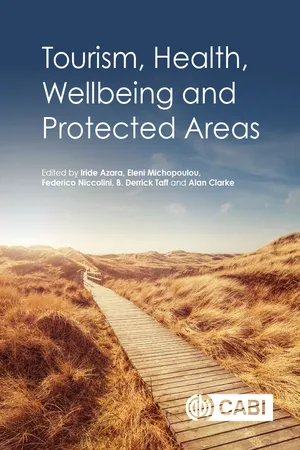
Around the world, there is mounting evidence that parks and protected areas contribute to a healthy civil society, thus increasing the economic importance of cultural and nature-based tourism. Operating at the intersection of business and the environment, tourism can improve human health and wellbeing as well as serve as a catalyst for increasing appreciation and stewardship of the natural world. While the revenues from nature-based activities help to make the case for investing in park and protected area management; the impacts they have need to be carefully managed, so that visitors do not destroy the natural wonders that attracted them to a destination in the first place. This book features contributions from tourism and recreation researchers and practitioners exploring the relationship between tourism, hospitality, protected areas, livelihoods and both physical and emotional human wellbeing. The book includes sections focused on theory, policy and practice, and case studies, to inform and guide industry decisions to address real-world problems and proactively plan for a sustainable and healthy future.Key features: Case studies discussing best practices for park and protected area tourism developmentMulti-disciplinary approach to the study of nature-based tourismInnovative approaches including SME within protected destinations
eBook - ePub
Tourism, Health, Wellbeing and Protected Areas
- English
- ePUB (mobile friendly)
- Available on iOS & Android
eBook - ePub
Tourism, Health, Wellbeing and Protected Areas
About this book
Information
1 Introduction: Tourism, Health and Wellbeing and Protected Environments
Iride Azara, Federico Niccolini, B. Derrick Taff, Eleni Michopoulou and Alan Clarke
This book was conceived during the international conference on ‘Tourism and Protected Areas’ (officially, Tourism Naturally), held in Italy in October 2016. The conference involved more than 150 academic and industry professionals from 28 countries. Through this international and collective perspective, this book offers a novel compilation of global, transdisciplinary contributions that demonstrate both fundamental – and partially unexplored – features of the relationship between tourism, health, wellbeing and protected areas. A discussion focusing on the links between tourism, health, wellbeing and protected areas is certainly not something novel in either academic or practitioner circles. Numerous authors have studied these relationships, and many experts have described the need for sustainable, responsible, tourism within the context of protected areas (e.g. Eagles et al., 2002; Jamal and Stronza, 2009; Buckley, 2012). What is less established, is how much these relationships can be symbiotic, and at the same time difficult to develop, adaptively manage and maintain to produce synergic positive, longterm effects (Jamal et al., 2014). This book deeply and clearly provides evidence to these latent aspects of the tourism-protected areas relationship. Central to this tenet is the notion that parks, protected areas and natural environments can and should play a key role in promoting individual, societal and environmental wellbeing and sustainable development (see, for example, Louv, 2005, 2011; Bowler et al., 2010), and that tourism (may this be called geological, gastronomical, nature-based, eco, wellness, medical, health oriented and so on) should not simply be a facilitator of the health and wellbeing, rather a positive force for change addressing environmental and socio-cultural concerns and sustainable development.
The concept of health (and its associated term wellbeing) has come under intense scrutiny in recent years. Health, defined as ‘as a state of complete physical, mental and social wellbeing and not merely the absence of disease or infirmity’ (World Health Organization, 2006) is both difficult to measure (see, for example, the criticisms forwarded by Hawks et al., 2008, Huber et al., 2011 and Dodge et al., 2012) and arguably imbued with notions of social and environmental injustice (see, for example, the interesting discussions forwarded by Jamal et al., 2014). Issues such as increased scarcity of resources, unfair wealth distribution across the world, deteriorating environmental landscapes, loss of important ecosystems as well as the emergence of new illnesses cast serious doubts on our ability globally to ever achieve a complete sense of wellbeing in the present or indeed the future. Thus, in this context it is not surprising that many scholars are calling for new healthbased approaches and paradigms that can better tackle the world’s sustainable development and wellbeing agendas (Griggs et al., 2013; Buse and Hawkes, 2015).
Tourism has affected human and the natural ecosystem’s health for centuries (Bushell, 2009, 2017; Smith and Puczkó, 2014) and, while it has often caused serious negative impacts, it has also demonstrated that it can play a significant role influencing and driving sustainable development, and improving the wellbeing and quality of life of humans, animals and the environment. This ethos is arguably encapsulated in the definition of sustainable tourism as one ‘that takes full account of its current and future economic, social and environmental impacts, addressing the needs of visitors, the industry, the environment and host communities’ (UNWTO, 2010, 2016). Yet this definition is not without criticisms (see, for example, Holden, 2003 and Butler, 2015 on the new reformulations), especially because of the challenges in understanding and measuring its success against the more subjective and complex constructs of wellbeing, happiness, quality of life in relation to places, their visitors, local communities and natural environments (Crouch, 2009). An increasing amount of work is being carried out highlighting the relationship between these dimensions and tourism (see, for example, Nawijin, 2011; Puczkó and Smith, 2011; Ward Thomson and Aspinall, 2011; Dolnicar et al., 2012; Uysal et al., 2012, 2016, 2017; Chen and Petrick, 2013; McCabe and Johnson 2013; Theofilou, 2013; Bell and Ward Thomson, 2014; Filep, 2014, to name but a few). However, it is argued that much more research remains to be done to truly position sustainable tourism as a healthy approach to ecosystem development. This book responds to this need, contributing to a better understanding of the interplay between tourism, health and wellbeing in protected areas. Given the complex relationships between these topics, the need for transdisciplinary research and understanding is pertinent and necessary. Therefore, this book represents a variety of disciplines, approaching understanding of the relationships between tourism, health, wellbeing and protected areas through both theoretical aspects and empirical data examinations. Attention has also been devoted to exhibiting both quantitative and qualitative methodologies. And indeed, if, on the one hand, it is true that identifying some tourism dynamics is better suited for quantitative methodologies (e.g. volume, frequency, measurable impact [both positive and negative] of tourism), on the other hand, different tourism phenomena involve constructs that may be more effectively and perhaps more innovatively explored with qualitative methodologies (e.g. place symbolism and place attachment).
Tourism and Protected Areas’ Sustainability
Tourism related to protected areas (PAs) has progressively grown in the last 100 years. It is well known that the sector has matured steadily to represent one of the world’s largest industries (United Nations World Tourism Organization, 2016). Similarly, every year the number of PAs, both terrestrial and marine, has increased in the world, reaching important percentages in each continent (World Database on Protected Areas, 2018). Globally, PAs have become the most effective tools to obtain the conservation of natural resources, including natural tourist attractions; a process that unites peoples, overcoming social, economic, cultural and even religious barriers.
Both practitioners and academics demonstrate that the continued expansion of tourism activities in PAs has brought economic benefits to tourism operators. However, less is understood about whether tourism has simultaneously contributed to improve the conservation of the natural resources, as well as the social conditions of those living within or working in proximity to these places. Or alternatively, has tourism, through the consumptive nature of some activities, led to depreciated natural resources, in some circumstances to a level that defies the original intrinsic value of the areas? These discussions are not new in the context of PAs (see, for example, Wagar, 1966; Hardin, 1968), yet they have remained stubbornly current. Tourism is a sector of the global economy where in recent decades, organizations have pledged commitment to consider and strategically plan for sustainability. During the 1990s and early 2000s, sustainability became the focus of many of the most important annual meetings in the sector (e.g. the Charter for Sustainable Tourism of Lanzarote in 1995; Agenda 21 for the Travel and Tourism Industry of 1996; Quebec Declaration on Ecotourism of 2002; Djerba Declaration on Tourism and Climate Change in 2003). Therefore, from a theoretical and case study point of view this book (particularly, but not exclusively, the section on tourism and the wellbeing of PAs) explores these questions through the lens of sustainability, because ultimately, in order for both ecological and human wellbeing to occur, sustainability needs to be facilitated. In this respect the multifaceted nature of sustainable tourism in and with regard to PAs is highlighted throughout the chapters. For example, in addition to achieving quality standards in the services offered, in relation to the need to protect or improve local natural and cultural heritage; respect local traditions, customs and lifestyles; and improving not just the health and wellbeing of people and the environment more globally, but also in the surrounding socio-economical systems (Micheli and Niccolini, 2013).
Ecotourism is a specific kind and philosophy of tourism that was developed almost symbiotically with the growth of PAs. The first formal definition of ecotourism is credited to Hector Ceballos-Lascuráin in the early 1980s (Sharpley, 2006). This definition (amended by the author in 1993 and subsequently adopted in its revised form by the International Union for Conservation of Nature (IUCN) in 1996), states that ecotourism is an ‘environmentally responsible travel and visitation to relatively undisturbed natural areas, in order to enjoy and appreciate nature (and any accompanying cultural features – both past and present) that promote conservation, has low visitor impact and provides for beneficially active socio-economic involvement of local populations’ (Ceballos-Lascuráin, 1996). Thus, many chapters are devoted to exploring the challenges and possibilities that ecotourism presents for the sustainable development of PAs. However, besides ecotourism, other emerging forms of tourism in and around PAs and natural, fragile environments are featured in this book. Wellness tourism, health tourism (in all its facets), geotourism, medical voluntourism and nature-based tourism may well be different, yet they all share the belief that sustainability goals are not automatically achieved if tourism systems are left free to market forces. The market, in fact, without any regulation, almost always tends to consume excessively and to degrade resources for the benefit of current visitors and tour operators (United Nations World Tourism Organization, 2010), and hence to decrease the opportunities (and the rights) of future generations to enjoy the tourism attractions of the same level of quality or health. Tourism systems must be adaptively managed and regulated to maintain sustainable practices, protecting the interests (such as health and wellbeing of social and ecological systems) of future generations. In this context, PAs represent the main ‘space’ where tourism can succeed in achieving the goal of securing the interest (such as health and wellbeing) of future generations.
Health, Wellbeing in Protected Areas
It is well known that the IUCN foresees six different types of PAs, including: nature reserve (Ia) and wilderness area (Ib); natural park (II); natural monument (III); habitat/species management area (IV); protected landscape/seascape (V); and managed resource protected area (VI). Their core purpose varies widely from wilderness protection (Ia and b), to protection and recreation of ecosystems (II) or landscapes (V), from conservation of specific natural features (III) or habitat and species (IV), to the sustainable use of natural resources (VI) (Day et al., 2012; International Union for Conservation and Nature, n.d.). The overarching or core purpose of PAs, however, is to preserve ecosystems while providing benefits to the visiting public. These benefits stem from the ecosystem services provided by these environments. As discussed in the Millennium Ecosystem Assessment (2005), eco-system services are categorized as provisioning, regulating, cultural and supporting services. For example, provisioning services may include clean water and air, and cultural services may include recreation or restorative benefits (Millennium Ecosystem Assessment, 2005). Facilitating the management of these benefits is the premise of the majority of PAs, across the array of IUCN designations but arguably of many natural or man-made restorative and recreational environments. Increasingly land managers, tour operators, health-care providers and, more significantly, tourists are beginning to recognize that preservation of the ecosystem services stemming from our protected natural areas correlates with our livelihoods (Aronson et al., 2016). These places must be managed to allow for sustainable tourism use, while maintaining the integrity of the ecological resources within (Eagles and McCool, 2002; Hammitt et al., 2015; Manning et al., 2017). Healthy natural environments, containing resilient and biodiverse natural ecosystem services, provide also for numerous psychological and physiological benefits (Summers et al., 2012; Sandifer et al., 2015). By and large, PAs offer opportunities to experience relatively pristine nature and natural resources that promote happier and healthier humans (Russell et al., 2013). Thus, the health of the environment and human health, and the overall sustainability efforts, are inextricably linked, and a growing body of research has begun to quantify these benefits. For example, in a thorough review of this topic, Hartig and colleagues (2014) found a substantial increase in peer-reviewed publications focused on ‘greenspace and health’ over the span of two recent decades. To date, studies have found linkages to both psychological and biophysical influences as a result of contact with nature. From the early studies linking natural aesthetic features to psychological recovery and wellbeing (e.g. Hartig et al., 1991; Ulrich et al., 1991; Kaplan, 1995), to the more recent reviews of the literature dissecting the exact environmental features and explicit health influences (e.g. Hartig et al., 2014), we are just now beginning to understand these relationships. However, the causal associations are still unclear, and the exact linkages to PAs still need further exploration. While there is growing interest and research, there is still a lack of understanding regarding the holistic relationship between tourism, health, wellbeing and PAs.
Future development of PAs and associated tourism will rarely be based on wilderness areas (i.e. IUCN Ib), given the growing scarcity of these places beyond what has already been set aside. Instead, PAs where natural features are the output of a longer progress of proximity or coexistence with anthropic societies and activities (such as category IV and V) will likely be the focus (Hartig et al., 2014). Thus, moving from a theoretical basis to specific case study perspectives, the geographical distribution and typology of the cases chosen in this book was not done randomly. We chose to focus the attention strongly, but non-exclusively, on case studies stemming from current and future trends around these topics. Many of these case studies take place in European settings, where natural resources have always had deep and ancient ties with the social, economic and cultural dimensions and thus are subjected to different pressures for use compared with less densely populated areas such as, for example, Australia or New Zealand. Furthermore, we focus on examples of protected area tourism specifically designed to improve health and wellbeing as well as natural or man-made wellbeing experiences as important recreational and restorative spaces, exploring how their enjoyment can be affected by human presence. Significantly, the book emphasizes how through the numerous benefits humans receive (Driver, 2008), we can build life-long emotional connections with these PAs (Rus...
Table of contents
- Front Cover
- Title Page
- Copyright Page
- Contents
- Contributors
- List of Figures
- List of Tables
- 1 Introduction: Tourism, Health and Wellbeing and Protected Environments
- Part 1: Tourism, Protected Areas, Health and Wellbeing
- Part 2: Health and Wellbeing, Protected Areas and Tourism
- Index
- Back Cover
Trusted by 375,005 students
Access to over 1.5 million titles for a fair monthly price.
Study more efficiently using our study tools.
Frequently asked questions
Yes, you can cancel anytime from the Subscription tab in your account settings on the Perlego website. Your subscription will stay active until the end of your current billing period. Learn how to cancel your subscription
No, books cannot be downloaded as external files, such as PDFs, for use outside of Perlego. However, you can download books within the Perlego app for offline reading on mobile or tablet. Learn how to download books offline
Perlego offers two plans: Essential and Complete
- Essential is ideal for learners and professionals who enjoy exploring a wide range of subjects. Access the Essential Library with 800,000+ trusted titles and best-sellers across business, personal growth, and the humanities. Includes unlimited reading time and Standard Read Aloud voice.
- Complete: Perfect for advanced learners and researchers needing full, unrestricted access. Unlock 1.5M+ books across hundreds of subjects, including academic and specialized titles. The Complete Plan also includes advanced features like Premium Read Aloud and Research Assistant.
We are an online textbook subscription service, where you can get access to an entire online library for less than the price of a single book per month. With over 1.5 million books across 990+ topics, we’ve got you covered! Learn about our mission
Look out for the read-aloud symbol on your next book to see if you can listen to it. The read-aloud tool reads text aloud for you, highlighting the text as it is being read. You can pause it, speed it up and slow it down. Learn more about Read Aloud
Yes! You can use the Perlego app on both iOS and Android devices to read anytime, anywhere — even offline. Perfect for commutes or when you’re on the go.
Please note we cannot support devices running on iOS 13 and Android 7 or earlier. Learn more about using the app
Please note we cannot support devices running on iOS 13 and Android 7 or earlier. Learn more about using the app
Yes, you can access Tourism, Health, Wellbeing and Protected Areas by Iride Azara, Eleni Michopoulou, Federico Niccolini, B Derrick Taff, Alan Clarke, Iride Azara,Eleni Michopoulou,Federico Niccolini,B Derrick Taff,Alan Clarke in PDF and/or ePUB format, as well as other popular books in Business & Hospitality, Travel & Tourism Industry. We have over 1.5 million books available in our catalogue for you to explore.