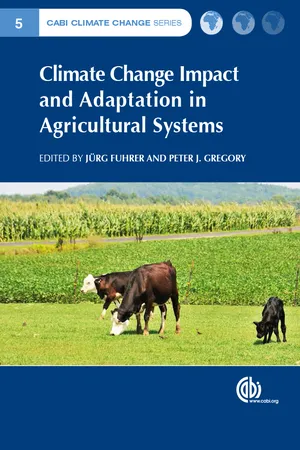
The focus of this book is future global climate change and its implications for agricultural systems which are the main sources of agricultural goods and services provided to society. These systems are either based on crop or livestock production, or on combinations of the two, with characteristics that differ between regions and between levels of management intensity. In turn, they also differ in their sensitivity to projected future changes in climate, and improvements to increase climate-resilience need to be tailored to the specific needs of each system. The book will bring together a series of chapters that provide scientific insights to possible implications of projected climate changes for different important types of crop and livestock systems, and a discussion of options for adaptive and mitigative management.
eBook - ePub
Climate Change Impact and Adaptation in Agricultural Systems
- English
- ePUB (mobile friendly)
- Available on iOS & Android
eBook - ePub
Climate Change Impact and Adaptation in Agricultural Systems
About this book
Information

1 Climate Projections for 2050
Markku Rummukainen
Centre for Environmental and Climate Research, Lund University, Sweden
1.1 Introduction
In order to assess the implications of climate change in terms of impacts and adaptation needs, projections of the future climate are needed. Climate models are the primary means of such simulations. The results are often coined ‘climate scenarios’ but should really be called projections, as they are built on alternative scenarios of future land-use changes and greenhouse gas emissions. The basis for climate projections is discussed in this chapter, together with a selection of general results that are of key relevance for agriculture, which stem from state-of-the-art climate projections. This chapter provides the background for the subsequent chapters in this book, and discusses climate projections for the next few decades. While the focus is on the period until 2050, it should be noted that climate change will very likely continue well beyond the middle of the 21st century. Indeed, the long-term prospects are about not only a changed climate but also a climate that is changing over time, i.e. it is about continuous change over a long time. The same is thus also true for our knowledge requirements regarding climate change impacts, as well as the motivation and need for climate change adaptation; however, these may take form.
1.2 Basis for Climate Change Projections
1.2.1 General
While we observe and experience our contemporary climate and intrinsically may expect its past behaviour to also give us a good picture of things to come, future conditions are innately unknown to us. This is especially true for the consequences of the use of fossil fuels and land-use change, which increasingly adds greenhouse gases to the atmosphere, not least carbon dioxide but also methane, nitrous oxide, etc. There are emissions that affect the tropospheric ozone, which has an effect on the climate, in addition to impacts on health and vegetation. Human activities also affect the amount of sulfate particles and soot in the atmosphere, which further compounds our impact on the climate. Land-use change, in addition to affecting carbon sources and sinks, affects the physical properties of the land surface, which further adds to the forces that the climate now responds to on global, regional and local scales (Pitman et al., 2011).
That we force the climate and that the climate responds is certain (IPCC, 2007). Climate change projections for the future have, however, uncertainties. This should not be confused with the view that they are left wanting; evaluation of climate models suggests that they perform well in many respects, and as they are based on physical principles, their results do have considerable credibility.
Model shortcomings are one source of uncertainty. Scenario uncertainty concerning underlying future emissions and land-use pathways is another. In addition, the climate system exhibits internal variability that arises from the complex interplay between the atmosphere, the ocean and the other climate system components. The relative importance of these sources of uncertainty is well established (e.g. Hawkins and Sutton, 2009).
Climate projection uncertainty is smaller at the global scale compared to the regional scale – and even more so, compared to the local scale. This is due largely to the ubiquitous internal variability that can simultaneously affect different regions in contrasting ways but which is largely cancelled out in the global mean. The relative importance of internal variability for climate projection uncertainty declines over time, as the forced climate change signals become greater. At the same time, the uncertainty linked to the emissions and land-use change scenarios grows. The uncertainty attributed to climate models has a more constant presence compared to the other two factors. These sources of uncertainty are discussed below.
1.2.2 Climate-forcing scenarios: fossil fuels and land-use change
Underlying climate model projections, i.e. forward-looking simulations of the evolution of the climate system, are scenarios of climate-forcing factors. In terms of the climate over the next few decades and beyond, this concerns anthropogenic emissions of greenhouse gases, particles and their precursors and the indirect greenhouse gases (see above), as well as land-use change. While today’s energy systems, consumption patterns, food and fibre production do lock us on to a path of continued climate change in the short and medium term, the longer-term situation is less certain. Thus, scenario assumptions of emissions and land-use change are an important part of uncertainty in climate projections.
Knowledge of both the underlying climate-forcing scenario (emissions, land-use change) and of the climate model (cf. ‘climate sensitivity’, see below) is paramount when considering a specific climate change projection; for example, in terms of temperature change. Climate models, emissions and land-use scenarios have evolved over time. Early on, more or less idealized scenarios were used, which were followed by more versatile ones. Over the past 10 years or so, most global and regional climate projections have been based on the IPCC Special Report on Emissions Scenarios (SRES; Nakićenović and Swart, 2000), which span a range of possible future emissions pathways. The most recent climate projections are based on the RCP scenarios (representative concentration pathway; Moss et al., 2010). These are coined RCP2.6, RCP4.5, RCP6.0 and RCP8.5. The SRES and the RCP scenarios are set up in different ways. The former provides greenhouse gas emission and land-use change pathways, based on underlying assumptions regarding socio-economic drivers such as population and economic and technical development. The atmospheric concentrations of greenhouse gases are then derived from the emissions scenarios, for use in climate models. The RCP scenarios provide radiative forcing/greenhouse gas concentration scenarios for the 21st century. The number attached to each scenario designates the radiative forcing in W m–2 by 2100. There is an accompanying effort with RCPs for the generation of corresponding greenhouse gas emissions, land use and socio-economic developments.
There is no one-to-one comparability of the RCPs and the SRES, but they span much of the same range of alternative future climate forcing. The RCPs, however, also include a scenario (RCP2.6) that corresponds to considerably lower emissions than any of the SRES scenarios, and as such is aligned with a considerable mitigation effort. Still, neither the SRES nor the RCPs are recommendations for policy, or forecasts. There are no probabilities affixed to them.
Overall, when interpreting climate model results, information is needed about the underlying emissions and land-use scenarios, as climate change projections largely scale with the emissions scenario. How much so depends, however, on the climate models themselves.
1.2.3 Climate sensitivity
Alongside assumptions regarding the emissions pathways and future land-use change, a second key uncertainty in climate change projections is the sensitivity of the climate system. Simply put, this is a measure of how much the climate changes when it is forced.1 Climate sensitivity is the net measure of the direct effect of the forcing and the feedback that arises within the climate system. An example of key feedback is that a warmer atmosphere can hold more moisture; as water vapour is a greenhouse gas, this enhances the initial warming. Possible changes in clouds are another key feedback. The sign of the overall climate sensitivity is robustly known (positive, i.e. feedback enhances the change due to some initiating factor, such as emissions), but its magnitude is generally only known within a range of values. The range of climate sensitivity in climate models overlaps with the body of estimates based on historical and contemporary climate variations, which provides confidence in the models and their results.
1.2.4 Climate models
Climate models are sophisticated simulation models that build on the physical, chemical and biological understanding of the climate system, written in computer code. There are today quite a few global and regional climate models in the world, constantly under further development, evaluation and in use in research. The majority of climate models have interacting components for the atmosphere, the ocean and the land surface, but there are also models with interactive carbon cycle and vegetation components, as well as some with yet additional climate system components. The latter are today known as ‘Earth System Models’. In the case of models that do not carry a vegetation component, relevant properties are prescribed.
While climate models do exhibit various biases, they also perform well in many respects (Randall et al., 2007), including the overall global and regional climate characteristics and the reproduction of observed changes over time.
Global climate models are fundamental when considering the response of the climate system to forcing. Solving the equations in climate models requires, however, extensive computational power, not least as simulations span from decades to centuries and often need to be repeated with several variations. This constrains the resolution of the models. Even today, many global climate models have a resolution (‘grid size’) of a few hundred kilometres. This is insufficient for resolving variable landforms and other physiographical details that have a significant effect on the near-surface climate in many regions. Global model results are therefore applied to regions by various downscaling techniques (Rummukainen, 2010) such as statistical models and regional climate models. The latter is also known as dynamic downscaling.
The global climate modelling community has a long tradition of organizing coordinated simulation experiments that span many climate models and different sets of simulations. Many of the results in the Fourth Assessment Report of the IPCC (Intergovernmental Panel on Climate Change; Meehl et al., 2007) came from the so-called CMIP3 coordinated study, which was followed by CMIP5 (Taylor et al., 2012). Coordinated regional climate model studies are fewer but have, during the past few years, emerged for several regions, not least Europe (Christensen and Christensen, 2007; Kjellström et al., 2013), the Americas (Menendez et al., 2010; Mearns et al., 2012) and Africa (Paeth et al., 2011). Coordinated studies of course provide more information for the characterization of model-related uncertainties, either by co-consideration of all results or by allowing a specific scenario to be tested in a wider context, including how it compares with other scenarios.
Advanced climate models are based on fundamental physical laws. This enables their use in projections of the future beyond the observed period. There are limitations on model resolution, as mentioned above, meaning that small-scale processes that cannot be resolved have to be parameterized (i.e. represented with approximate descriptions). For example, cloud formation cannot be simulated explicitly in climate models as it ultimately involves very detailed mechanisms. Rather, it may be parameterized in terms of relevant large-scale ambient conditions in the models. Parameterization is, however, also based on the physical understanding of the involved processes.
Parameterizations are formulated in somewhat different ways in different climate models. This explains why climate models as a whole exhibit a range of climate sensitivities. This range overlaps observational estimates.
1.2.5 Internal variability
Finally, the climate system is non-linear. This manifests itself in ubiquitous internal variability within the climate system, resulting in inter-annual variability and also variability at the decadal scale. The global mean temperature, for example, exhibits some inter-annual variability in concert with the large-scale interaction between the ocean and the atmosphere in the Pacific, known as El Niño–Southern Oscillation (ENSO). ENSO also has various strong regional signals around the world of anomalous warmth and coolness, as well as unusually wet and dry conditions. Different variability patterns characterize yet other world regions, including the Arctic and North Atlantic Oscillations (AO, NAO; Thompson and Wallace, 1998), the Pacific-North American Pattern (PNA), as well as the more regular monsoon circulations.
The presence of significant regional-scale climate variability implies that, to begin with, while climate change is indisputably discernible at the large scale, it still may remain within regional-scale variability, meaning that it may be more difficult to identify conclusively at this scale. The same applies to climate projections and, consequently, the emergence of statistically significant change occurs later in many regions than in the global mean (Giorgi and Bi, 2009; Kjellström et al., 2013). Mahlstein et al. (2012) find, for example, that statistically significant regional precipitation changes emerge only once global mean warming climbs above 1.4°C, which is roughly a doubling of the warming until the beginning of the 2000s. There is not, however, an absence of ongoing regional changes before clear signals emerge; rather, regional climates undergo transitions that may manifest themselves earlier as changes in, for example, the likelihood of extreme events (Stott et al., 2004; Jaeger et al., 2008), before the mean climate shows a significant response.
1.3 Projections
1.3.1 Temperature
Temperature change is a fundamental characteristic of climate change (‘global warming’ is often used synonymously with the present-day ‘climate change’). The observed global mean change since the pre-industrial era is large compared to variability over comparable timescales, and now amounts to c.0.8–0.9°C. To keep the global mean temperature rise under 2°C has been agreed as the international target under the UN Framework Convention on Climate Change (UNFCCC). However, the present evolution of emissions is not aligned with emissions pathways that might provide a likely chance of meeting the two-degree goal (e.g. Peters et al., 2013), suggesting that global warming may well come to exceed this UNFCCC target. The majority of climate change projections to date build on scenarios that do not include specific new climate policy measures and, consequently, result in a larger warming than the two-degree goal. The IPCC (2007) Fourth Assessment Report contained projected global warming results that ranged from around 1°C to more than 6°C for the period between the late 20th century and the late 21st century, with consideration of different emissions scenarios, climate models and information on climate change impacts on the carbon cycle. When additionally considering the observed warming since the pre-industrial until the late 20th century, the same projected change in temperature increases to c.1.5–7°C.
The climate system response to forcing is not uniform. While the overall pattern due to emissions is one of warming, some regions will warm more (or less) than others, and thus more (or less) than the global mean change (see Plate 1). For example, a 2°C global mean warming would imply temperature increases larger than 2°C over land regions.
Changes in the average temperature emerge over time in a relatively gradual manner. Changes in variability, and not least in extremes, can, however, manifest themselves in more complicated ways. Intuitively, and what is also evident in climate projections, is that warm extremes become more commonplace, whereas cold extremes less so (e.g. Zwiers et al., 2011; Orlowski and Seneviratne, 2012; Rummukainen, 2012). It is also characteristic that in areas in which there is a reduction in seasonal snow cover, such as the high northern latitudes, the reduction of cold extremes exceeds the wintertime mean temperature change. Correspondingly, in the relatively dry subtropical areas that experience increasing dryness, changes in warm extremes exceed the average regional temperature change (e.g. Kharin et al., 2013).
As extremes manifest themselves in a more or less sporadic fashion, changes in them are more difficult to pinpoint than those of climate means (Trenberth, 2012). Extremes can also change in terms of their return period or likelihood of occurrence, magnitude, geographical distribution, and so on. When posing the question of whether extreme events will change in ways that impact a specific sector or ...
Table of contents
- Cover Page
- Title Page
- Copyright Page
- Contents
- Contributors
- Foreword
- Climate Change Impact and Adaptation in Agricultural Systems – Introduction
- 1 Climate Projections for 2050
- 2 Rainfed Intensive Crop Systems
- 3 Climate Sensitivity of Intensive Rice–Wheat Systems in Tropical Asia: Focus on the Indo-Gangetic Plains
- 4 Climate Change Challenges for Low-Input Cropping and Grazing Systems – Australia
- 5 Diversity in Organic and Agroecological Farming Systems for Mitigation of Climate Change Impact, with Examples from Latin America
- 6 UK Fruit and Vegetable Production – Impacts of Climate Change and Opportunities for Adaptation
- 7 Intensive Livestock Systems for Dairy Cows
- 8 Climate Change and Integrated Crop–Livestock Systems in Temperate-Humid Regions of North and South America: Mitigation and Adaptation
- 9 Land Managed for Multiple Services
- 10 Adaptation of Mixed Crop–Livestock Systems in Asia
- 11 Enhancing Climate Resilience of Cropping Systems
- 12 Shaping Sustainable Intensive Production Systems: Improved Crops and Cropping Systems in the Developing World
- 13 The Role of Modelling in Adapting and Building the Climate Resilience of Cropping Systems
- 14 Agroforestry Solutions for Buffering Climate Variability and Adapting to Change
- 15 Channelling the Future? The Use of Seasonal Climate Forecasts in Climate Adaptation
- 16 Agricultural Adaptation to Climate Change: New Approaches to Knowledge and Learning
- 17 What are the Factors that Dictate the Choice of Coping Strategies for Extreme Climate Events? The Case of Farmers in the Nile Basin of Ethiopia
- Index
- Footnote
Trusted by 375,005 students
Access to over 1.5 million titles for a fair monthly price.
Study more efficiently using our study tools.
Frequently asked questions
Yes, you can cancel anytime from the Subscription tab in your account settings on the Perlego website. Your subscription will stay active until the end of your current billing period. Learn how to cancel your subscription
No, books cannot be downloaded as external files, such as PDFs, for use outside of Perlego. However, you can download books within the Perlego app for offline reading on mobile or tablet. Learn how to download books offline
Perlego offers two plans: Essential and Complete
- Essential is ideal for learners and professionals who enjoy exploring a wide range of subjects. Access the Essential Library with 800,000+ trusted titles and best-sellers across business, personal growth, and the humanities. Includes unlimited reading time and Standard Read Aloud voice.
- Complete: Perfect for advanced learners and researchers needing full, unrestricted access. Unlock 1.5M+ books across hundreds of subjects, including academic and specialized titles. The Complete Plan also includes advanced features like Premium Read Aloud and Research Assistant.
We are an online textbook subscription service, where you can get access to an entire online library for less than the price of a single book per month. With over 1.5 million books across 990+ topics, we’ve got you covered! Learn about our mission
Look out for the read-aloud symbol on your next book to see if you can listen to it. The read-aloud tool reads text aloud for you, highlighting the text as it is being read. You can pause it, speed it up and slow it down. Learn more about Read Aloud
Yes! You can use the Perlego app on both iOS and Android devices to read anytime, anywhere — even offline. Perfect for commutes or when you’re on the go.
Please note we cannot support devices running on iOS 13 and Android 7 or earlier. Learn more about using the app
Please note we cannot support devices running on iOS 13 and Android 7 or earlier. Learn more about using the app
Yes, you can access Climate Change Impact and Adaptation in Agricultural Systems by Jurg Fuhrer, P Gregory, Jurg Fuhrer,P J Gregory in PDF and/or ePUB format, as well as other popular books in Biological Sciences & Environmental Science. We have over 1.5 million books available in our catalogue for you to explore.