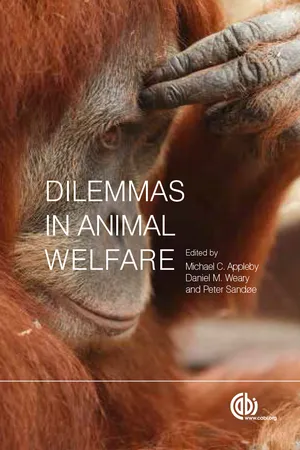
There are many ongoing debates within and about the subject of animal welfare. This book distils some of the major themes of current debate into one volume, edited by internationally known names in the field of animal welfare. Each chapter is written by one or more leading experts who discuss, in an even-handed way, a provocative topic that will be of interest to anyone concerned with animal welfare. Issues covered include tail docking, farm animal production, neutering of feral cats and the need to conserve habitats of native wild animals in the face of threats from non-native species. Chapters address the different values and priorities involved in dealing with these issues, including scientific and more explicit ethical approaches. Each chapter ends with questions for discussion that may help readers to engage with these dilemmas.
eBook - ePub
Dilemmas in Animal Welfare
- English
- ePUB (mobile friendly)
- Available on iOS & Android
eBook - ePub
Dilemmas in Animal Welfare
About this book
Information
Topic
MedicineSubtopic
Veterinary Medicine1 Introduction: Values, Dilemmas and Solutions
Michael C. Appleby,1* Daniel M. Weary2 and Peter Sandøe3
1World Society for the Protection of Animals, UK; 2University of British Columbia, Canada; 3University of Copenhagen, Denmark
1World Society for the Protection of Animals, UK; 2University of British Columbia, Canada; 3University of Copenhagen, Denmark
1.1 Introduction
Why a book on dilemmas in animal welfare? Thinking seriously about issues relating to animal welfare often means confronting a range of uncertainties over welfare outcomes, definitions of basic concepts, methodologies and appropriate decision making. Our hope is that confronting these uncertainties will improve our recognition of some of the gaps in our understanding and allow us to communicate our views in a more transparent way. We believe that such consideration is a real need for all those who confront the subject, including professionals working in the area of animal welfare (welfare scientists, philosophers, legislators, campaigners), people concerned for the welfare of animals under their care (pet owners, farmers, scientists using experimental animals) and members of the general public, for example those urged to support an animal charity or trying to decide what sort of eggs to buy.
Animal welfare provides a rich source of dilemmas, in part because opinions about the appropriate course of action are rooted in human values. The plural, ‘values’, is important here because individual humans have values that may be partially or completely in conflict (thus, a person may believe in both freedom of speech and the right of people not to hear speech that offends them), and different people may have different values that give rise to disagreements about decisions that affect animal welfare.
1.2 What is a Dilemma Relating to Animal Welfare?
Imagine your family has a much-loved 4-year-old dog. One day you notice a growth on the side of her neck. You take her to the vet, who takes a biopsy and sends it off to be tested. The test result shows that the dog has a malignant cancer and is likely to die within 3 months if not treated. There is chemotherapy available that will probably allow the dog to live for another year but which also causes negative side effects, including appetite loss and fatigue. You are faced with a dilemma: euthanizing your loyal companion within the next few weeks or imposing an unpleasant procedure that may buy more time. In the face of such dilemmas, we are torn between competing concerns: neither choice is ideal and the harm imposed cannot be compared easily.
Different people may disagree about how to rank the competing values. Some members of your family may put more weight on the sanctity and duration of life and believe that the life of the dog should be prolonged at almost any cost; others may put more weight on minimizing suffering and will believe that prompt euthanasia is best for the dog’s well-being. Cases may also involve uncertainty about different outcomes. For example, dogs vary in how well they respond to chemotherapy. So, there will be uncertainty about the outcome of the chemotherapy for the prognosis as well as the side effects.
This volume addresses a range of dilemmas. It deals with how, when deciding on the best way to treat an animal or groups of animals, one can be torn either between different concerns relating to the physical and affective welfare of the animal or between concern for the welfare of the animal and other, competing concerns. Different people may, as mentioned, disagree about how to resolve such dilemmas; these disagreements may relate to different views about how to handle uncertainties, for example about measuring and summing welfare concerns. Ultimately, they will typically be grounded in conflicting ethical perspectives.
1.3 Dilemmas within Animal Welfare
Some dilemmas can occur over how we conceptualize animal welfare: which aspects of animal welfare we value most and how we prioritize competing aspects. Thus, some cases pit concerns about animal health against those about affective states or the ability to engage in natural behaviours. For example, Edwards and Bennett’s chapter on tail docking (Chapter 2) describes how concerns about the practice relating to pain and loss of natural function can be weighed against benefits to health. In this example and others, the facts associated with different cases may lead to different recommendations. Tail docking dairy cows was thought to improve udder health, but a series of studies has failed to show any health benefit from docking; this makes the decision to stop docking cows on an animal welfare basis an easy one. Other cases are more difficult. As Edwards and Bennett explain, pigs with intact tails are more likely to experience outbreaks of tail biting, leading to painful injuries and even death. In this case, one view would be that docking is the price that must (in current housing and management systems) be paid to avoid the risk of more serious injury. An alternative and conflicting view would be that it is wrong to cut off parts of animals to suit them to existing production systems and that the way forward must be to change the systems rather than mutilating the animals.
The idea of imposing a short-term pain or frustration for some longer-term health benefit also emerges in the chapter by Sandøe, Corr and Palmer (Chapter 3). In this case, the question is how we resolve the competing claims of fulfilling a dog’s current wants (more food, more often) and keeping stress levels low, with reducing the incidence of diseases related to obesity. Rushen and de Passillé discuss (in Chapter 10) a related dilemma: keeping social animals in isolation (and in conflict with their motivations) with the hope of reducing the risk of injuries (due to social competition) and disease (due to direct contact between animals). In this case again, the resolution of different issues will depend on the empirical evidence that can be brought to bear and will vary with how the animals are housed and managed.
In all three examples, we can also see the competing values of harm minimization versus maximizing the opportunities for good welfare. Keeping sows in gestation crates prevents harmful competition, but also greatly limits the sows’ ability to engage in normal locomotion and social behaviours that are probably important to a good life for the animals.
Although there are disagreements about the relative weighting of different aspects of animal welfare, most people working in the field agree that animal health, affective states and the ability to express motivated behaviours are all important. There is less consensus on where we should draw a line or gradient of moral concern within an issue. Weary’s chapter (Chapter 11) challenges the reader to consider when certain types of negative affective states deserve special attention, by developing a new standard to identify when ‘suffering’ occurs. Cases where different sources of negative affect interact are likely to be a special concern, such as when animals repeatedly experience a painful procedure and develop a fear of the location or handlers associated with the procedure. If the fear can be avoided (e.g. by training the animals to approach the handler freely for a food reward), then the pain (e.g. from the injection) is of less concern.
1.4 Dilemmas within a Wider View of Animal Ethics
There are also disagreements about how other animal-centric arguments should be weighed against more traditional welfare values. A key example is the taking of a life. Most welfarists will argue that death per se is not a welfare concern, so long as the animal experiences a good death. Moreover, welfarists are typically concerned about individuals but struggle with how to make a trade-off between significant harm imposed on a few animals versus lesser harm imposed on many animals. Even if the sum of harm (however that is calculated) is smaller in the first case, it may still seem fairer to spread the harm more evenly among a larger group of animals. The chapter by Franco, Magalhães-Sant’Ana and Olsson (Chapter 4) takes us through a series of cases that discuss these conflicts, such as when it might be better to use more animals in an experiment if this means that each animal experiences less harm from the procedure. Palmer’s chapter (Chapter 9) discusses how colonies of feral cats are ‘managed’ by sterilizing the animals, which results both in animals typically living longer and in there being fewer animals to deal with as fewer are born.
Palmer’s chapter also challenges us to consider how welfare harm and welfare benefits vary for different types of animals. Sterilizing feral cats may help reduce colony size and reduce attacks on wild birds; keeping owned cats indoors will also reduce these attacks. In both cases, the suggestion is to impose one type of harm (e.g. preventing cats from engaging in a highly motivated natural behaviour) to avoid a painful death for other animals. The value we place on different types of animals also emerges in Beausoleil’s chapter (Chapter 8), where we see the same species (the brushtail possum) treated with respect in Australia but exterminated (sometimes using painful and slow-acting chemicals) in New Zealand. The chapters by Molento (Chapter 7) and Palmer show us how the same species (dogs and cats, respectively) can sometimes be seen as a valued companion and at other times as a troublesome pest, leading to very different outcomes for the same blameless animals. Appleby’s chapter (Chapter 6) explicitly takes on the issue of divergent values ascribed to different animals. He argues that we should preferentially use animals of high economic value in our farming systems as these animals are most likely to receive high levels of individual care.
Actions that favour the welfare of some animals may also come into conflict with values related to the ecosystem. Beausoleil discusses this conflict in her example of poisoning possums to save native birds, and Palmer discusses in her example the conflict of when to kill feral cats to save birds. Human health concerns can also come into conflict with concerns for animal welfare. Molento’s chapter addresses how urban dog control programmes are often motivated by a desire to reduce the spread of diseases that dogs are thought to carry. Similarly, the chapter by Hötzel (Chapter 5) argues that decisions about livestock production systems ‘must consider animal welfare, human health and nutrition, the environment and food security’.
1.5 Dealing with Dilemmas
There is no single, uniform way in which people can progress in the face of an animal welfare dilemma. One proven approach is to identify better ways of keeping or dealing with the animals in question that diminish or resolve the dilemma. The chapter by Beausoleil provides an example of using science to identify poisons that cause the least amount of pain and other negative experiences and thus reduce the conflict between the suffering of the target pest species (possums) and the environmental benefits that are thought to come from the death of these animals. In this way, applied animal welfare science often helps ameliorate welfare dilemmas.
But even when using the best choice of poison, the possums probably experience an unpleasant death, and definitely experience a shortened life, so in this case we are left with the conflict between animal welfare harm (to the possum) versus environmental benefits (to the endemic wildlife).
One common area of disagreement relates to the relative weight assigned to economic versus animal welfare considerations. For example, even though dairy farmers are generally aware that keeping cows in poorly bedded cubicles results in hock lesions, some choose to keep animals in such conditions for economic reasons. They may even claim that they have no choice because they would not survive economically if they were to use more costly bedding.
The chapters in this book provide no easy solutions to such dilemmas, but we hope that they will make readers think about the topics covered and allow them to recognize better some of the complexities involved. Each chapter ends with a few questions designed to facilitate discussion among readers. We believe that such discussion is valuable in itself, and it may also lead to ideas for how these and other dilemmas in animal welfare may eventually be resolved.
2 Tales about Tails: Is the Mutilation of Animals Justifiable in Their Best Interests or in Ours?
Sandra Edwards1* and Pauleen Bennett2
1University of Newcastle, UK; 2La Trobe University, Australia
1University of Newcastle, UK; 2La Trobe University, Australia
2.1 Abstract
Tail docking, involving surgical or non-surgical removal of a portion of the tail, is one of the most widely carried out and contentious mutilations inflicted by humans on animals. To differing extents, this procedure is carried out on farm livestock, draught animals and companion animals. The justifications range from benefits for the animals themselves, in reducing risk of future injury or disease, to human convenience or aesthetic preference. However, extensive scientific research indicates that the animals will experience some degree of acute pain and distress at the time of the procedure and medium-term pain arising from tissue damage, with longer-term chronic pain and adverse health effects also possible. As the acute pain can be controlled by the use of anaesthesia and analgesia and the absence of a tail has seldom been shown to disadvantage the animals greatly, a utilitarian analysis focusing on direct effects might conclude tail docking to be an acceptable procedure where significant benefits are obtained. However, it is important to consider whether, in condoning procedures that are justified as short-term solutions to existing suboptimal practices, we delay the implementation of more desirable longer-term solutions and potentially promote instrumental attitudes towards animals that we might prefer were discouraged.
2.2 Introduction
Mutilation of an animal is defined in English law as ‘a procedure which involves interference with the sensitive tissues or bone structure of an animal, otherwise than for the purpose of its medical treatment’ (Defra, 2007, p. 2). Such procedures have been widely carried out in the past on both farm livestock and companion animals. They include castration of male animals in all species and of female animals in many companion animal species, removal of horns and supernumerary teats of cattle, dew claws of dogs, and beak tips and claws of poultry. Removal of small segments of tissue from ears or feet, when tagging or notching for identification purposes, is also common in farm and laboratory animals. In recent times, all of these practices have become, to a greater or lesser extent, a subject of debate from both animal welfare and ethical perspectives.
One of the most widely carried out and contentious mutilations is tail docking (Bennett and Perini, 2003; Sutherland and Tucker, 2011). This involves amputation of part or all of the tail, by surgical severance or by necrosis following occlusion of the blood flow, in a procedure usually performed in young animals without anaesthesia or analgesia. Tail docking has, at some times and in some countries, been carried out routinely in farm livestock (cattle, sheep, pigs), draught animals (horses) and companion animals (dogs). A similar procedure is involved in tail resection for blood sampling purposes in laboratory rodents (BVA, 1993), but is not considered further in this chapter as it is a specific experimental procedure rather than routine commercial practice. The reasons for docking are different in different species and range from animal welfare concerns through to human convenience or even aesthetic preference. It has become perhaps one of the most extensively debated of the mutilations because of its widespread performance, the seemingly innocuous nature of the procedure itself, the importance attached to the benefits of its implementation in some species and, in the case of companion dogs, personal involvement by numerous members of the general public who rarely engage directly with other animals or concern themselves with welfare debates.
In this chapter, using tail docking as an example, we consider whether it is ever ethically acceptable to carry out mutilations and, if so, in which situations the benefits arising from such a procedure might be deemed to outweigh the harm involved.
2.3 Ethical Approaches to Consideration of Mutilations
The consideration of whether or not mutilations should be performed requires an ethical framework within which the available evidence can be placed. In a consideration of the ethics of neutering companion animals, which has many parallels with the issues of tail docking, Palmer et al. (2012) discussed how contrasting ethical approaches might give rise to different conclusions.
Rights approaches would suggest that any animal has a right not to be harmed and to be treated with respect. Thus, if mutilation imposes non-trivial harm, such as pain, distress or health compromise associated with the procedure, no future possibility of beneficial consequences will justify the violation of these rights. A particular consideration in relation to mutilations is the right to bodily integrity. While humans can relinquish such rights voluntarily if they perceive significant welfare benefits from doing so, animals do not have this capability and it is problematic for humans to make this choice on their behalf. The concept of integrity has b...
Table of contents
- Cover Page
- Title Page
- Copyright Page
- Contents
- Contributors
- Preface
- 1 Introduction: Values, Dilemmas and Solutions
- Part I: Dilemmas Within Animal Welfare
- Part II: Animal Welfare and Social Priorities
- Part III: Animal Welfare and Conservation
- Part IV: Conceptual dilemmas
- Index
Trusted by 375,005 students
Access to over 1.5 million titles for a fair monthly price.
Study more efficiently using our study tools.
Frequently asked questions
Yes, you can cancel anytime from the Subscription tab in your account settings on the Perlego website. Your subscription will stay active until the end of your current billing period. Learn how to cancel your subscription
No, books cannot be downloaded as external files, such as PDFs, for use outside of Perlego. However, you can download books within the Perlego app for offline reading on mobile or tablet. Learn how to download books offline
Perlego offers two plans: Essential and Complete
- Essential is ideal for learners and professionals who enjoy exploring a wide range of subjects. Access the Essential Library with 800,000+ trusted titles and best-sellers across business, personal growth, and the humanities. Includes unlimited reading time and Standard Read Aloud voice.
- Complete: Perfect for advanced learners and researchers needing full, unrestricted access. Unlock 1.5M+ books across hundreds of subjects, including academic and specialized titles. The Complete Plan also includes advanced features like Premium Read Aloud and Research Assistant.
We are an online textbook subscription service, where you can get access to an entire online library for less than the price of a single book per month. With over 1.5 million books across 990+ topics, we’ve got you covered! Learn about our mission
Look out for the read-aloud symbol on your next book to see if you can listen to it. The read-aloud tool reads text aloud for you, highlighting the text as it is being read. You can pause it, speed it up and slow it down. Learn more about Read Aloud
Yes! You can use the Perlego app on both iOS and Android devices to read anytime, anywhere — even offline. Perfect for commutes or when you’re on the go.
Please note we cannot support devices running on iOS 13 and Android 7 or earlier. Learn more about using the app
Please note we cannot support devices running on iOS 13 and Android 7 or earlier. Learn more about using the app
Yes, you can access Dilemmas in Animal Welfare by Michael Appleby, Peter Sandøe, Daniel M Weary, Michael C Appleby,Peter Sandøe,Daniel M Weary, Michael Appleby, Peter Sandøe, Daniel Weary in PDF and/or ePUB format, as well as other popular books in Medicine & Veterinary Medicine. We have over 1.5 million books available in our catalogue for you to explore.