This is a practical guide to seed germination in oil palm for both breeding and genetic studies as well as commercial seed production. Oil palm is the top oil crop in the world and this manual provides step-by-step illustrated methods, written by practitioners actively engaged in oil palm seed production and breeding.Presenting sound practices based on scientific innovation and knowledge, this guide brings together the many aspects of seed germination in oil palm in one place. Promoting green, eco-friendly agriculture, this book covers: Health and safety considerationsPollination and harvestingSeed preparation, viability testing and moisture testingSeed processing for commercial production and breedingBased on experience and protocols, this is an invaluable manual for students and researchers in agriculture, plant breeders, growers and end users interested in the practicalities of oil palm seed production. It is also a valuable resource for training, for those entering a career in oil palm and as a reference for managers, to ensure best practices in maximising sustainability and production of this important crop.
eBook - ePub
Seed Production in Oil Palm
A Manual
- English
- ePUB (mobile friendly)
- Available on iOS & Android
eBook - ePub
Seed Production in Oil Palm
A Manual
About this book
Information
Introduction 1
Abstract
Oil palm, EIaeis guineensis Jacq., is an important source of vegetable oil. Oil is extracted from the fruit mesocarp (crude palm oil) and from the seed (palm kernel oil). Botanically, the fruit is a drupe, with the kernel protected by a shell (nut). The commercial oil palm is Tenera (thin shelled), which is a hybrid from crossing Dura (thick shelled) seed palms with Pisifera (no shell) pollen palms. Since the shell is maternal tissue, seed for commercial planting has a thick shell. Like most seeds with very thick shells, oil palm seeds are difficult to germinate, the seed naturally germinates sporadically over time, and dormancy can last for up to 2 years. The challenges for seed production are to overcome dormancy (by weakening the operculum to allow germination), synchronize germination, produce a high germination percentage and high-quality germinated seed, free of abnormality or fungal infection. The processes used involve temperature treatments, imbibition, adjustment of seed moisture content and fungal control.
1.1 History of Oil Palm Production and Crop Facts
The African oil palm has the latin name Elaeis guineensis Jacq.: the genus name is derived from the Greek ‘elaion’, meaning oil, and the species name indicates its West African origin. The crop was discovered by travellers to Africa in the 15th century, but the first plantings in Indonesia, which led to its rise as the world’s pre-eminent oil crop, did not occur until the late 19th century, with the first four Deli palms planted in 1848 (Pamin, 1998). Large-scale plantations were established in the early 20th century in both Africa and South-east Asia as interest in the crop developed. These initial plantations were composed of Dura palms, which are characterized as having thick-shelled fruits (Fig. 1.1). In the 1920s, the first crosses were made in deliberate attempts to improve the crop through plant breeding, and in the 1950–1960s, the more productive Tenera types (a result of crossing Dura with Pisifera; see Beirnaert and Vanderweyen, 1941) took over as the favoured commercial material in both Africa and South-east Asia. Tenera genotypes are thin shelled, have thick, oil-bearing fruit flesh (mesocarp) and yield 30% more oil than Duras. Thus, crossing became an essential and major component in commercial oil palm seed production, as well as in breeding.
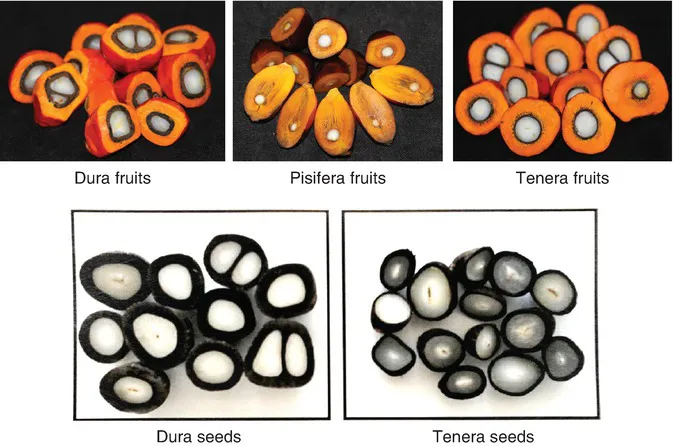
Fig. 1.1. The appearance of Dura, Tenera and Pisifera fruits (sliced open) and Dura and Tenera seeds (nuts, thick and thin shelled, respectively).
Table 1.1. Oil palm D×P seed production capacity worldwide 2009. (From Khusairi et al., 2010.)
| Country | Seed production (million) |
| Asia | |
| Indonesia | 250 |
| Malaysia | 81.5 |
| Papua New Guinea | 30 |
| Thailand | 13 |
| India | 2 |
| Total | 376.5 |
| Central-South America | |
| Costa Rica | 30 |
| Honduras | 2 |
| Colombia | 2 |
| La Cabana | 1.5 |
| Ecuador | 2 |
| Brazil | 1 |
| Total | 38.5 |
| Africa | |
| Benin | 6 |
| Nigeria | 2 |
| Cameroon | 2 |
| Ghana | 2 |
| Democratic Republic of Congo | 3 |
| Ivory Coast | 10 |
| Total | 25 |
| Grand total | 440 |
Oil palm is grown in the humid tropics, usually between latitudes 10° north and south of the equator, and covers over 8.5 million hectares (Mha) worldwide. It is grown mainly from seed, although clonal plantings of tissue culture-produced ramets are also practised. The crop is highly profitable and grown both on large-scale plantations and by smallholders (Sayer et al., 2012). Ripe, fresh fruit bunches are harvested continually, at intervals of 7–14 days, and sent to local mills for oil and kernel extraction. Oil palm fruits provide both crude palm oil (CPO) and palm kernel oil (PKO), extracted from the fruit flesh (mesocarp) and kernel (endosperm), respectively. CPO is made up of palmitic (43%), oleic (39%), stearic (5%) and other fatty acids (Siew, 2002), and is a major source of provitamin A and vitamin E (Barcelos et al., 2015). PKO is a high-quality oil containing lauric (up to 50%), myristic (15%) and other essential fatty acids (Sambanthamurthi et al., 2000). Since oil palm is harvested continually, CPO represents a relatively stable commodity compared to annual oil crops. The main CPO-producing countries are Indonesia (53% of global production) and Malaysia (38%); the largest consumers are India (28% of the market), Europe (22%) and China (22%).
1.2 Overview of Oil Palm Seed Production
Oil palm is the most popular oil crop in tropical regions. The first plantations of oil palm using commercially-produced seed were set up at the beginning of the 20th century. Malaysia developed the first oil palm seed market, launched in the 1970s, which included very strict planting programmes. Indonesia has the largest oil palm plantation area in the world and is the biggest CPO producer and the largest seed producer in the world.
1.3 Biology and Genetics of Oil Palm
Oil palm (E. guineensis) is a long-lived perennial. It has a single apical meristem and does not sucker/conventionally reproduce asexually. After germination, there is a 3-year juvenile stage before inflorescences appear. These are produced in each leaf axil and are either male or female (monoecious), the first inflorescences produced after the juvenile growth phase (2 years) are normally male. Oil palm is an outbreeding species and pollination is affected predominantly by the weevil, Elaeidobius kamerunicus, which depends on oil palm inflorescences to complete its life cycle. Oil palm inflorescences are large and typically give rise to bunches containing 100–4000 fruits, depending on palm age. Fruits mature at about 150 days after pollination, turning from black to red, and the outer fruit begins to fall out/abscise from the bunch when it is ripe. The fruit is a drupe (stone fruit) composed of a fleshy mesocarp and a central kernel protected by a shell (endocarp). The kernel contains the products of fertilization: embryo and endosperm. In the wild, the mesocarp of fallen fruits rots or is eaten, leaving behind the kernel: germination takes place in favourable conditions by the emergence of a seedling shoot and root through the germ pore in the shell. Generally, one seedling is produced per seed, but up to three may occur.
Oil palm is diploid, with 16 pairs of chromosomes, but is thought to have evolved from an ancient tetraploid species as there is extensive genome duplication (Singh et al., 2013). It is highly heterozygous owing to its outbreeding reproductive system. Although oil palm can be artificially self-pollinated, inbreeding depression has been widely reported. Genetic maps of the oil palm genome have been developed (Mayes et al., 2000; Billotte et al., 2005) and the genome has been sequenced (Singh et al., 2013); thus, genetic markers may be deployed in screening for genes of interest in progeny from deliberate crossings.
1.4 Crossing and Seed Type
Commercial seed production is based on Dura (D) × Pisifera (P) crosses, which produce the desired thin-shelled Tenera (T). The predominant parental lines have been Deli Duras and AVROS Pisiferas. In addition to commercial seed p...
Table of contents
- Cover
- Half Title
- Techniques in Plantation Science Series
- Title
- Copyright
- Series Foreword – Techniques in Plantation Science
- Contents
- Acknowledgements
- Preface
- 1 Introduction
- 2 Health and Safety Considerations
- 3 Isolation of the Female Inflorescence
- 4 Pollination
- 5 Harvesting
- 6 Seed Preparation
- 7 Seed Viability Testing
- 8 Seed Moisture Testing
- 9 Seed Processing for Commercial Seed Production
- 10 Seed Production for Breeding
- Index
- Back Cover
Trusted by 375,005 students
Access to over 1.5 million titles for a fair monthly price.
Study more efficiently using our study tools.
Frequently asked questions
Yes, you can cancel anytime from the Subscription tab in your account settings on the Perlego website. Your subscription will stay active until the end of your current billing period. Learn how to cancel your subscription
No, books cannot be downloaded as external files, such as PDFs, for use outside of Perlego. However, you can download books within the Perlego app for offline reading on mobile or tablet. Learn how to download books offline
Perlego offers two plans: Essential and Complete
- Essential is ideal for learners and professionals who enjoy exploring a wide range of subjects. Access the Essential Library with 800,000+ trusted titles and best-sellers across business, personal growth, and the humanities. Includes unlimited reading time and Standard Read Aloud voice.
- Complete: Perfect for advanced learners and researchers needing full, unrestricted access. Unlock 1.5M+ books across hundreds of subjects, including academic and specialized titles. The Complete Plan also includes advanced features like Premium Read Aloud and Research Assistant.
We are an online textbook subscription service, where you can get access to an entire online library for less than the price of a single book per month. With over 1.5 million books across 990+ topics, we’ve got you covered! Learn about our mission
Look out for the read-aloud symbol on your next book to see if you can listen to it. The read-aloud tool reads text aloud for you, highlighting the text as it is being read. You can pause it, speed it up and slow it down. Learn more about Read Aloud
Yes! You can use the Perlego app on both iOS and Android devices to read anytime, anywhere — even offline. Perfect for commutes or when you’re on the go.
Please note we cannot support devices running on iOS 13 and Android 7 or earlier. Learn more about using the app
Please note we cannot support devices running on iOS 13 and Android 7 or earlier. Learn more about using the app
Yes, you can access Seed Production in Oil Palm by Eddy S Kelanaputra,Stephen P. C. Nelson,Umi Setiawati,Baihaqi Sitepu,Fazrin Nur,Brian P Forster,Abdul R. Purba, Brian Forster, Peter D. S. Caligari, Brian P Forster,Peter D. S. Caligari in PDF and/or ePUB format, as well as other popular books in Biological Sciences & Horticulture. We have over 1.5 million books available in our catalogue for you to explore.