The fastest growth in tourism is the culinary sector. Covering farmers markets, taste tours, agri-entertainment, glamping, restaurants, farm shops and more, food tourism has become both an important part of holidaying and a purpose in itself. With growth occurring in most developed countries and tourists searching out culinary tourism throughout the world, this book provides an overall direction to the development of food tourism and a section on the future of this trend.
- English
- ePUB (mobile friendly)
- Available on iOS & Android
eBook - ePub
About this book
Information
| I | Food Tourism and the Tourist |
The world has become accustomed to tourism. According to the World Tourism Organization1 a tourist is ‘travelling to and staying in places outside their usual environment for not more than one consecutive year for leisure, business or other purposes.’ In 2012 over 1 billion of us were tourists and as tourists we spent over US$1.03 trillion. In 2012 China became the biggest tourist spenders as a nation, spending US$102 billion on tourist activities.
According to Funk and Wagnall,2 the difference between a tourist and a visitor is that a visitor is ‘one who visits an area within their local area.’
‘Food tourism’ may be a new set of words on the tourist scene. Even though the first guide to food tourism was written in 1931, Guida Gastronomica d’Italia,3 food tourism is still looked on as something new and trendy.
Food tourism in most regions of the world has been and needs to be integrated into traditional tourism activities, although in some regions, for example in France and Italy, it is becoming the main reason to visit the destination.
The wonderful thing about this type of tourism is that it is a 24/7, global and available 365 days of the year activity. The authors have been up at 3.00am in Japan to join a line of tourists to visit the Tsukiji Market4 in Tokyo (www.tsukiji-market.or.jp) and tolerated the snow of Vermont in New England, USA in the sugaring season in March to taste maple syrup (www.vermontmaple.org). At Christmas the Christmas markets of Prague (Czech Republic) and Germany are now major tourist attractions with a global market. Many business people may not even consider they are in food tourism. Ask the majority of tourists visiting the UK for the first time what they are going to do when they arrive and one common answer is to visit an English pub. This has become a real tourist experience, but how many publicans would classify themselves as working in tourism?
| 1 | Introduction |
What is Food Tourism?
Tourism is experiencing rapid growth. According to Jane Chang of Chang Brothers Travel in Singapore, when she was interviewed in March 2014,5 the growth in food tourism has been 30% a year for the last decade with food tours to China, South Korea, Taiwan, Hong Kong, Australia, New Zealand and Turkey being the most popular. In Singapore itself a one billion Singapore dollar fund was announced in 2012 to develop tourism, including food tourism, and Prime Minister Lee added part of the secret was ‘High Touch’ and ‘High Tech’ business development in the sector.6
Ten years ago the Food Tourism Association was formed, which now goes under the name of the World Food Travel Association (WFTA; www.worldfoodtravel.org). The WFTA is based in Portland, Oregon and its aim is to develop and promote food tourism internationally. Their definition of food tourism is where we should start our journey: ‘The pursuit and enjoyment of unique and memorable food and drink experiences, both far and near.’
Food tourism has been gaining momentum over the last decade around the world for two main reasons. First, a desire for people to discover where their food comes from and second to discover new foods and food preparations.
The challenge is where does food tourism start and finish. How many of the existing activities carried out on the farm are tourism activities in the view of the traveller? A visit to a farmers’ market is often cited as a tourist activity, whereas a visit to the supermarket in the past, to purchase the same product, was not classified as a tourist activity. Having said that we now have the ‘Waitrose Effect’. This is where a specific food retailer, such as Waitrose in the UK, has such a highly desirable brand reputation that house prices around the store increase as it is such a desirable place to shop. This influence was reported by the BBC News in the UK.7 Research by Savills, the estate agents (www.savills.co.uk), indicates that house prices in areas where there is a Waitrose store are typically 25% higher than the UK average. In London, there is a 50% premium in Waitrose postcodes.
The Daily Mail Online8 newspaper in the UK reported: ‘It’s Christmas glee for Waitrose, but Sainsbury’s suffer – shoppers flood to upmarket chain to buy Heston endorsed products.’ The article went on to explain that TV celebrity chef Heston Blumenthal endorsed a range of products in store and sales in the lead up to Christmas 2013 increased by 4.1% against a Sainsbury’s growth of 0.2%. This meant that 22,000 products a minute were sold by Waitrose on 23 December 2013, highlighting the influence celebrity chefs have on food retailing and food tourism in the UK.
In Austin, Texas, the Wholefoods store at The Domain fits into our definition of food tourism. It has an outdoor beer and bratwurst bar, is a venue for live music, has a Texas Ramen bar (sushi-style individual dishes), 11 different seating areas, an indoor oyster bar, a community meeting place and has local artists’ paintings and artwork displayed around the store.
It is increasingly clear that the gap between tourism and retailing as we understood it is blending and that food tourism could now include the weekly food shop.
Farmers are also joining in on the new developments. In Chicago, Illinois, located next to Dunkin Donuts on North Clark Street, you will find the Farmer’s Fridge: a vending machine developed by Luke Saunders selling healthy organic food from the farm in recyclable jars (www.farmersfridge.com).
These developments are all based around food attracting visitors to a certain area. Whether they should be included in a book on food tourism we are sure will cause debate. The authors’ approach has been to set the net wide to ensure coverage of as many aspects that we can on the culinary tourist’s journey, and hopefully inspire the reader to think outside of the box.
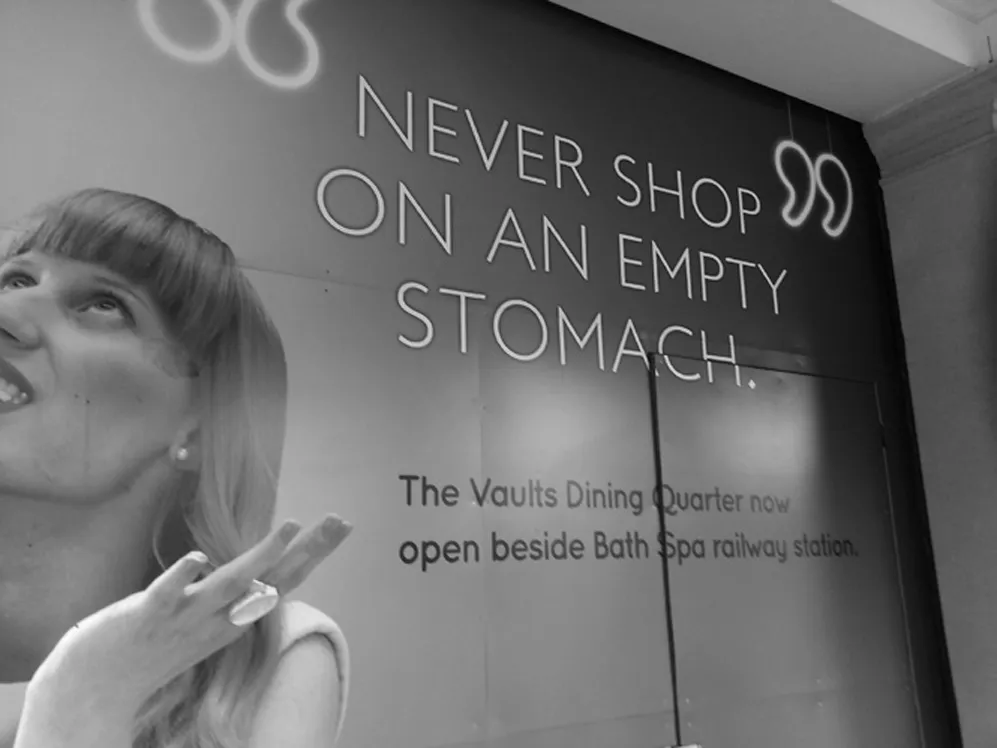
Fig. 1.1 ‘Never Shop on an Empty Stomach’ in Bath Spa, UK.
Consumer Awareness of Food Tourism
In the 1970s the consumer became more aware of the different types of food available and the quality of food they were consuming. Prior to this most consumers relied on the local supermarket or grocery store, which in turn, in order to survive, evolved into out-of-town food halls. At the same time though, another movement started; the development of farmers’ markets and farm retail experiences. This in turn was followed by a surge in food programmes on TV and the arrival of the celebrity chefs who today, in many countries, are as popular as rock stars.
In 1945 the Food and Agriculture Organization of the United Nations set up World Food Day9 on 16 October each year. The original aim was to help develop further interest in food origins and bring attention to the food dilemma in third-world countries. Each year the event has a different theme and becomes more recognized as an important date in the calendar. Although originally focused on preventing starvation, over the years the day has developed to have a wider appeal and includes sustainability and the origins of food.
More and more consumers are now wanting to know not only where their food is coming from, they want to visit the source and experience new foods as they travel. Plus they want to experiment personally in new ways of adding value to food. As a result more small businesses are getting involved in food tourism. For example, in France there are over 246 varieties of cheese being produced and in the UK over 700 varieties of cheese.10
The Global Cheese Awards (www.globalcheeseawards.com) are held in Somerset in the UK. In 2013 they voted for a Canadian cheese as the best cheese in the world; this was a creamy-gouda style Lankaaster cheese from Ontario created by Margaret Peters.
In 2010 the International Culinary Tourism Association joined forces with the New Zealand-based International Culinary Tourism Development to produce the ‘State of the Culinary Tourism Industry Report’.11 This identified the most prepared regions of the world for culinary tourism. The top three in order of ranking were Scotland, Louisiana, and Ontario. The least prepared, but the one with the most potential, was South Africa. Peru had its own Facebook page to develop the market in that country, the only one to have done so (www.facebook.com/perumuchogusto).
Key Drivers of Culinary Tourism – A Consumer Perspective
From a consumer’s perspective the drivers are wide and varied, but can be summarized as follows.
Increased awareness in improved nutrition
Many consumers are now more health conscious or want to be more health conscious and are therefore prepared to search for healthier food options, whether this be at a food store or farm.
Food deserts still exist in many cities, but this is also gaining more public attention and action is starting to take place to improve health standards. This serves to remind more affluent consumers about the importance of health foods. According to the Food Empowerment Project,12 a food desert can be described as ‘A geographic area where residents’ access to affordable, healthy food options (especially fresh fruits and vegetables) is restricted or nonexistent due to the absence of grocery stores within convenient travelling distance’. A report prepared for the US Congress by the Economic Research Service of the US Department of Agriculture 13 estimated about 2.3 million people in the USA live more...
Table of contents
- Cover
- Half Title
- Title
- Copyright
- Content
- About the Authors
- Contributors
- Foreword
- Preface
- Part I: Food Tourism And The Tourist
- Part II: Farm Produce And Agritourism
- Part III: Food Tourism – The Wider Picture
- Part IV: Marketing And The Future
- Appendix 1: Culinary, Retail and Tourism Terms
- Appendix 2: 51 Ways to Promote Your Culinary Business to the Local Community
- Further Reading
- Index
- Back Cover
Trusted by 375,005 students
Access to over 1.5 million titles for a fair monthly price.
Study more efficiently using our study tools.
Frequently asked questions
Yes, you can cancel anytime from the Subscription tab in your account settings on the Perlego website. Your subscription will stay active until the end of your current billing period. Learn how to cancel your subscription
No, books cannot be downloaded as external files, such as PDFs, for use outside of Perlego. However, you can download books within the Perlego app for offline reading on mobile or tablet. Learn how to download books offline
Perlego offers two plans: Essential and Complete
- Essential is ideal for learners and professionals who enjoy exploring a wide range of subjects. Access the Essential Library with 800,000+ trusted titles and best-sellers across business, personal growth, and the humanities. Includes unlimited reading time and Standard Read Aloud voice.
- Complete: Perfect for advanced learners and researchers needing full, unrestricted access. Unlock 1.5M+ books across hundreds of subjects, including academic and specialized titles. The Complete Plan also includes advanced features like Premium Read Aloud and Research Assistant.
We are an online textbook subscription service, where you can get access to an entire online library for less than the price of a single book per month. With over 1.5 million books across 990+ topics, we’ve got you covered! Learn about our mission
Look out for the read-aloud symbol on your next book to see if you can listen to it. The read-aloud tool reads text aloud for you, highlighting the text as it is being read. You can pause it, speed it up and slow it down. Learn more about Read Aloud
Yes! You can use the Perlego app on both iOS and Android devices to read anytime, anywhere — even offline. Perfect for commutes or when you’re on the go.
Please note we cannot support devices running on iOS 13 and Android 7 or earlier. Learn more about using the app
Please note we cannot support devices running on iOS 13 and Android 7 or earlier. Learn more about using the app
Yes, you can access Food Tourism by John Stanley,Linda Stanley in PDF and/or ePUB format, as well as other popular books in Business & Hospitality, Travel & Tourism Industry. We have over 1.5 million books available in our catalogue for you to explore.