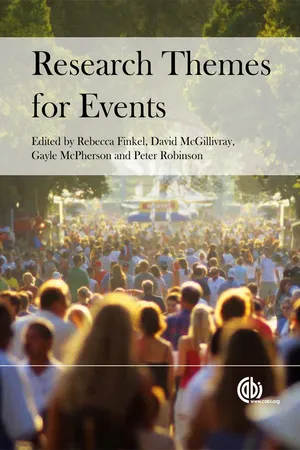
*The first book to cover events management from a research angle*Includes a number of case studies to provide a well-rounded approach to the subject*Addresses key concepts, theories and discussions around subjects such as consumer behaviour, authenticity and new technology
eBook - ePub
Research Themes for Events
- English
- ePUB (mobile friendly)
- Available on iOS & Android
eBook - ePub
Research Themes for Events
About this book
Information
1 Introduction
Rebecca Finkel,1* David McGillivray,2 Gayle McPherson2 and Peter Robinson3
1Queen Margaret University, Edinburgh, UK; 2University of the West of Scotland, Paisley, UK; 3University of Wolverhampton, Walsall, UK
When conceptualizing this book, the editors made a point to identify the key themes of the prevailing research literature in events and recognized the need to highlight the seminal literature and theoretical frameworks underpinning primary research in this growing subject area (e.g. Richards and Palmer, 2010; Foley et al., 2011; Getz, 2012). Broadly, this is an events management book framed in a research context drawing social scientific approaches. It differs from other subject-specific books by not focusing on operations or management but rather on theoretical frameworks illustrated through case studies. The goal is to shine a brighter spotlight on research, bringing it to the forefront of the discussion in the events management field. This is neither a research methods text nor a business text but rather a text for the events researcher to use as a guide for comprehending what are the particular challenges of conducting primary research in this field. As events research encompasses cross-disciplinary perspectives, drawing from tourism, leisure, cultural studies, urban geography, sociology, marketing and other social science and management discourses, not all of the divergent themes that events researchers pursue could be included. The editors, therefore, purposefully selected the themes for this book to present a consistency and coherence that many edited books lack.
In order to avoid creating a collection of chapters loosely linking scholars’ research interests, a more coherent narrative from one chapter to another is developed by connecting the theoretical contexts of each theme as the reader progresses. The book begins with an exploration of the social issues, impacts and developments in events research; it then moves on to analysing economic and management aspects surrounding research into the events industry, addresses issues of technology and tools and concludes with more political and policy-oriented chapters to highlight research into the main debates in the public sector and sphere. There are obviously discussions of social, economic and political elements in most of the chapters, as they do not exist in isolation, and each topic was selected to help readers fully understand the myriad of approaches and processes involved in undertaking this type of research. The chapters also develop similar sub-themes in order to examine some of the most relevant concepts in current events research and demonstrate how they can be applied to various topics within the field. These include analyses of: (i) holistic interpretations of sustainability; (ii) the complexity of authenticity; (iii) governance and policy influences; (iv) risk assessment and management; (v) public order and safety; (vi) liminality and transformational experiences; (vii) legacy and impacts, evaluation and measurement; and (viii) social inclusion, exclusion and accessibility. These were also selected because many scholars, students and practitioners frame their research around these concepts and construe meaning through these various lenses. The aim was to allow scholars to capture the approaches to research that have been utilized to either conceptualize practice or showcase issues of practice presented in the form of case studies. The book has its own methodological approach that demonstrates a coherence around the analysis of key issues and this is an important addition to the field of research in this area.
Each chapter is set out consistently to make it easy for students and readers to follow. Authors were asked to follow a certain set structure in order for them to present their work in a way that would be comprehensible and meaningful for the reader. Each chapter begins with an introduction of key theories and concepts and comprehensive review of the pertinent literature for the subject. Relevant primary research is then set out followed by a brief discussion of research methods if appropriate. There are different methodologies and methods employed throughout the book, which gives the reader an idea of the breadth and depth of the approaches to events research design and can help inform innovative thinking about how to advance new research projects. One case study is presented in each chapter to exemplify the main themes. Multifarious types of events, such as festivals and Olympic Games, as well as many genres of events, such as culture, music, sport, to name a few, have been included. Also, the case studies analyse events of different size and scope from community-based events to mega events in order to demonstrate the differing processes and approaches required for conceptualizing and researching a spectrum of events. Internationalization is an important factor in events worldwide and many of the chapters have an international focus or deal with issues that are internationally relevant through the case studies, which are diverse and have a focus on the developing as well as the developed world. Together, these case studies illustrate a contemporary landscape of events research and form a narrative of the international events environment. The chapters end with conclusions, implications for the events arena, recommendations for future research and questions for thought and discussion.
Outline of Chapters
Setting the tone for an examination of the more social aspects of researching events, Dr Allan Jepson and Dr Alan Clarke explore community festivals illustrated through a case study of the Derby Jubilee Festival. This chapter provides an overview of community festivals and seeks to provide a more inclusive definition of community festivals, which is firmly set within a local community context. Researching community festivals is an emergent, growing and vibrant sector of the tourism and leisure industries, which are seen to have significant economic, socio-cultural and political impacts on the destination area and host groups. This chapter seeks to develop community festivals research by arguing for a future research agenda beyond economic impact assessments.
The chapter by Dr Laura Misener focuses on the potential of sporting events to help build stronger communities and influence the development of community-level social capital. The purpose is to focus on the emergence of ways to utilize sporting events to affect communities in a positive manner and showcase how events can be leveraged for greater social benefits. By situating the discussion in relevant theoretical frameworks, this chapter identifies and examines the positive potential of the events processes as a way of building social capital, engaging communities and improving the overall social well-being of community members. A case study of the ‘Playing for Keeps’ strategy of the 2012 Ontario Summer Games and the 2015 Pan American Games in Toronto, Canada, is used to locate the analysis of key concepts related to leveraging positive social impact, social leveraging, community social capital and community engagement.
Events and festivals are increasingly being used as the social panacea for fractured communities and neighbourhoods. The apparent crisis in the lack of civic engagement in communities and cities has seen a growth in the use of events and festivals to encourage volunteers to ameliorate this problem. The chapter by Professor David McGillivray, Professor Gayle McPherson and Ms Clare Mackay examines theoretical understandings of the social and human case for events and the belief that they can work as the ‘social glue’ of communities by aiding capacity building and cementing a sense of place identity (whether a nation, a city or a neighbourhood). By presenting a case study of the 2010 Delhi Commonwealth Games, this chapter looks at how human capital, in the form of volunteering, meets social capital, through extended and sustainable networks and how this can generate useful and new knowledge for event organizers.
It can be argued that there are a myriad of reasons to attend, spectate and participate in an event, or to be an actor within the staging of an event. Such interaction depends on: (i) multiple needs and motives; (ii) the circumstances of the individual; (iii) the factors in society that influence those individuals; and (iv) the types of events that are available and accessible to those motivated to attend or participate. The chapter by Ms Gemma Gelder and Mr Peter Robinson builds upon research exploring event motivations and discusses the factors that influence decision making among audience and participants in events.
Events research often encompasses concepts relating to personal, lifestyle and cultural identities. In addition to this, special events and festivals have become increasingly important vehicles for the public manifestation of gay and lesbian identities, often framed within a discourse of ‘pride’. These events are of critical interest not only because of the way they have been mobilized to achieve sexual diversity goals but also because of the social, cultural, economic and tourism impacts that they have on destination communities. The chapter by Dr Kevin Markwell and Dr Gordon Waitt explores the relationships between events and sexualities. Particular attention is given to introducing five key terms in the literature: (i) impacts; (ii) the body; (iii) sexuality; (iv) pride; and (v) the closet. The Sydney Gay and Lesbian Mardi Gras serves as a case study with which to illustrate conceptual and empirical understandings identified in the literature review. The chapter concludes by drawing out the ramifications of the discussion for festival and events management policies and practices.
While it is widely recognized that there are many reasons for a host destination to stage an event, one of the most important is the economic impact that events are seen to generate. The attraction of economic benefits for the host destination has underpinned the fierce competition that often takes place for the right to stage an event and helps explain the fact that governments are prepared to invest substantial sums providing the infrastructure needed to host the event and to subsidize its operation. Dr Leo Jago and Professor Larry Dwyer provide an historical overview of the way that the economic performance of events has been evaluated with commentary as to the theoretical and practical advantages and disadvantages of the different approaches. A case study based on the Auditor General’s evaluation of the Melbourne Formula One Grand Prix is then presented to highlight issues in relation to some of the more advanced techniques used to assess the performance of a major event. Recommendations are then made as to the manner in which the performance of events should be evaluated in the future.
The professionalism and scale of the events management industry has grown in the past decade, as evidenced by the increase in investment in events of all types and sizes throughout the world. In his chapter, Professor Joe Goldblatt explores the developments and processes involved when researching the management of events. The case study of The Gathering 2009 in Edinburgh, Scotland, is used to highlight the key issues of events research as it pertains to the concept of managed phenomenon.
The trend towards a new phenomenon called ‘sport event tourism’ has led to policy makers and politicians trying to capitalize on their investment in hosting both mega events and also local events. Strategies are now formed around the return on investment that sports events can bring to towns, cities and nations. However, in their chapter Dr John Nauright, Dr Andrea Giampiccoli and Dr Seungwon ‘Shawn’ Lee discuss recurring sports events (RSEs) and their impact on policy decisions for governments and the tourism of an area. The ongoing, year-on-year benefits of RSEs are highlighted and they are critical of the many externally driven return-on-investment-type reports that have been commissioned by stakeholders with a key interest. They argue that a strategy based around recurring sporting and touristic interest is more likely to bring success in terms of visitor numbers and brand identity than one-off events that only briefly leave their mark.
By their nature, events are spectacular, experiential and capture the imagination of consumers. Today, multimedia has a symbiotic relationship with events, as it lies at the heart of the production, promotion and experiential performance of these modern spectacles. Dr Matt Frew explores the evolution of the relationship between media, spectacle and events by drawing on a case study of Glastonbury Music Festival. The chapter evaluates the emergence of mass media forms in the 19th century and their relationship with the major events of that period, including the Expos, World Fairs and the Olympic Games. It then examines the ways in which transformations in the media landscape have developed symbiotically with the changing purpose, shape and profile of what might be termed ‘mediaevents’, including the Olympics, the World Cup and major carnivals. Important within this discussion is how, with the sophisticated development of consumer capitalism, an uneasy relationship between traditional and new media has emerged.
Many local governments have invested in events, such as arts festivals, because they have the potential to assist in the promotion and support of cultural agendas, urban regeneration, tourism and place marketing. As inter-urban competition increases due to globalization processes, the role of events becomes increasingly important in conveying positive messages about the liveability of a place. Dr Rebecca Finkel analyses the political agendas associated with festival provision and evaluates the impacts such instrumental policies can have on event content, atmosphere and experience. Using the Cardiff Festival as a case study, the connections between place, people, policies and festivity are explored. Cardiff Council can be seen to be seeking to enhance its destination image by leveraging cultural events to position itself on a par with and even surpassing other British capital cities and European port cities in order to compete for tourists, investment and resources.
Professor David McGillivray and Ms Jennifer Jones take as their focus the increasingly prevalent narrative of resistance that accompanies sporting, cultural and political events. Because certain events represent the site for contestation over meaning and identity, these events have also been effectively employed historically to communicate political discontent, disagreement, dissent and protest. This chapter explores the two main ways of analysing the mobilization of resistance around events in the contemporary period. First, there are those events that have, as their raison d’être, the promotion of a political struggle (protest) for rights, for equality or for justice (e.g. gay rights parades, anti-capitalism protests). Second, there are those events organized around sporting or cultural themes but which act as a vehicle for protest and resistance to wider political, social and economic circumstances (e.g. the Olympic Games or carnival). This chapter analyses the contemporary significance of the second event type, drawing on case material from the authors’ own research investigations into sporting and cultural events, focused especially on the Olympic Games. Finally, particular attention is paid to the increasingly influential role of ‘new’ media activism as a means of mobilizing resistance to the excesses associated with major sporting and cultural events.
In order to avoid commodification and to protect the authenticity, heritage and identity of their festivals, organizers are recognizing the need to re-establish the ethos and cultural values of these events. It is evident that there are still a number of festivals that hold true to their ethical and moral values within their ethos and culture. The chapter by Ms Anna Borley, Ms Debra Wale and Mr Peter Robinson analyses Glastonbury Music Festival as an example of a festival that has retained vestiges of its heritage in order to sustain the legacy of the 1960s’ countercultural era when ecological values were emerging in importance with many pioneers of the Green Movement gaining traction at that time. By raising environmental awareness, the ‘greening’ of events educates a new generation of festival goers in sustainable practices and can have an impact on audience behaviour at events. This chapter suggests that, while festivals are effective forums for short-term change in behaviour through green education, securing a legacy of green cultural behaviour is problematic and needs further consideration and ongoing educational initiatives.
Professor Malcolm Foley and Mr Gordon Hunt take as their focus the contemporary issue of the use of technology in changing the way that sporting mega events are viewed and consumed. The role of technology in transforming the spectator relationship with sport is conceptualized and discussed before they present a case study of the Formula One World Championship. The shift from a purely live experience to an immersive multimedia environment is discussed in terms of Formula One’s development as a truly global sport paralleled by advances in technology, broadcasting and social media. The ability of Formula One teams and media to engage fans interactively through social media channels is showcased and the issue of fan choices between different media environments is examined. The opportunity for fans to personalize their experience of the event and the boundary between the physical and virtual experience of Formula One as a mega event is at the centre of the discussion. The move from the passive spectator to the active and interactive spectator through their use of technology is presented and implications for the way sporting events are delivered and bought are explored.
Events, although temporary, are symbolic in nature and thus have the potential to reflect and represent the values and customs of communities and societies throughout the world. By including chapters that set out different research processes and approaches illustrated through diverse case studies, this book seeks to capture a snapshot of the major concepts and contexts employed to interpret, evaluate and analyse these experiential phenomena in an effort to make sense of their growing influence and impacts on all of our lives.
References
Foley, M., McGillivray, D. and McPherson, G. (2011) Event Policy: From Theory to Strategy. Routledge, London.
Getz, D. (2012) Event Studies: Theory, Research and Policy for Planned Events, 2nd edn. Butterworth-Heinemann, Oxford.
Richards, G. and Palmer, R. (2010) Eventful Cities: Cultural Management and Urban Revitalisation. Butterworth-Heinemann, Oxford.
2 Events and Community Development
Allan Jepson1* and Alan Clarke2
1University of Hertfordshire, Hatfield, UK; 2University of Pannonia, Veszprém, Hungary
Introduction
Community festivals are recognized as a worldwide phenomenon (Chacko and Schaffer, 1993; Getz, 1997; Derrett, 2003; Gabr, 2004) with about 400 active festivals in Europe alone (Maurin, 2003). Arcodia and Whitford (2006) depicted festivals as an emergent, growing and vibrant sector of the tourism and leisure industries, which are seen to have significant economic, socio-cultural and political impacts on the destination area and host groups. Community festivals research has become skewed in many areas and has followed a positive pattern of benefits or impact research perhaps similar to the way in which tourism has evolved into a field of study.
This chapter is split into three distinct sections. The first section provides an overview of community festivals and seeks to provide a more inclusive definition of community festivals, which is firmly set within a local community context. The second section seeks to investigate the literature surrounding community festivals, while the third and final section of the chapter argues for a future research agenda within community festivals.
Defining Community Festivals
Community festivals can be considered as part of the new wave of alternative or special interest tourism as identified by Poon (1993). This means that they contain certain unique elements that are not replicated or mass produced. Festivals can be seen as prime manifestations of the experience economy (Pine and Gilmore, 1999) as they entertain, educate, hold aesthetic value and provide the platform for escapism. Falassi (1987) saw festivals as ‘a sacred or profane time of celebration marked by special observances’ maintaining that the social functions of a festival are closely related to community values. Farber (1983, cited in Getz, 1991) investigated festivals and public celebrations and concluded that much could be learned about a community’s symbolic, economic, political and social life. Falassi (1987) then added to Farber’s notions of symbolism by commenting that both the social and the symbolic mean...
Table of contents
- Cover Page
- Title Page
- Copyright Page
- Contents
- Contributors
- Acknowledgements
- 1 Introduction
- 2 Events and Community Development
- 3 Events and Social Capital
- 4 Events and Volunteerism
- 5 Events and Motivations
- 6 Events and Sexualities
- 7 Events and Economics
- 8 Events and Management
- 9 Events and Sport Tourism
- 10 Events and Media Spectacle
- 11 Events and Political Agendas
- 12 Events and Resistance
- 13 Events and Environmental Awareness
- 14 Events and Technology
- 15 Conclusion
- Index
- Footnotes
Trusted by 375,005 students
Access to over 1.5 million titles for a fair monthly price.
Study more efficiently using our study tools.
Frequently asked questions
Yes, you can cancel anytime from the Subscription tab in your account settings on the Perlego website. Your subscription will stay active until the end of your current billing period. Learn how to cancel your subscription
No, books cannot be downloaded as external files, such as PDFs, for use outside of Perlego. However, you can download books within the Perlego app for offline reading on mobile or tablet. Learn how to download books offline
Perlego offers two plans: Essential and Complete
- Essential is ideal for learners and professionals who enjoy exploring a wide range of subjects. Access the Essential Library with 800,000+ trusted titles and best-sellers across business, personal growth, and the humanities. Includes unlimited reading time and Standard Read Aloud voice.
- Complete: Perfect for advanced learners and researchers needing full, unrestricted access. Unlock 1.5M+ books across hundreds of subjects, including academic and specialized titles. The Complete Plan also includes advanced features like Premium Read Aloud and Research Assistant.
We are an online textbook subscription service, where you can get access to an entire online library for less than the price of a single book per month. With over 1.5 million books across 990+ topics, we’ve got you covered! Learn about our mission
Look out for the read-aloud symbol on your next book to see if you can listen to it. The read-aloud tool reads text aloud for you, highlighting the text as it is being read. You can pause it, speed it up and slow it down. Learn more about Read Aloud
Yes! You can use the Perlego app on both iOS and Android devices to read anytime, anywhere — even offline. Perfect for commutes or when you’re on the go.
Please note we cannot support devices running on iOS 13 and Android 7 or earlier. Learn more about using the app
Please note we cannot support devices running on iOS 13 and Android 7 or earlier. Learn more about using the app
Yes, you can access Research Themes for Events by Rebecca Finkel, David McGillivray, Gayle McPherson, Peter Robinson, David McGillivray,Gayle McPherson,Peter Robinson in PDF and/or ePUB format, as well as other popular books in Commerce & Industrie de l'hôtellerie, du voyage et du tourisme. We have over 1.5 million books available in our catalogue for you to explore.