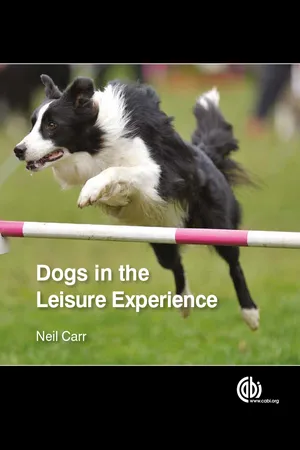
This book explores the social and cultural constructions and debates of what are dogs and what is leisure. It looks at how working dogs play a significant role in leisure experiences such as ensuring the safety of air transport, and considers the differing roles and changing acceptance of dogs' involvement in sport. Within the setting of the animal welfare and sentience debates, it examines the leisure needs of dogs and their owners. Providing an original contribution to our understanding of dogs as both participants and objects in the leisure experience, this book is a useful resource for researchers in leisure, hospitality and tourism.
- English
- ePUB (mobile friendly)
- Available on iOS & Android
eBook - ePub
Dogs in the Leisure Experience
About this book
Information
1 Introduction
Why a Book on Dogs in Leisure?
The dog, Canis familiaris, has played and continues to play an integral role in the lives of many individual humans and societies throughout the world. This has been an evolving relationship since at least the Neolithic era (Herzog, 2010; Bradshaw, 2011; Power, 2012), with dogs being defined as the first domesticated animal (King et al., 2009; Holmberg, 2013). These first dogs are actually more accurately defined as wolves. While debate continues about the exact time of the split between the wolves and dogs, according to Bensky et al. (2013) it began approximately 100,000 years ago. Today, there is a huge array of types of dogs yet they all have one thing in common: their relation with humans. The willingness of the wolf to share its space and time with early humans has been identified as a central reason for the evolution of the dog and this willingness is clear today in virtually all dogs, be they pets or working animals. It is the closeness between dogs and humans in general, and particularly between me and my dogs, that is the driving force behind this book.
Despite the apparent closeness between humans and dogs, it is clear that this relationship and indeed the dogs themselves have existed at best at the margins of academic interest and research (Budiansky, 2000; Coppinger and Coppinger, 2001; Wise, 2002; Csanyi, 2005). This view is supported by Westgarth et al. (2010: 38) who stated: ‘It is surprising how little we know about the domestic dog’. More generally, as Herzog (2010: 16) pointed out: ‘the study of our interactions with other species has, until recently, been neglected by scientists’. This does not mean we have not studied animals as objects, far from it, but that we have not focused significant attention, especially traditionally, on researching them from a perspective that sees them as sentient beings. The sentience of dogs is an issue that will be explored in detail in this chapter and referred to again elsewhere in the book.
As changes have occurred in academia and we have witnessed the development of understandings of animals as more than mere objects, there has arguably been a focus, as so often in research, on the exotic. Academics by and large seem to have, just like the general populace, an obsessive interest in the exotic, whereas interest in the everyday, the mundane, tends to be limited. It is into this latter category that the most popular pets, including the dog, fit. Indeed, McConnell (2005: xxvi) has stated that dogs have: ‘been proof for decades of the saying “Familiarity breeds contempt”. Scientists could study right whales or Serengeti lions or scissor-tailed flycatchers, but heaven forbid you tried to make your name as a researcher studying dogs.’ Yet, as McConnell (2005) noted, this situation is changing. Indeed, Hare and Woods (2013: 125) have noted that: ‘From being thought of as an unremarkable animal made stupid by domestication, all of a sudden dogs have become one of the most popular species for animal researchers to study.’
The field of leisure studies, as broadly defined, has similarly tended to ignore pets in general (Norris et al., 1999) and dogs in particular, focusing instead on the more exotic, wild animals in the tourism context (e.g. Coghlan and Prideaux, 2008; Markwell and Cushing, 2009; Duffy, 2014). Limited number of studies that have examined dogs in leisure have tended to focus on dog sports such as flyball and agility (Gillespie et al., 1996), as discussed in Chapter 3. Yet, while they are focused on a dog-related activity, the attention in most of these works has been on humans (e.g. Kemp, 1999; Baldwin and Norris, 1999; Gillespie et al., 2002; Hultsman, 2013). In contrast, the limited work undertaken in the veterinary sciences field on dogs in sport has focused exclusively on the mechanics of the animal (Pfau et al., 2011; Payne, 2013a, b; Birch and Leśniak, 2013), ignoring in the process the role of humans and the social construction of these dogs and the sport in which they are involved. This view is supported by Atkinson and Young (2005), who identified a lack of research by sociologists into blood sports in general and the sport of greyhound racing in particular. As will be discussed throughout the book other works, though small in number, have looked at dogs in a variety of settings but have generally failed to do so through a leisure studies lens, despite the activities the dogs and their owners are engaged in being clearly identifiable as leisure. More often than not they have focused on humans rather than the dogs. Even where attempts have been made to look at the dog and human as subjects, the data have tended to stem exclusively from the latter group (e.g. Kuhl, 2011), in the process arguably devaluing the voice of the dog.
History of the Dog and its Relationship with Humanity
Dogs have had and continue to have a complex variety of relations with humans. At one extreme there are people who harbour a deep-seated dislike, fear and even hatred of dogs; at the other extreme we see a strong bond of love and affection between people and dogs. Any examination of the nature of the position and experiences of dogs in the leisure environment needs to recognize the conflicting emotions that dogs can generate within the human population.
The relation between humans and dogs is complex and constantly evolving; it is also one that is specific to a given place and culture. Despite this, it is important to recognize that today dogs are more accepted as a ‘member of the family’ than at any time in history (Reichmann, 2000; Katz, 2003; Power, 2008). Or, as Rudy (2011: 29) said: ‘we have never in history been closer to our pets than we are today’. Indeed, Sanders (1999: 9) pointed out that most people who own a dog today identify it as a person or something with ‘person status’. Consequently, he stated that: ‘Studies show that somewhere between 70 and 99 percent of pet caretakers define their animals as members of the family, and from 30 to 83 percent consider the pet to be a “special” or “close” friend’ (p. 10). Indeed, reporting on a study in Australia, Power (2013) noted that 90% of Australians recognize their dogs as members of the family. Although not quite reaching the levels reported by Sanders, it is still important to note Herzog’s (2010: 9) claim that ‘Over half of dog owners think of their pets as family members.’ The result is that as Racher (2005: 11) stated: ‘dogs have become a major element of many families’. This view was echoed in an interview undertaken with one of the management team at the Hilton Hotel in Whistler in 2008 when he stated: ‘Time and time again you see families come up [to Whistler] and the pets [dogs] are their children.’ Such is the closeness between many people and their dogs that owners are said to form intimate and emotionally close and strong relations (not just bonds) with their animals and to even engage in conversations with them (Sanders, 1999). Indeed, it is not uncommon now to see it being claimed that owners place as much, or even more, value on their dogs and rely on them more for emotional support than they do on human members of their family (Sanders, 1999; Katz, 2003).
The move towards the positioning of the dog in the centre of the human family has arguably been an ongoing one throughout the history of the relationship between humans and dogs, but has become prevalent since the Industrial Revolution and the urbanization of formerly rural populations, and even more so in the last 100 years. Yet this trend can be traced back even further in its origin to the Renaissance era in Europe when the urbanized middle and upper classes began to keep pets; prime among which was the dog (Kalof, 2007). Indeed, Borsay (2006: 142) has stated: ‘what underpinned the increasingly sentimental attitude towards the animal kingdom was industrialization and urbanization, which drew more and more people away from direct contact with agriculture and the associated rearing, deployment, and killing of animals’. While there is clearly a long history associated with the pet dog in Europe it is important to note that Hare and Woods (2013) have identified that the pet dog existed in China in as early as the 1st century BC. As the quotation from Borsay suggests it is not just that humans have been positioning dogs as an ever more central component of the family, but that the meaning behind the dog has also been changing; shifting from an animal to be used by humans in the process of their work and even survival (a tool or object) to a pet. Indeed, Serpell and Paul (1994) noted the adoption of first the word ‘pet’ and more recently the term ‘companion animal’ as signs to show the changing nature of how we view animals such as the dog. These terms shift the emphasis away from the economic value of the domesticated animal and its overt use as a tool of work towards a recognition of the social and emotional value of the animal, and by the highlighting of these values draw such labelled animals closer to the human family. Yet these values have not always been recognized, leading to the suggestion by Serpell (in Herzog, 2010), among others, that the pet has no function and therefore is without value. This consigns the pet dog to the bottom of the heap where it is not only a mundane animal, but a valueless mundane animal.
Just becoming a pet does not, of course, mean that a dog ceases to be an object or tool. Indeed, as will be discussed in Chapter 4, many dogs have been and still are owned as pets, if not solely then certainly partially, for the displaying of the owners’ wealth and status. This trend, Power (2012) suggested, emerged with the growth of the middle class in western Europe in the 1800s and the growth in dog ownership among this population. The Council for Science and Society (1988: 4) saw this situation having continued into the contemporary era where: ‘Unusual and expensive breeds of dog or cat, for example, may be owned as much for reasons of prestige as for anything else.’ They further pointed out that: ‘Animals kept solely as status symbols are often admired and well looked after, but only as long as the image they project corresponds to the owner’s expectations.’ The construction of pet dogs as symbols of the status and wealth of their owners is something that ensures the continued positioning of the dog by humans as an object or tool. The Council for Science and Society also raised the issue of the pet dog as a play toy, hobby or recreational tool, identifying an emphasis on the dog as object in these instances. However, as part of bringing dogs into the house and out of the traditional working environment they have, thanks to humans, assumed more human characteristics (in a process that identifies all that can be wrong with anthropomorphism) and through this potentially negative minefield have emerged, at least partially, as a creature with rights: a sentient being.
The result, as Rice (1968: 210) noted, was that even by the 1960s in the USA and elsewhere, ‘many pets [especially dogs] are part of the family. Their status may be that of an amusing child, a pleasant companion, an understanding friend, or a loving soul-mate. They receive the attention and affection customarily given to people.’ Such a view was also noted by Mann (1975) and is supported by Joseph (2010) who saw animals functioning increasingly as companions, able to alleviate loneliness, make humans feel loved and loving, and provide a conduit through which social bonds between people may be established. In this way the companion dog, it is possible to suggest, is perceived not as an object, but as a subject (Council for Science and Society, 1988) – a sentient animal. Consequently, there is a ‘relationship’ between a companion dog and human owner, which contrasts with the dog as object, with whom a relationship cannot exist.
While acceptance of the dog as a member of the human family has its origins in North America and north-western Europe, there is evidence to suggest that it is becoming a global trend, with dogs being more commonly seen as family members in such diverse places as Australia and New Zealand, India, China and South-east Asia. This trend and its implications will be discussed throughout the book but particularly in Chapter 7, which is concerned with the dog as human cuisine.
The nature of the relation between dogs and people both influences and is influenced by how the sentience of dogs and hence their ‘rights’ are perceived. Questions of sentience and animal rights will be discussed later in this chapter as they colour the entirety of this book, how it is written and how it will doubtless be perceived by the reader. As we see dogs becoming ever more accepted as members of the human family we have witnessed an increasing discussion of the intimate, platonic bonds that can and do develop between dogs and their human family. These relationships are perceived and displayed as ones where ‘The warmth and depth of the affection a dog can display towards its owners and all members of the family, especially to children, is legendary’ (Reichmann, 2000: 353–354).
Why have we witnessed a growth in the number of dogs living as a member of a human family, often sleeping inside, on or near the humans’ bed; travelling in the family car; and going on holiday with the family? One of the most commonly cited reasons is the supposed affection that dogs display to their family members (Reichmann, 2000). This affection is claimed to be unconditional and honest in a way that is incomparable to that available from most human–human relationships (Reichmann, 2000). It is further suggested that in our post-modern society where people increasingly lead isolated lives, separated from their kin and alienated from their neighbours, dogs offer a source of by affection that is not available elsewhere (Katz, 2003). Such a view is supported by the New Zealand Companion Animal Council (2011), which stated that 53% of New Zealanders acquire a dog primarily for companionship.
Based on the recognition of the dog as a source of companionship and affection it has begun to be viewed as a means of increasing the mental health and well-being of people in general (Miklósi, 2007; Wood et al., 2007; Zilcha-Mano et al., 2012), and elderly (Norris et al., 1999) single people in particular. With specific reference to children, dogs have been identified as an aid to their healthy physical and psychological development (Endenburg and van Lith, 2011). The dog also offers the opportunity and drive to enhance the fitness of the owner through its need for exercise (Brown and Rhodes, 2006; Cutt et al., 2008; Yabroff et al., 2008; Oka and Shibata, 2009; Reeves et al., 2011). The benefits of dog ownership do not, according to Wood et al. (2007) and Messent (1983), accrue only to the pet owner. Rather, dogs have the potential to facilitate positive social interaction between owners and non-dog owners that benefits the wider society through the development of a sense of community. Such a claim is well known to most dog owners whose animals often act as social lubricants and initiators of conversations with other owners. Such benefits assume that all social interactions between dogs and their owners and others are positive, which, unfortunately, is not the case. Despite this, as long as the positive encounters outweigh the negative ones, then the presence of dogs in society can be argued to be positive for social cohesion. Furthermore, the dog may offer security (which is often more imaginary than real with pet dogs who are as likely to invite a stranger into the house as bark threateningly at one), which can be very important for those living by themselves (Gillespie et al., 1996). Overall, as Rogerson (1991) and Herzog (2010: 68) noted, we: ‘bring animals [and particularly dogs] into our lives because they make us feel happier, healthier, and more loved’. The reasons why we bring dogs as pets into our lives undermines the argument that a pet is without function or value; rather they are beyond economic valuing and are certainly not valueless to research either in their own right or in the context of their relations with humans. The result of all these reasons for bringing dogs into our lives is an increasingly close bond between dogs and humans that blurs the distinction between animals and humans and ensures dogs are seen ever more as a member of the family.
The idea that dogs help to ensure the mental and physical well-being of humans, while prominent today, is something that appears to have been in existence since at least the medieval era in Europe; then, royalty often kept dogs for the emotional outlet they offered when the humans were faced with the reality of the isolation with which their positions presented them (Kalof, 2007). This just goes to show how ideas, like fashion, come and go and that the current position of the dog is not necessarily the one it will be situated within in the future.
The term ‘pet’ has developed negative connotations of ownership in recent years, suggesting the animal is owned as an object for the benefit of the human and consequently its rights are not necessarily taken into consideration. As a result, we have seen the emergence of terms such as ‘companion animal’ and ‘pet guardian’. The notion that an animal can be the companion of a human suggests that both actors are in a relationship where if there is not equality there is at least recognition of the rights of both and as such both are empowered. In this sense the relation between dog and human may, in Goff...
Table of contents
- Cover
- Half Title
- Title
- Copyright
- Content
- List of Tables
- List of Figures
- Acknowledgements
- 1 Introduction
- 2 Working Dogs
- 3 Sport Dogs
- 4 Leisured Dogs and Dogs as Leisure Objects
- 5 Providing for the Leisured Dog and Dog as Leisure Object
- 6 The Boarding Kennel and Dog Day-care Centre: Dog Holidays
- 7 Dogs as Cuisine
- 8 Dog Cuisine
- 9 Conclusions
- Appendix 1 Breweries and beers utilizing dogs in marketing and branding
- Appendix 2 Dog cuisine books available via Amazon UK in October 2013
- References
- Index
Trusted by 375,005 students
Access to over 1.5 million titles for a fair monthly price.
Study more efficiently using our study tools.
Frequently asked questions
Yes, you can cancel anytime from the Subscription tab in your account settings on the Perlego website. Your subscription will stay active until the end of your current billing period. Learn how to cancel your subscription
No, books cannot be downloaded as external files, such as PDFs, for use outside of Perlego. However, you can download books within the Perlego app for offline reading on mobile or tablet. Learn how to download books offline
Perlego offers two plans: Essential and Complete
- Essential is ideal for learners and professionals who enjoy exploring a wide range of subjects. Access the Essential Library with 800,000+ trusted titles and best-sellers across business, personal growth, and the humanities. Includes unlimited reading time and Standard Read Aloud voice.
- Complete: Perfect for advanced learners and researchers needing full, unrestricted access. Unlock 1.5M+ books across hundreds of subjects, including academic and specialized titles. The Complete Plan also includes advanced features like Premium Read Aloud and Research Assistant.
We are an online textbook subscription service, where you can get access to an entire online library for less than the price of a single book per month. With over 1.5 million books across 990+ topics, we’ve got you covered! Learn about our mission
Look out for the read-aloud symbol on your next book to see if you can listen to it. The read-aloud tool reads text aloud for you, highlighting the text as it is being read. You can pause it, speed it up and slow it down. Learn more about Read Aloud
Yes! You can use the Perlego app on both iOS and Android devices to read anytime, anywhere — even offline. Perfect for commutes or when you’re on the go.
Please note we cannot support devices running on iOS 13 and Android 7 or earlier. Learn more about using the app
Please note we cannot support devices running on iOS 13 and Android 7 or earlier. Learn more about using the app
Yes, you can access Dogs in the Leisure Experience by Neil Carr in PDF and/or ePUB format, as well as other popular books in Business & Hospitality, Travel & Tourism Industry. We have over 1.5 million books available in our catalogue for you to explore.