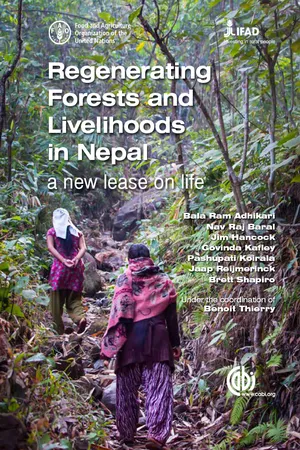
Regenerating Forests and Livelihoods in Nepal: A New Lease on Life documents the success story of an innovative rural development programme in the Himalayan foothills, Nepal. The project has made a real difference by transforming increasingly degraded land, where farmers carved out a meagre existence, into a fertile and prosperous zone where they could thrive. Project activities included bringing in effective cultivation techniques to protect the environment and introducing new local crops and goats, as well as promoting entrepreneurial spirit. Every intervention was carefully selected and conducted to mitigate climate change as well as to help farmers become more resilient to its effects.The ingredients of the project's success, from both the technical and human perspectives, are presented in this book, demonstrating people's commitment in a country prone to natural disasters and earthquakes.
- English
- ePUB (mobile friendly)
- Available on iOS & Android
eBook - ePub
About this book
Trusted by 375,005 students
Access to over 1.5 million titles for a fair monthly price.
Study more efficiently using our study tools.
Information
Chapter 1
Rural Nepal: its people, its forests
“Standing on the beautiful hilltop
Looking at the distant snow-capped
Mountains hiding behind clouds…
I look at the stretched green field
Down the hill at the smoking valley
And instantly realize that
It is not the dream of heaven unknown…
But it is the sips of air that I take
For the well-being of the world
And of the hope of all green…”
From Sips of Air, a poem by Dhal Bahadur Jirel, Nepal
A brief history of Nepal
It is theorized that the word “Nepal” was derived from the Sanskrit “nipalaya”, which means “at the foot of the mountains” or “abode at the foot”, a reference to its location in relation to the Himalayas.
Prehistory: There is evidence that people of Kirat ethnicity lived in what is now Nepal more than 2,500 years ago and ruled the area for about 1,225 years (800–300 BCE). Their reign had 29 kings, the first of whom was Elam (also known as Yalambar), who is referenced in the epic Mahabharata.
1700s – the beginning of modern Nepal: Modern Nepal was created in the second half of the 18th century. The king of the small principality of Gorkha, Prithvi Narayan Shah, formed a unified country from a number of independent hill states. At an early age, he dedicated himself to the conquest of the Kathmandu Valley and the creation of a single state, which he achieved in 1768.
1800s – internal turmoil: After Shah’s death, his dynasty began to expand the kingdom into what is present-day northern India. At the same time, his heirs were unable to maintain firm political control over Nepal. Rivalry between Nepal and the British East India Company over the states bordering Nepal and India led to the Anglo-Nepalese War (1814–1816). In the end, large parts of the Nepali territories of Terai (nearly one third of the country) were ceded to the British in exchange for Nepalese autonomy. These territories remained in India when India became independent in 1947.
The Rana dynasty ruled the Kingdom of Nepal from 1846 to 1953. The Shah monarch was reduced to a figurehead, and Jung Bahadur was the first ruler. He codified laws and modernized the state’s bureaucracy, and in 1855 he attempted to impose his influence in Tibet but was stopped in the Nepalese–Tibetan War (1855–1856). In 1885 a coup d’état took place. The nephews of Jung Bahadur killed his sons and took control. The Rana dynasty developed into a power family and is still very influential in the country. The family formed close alliances with the Shah dynasty through marriage and business.
1900s – from “monarchy” to “democracy”
1950s. Popular dissatisfaction was growing among those who were educated in Indian schools and also among the Ranas themselves – many of whom were marginalized within the hierarchy. They wanted to liberate Nepal from autocratic Rana occupation. After an armed revolt, the Shah family returns to power and appoints a non-Rana as prime minister. A period of quasi-constitutional rule follows.
1959. A new constitution was issued, and the first democratic elections for a national assembly were held. However, years of wrangling between kings and the government ensued, and in 1960 the democratic experiment was dissolved.
1960. King Mahendra carried out a royal coup and promulgated another new constitution. Members of Parliament and hundreds of activists were arrested in the process. The new constitution established a party-less system of panchayats (councils) and solidified the absolute power of the monarchy, keeping the King as head of state with sole authority over all governmental institutions.
1979. King Birenda (King Mahendra’s son) called for a national referendum to decide on the nature of Nepal’s government: either the continuation of the panchayat system with democratic reforms, or the establishment of a multi-party system. The former system won, and the King carried out the promised reforms.
1991. Nepal held its first parliamentary elections in nearly 50 years. The Nepali Congress won 110 of the 205 seats and formed the first elected government in 32 years.
1996. The Communist (Maoist) Party of Nepal began an insurgency in five districts, establishing a provisional “people’s government” at the district level in several locations. The rebellion escalated.
2001. The royal family was assassinated and soon after, the new king temporarily deposed the government and took complete control.
2005. The King declared a state of emergency to quash the revolution, placing politicians under arrest, cutting telephone and internet lines, and curtailing freedom of the press.
2006. Strikes and street protests forced the King to reinstate the parliament. A seven-party coalition took control of the government and stripped the King of most of his powers.
2008. In the elections, the Maoists secured a largest-party status, with the prospect of forming a government to rule the proposed “Republic of Nepal”. The newly elected Assembly declared Nepal a Federal Democratic Republic, thus abolishing the 240-year-old monarchy. Ram Baran Yadav (Nepali Congress) became the first president, and Pushpa Kamal Dahal (Unified Communist/Maoist Party) became the first elected prime minister.
2013. November, new elections were conducted after Parliament failed to finalize and promulgate the new Constitution.
The country at a glance
Landlocked between India and China, Nepal has a total area of 147,181 square kilometres. Altitudes range from less than 100 metres above sea level to more than 8,800 metres in less than 100 km distance. With this variety of altitude and corresponding climates, the country is rich in biodiversity, and has a huge potential for niche agricultural products. Natural resources are abundant, and various agro-climatic conditions are favourable to developing food and cash crops. However, the physical isolation and rugged terrain of Nepal’s hilly and mountainous regions make it difficult to promote economic activities and deliver services.
About half the population lives in the Plains (Terai), the tiny southern belt of Nepal; 43 per cent live in the Hill areas (up to 2,500 metres); and 7 per cent in the mountain areas that are more than 3,000 metres above sea level.
In recent years, political instability has been another major obstacle to development efforts. Poverty, lack of economic growth, and increasing marginalization contributed to political unrest and violence. A Maoist rebellion that began in 1996 in the remote hill districts of the Mid-Western region later intensified and spread across large parts of the country. More than 14,000 Nepalese were killed during the major conflict period and about 600,000 were internally displaced or made homeless. In addition, more than 2 million people are believed to have fled to India. Fighting occurred largely in rural districts, starting in the West, taking a heavy toll on agriculture. In November 2006, a comprehensive peace accord was signed between the then Royal Government and the Maoists, which marked the ending of the armed conflict. The accord also included clauses about the transformation of the country to a multi-party democratic republic as well as about respect of human, social and economic rights. A reinstated parliament abolished the monarchy, formed an interim government led by the Nepali Congress leader and provided an interim constitution for the nation. A Constituent Assembly election was held in April 2008, and the country entered into the era of the “3Rs” – reconciliation, rehabilitation and reconstruction. Although the armed conflict has ended, peace and the political situation remain fragile. Following the peace accord, Nepal has been making the arduous transition from a decade-long conflict to a democratic society. However, political uncertainty persists, with no agreement reached over the key issues of governance structure.
Despite these obstacles, Nepal has achieved notable gains in reducing poverty: the “incidence of poverty” (i.e. the share of the population whose income or consumption is below the poverty line) decreased from 42 per cent in 1996 to 33 per cent in 2006, to 25 per cent in 20101, and 23.25 per cent in 20122. In addition to the expansion of road and communication networks in the country (in 2013, almost each of the 75 districts had road access), these gains have come about mainly through a significant increase in remittances resulting from the mass migration of adults and youth in search of alternative livelihoods from villages to cities, neighbouring countries and abroad. With about 1,000 men travelling abroad for work every day, remittances now constitute a significant proportion of Nepal’s gross domestic product (GDP) – 23 per cent in 2011 – and they keep growing. At the same time, more women are heading households alone and taking on the burden of sustaining the rural economy, a phenomenon called the “feminization of agriculture”. Women constitute more than 60 percent of the agricultural labour force but have little access to land, production technologies and training.
There is progress and there are obstacles. When taken together, however, Nepal is one of the poorest and least developed countries in Asia and in the world. Its per capita GDP is about USD 630 (World Bank, 2011), and nearly a quarter of the total population lives below the national poverty line. There are serious problems of food insecurity and malnutrition throughout the country, especially in the hilly and mountainous regions where 50 per cent of children are malnourished. This is largely due to the poor performance of the agricultural sector (ref. 19 + IFAD website).
Lens on the rural areas
About 80 per cent of Nepal’s population lives in rural areas and depends on small, fragmented subsistence farming for their livelihoods. Household food security and poor nutrition are still widespread in rural areas. Most households have little or no access to basic social services such as primary health care, education, clean drinking water and sanitation services. They have generally very small landholdings and a few are landless, have high rates of illiteracy and are also concentrated in specific ethnic, caste and minority groups, particularly those of the lowest caste (dalits, or untouchables) and indigenous peoples (janajatis). Life is a constant struggle for survival. The most vulnerable and marginalized groups are the lowest social castes, indigenous peoples and women.
Poor rural people in Nepal include:
• destitute people, such as sick or disabled people, abandoned children and displaced persons;
• extremely poor people, including illiterate or landless people or those with very few assets;
• moderately poor people, such as those who have small farms that produce insufficient food for family consumption or for income generation, and thus are often heavily indebted;
• people who are “nearly poor”, including small farmers who are at risk of slipping deeper into poverty as a result of factors such as conflict, debt and land degradation.
Land ownership – especially of productive arable land – in Nepal has traditionally been concentrated in the hands of a few. For most poor rural families, access to land is extremely limited. Almost 70 per cent of households have holdings of less than 1 hectare and many of them depend on plots that are too small to meet their subsistence requirements. The growing population has put huge pressure on cultivable land, especially in the Terai, which also supports many landless migrants from the hills. The growing population also has led historically to unsustainable use of natural resources, including overgrazing and deforestation in hill and mountain areas. And erosion in the uplands causes flooding in the lowlands that can be devastating to crop yields. Social discrimination in rural Nepal plays a significant role in keeping the most disadvantaged people poor and marginalized. Excluded groups include smallholder farmers, landless labourers, lower castes, indigenous peoples and women. Discrimination on the grounds of caste is officially illegal in Nepal but is in fact widespread, especially in rural areas. Members of the lowest caste (dalits) are the most disadvantaged group, and many of them work as wage labourers for higher-caste and well-off farmers.
Figure 1: Distribution of caste and ethnic groups in Nepal

There is a wide gap between women and men when it comes to access to health, nutrition, education and participation in decision-making. Infant mortality is much higher for girls, and illiteracy is far more common among women than men. Many rural women live in severe poverty, without any means of improving conditions for themselves and t...
Table of contents
- Cover Page
- Title Page
- Copyright Page
- Table of Contents
- Acronyms
- List of tables, charts and pictures
- Preface-Foreword
- Introduction
- 1 Rural Nepal: its people, its forests
- 2 An initiative takes root – HLFFDP, the first leasehold forestry project
- 3 The initiative gathers force – LFLP, the second leasehold forestry project
- 4 Impacts of leasehold forestry
- 5 Beyond the two projects, a national perspective and institutional context
- 6 When the programme leaves
- 7 Conclusions
- About the Authors
- List of LFLP TA project publications
- References
- Backcover
Frequently asked questions
Yes, you can cancel anytime from the Subscription tab in your account settings on the Perlego website. Your subscription will stay active until the end of your current billing period. Learn how to cancel your subscription
No, books cannot be downloaded as external files, such as PDFs, for use outside of Perlego. However, you can download books within the Perlego app for offline reading on mobile or tablet. Learn how to download books offline
Perlego offers two plans: Essential and Complete
- Essential is ideal for learners and professionals who enjoy exploring a wide range of subjects. Access the Essential Library with 800,000+ trusted titles and best-sellers across business, personal growth, and the humanities. Includes unlimited reading time and Standard Read Aloud voice.
- Complete: Perfect for advanced learners and researchers needing full, unrestricted access. Unlock 1.5M+ books across hundreds of subjects, including academic and specialized titles. The Complete Plan also includes advanced features like Premium Read Aloud and Research Assistant.
We are an online textbook subscription service, where you can get access to an entire online library for less than the price of a single book per month. With over 1.5 million books across 990+ topics, we’ve got you covered! Learn about our mission
Look out for the read-aloud symbol on your next book to see if you can listen to it. The read-aloud tool reads text aloud for you, highlighting the text as it is being read. You can pause it, speed it up and slow it down. Learn more about Read Aloud
Yes! You can use the Perlego app on both iOS and Android devices to read anytime, anywhere — even offline. Perfect for commutes or when you’re on the go.
Please note we cannot support devices running on iOS 13 and Android 7 or earlier. Learn more about using the app
Please note we cannot support devices running on iOS 13 and Android 7 or earlier. Learn more about using the app
Yes, you can access Regenerating Forests and Livelihoods in Nepal by Benoît Thierry in PDF and/or ePUB format, as well as other popular books in Technology & Engineering & Forestry. We have over 1.5 million books available in our catalogue for you to explore.