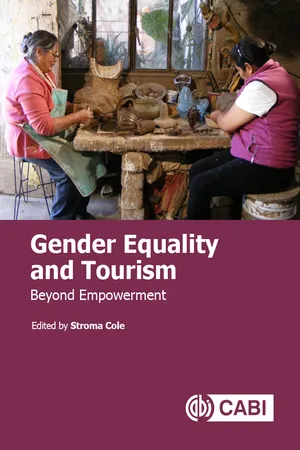
Does tourism empower women working in and producing tourism? How are women using the transformations tourism brings to their advantage? How do women, despite prejudice and stereotypes, break free, resist and renegotiate gender norms at the personal and societal levels? When does tourism increase women's autonomy, agency and authority? The first of its kind this book delivers: A critical approach to gender and tourism development from different stakeholder perspectives, from INGOs, national governments, and managers as well as workers in a variety of fields producing tourism.Stories of individual women working across the world in many aspects of tourism.A foreword by Margaret Bryne Swain and contributions from academics and practitions from across the globe.A lively and accessible style of writing that links academic debates with lived realities while offering hope and practical suggestions for improving gender equality in tourism.Gender Equality and Tourism: Beyond Empowerment, a critical gendered analysis that questions the extent to which tourism brings women empowerment, is an engaging and thought-provoking read for students, researchers and practitioners in the areas of tourism, gender studies, development and anthropology.
- English
- ePUB (mobile friendly)
- Available on iOS & Android
eBook - ePub
About this book
Information
1 Introduction: Gender Equality and Tourism – Beyond Empowerment
University of the West of England, Bristol, UK
*E-mail: [email protected]
The Origins of This Book
The ideas fuelling the creation of this book arose from submissions to a conference organized by Equality in Tourism (http://equalityintourism.org), an organization dedicated to ensuring women always have a voice in global tourism, and Yeşil Valiz (http://yesilvaliz.org), which was to be held in Turkey in 2016. Sadly, the conference had to be abandoned due to the violent political events that took place at the time – reminding us just how fickle the tourism endeavour is! However, from the ashes, the abstracts, together with an engagement with some of our associates at Equality in Tourism, became discussions, and the book was born.
Drawing on the theme of gender equality in tourism, this book aims to identify the main obstacles to women’s advancement in the tourism industry, and to discover and share successful strategies to overcome them, drawing on case studies from all over the world. All the authors contributing to this book are proudly feminist and, with the exception of Chapter 3, have used qualitative methods to give depth and feeling to the women’s stories they present. All of us have used positionality and reflexivity to reflect our engagement with subjectivity. Many of the authors are not writing in their first language and this book has the privilege of bringing Spanish-speaking and Latin American scholarship to the English-speaking world. Interlaced between the chapters are stories from women who work in tourism.
Why Gender Equality?
Gender is a system of cultural identities and social relationships between females and males (Swain, 1995), characterized by unequal power and norms that determine an unequal distribution of resources, work, decision making, political power, and the entitlement of rights and obligations in both the private and public spheres (Thierry, 2007). The study of gender as a pertinent issue within tourism began receiving academic interest and systematic investigation in the 1990s (Swain, 1995; Figueroa-Domecq et al., 2015). Although on the agenda for 30 years, women continue to face injustice, and it remains the case that while women make up between 60 and 70% of the labour force (Baum, 2013), they are far more likely than men to be found in lower-paid, unskilled jobs. Women face discrimination, occupational segregation, are undervalued, stereotyped and not promoted, given less training than men and struggle more with work–life balance (Wong and Ko, 2009). They tend to have unskilled or semi-skilled work in the most vulnerable jobs, where they are more likely to experience poor working conditions, inequality of opportunity and treatment, violence, exploitation, stress and sexual harassment (Baum, 2013). In a sample of 78 tourism companies, women only made up 15.8% of board members, and over 20% of tourism companies had no women on their boards (Equality in Tourism, 2013). Furthermore, the tourism industry draws on and reinforces gender inequalities through its reliance on the ‘embodied attributes of the worker, and his/her ability to perform emotional labor’ (Webster, 2010, p. 188).
Empowerment and Beyond
Institutional responses suggest that women can be empowered by tourism. According to the World Tourism Organization (UNWTO) ‘tourism can empower women in multiple ways, particularly through the provision of jobs and through income-generating opportunities in small and larger-scale tourism … enterprises’. And ‘…tourism can be a tool for women to unlock their potential … and thus contribute to the UNSDG 5: Achieve gender equality and empower all women and girls’ (UNWTO, 2015). However, the rhetoric is frequently overstated and the global hegemonic masculinity that gives agency to capitalism (Swain, 2002) frequently results in a lack of control and powerlessness. This book’s critical analysis of women in tourism from different stakeholder perspectives, from international non-governmental organizations (INGOs), national governments and managers, as well as workers in a variety of fields producing tourism, explores the continuing power imbalances and injustices women experience and sheds some light on how to overcome them.
While using the framework of empowerment this book takes a critical view of how empowerment is understood and, while building on ‘the nascent research line that examines gender-tourism-empowerment’ (Panta and Thapa, 2018, p. 22), it points to why empowerment, as it has been hijacked by the neoliberal agenda, is missing the point. Empowerment as so frequently conceptualized deals only with productive and not reproductive labour, and fails to address the structural inequalities that lie at the base of societies built on patriarchal symbolic and normative codes. Entrenched gender discrimination practices of patriarchal cultures and structures that are internalized and socialized are constantly replicated. Transformation for women will only happen when the structural inequalities in society are laid bare and overcome.
The following sections of this introduction are structured to first introduce the reader to the development and empowerment literature, before moving on to review studies of tourism and empowerment. In the third section some critical reflections are explored.
Development and Empowerment
Empowerment is a relatively broad concept lacking a single clear definition (Trommlerova et al., 2015); it has experienced growing importance and become one of the most elastic buzzwords in the international development lexicon (Cornwall, 2016) with over 29 definitions (Ibrahim and Alkire, 2007). ‘Empowerment has become a very popular concept across various fields of study particularly those dealing with development and politics. Its use in both scholarly and practice literature has been so wide that many authors no longer care to define it in terms of how they use it. It is as if the meaning is clear and without dispute, yet it is a highly loaded concept’ (Lenao and Busupi, 2016, p. 54). However, ‘women’s empowerment’ remains a central objective of international development (Mosedale, 2014). While its use started in the 1980s and 1990s as a radical approach concerned with transforming power relations in favour of women’s rights and greater equality between women and men (Cornwall, 2016) it runs the risk of becoming an empty-shell mantra for governments, INGOs and NGOs. Empowerment was about transforming gendered inequality, but has come to mean providing income for women (or perhaps even to increase the labour force and provide businesses with cheap employees to exploit).
Accepting the term has a longer history (Batliwala, 2010). Scholars commonly use one of two models that explore aspects of empowerment. Friedmann (1992) put forward three kinds: psychological, social and political, whereas Rowlands (1997) used ‘power to’ (‘generative or productive power’), ‘power with’ (collective power of a group) and ‘power within’ (strength based on self-acceptance and consciousization). While each of these might be seen as a distinct exercise of agency (Trommlerova et al., 2015), I explain empowerment with three As:
• Agency – the ability to make things happen, the capacity to initiate action.
• Autonomy – the ability to make choices, self-governance, to decide for oneself and being able to have a role in public life.
• Authority – to be respected, listened to and be looked up to.
Common to all three conceptualizations is that empowerment is a process. ‘Empowerment relates to processes of change. In particular, it refers to the processes by which those who have been denied the capacity for choice gain this capacity’ (Kabeer, 2017, p. 650) and we are talking here about meaningful or strategic choices.
Women’s lack of agency comes from entrenched gender discrimination practices of the patriarchal cultures and structures in society that are acculturated and socialized (Munar et al., 2015). As gender operates through the unquestioned acceptance of power, many women are not aware of the possibilities of equality; they accept their subordinate position as the only option. Cultural norms surrounding gender roles frequently deny that inequalities exist or that such inequalities are unjust. Norms are internalized and responses are automatic and habituated, maintaining and reproducing patriarchy. Systemic, and unconscious for the majority, inequality is pervasive and reinforced throughout societies, and begins very early as demonstrated in this video (https://www.facebook.com/BBCStories/videos/10155357926475659). It is reproduced through education systems including in the Western ‘developed’ world, as can be seen in these videos: (https://www.youtube.com/watch?v=Z1Jbd4-fPOE; https://www.youtube.com/watch?v=6syQC4rc_W0); and continues through to the top of tourism businesses as discussed here (https://www.youtube.com/watch?v=ibjEVtseGbU).
While I cannot do justice to all the discussion on empowerment in the development literature, a number of debates are pertinent to the arguments germane to a critical analysis of tourism gender and empowerment. These debates are overlapping and interconnected, so, for ease of discussion, I have separated them into four broad themes here:
1 Drivers or determinants of empowerment
A number of studies have looked at what empowers, what are the drivers or determinants? For example, Trommlerova and colleagues’ (2015) study in The Gambia concluded that age, health and marital status correlated with empowerment. According to Syed (2010) such correlations that have been identified are specific and limited. Deeper studies have far more nuanced conclusions. For example, Kabeer explored the economic pathways to empowerment in Bangladesh. She concluded ‘paid work outside the home, . . . may have brought greater voice and influence in family and, for some forms of work, reduced domestic violence, but it also subjected women to more physically demanding and personally demeaning forms of work and greater difficulties in reconciling their domestic and earning responsibilities’ (Kabeer, 2017, p. 661).
2 Conceptualization and measuring empowerment
Although evidence suggests there is no one-size-fits-all recipe for empowerment (Cornwall, 2016), attempts have been made to measure it, for example, the United Nations Development Programme’s (UNDP) Gender Empowerment Measure. However, as Syed (2010) discusses, these measures have inherent biases. First, the capitalist bias – they only measure productive labour. With a narrow focus on those incorporated into paid work, the quality of the work, the double burdens associated with that work and the ignorance of the importance of reproductive labour are not considered, but are significant (and will be discussed in further detail in relation to gender and tourism). Syed also alerted us both to an elite bias in the metric, for example, female members of parliament are counted but not females on local councils, and a secular bias, as religious choices and commitments were not taken into account.
3 A shift from power
In the early formulations of empowerment, economics did not feature. ‘… all efforts to conceptualise the term … clearly stressed … a socio-political process, that the critical operating concept within empowerment was power’ (Batliwala, 2010, p. 124). Over time, ‘it has been “mainstreamed” in a manner that has virtually robbed it of its original meaning and strategic value’ (Batliwala, 2010, p. 126). The UN’s sustainable development goal (SDG) on why gender equality matters (UN, 2016) states: ‘Women’s and girls’ empowerment is essential to expand economic growth and promote social development. The full participation of women in labour forces would add percentage points to most national growth rates – double digits in many cases’. This is a clear example of how the power has been removed from empowerment. As Cornwall (2016) discusses, ‘it is commonplace for contemporary “empowerment” initiatives to begin and end with increasing women’s access to resources. The underpinning assumption of this being that once wo...
Table of contents
- Cover
- Half Title
- Dedication
- Title
- Copyright
- Contents
- Contributors
- Foreword by Margaret Byrne Swain
- Acknowledgements
- 1 Introduction: Gender Equality and Tourism – Beyond Empowerment
- 2 Gender Equality and Tourism: The Global Policy Context
- 3 Feminist Perspectives in the Development of Action Plans for Tourism
- 4 ‘An Uneasy Truth?’: Female Tourism Managers and Organizational Gender Equality Measures in Portugal
- 5 Tourism as Empowerment: Women Artisan’s Experiences in Central Mexico
- 6 Trekking to Women’s Empowerment: A Case Study of a Female-Operated Travel Company in Ladakh
- 7 Women and Tourism in the Township: Tourism for Empowerment?
- 8 Journeys of Emancipation: Disrupting Poverty in Nepal
- 9 Tourism and Women’s Rights in Tunisia
- 10 Tourism Entrepreneurship and Gender in the Global South: The Mexican Experience
- 11 Tourism, Dolls and Dreams: The Last Generation?
- 12 Conclusions: Beyond Empowerment
- Index
- Back Cover
Trusted by 375,005 students
Access to over 1.5 million titles for a fair monthly price.
Study more efficiently using our study tools.
Frequently asked questions
Yes, you can cancel anytime from the Subscription tab in your account settings on the Perlego website. Your subscription will stay active until the end of your current billing period. Learn how to cancel your subscription
No, books cannot be downloaded as external files, such as PDFs, for use outside of Perlego. However, you can download books within the Perlego app for offline reading on mobile or tablet. Learn how to download books offline
Perlego offers two plans: Essential and Complete
- Essential is ideal for learners and professionals who enjoy exploring a wide range of subjects. Access the Essential Library with 800,000+ trusted titles and best-sellers across business, personal growth, and the humanities. Includes unlimited reading time and Standard Read Aloud voice.
- Complete: Perfect for advanced learners and researchers needing full, unrestricted access. Unlock 1.5M+ books across hundreds of subjects, including academic and specialized titles. The Complete Plan also includes advanced features like Premium Read Aloud and Research Assistant.
We are an online textbook subscription service, where you can get access to an entire online library for less than the price of a single book per month. With over 1.5 million books across 990+ topics, we’ve got you covered! Learn about our mission
Look out for the read-aloud symbol on your next book to see if you can listen to it. The read-aloud tool reads text aloud for you, highlighting the text as it is being read. You can pause it, speed it up and slow it down. Learn more about Read Aloud
Yes! You can use the Perlego app on both iOS and Android devices to read anytime, anywhere — even offline. Perfect for commutes or when you’re on the go.
Please note we cannot support devices running on iOS 13 and Android 7 or earlier. Learn more about using the app
Please note we cannot support devices running on iOS 13 and Android 7 or earlier. Learn more about using the app
Yes, you can access Gender Equality and Tourism by Stroma Cole in PDF and/or ePUB format, as well as other popular books in Business & Hospitality, Travel & Tourism Industry. We have over 1.5 million books available in our catalogue for you to explore.