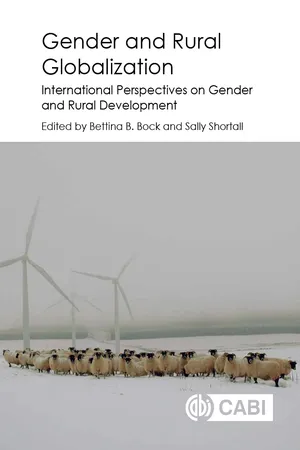
This book explores how rural gender relations are changing in a globalizing world that fundamentally impacts on the structure of agricultural life in rural areas and urban-rural relations. It analyses the development of rural gender relations in specific places around the world and looks into the effects of the increasing connectivity and mobility of people across places. The themes covered are: gender and mobility, gender and agriculture, Gender and rural politics, rurality and Gender identity and women and international development. Each theme has an overview of the state of the art in that specific thematic area and integrates the case-studies that follow.
eBook - ePub
Gender and Rural Globalization
International Perspectives on Gender and Rural Development
- English
- ePUB (mobile friendly)
- Available on iOS & Android
eBook - ePub
Gender and Rural Globalization
International Perspectives on Gender and Rural Development
About this book
Information
1
Gender and Rural Globalization: An Introduction to International Perspectives on Gender and Rural Development
1Wageningen University, Wageningen, The Netherlands; 2Groningen University, Groningen, The Netherlands; 3Newcastle University, Newcastle upon Tyne, UK

Introduction
In the Introduction to the book Rural Gender Relations in 2006 we discussed how globalization and liberalization of agriculture irrevocably changed rural life and with it rural gender relations. A lot has happened since 2006; yet we could very well repeat the same sentence introducing this book ten years later. Globalization is, after all, still ongoing and the liberalization of agricultural policies is still a topical issue today. Actually, it is the accelerating process of globalization and the sociological theories that elaborate on it, which convinced us of the need for reflection and a new collection on rural gender research.
Giddens defines globalization as the ‘growing interdependence between different peoples, regions and countries in the world as social and economic relationships come to stretch worldwide’ (Giddens, 2001, p. 690). In particular, he refers to the interchange of products and capital through global trade, the interchange of people through global travel and migration, as well as the interchange of culture, ideas and world views. Globalization, moreover, affects politics in terms of expanding collaboration as well as interdependency. There is increasing awareness that we are facing challenges that may only be addressed through collaboration (e.g. climate change) (Beck, 2016). On the other hand, we see that the fast travel of information through information and communications technology may ‘globalize’ local political events in an unforeseen manner and interrelate places at great geographical distance. Globalization does not stop at the border of the rural, as Woods (2007) has demonstrated. After all, farmers in many rural areas deliver agricultural products to the world market and are, hence, closely involved in global trade and through their organizations in global negotiations. The same is true for other ‘global production sectors’ such as forestry and fisheries, energy, biofuel, minerals, as well as the non-agricultural rural entrepreneurs and rural residents more generally. They all are increasingly involved in worldwide connections and networks of collaboration, not least because many rural areas are receiving ‘newcomers’ from all over the world.
This idea of the interconnected world in which the travel of information is unbound has inspired Manuel Castells’s theory of the network society in which he elaborates on the importance of electronically processed information networks to organize social structures and relations (Castells, 2000). These networks constitute a means by which information is exchanged and relations are established. As these networks are virtual and unbound by geographical location, traditional spatial barriers, such as remote location, lose their importance. It is the extent to which networks criss-cross and interconnect that defines their power and not their geographical location. In theory, rural peripheral locations may be as included in the network society as central and urban places. In practice, the so-called ‘connectivity’ of rural residents is often lower because, among other factors, of the limited accessibility of high-speed Internet (Salemink et al., 2016).
Urry (2007) and Cresswell (2010) elaborate on the movement of people, ideas and things that go along with the network society and contribute to globalization. They define the current time as an era of mobility and stress the importance of understanding humans as travellers. According to Urry, modern mobility includes the ongoing corporeal travelling of people and objects between places; the pluri-local senses of belonging to, and engagements in, places that create translocal social networks; and the imaginative, virtual and communicative ‘travelling’ that vivifies and invigorates those networks. The mobility turn is relevant for rural studies in several ways: it opens our eyes to the fact that rural residents are far less sedentary or immobile than often assumed (Milbourne and Kitchen, 2014), yet also underlines the huge disadvantage of rural areas when mobility is structurally limited through lack of infrastructure (Bell and Osti, 2010).
Taking account of mobility has consequences for theoretical frameworks as well as research methodologies. This is forcefully expressed in what Beck and Sznaider (2010, p. 382) call ‘the cosmopolitization of reality’, in which not only cross-border communication and collaboration increases but also the material and immaterial interdependence among social actors across national borders. These borders become more fluent and pervious as a result and may challenge commonly known differences between nations and/or localities. Turning to Europe, we have already seen that rural-urban distinctions are increasingly difficult to identify for gender relations (Shortall, 2014). This calls for multi-sited and comparative research or a cosmopolitan perspective, following Beck’s idea of ‘the cosmopolitan turn’ (Beck and Sznaider, 2010). Its explicit aim is to go beyond the usual isolation of social matters as local or national phenomena and their traditional separation as a concern of so-called ‘developed or developing’ countries, and to understand how they are co-created in a global interplay of forces. Beck therefore argues we should let go of the usual methodological nationalism and localism to understand the construction of social relations. In terms of rural gender relations, this means that we should look beyond rural places when trying to understand their construction and functioning; also, separate discussions of Southern and Northern rural gender relations make less and less sense in an increasingly connected world.
Globalization and Rural Gender Studies
Globalization matters greatly for rural gender studies in our view. Globalization offers chances as it promotes the inclusion of even remote rural areas in the global network society. As a result many of the traditional structural and cultural barriers may no longer hamper rural women’s empowerment and, hence, promote more equal gender relations. The increasing material and virtual mobility and connectivity may, in addition, promote collaboration of men and women across rural-urban and national borders. It also includes risks of course when the rural becomes part of a global field of action and with it competition and conflict at a global level. Higher levels of mobility render travelling affordable also for rural residents, yet also enable outmigration – in particular of young women as we have seen (e.g. Johansson, 2016) – as well as the entry of newcomers from all over the world. Both may change the existing structure of rural societies. In the following we discuss how such developments are taken up in research. We reflect upon the development of rural gender studies as described in the previous book, the relevance of the then defined research themes and the emergence of new topics and methodologies. Thereafter we introduce the structure and content of the current book.
In the Introduction to Rural Gender Relations (2006) we argued that rural gender studies started with research that revealed women’s engagement in farming, which was continuously overlooked. Gender research of that time also identified how development policies and projects that ignored women’s productive role, undermined women’s position in society and created unequal gender relations (Bock, 2006). In the course of the 1980s rural gender researchers were among those who criticized the dominant idea of modernization as development, as it supported the profits of capitalist firms and countries, contributed to social inequality more generally, reinforced patriarchy and with it the dependency of women. At the same time research revealed the important role that women played in the maintenance of family farms and the elaboration of alternative pathways towards organic or multifunctional agriculture, part-time farming and rural entrepreneurship (e.g. agritourism).
Rural gender research is strongly influenced by mainstream gender studies in terms of theoretical and methodological development as well as research topics. This is clearly reflected in the growing attention to differences among women and the flexibility of gender identities in terms of dominant definitions of rurality and sexuality. In the following years this topic has been further developed, also theoretically, which is mirrored in increasing attention to lesbian, gay, bisexual, transgender, intersex and questioning (LGBTIQ) identities and queer theory (Keller, 2015). Rural gender researchers also followed up on the mobility turn with more research into the effects of globalization and the increased mobility of women and men on rural gender relations.
Based on this we may argue that rural gender studies in the global North and South followed roughly the following development path, when developing research on the following topics:
1. The visibility of women in agriculture and rural development.
2. Critique of (rural) development and patriarchy.
3. Struggle for empowerment and recognition of women’s agency.
4. The acknowledgement of heterogeneity and flexible gender identities.
5. Mobility, globalization and transnationalism.
Rural gender studies started with research into women in agriculture and development and proceeded from there. The development is, however, not linear as most of the themes remain relevant despite the emergence of new ones, as we will demonstrate by giving just a few examples. Gender and agriculture is still a very topical issue; it is however studied in a different way, taking account of the theoretical and methodological insights gained, and of the relevance of mobility and globalization. New research looks, for instance, at how the increasing involvement of women as paid labourers in the expanding plantation agriculture in the global South affects their position (Canning, Chapter 21, this volume), into women’s and men’s involvement in agriculture as migrant labour or how women’s access to agricultural innovation could be improved (FAO, 2016). There is also still research going on which critically evaluates the attempts of rural development policy to involve rural women in targeted projects, which more often than not reinforce traditional rural identities and relations (Shortall and Bock, 2015). In the global South gender is still an important focus in mainstream development projects, even though several researchers have a rather critical view of it. Already in 2007 Cornwall et al. reflected critically on their own role in mainstreaming gender. In a recent article Cornwall (2016) elaborates how current attempts to empower women have lost their critical stance by focusing too much on the economic involvement of women. In doing so we have, in her view, foregone the earlier focus on supporting women’s agency, which renders any attempt to transform gender relations futile.
One interesting development is the growing interest in heterogeneous and flexible gender identities. This is evident in the types of questions being asked in research about rural masculinities and in the acceptance of LGBTIQ orientations and identities in rural areas in different parts of the world (Abelson, 2016). It often confirms earlier research that pointed to the conservative character of rural areas as well as the limited inclusion and integration of those who are considered different (Cloke, 2007). Finally, there is an expanding body of research into rural mobility and migration. Such research examines the arrival of labour migrants in Europe who contribute to the revitalization of rural areas, the ambivalent reception of refugees as well as the continuous trend of population decline in (remote) rural areas throughout the world, the dreams of those who leave as well as the experiences of those who stay behind (Bock et al., 2016). In addition, several researchers have meticulously detailed the mobility of rural residents and ‘the rural’ in Europe, addressing the supposed immobility of the rural in this era of mobility (see Chapter 2, this volume).
This Book
The developments discussed above inspired us to edit a book that explores how rural gender relations are changing in a globalizing world. It analyses the development of rural gender relations in specific places around the world and looks at the effects of the increasing connectivity and mobility of people across places. The book is not geographically or geopolitically organized but integrates experiences across the globe through the discussion of four themes which reflect the above listed key themes in rural gender research: agriculture, international development, gender identities and mobility. Each theme is introduced with a paper that gives an overview of the state-of-the-art in that specific thematic area and integrates the case studies that follow. The contributors present empirical work from the global North and South, and more particularly Sweden, Norway, Northern Ireland, Republic of Ireland, the UK, Poland, Greece, Italy, Slovenia, Uzbekistan, India, Africa, Asia and Latin America, Australia, New Zealand, Canada and the USA.
The first section (Chapters 2–6) examines how mobility affects men and women in rural areas. It explores gender differences in mobility patterns and analyses how mobility affects rural gender identities and relations. The section opens with Chapter 2, an overview in which Bettina Bock discusses the development of mobility research and the attention given to the impact mobility has on gender relations and vice versa. She then introduces the chapters that contribute to this section. Chapter 3 by Donatella Greco and Chiara Zachetti reports on the experiences of Ukrainian women who work in rural areas of Italy as domestic caregivers. In doing so they cover the inadequacy of the Italian welfare system, which no longer supports the availability of sufficient services in rural areas, particularly for (elderly) citizens with limited mobility. In Chapter 4, Nargiza Nizamedinkhodjayeva, Bettina Bock and Peter Mollinga discuss how labour migration in rural Uzbekistan, which increased enormously in the aftermath of its independence, affects the livelihood of those who stay behind and how the importance of the economic contribution of labour migrants impacts on household relations in terms of gender and generation. In Chapter 5, Jessica Duncan and Monika Agrawal explore how land grabbing hinders the mobility of pastoralist communities in Gujarat in India and how the restricted mobility affects their livelihood, personal well-being and gender relations. Chapter 6 by Janet Momsen compares how two opposing migration streams – tourist immigration and labour emigration – play out in two regions with very different histories of migration: the Caribbean islands and the Yucatán Peninsula in Mexico. She demonstrates how migration may strengthen the position of women through their increased involvement in gainful employment as well as the interaction with other lifestyles, norms and values.
The second section (Chapters 7–11) focuses on agricultural change and the development of agricultural and rural policies, the response of individuals within farm households and the implications for gender relations in rural areas. It starts in Chapter 7 with an overview of the development ...
Table of contents
- Cover Page
- Title Page
- Copyright Page
- Contents
- Contributors
- 1 Gender and Rural Globalization: An Introduction to International Perspectives on Gender and Rural Development
- Part I Gender and Mobility
- Part II Gender And AGRICULTURE
- Part III Gender and Rural Identity
- Part IV Gender and International Development
- Index
- Backcover
Trusted by 375,005 students
Access to over 1.5 million titles for a fair monthly price.
Study more efficiently using our study tools.
Frequently asked questions
Yes, you can cancel anytime from the Subscription tab in your account settings on the Perlego website. Your subscription will stay active until the end of your current billing period. Learn how to cancel your subscription
No, books cannot be downloaded as external files, such as PDFs, for use outside of Perlego. However, you can download books within the Perlego app for offline reading on mobile or tablet. Learn how to download books offline
Perlego offers two plans: Essential and Complete
- Essential is ideal for learners and professionals who enjoy exploring a wide range of subjects. Access the Essential Library with 800,000+ trusted titles and best-sellers across business, personal growth, and the humanities. Includes unlimited reading time and Standard Read Aloud voice.
- Complete: Perfect for advanced learners and researchers needing full, unrestricted access. Unlock 1.5M+ books across hundreds of subjects, including academic and specialized titles. The Complete Plan also includes advanced features like Premium Read Aloud and Research Assistant.
We are an online textbook subscription service, where you can get access to an entire online library for less than the price of a single book per month. With over 1.5 million books across 990+ topics, we’ve got you covered! Learn about our mission
Look out for the read-aloud symbol on your next book to see if you can listen to it. The read-aloud tool reads text aloud for you, highlighting the text as it is being read. You can pause it, speed it up and slow it down. Learn more about Read Aloud
Yes! You can use the Perlego app on both iOS and Android devices to read anytime, anywhere — even offline. Perfect for commutes or when you’re on the go.
Please note we cannot support devices running on iOS 13 and Android 7 or earlier. Learn more about using the app
Please note we cannot support devices running on iOS 13 and Android 7 or earlier. Learn more about using the app
Yes, you can access Gender and Rural Globalization by Sally Shortall, Bettina Bock, Bettina Bock, Sally Shortall in PDF and/or ePUB format, as well as other popular books in Technology & Engineering & Agriculture. We have over 1.5 million books available in our catalogue for you to explore.