A comprehensive overview of both traditional and current knowledge on the health effects of plant based antioxidants, this book reviews medicinal and aromatic plants from around the world. It covers the different sources of antioxidants including essential oils, algae and marine microorganisms, as well as the role of abiotic and biotic stresses, endophytes, transgenic approaches in scavenging ROS and antioxidant plants used in different therapeutic systems.
- English
- ePUB (mobile friendly)
- Available on iOS & Android
eBook - ePub
Plants as a Source of Natural Antioxidants
About this book
Information
1 Plants of Indian Traditional Medicine with Antioxidant Activity
1.1 Introduction
Free radicals are chemical species that have one or more unpaired electrons, as a result of which they are highly unstable and can cause damage to other molecules by extracting electrons from them in order to attain stability. Among them are reactive oxygen species (ROS) that include superoxide radicals, hydroxyl radicals, singlet oxygen and hydrogen peroxide, which are often generated as by-products of biological reactions but can also be derived from exogenous factors (Cerutti, 1991). Some ROS have positive biological roles, in processes such as energy production, phagocytosis, regulation of cell growth, intercellular signalling and synthesis of biologically important compounds (Halliwell, 1997). Often though, they can induce the oxidation of lipids, causing membrane damage and decreasing membrane fluidity. ROS can also lead to cancer via DNA mutations (Cerutti, 1991, 1994; Pietta, 2000), and to abnormal ageing and neurodegenerative diseases (Beal, 1995).
The amounts of ROS present in an organism can be regulated by synthesizing enzymes such as endogenous superoxide dismutase, glutathione peroxidase and catalase, or by non-enzymatic antioxidants such as ascorbic acid (vitamin C), α-tocopherol (vitamin E), glutathione (GSH), carotenoids, flavonoids, etc. Sies (1993) has examined these strategies. As already noted, the overproduction of reactive species, induced by exposure to external oxidant substances, or by a failure in the usual defence mechanisms, can lead to the development of degenerative diseases (Shahidi et al., 1992); these include cardiovascular diseases, cancers (Gerber et al., 2002), neurodegenerative diseases (for instance Alzheimer’s disease; Di Matteo and Esposito, 2003) and inflammatory diseases (Sreejayan and Rao, 1996). In particular, the hydroxyl radical is known to react with all of the components of DNA (Halliwell and Gutteridge, 1999), with the polyunsaturated fatty acid residues of phospholipids (Siems et al., 1995) and with the side chains of all amino acid residues of proteins, especially cysteine and methionine residues (Stadtman, 2004).
One solution to this major problem is to supplement the diet with antioxidant compounds that are found in natural plant sources (Knekt et al., 1996). Plants produce antioxidants to counter the oxidative stress caused by the production of ROS during photosynthesis and thus represent a source of new antioxidant compounds. The traditional Indian medicine system of Ayurveda has a special branch called rasayana in which disease is prevented and the ageing process counteracted through the optimization of homeostasis. Some of the plants used in rasayana preparations have been found to be 1000 times more potent than ascorbic acid, α-tocopherol, and probucol in their antioxidant activity (Scartezzini and Speroni, 2000).
In recent years, the use of natural antioxidants present in traditional medicinal plants has become of special interest in the scientific world due to their presumed safety and nutritional and therapeutic value (Ajila, In recent years, the use of natural antioxidants present in traditional medicinal plants has become of special interest in the scientific world due to their presumed safety and nutritional and therapeutic value (Ajila, et al., 2007). This contrasts with the synthetic antioxidants that are commonly used in processed foods, such as butylated hydroxytoluene (BHT) and butylated hydroxyanisole (BHA), which have side effects and have been reported to be carcinogenic (Ito et al., 1983). The majority of the antioxidant activity of plants is due to the presence of phenolic compounds (flavonoids, phenolic acids and alcohols, stilbenes, tocopherols, tocotrienols), ascorbic acid and carotenoids. Recent reports have indicated that there is an inverse relationship between the dietary intake of antioxidant-rich foods and the incidence of human disease, so it seems that natural plant antioxidants can serve as a type of preventive medicine. A large number of plants worldwide have been found to have both strong antioxidant activity (Baratto et al., 2003) and powerful scavenger activity against free radicals (Kumaran and Karunakaran, 2007).
India is a land of multiple geographical regions, and its flora, with more than 45,000 plant species, represents 7% of the world’s flora. Out of this vast number of plant species, medicinal plants comprise approximately 8000 species, and account for about 50% of all the Indian higher flowering plant species and 11% of total known world flora (Ali et al., 2008). A number of these Indian medicinal plants have been used in the traditional Ayurveda system of medicine for thousands of years. Ayurveda (literally ayus, life, and veda, knowledge; hence science of life) is the oldest medical system in the world and has been practised in India for more than 3500 years. The first recorded book on Ayurvedic medicine was Acharya Charak’s Charaka Samhita (600 bc), and traditional healers have used this resource since time immemorial for the benefit of humankind. Other ancient Indian literature is also a source of information on the medicinal properties of herbal plants and preparations that have been found to be effective in the treatment of various diseases, as detailed in the Glossary of Indian Medicinal Plants (Chopra et al., 1956). The more modern manifestation of Ayurveda is Maharishi Ayurveda (Glaser, 1988).
The World Health Organization (WHO) has estimated that almost 80% of the earth’s inhabitants believe in traditional medicine for their primary health care needs, and that most of this therapy involves the use of plant extracts and their active components (Winston, 1999). A number of plants and plant products have medicinal properties that have been validated by recent scientific developments throughout the world, owing to their potent pharmacological activity, low toxicity and economic viability. A plethora of literature is available on traditional Indian medicinal plants with antioxidant activity (Scartezzini and Speroni, 2000; Ali et al., 2008). This chapter reviews the antioxidant activity of such traditional Indian medicinal plants based on a literature survey.
1.2 Some Traditionally used Antioxidant Plants and Methods Used for Screening Them
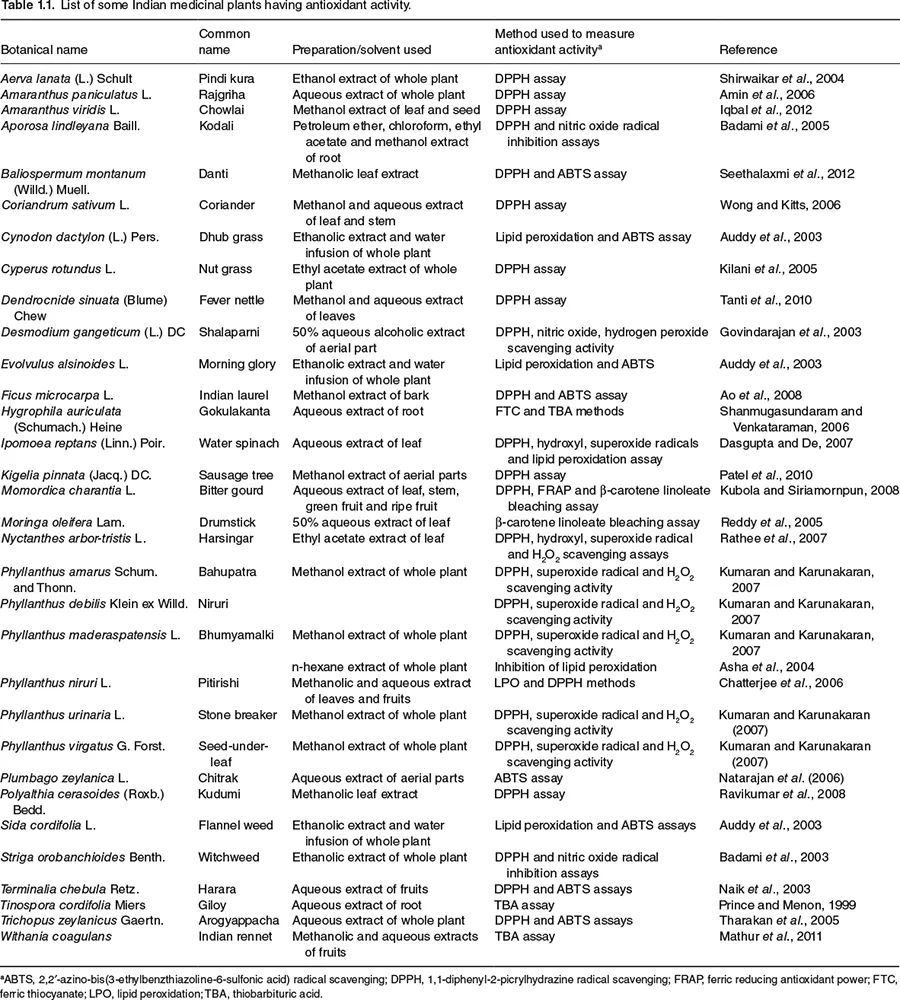
Ayurveda, whose efficacy has been approved by the WHO (Zaman, 1974) provides an approach to prevention and treatment of different diseases by a large number of medical procedures and pharmaceuticals. There is a long list of traditional Indian medicinal plants that show antioxidant activity when screened by different methods. Table 1.1 presents a selection of such plants as reported by different researchers, with brief details of the assay methods and plant preparations used for each; further information on the methods mentioned in the table is given below.
A number of methods have been described by different workers for testing the antioxidant activity of medicinal plants (see Ali et al., 2008 and Krishnaiah et al., 2011). They include the following in vitro enzymatic and non-enzymatic antioxidant assays:
• 1,1-diphenyl-2-picrylhydrazyl (DPPH, also designated 2,2-diphenyl-1-picrylhydrazyl) radical scavenging (Brand-Williams 1,1-diphenyl-2-picrylhydrazyl (DPPH, also designated 2,2-diphenyl-1-picrylhydrazyl) radical scavenging (Brand-Williams et al., 1995);
• β-carotene linoleic acid bleaching (Koleva et al., 2002);
• inhibition of linoleic acid peroxidation (Osawa and Namiki, 1981);
• ferric reducing antioxidant power (FRAP) (Benzie and Strain, 1996);
• total radical trapping antioxidant potential (TRAP) (Krasowska et al., 2001);
• oxygen radical absorbance capacity (ORAC) (Huang et al., 2002);
• 15-lipoxygenase inhibition (Lyckander and Malterud, 1992);
• lipid peroxidation (LPO) (Ramos et al., 2001);
• nitroblue tetrazolium (NBT) reduction or superoxide anion scavenging activity (Kirby and Schmidt, 1997);
• hydroxyl radical scavenging activity (Jodynis-Liebert et al., 1999);
• non-site- and site-specific deoxyribose degradation assay (Maulik et al., 1997);
• hydrogen peroxide scavenging activity (Ruch et al., 1989);
• 2,2′-azino-bis(3-ethylbenzthiazoline-6-sulfonic acid) (ABTS) radical scavenging (Re et al., 1999);
• reducing power assay (Oyaizu, 1986);
• Briggs Rauscher (BR) method (Cervellati et al., 2002);
• Trolox equivalent antioxidant capacity (TEAC) method (Rice-Evans et al., 1996) – Trolox (6-hydroxy-2,5,7,8-tetramethylchroman-2-carboxylic acid) is a water-soluble vitamin E analogue used as a standard antioxidant;
• phenazine methosulfate–nicotinamide adenine dinucleotide reduced (PMS–NADH) system superoxide radical scavenging (Lau et al., 2002);
• linoleic acid peroxidation–ammonium thiocyanate (ATC) method (Masuda et al., 1992); and
• ferric thiocyanate (FTC) and thiobarbituric acid (TBA) reaction methods (Mackeen et al., 2000).
Of these methods, the most widely used and reliable methods are the ABTS and DPPH methods.
Auddy et al. (2003) screened the antioxidant activity of the ethanolic extracts of three Indian medicinal plants traditionally used for the management of neurodegenerative diseases, viz. Sida cordifolia, Evolvulus alsinoides and Cynodon dactylon, and found IC50 (half maximal inhibitory concentration) values 16.07, 33.39 and 78.62 mg/ml, respectively, when tested with the ABTS assay. Using the same assay, the relative antioxidant capacity (IC50) for water infusions of the same three plants was as follows: E. alsinoides, 172.25 mg/ml; C. dactylon, 273.64 mg/ml; and S. cordifolia 342.82 mg/ml. When tests were performed of the effects of the water infusions on lipid peroxidation, the IC50 values were as follows: E. alsinoides 89.23 mg/ml; S. cordifolia, 126.78 mg/ml; and C. dactylon. 608.31 mg/ml.
Naik et al. (2003) examined the antioxidant potential of four aqueous extracts from different parts of medicinal plants used in Ayurvedic medicine, viz. Momordica charantia, Glycyrrhiza glabra, Acacia catechu and Terminalia chebula, using the ABTS and DPPH methods. The T. chebula extract showed the maximum potency and was equivalent to that of ascorbic acid. The IC50 value of the methanolic leaf extract of Amaranthus viridis (14.25 μg/ml) was greater than that of BHT (15.7 μg/...
Table of contents
- Cover
- Halftitle Page
- Title Page
- Copyright
- Contents
- Contributors
- Preface
- 1 Plants of Indian Traditional Medicine with Antioxidant Activity
- 2 Natural Antioxidants from Traditional Chinese Medicinal Plants
- 3 Review of the Antioxidant potential of African Medicinal and Food Plants
- 4 Antioxidant Plants from Brazil
- 5 Antioxidant Characteristics of Korean Edible Wild Plants
- 6 Algae as a Natural Source of Antioxidant Active Compounds
- 7 Antioxidant Potential of Marine Microorganisms: A Review
- 8 Biotechnologies for Increasing Antioxidant Production from Plants
- 9 Plant-Derived Antioxidants as Food Additives
- 10 Biochemical Activity and Therapeutic Role of Antioxidants in Plants and Humans
- 11 Pharmacology of Medicinal Plants with Antioxidant Activity
- 12 Endophytic Fungal Associations of Plants and Antioxidant Compounds
- 13 Mycorrhizal Symbiosis in the Formation of Antioxidant Compounds
- 14 Role of Mushrooms as a Reservoir of Potentially Active Natural Antioxidants: An Overview
- Index
Trusted by 375,005 students
Access to over 1.5 million titles for a fair monthly price.
Study more efficiently using our study tools.
Frequently asked questions
Yes, you can cancel anytime from the Subscription tab in your account settings on the Perlego website. Your subscription will stay active until the end of your current billing period. Learn how to cancel your subscription
No, books cannot be downloaded as external files, such as PDFs, for use outside of Perlego. However, you can download books within the Perlego app for offline reading on mobile or tablet. Learn how to download books offline
Perlego offers two plans: Essential and Complete
- Essential is ideal for learners and professionals who enjoy exploring a wide range of subjects. Access the Essential Library with 800,000+ trusted titles and best-sellers across business, personal growth, and the humanities. Includes unlimited reading time and Standard Read Aloud voice.
- Complete: Perfect for advanced learners and researchers needing full, unrestricted access. Unlock 1.5M+ books across hundreds of subjects, including academic and specialized titles. The Complete Plan also includes advanced features like Premium Read Aloud and Research Assistant.
We are an online textbook subscription service, where you can get access to an entire online library for less than the price of a single book per month. With over 1.5 million books across 990+ topics, we’ve got you covered! Learn about our mission
Look out for the read-aloud symbol on your next book to see if you can listen to it. The read-aloud tool reads text aloud for you, highlighting the text as it is being read. You can pause it, speed it up and slow it down. Learn more about Read Aloud
Yes! You can use the Perlego app on both iOS and Android devices to read anytime, anywhere — even offline. Perfect for commutes or when you’re on the go.
Please note we cannot support devices running on iOS 13 and Android 7 or earlier. Learn more about using the app
Please note we cannot support devices running on iOS 13 and Android 7 or earlier. Learn more about using the app
Yes, you can access Plants as a Source of Natural Antioxidants by Nawal Kishore Dubey in PDF and/or ePUB format, as well as other popular books in Biological Sciences & Botany. We have over 1.5 million books available in our catalogue for you to explore.