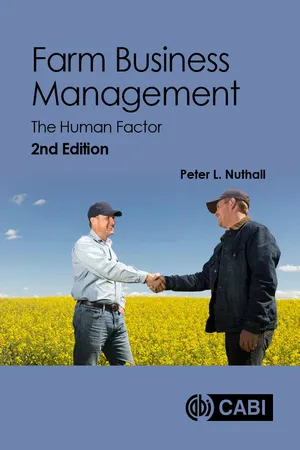
The underlying economic factors that affect primary production are frequently studied and written about - soil quality, animal health, climate, machinery - but this is the first book to explore the role of the decision psychology of the manager running the farm business, the person responsible for staff, strategic and operational decisions and the success or failure of financial and other objective outcomes. This second edition addresses fundamental questions such as the process of decision making, personal skills, and methods to improve managerial ability. It is an essential reference for farm managers and students in farm economics and management. Key Features: This is the first farm business management book published worldwide focused on human factors and decision making in primary productionThe second edition introduces two new chapters covering the key decision method, intuition and its enhancement, and the importance of human characteristics in a range of decision topics and areas
- English
- ePUB (mobile friendly)
- Available on iOS & Android
eBook - ePub
About this book
Information
1 Introduction
General Overview
Most production economists refer to the production factors as land, labour and capital. While ‘labour’ might embody the managerial decision-making input as well as physical labour, it is clearer to separate management as a fourth factor of production. The decisions on how to use the production inputs and resources, and the implementation of the plans, are the responsibility of this fourth factor – management. In that the quality of the decisions gives rise to the success of the operation, this managerial skill is clearly absolutely critical to efficiency and profit. However, no texts and courses include the management factor in any depth. This book sets this situation to rights.
Texts on production economics cover the optimal allocation of resources. However, they largely assume that man is a rational being with near-perfect information. The reality is quite different. Managers are human. This means they react in an emotion-determined way. People observe the world around them and come to a conclusion about the current situation. Their mind, perhaps with the aid of calculations, comes to a decision over what actions should be taken. Thus, cues are observed that trigger action, or possibly inaction in some situations. This observation–decision–action process is something that varies with different individuals, and needs to be understood if a farm manager is to improve the decisions aimed at achieving the farm’s objectives.
The purpose of this book is to outline the human components of what makes a person, and why a manager acts in particular ways. This understanding is essential in assisting farmers to improve their management, and thus attain their objectives. This assumes that improvement is indeed possible using various techniques. Evidence pointing in this direction will be reviewed. As understanding provides wisdom, the emphasis is on looking at theories and their application in contrast to rote-learning rules and solutions. These seldom cover the myriad of situations possible, thus leading to misinterpretations and mistakes. Armed with knowledge on the parameters that determine how an individual reacts, and their relationships, it is then possible to treat each unique case on its merits.
There is ample evidence that farm managers vary markedly in their skills. Profit and efficiency data from farms in similar environments make this clear. For example, studies that relate individual farms’ position relative to their peers show the average technical efficiency can be as low as 36% (a Swedish study) and as high as 85% (a Pakistani case). Of course, these studies assume that all the farmers have the same objective. In reality, some will be happy to be less technically efficient if it means, for example, their average production is quite stable. Similar ranges in efficiency exist when using economic outcomes as the yardstick. One study for Brazilian farmers put their average efficiency at 13%, in contrast to a US dairy study giving an average efficiency of 70% (Dhungana, 2000).
These efficiency studies determine which farmers are producing the greatest output for given inputs, and then relate other farmers against these producers as benchmarks. If the average efficiency was 100%, this would mean all farmers are producing the same ratio of output to inputs. As a comparative measure, this does not necessarily mean that the ‘efficient’ farmers are in fact efficient in an absolute sense. No doubt they could increase their efficiency through even better decision making, using the latest technologies. This can only be judged if, for example, comparisons with perfectly managed demonstration farms are possible.
The farmers that are the most efficient in a sample can be called ‘experts’. Studies of experts show they have particular attributes. These include:
• their expertise is restricted to a limited domain of operation;
• good at clearly defining a problem;
• accurately observe relevant cues and the importance of each;
• automatically perceive meaningful patterns;
• come up with solutions almost instantly;
• having superior short- and long-term memory;
• observing and characterizing a problem in terms of its basic structure; spending considerable time quantifying and analysing problems, particularly if not faced before, thus adding to their understanding and store of knowledge; and
• clear self-monitoring abilities leading to improvement (i.e. good and objective self-criticism).
Relative to novices, experts know what to observe, do so quickly and accurately, and use their experience to provide a solution that is appropriate. If the problem has never been experienced before, their superior processing systems work out the solution, and then store this for future reference. With time, they become real masters. If any one of the characteristics of an expert is not present, the person will not attain the true expert classification, though there will be degrees of expertise. The important questions relate to the characteristics required to become an expert, and how this status can be acquired.
It was pointed out that experts are quick with their judgement and decision. This is most likely due to pattern matching. This refers to having the pattern of a problem, and its solution, stored in memory so that when the expert observes the values of the critical parameters, this set of data is sent to memory to find a match with the stored information. When found, the solution is readily available. These patterns might be visual (a picture of some kind), or abstract (lists of benchmark data perhaps). For example, if you see a bush with flowers on it of a certain nature, if you have seen the bush before and its image is stored in your memory, it is immediately recognized as, say, a rhododendron. Analysis of some kind is not necessary. However, if the bush is not recognizable, research is required. This might be referring to a book, or perhaps a recognized expert. Next time, you have this newly acquired pattern stored in memory and immediate recognition occurs.
An important question concerns the personal qualities that are necessary to become, in this case, an expert farm manager. While training and experience can make up for a lack of inherent ability, a good measure of both is probably highly beneficial. Being an expert enables appropriate decisions in good time. Good farmers seldom have to spend large chunks of time sorting out a problem because their systems have the right answer stored. This ability to quickly make a decision is sometimes referred to as ‘intuition’, or sometimes ‘tacit knowledge’. This sounds like a mysterious quality that only some managers have. In fact, it probably relates to having the right attributes, experience and training. Thus, intuition is probably a learnt attribute that we all have to a greater, or lesser, extent. As it is not appropriate in many cases to spend a long time researching a problem or opportunity, developing this intuition is an important aspect of being a good manager. Similarly, knowing when your intuition is likely to be incorrect is also obviously an important attribute. In such cases, formal study, research and analysis are required. This usually leads to an enhancement of the manager’s intuition.
Skill and intuition must cover a wide range of areas for successful farm management. Any production system (agriculture, horticulture), involves an extremely wide range of necessary skills. Frequently production involves:
• soils, rainfall and climate, plants;
• animals, harvesting and machinery in general, engineering (buildings, structures, irrigation…);
• labour and personalities;
• markets, finance and economics; and
• politics and the resulting impacts on the rules and regulations that must be complied with.
This very wide range of subjects covers everything from physics and chemistry through to biology and psychology in that the people involved operate within the bounds of their human characteristics. The excellent manager will have a reasonable understanding of all these areas.
Nevertheless, equally, if not more important, are the management skills that a manager brings to the job, which, in turn, lead to the decisions made and implemented. Thus, a manager must know how to use facts and figures through being skilled in:
• understanding the technology and what lies behind it (sowing rates, fertilizer outcomes, the sciences – biology, physics, etc. involved);
• observation and recording (soil conditions through to international markets);
• planning (risk management, cash flows, job priorities, time management, economic principles, etc.);
• anticipation (possible outcomes and their chances);
• people skills (labour management, network maintenance, negotiations, etc.); and
• personality management (stress management, motivation, objectives, and so on).
Acquiring abilities in all these areas is dependent on the basic attributes of a potential manager, and the opportunities for training and experience that are made use of. Some will be good at a sub-sample of the attributes, and some will be rounded with a complete package of excellent skills. The critical question relates to how a manager might acquire such a fully rounded set of attributes.
It appears that a human being is defined by two, possibly three, basic sets of factors:
• the first is a person’s personality;
• the second their intelligence; and
• the third their motivation, although some researchers believe motivation arises from their personality and intelligence.
Personality is made up of sub-factors such as extroversion and anxiety levels, and intelligence is similarly made up of components such as memory and reasoning. In each segment, an individual will have a defined make-up, leading to the unique whole. Some will be good managers, others not.
When observing the attributes of a manager, you observe what is called his or her ‘phenotype’. In contrast, the package that a person is born with is referred to as the ‘genotype’. This is defined by the inherited genes passed on 50–50 by the parents. But the genes only define the person’s building blocks, which then interact with the environment and experience that a person is exposed to. The sum of the genotype and environmental experiences gives rise to the observable phenotype.
The question is what phenotype is appropriate for good management, and how is this attained? Clearly the genotype cannot be altered, nor can a person’s early experiences – this is now history. However, some phenotypes will more than likely be capable of being modified through the correct training and experiential exposure. For a manager to improve his or her skills, it is clearly important to discover what training will in fact work. This assumes phenotypes are alterable, and fortunately there is evidence this is indeed the case. Understanding phenotypes and managerial skill is also important in setting up the correct conditions right from an early age to ensure that good managers are created. Clearly, the approach of providing an appropriate set of experiences and training in early life is preferable to trying to improve skills in later life, though both possibilities must be followed.
People, and managers, are seldom totally consistent in their actions through time. This might be because they have re-evaluated their objectives, but more likely simply because they are human. While an individual has fixed traits defining his personality and intelligence, how these give rise to decisions made on any one day can be variable. You will be aware that your emotions and state of mind vary from time to time in response to events and activities. This is an expression of personality with some people varying more than others as defined by their phenotype. The consequence is that the decisions made will not always be consistent, even given the same circumstances, part...
Table of contents
- Cover
- Half Title
- Title
- Copyright
- Contents
- The Author
- Acknowledgements
- List of Figures
- List of Tables
- 1 Introduction
- 2 What Defines Management Ability?
- 3 The Origins of Managerial Ability
- 4 Decision Processes and Goals
- 5 Skills Required
- 6 Biases and Stress
- 7 Intuition
- 8 The Influence of Farmers’ Personal Characteristics on a Range of Issues in Management
- 9 More on Objectives: Family Influences, Origins and Modification
- 10 Methods of Improving Managerial Ability
- References
- Index
- Back Cover
Trusted by 375,005 students
Access to over 1.5 million titles for a fair monthly price.
Study more efficiently using our study tools.
Frequently asked questions
Yes, you can cancel anytime from the Subscription tab in your account settings on the Perlego website. Your subscription will stay active until the end of your current billing period. Learn how to cancel your subscription
No, books cannot be downloaded as external files, such as PDFs, for use outside of Perlego. However, you can download books within the Perlego app for offline reading on mobile or tablet. Learn how to download books offline
Perlego offers two plans: Essential and Complete
- Essential is ideal for learners and professionals who enjoy exploring a wide range of subjects. Access the Essential Library with 800,000+ trusted titles and best-sellers across business, personal growth, and the humanities. Includes unlimited reading time and Standard Read Aloud voice.
- Complete: Perfect for advanced learners and researchers needing full, unrestricted access. Unlock 1.5M+ books across hundreds of subjects, including academic and specialized titles. The Complete Plan also includes advanced features like Premium Read Aloud and Research Assistant.
We are an online textbook subscription service, where you can get access to an entire online library for less than the price of a single book per month. With over 1.5 million books across 990+ topics, we’ve got you covered! Learn about our mission
Look out for the read-aloud symbol on your next book to see if you can listen to it. The read-aloud tool reads text aloud for you, highlighting the text as it is being read. You can pause it, speed it up and slow it down. Learn more about Read Aloud
Yes! You can use the Perlego app on both iOS and Android devices to read anytime, anywhere — even offline. Perfect for commutes or when you’re on the go.
Please note we cannot support devices running on iOS 13 and Android 7 or earlier. Learn more about using the app
Please note we cannot support devices running on iOS 13 and Android 7 or earlier. Learn more about using the app
Yes, you can access Farm Business Management by Peter L Nuthall in PDF and/or ePUB format, as well as other popular books in Technology & Engineering & Agriculture. We have over 1.5 million books available in our catalogue for you to explore.