Destinations rely on regional strategies to support and enhance the tourism product through regional partnerships and integration. Integrated tourism is defined as tourism that is explicitly linked to the economic, social, cultural, natural and human structures of the region in which it occurs. Integrated tourism has evolved to include numerous meanings and definitions, but generally includes a vertical business or industry approach. The first of its kind, this book applies a more inclusive approach to integration by providing insight into inclusive regional development strategies that support both the needs of urban and rural areas whilst enhancing the tourist experience, supporting the positive impacts of tourism and mitigating the negative. Regional studies tend to portray either an urban or rural focus without acknowledging that often these spaces constitute joint governance structures, similar historical and cultural roots, and economic dependencies. Sustainable tourism promotes sourcing locally, such as using rural agricultural products in urban tourism experiences. Furthermore, innovative rural marketing strategies linking tourism heritage, attractions, food and drink trails, and artisans with urban visitors are emerging. Including theoretical and applied research and international case studies, this will be a valuable resource to academics, students and practitioners working in tourism development and regional policy.
eBook - ePub
Linking Urban and Rural Tourism
Strategies in Sustainability
- English
- ePUB (mobile friendly)
- Available on iOS & Android
eBook - ePub
About this book
Information
Part I Urban Rural Linkages
1 Discussing Rural–Urban Tourism: A Review of the Literature
Università degli Studi di Udine, Italy and Katholische Universität Eichstätt Ingolstadt, Germany
*E-mail: [email protected]
Introduction
Relations between urban and rural areas have a long tradition in academic research (Tacoli, 1998). Evidence confirms that urban–rural interdependencies have been influenced by opposite positions of anti-urban and pro-urban approaches (Davoudi and Stead, 2002). After many years of binary divide between rural and urban areas, the past two decades have witnessed unprecedented urban–rural connections (Potter and Unwin, 1995). The debate about urban–rural linkages has gained fresh prominence, with many authors arguing that both urban and rural places benefit from interlinked relationships and that urban–rural cooperation provides solutions to socio-economic and environmental problems in a more sustainable perspective (Tacoli, 1998; Beesley, 2010). This literature has been echoed by international institutions, governments and research centres, which called for stronger rural and urban relations, integrated policies and inclusive governance to support sustainable development, competitiveness in both rural and urban areas (Organisation for Economic Co-operation and Development (OECD), 2013) and address poverty reduction (Global Monitoring Report, 2013) and world inequalities (World Bank, 2006). Furthermore, the use of new terms, such as urbrural, rurbance, rurbanity and re-urbanity, together with the experiences of ‘urbanizing the rural and ruralizing the urban’ like city farms and farmers’ markets, confirm the need for further research in supporting unconventional planning and management approaches.
In agreement with the historical tendency of the debate, rural tourism and urban tourism have developed independently from each other, within the broader tourism literature. The attempt to link rural and urban tourism has registered limited consensus among scholars. However, people travel to different places all the time, moving to and across rural, urban and fringe areas. The flow of visitors affects urban–rural interactions in terms of the transfer of income, exchange of experiences, knowledge and cultural values (Van Leeuwen, 2015). The studies that can be found in the literature discuss urban–rural and tourism relations according to three different perspectives: tourism literature; geography–spatial analysis studies; and social sciences and development. Tourism literature focuses mainly on the comparison of tourism related issues within urban and rural contexts, investigating differences, similarities and implications. Geographers pay attention to urban–rural spaces and, together with tourism geographers, study particular forms of tourism that take place in the fringe, exurbs and urban–rural continuum. Multidisciplinary approaches rooted in social sciences, regional development and environmental planning address tourism, and related issues, as a specific type of urban–rural linkage. According to Weaver (2005), on one side, urban–rural relations and places have been studied by social sciences, geography, development and environmental disciplines with little attention paid to tourism topics and, on the other side, tourism literature has produced limited research in urban–rural interconnection and spaces.
The present chapter aims to provide an overview of the most relevant publications discussing the urban–rural and tourism relationship by combining the benefits of both traditional and systematic reviews of the literature published in the past 40 years. This contribution will, first, investigate the existing academic contributions that focus on tourism and rural–urban; and second, present and organize the results, highlighting gaps and addressing further research development, thus contributing to the academic debate.
It is important to make clear that the order of the words ‘urban–rural’ or ‘rural–urban’ employed in this chapter is not intended to have any significance in terms of relevance, dominance or supremacy of one area over the other (Copus, 2013).
Urban–Rural Relations and Tourism in the Literature
Although urbanization, industrialization and agriculture still compete for land use, people, employment and natural resources, urban and rural economies are mutually interconnected and depend on each other (Bulderberga, 2011). The boundaries between concrete urban centres and extreme rural places have become blurred, in favour of a larger continuum and stronger interdependencies (Irwin et al., 2010). Some authors clearly state that the urban–rural dichotomy of past times no longer exists (Schaeffer et al., 2012). Scholars agree that both urban and rural places benefit from urban–rural relationships (Van Leeuwen, 2015), cities and countryside are interlinked parts of regional and national economy, and that an urban–rural approach provides solutions to address common socio-economic and environmental problems in a more sustainable perspective (Tacoli, 1998). However, to date, there is a limited body of academic research focusing on urban–rural linkages (Caffyn and Dahlström, 2005) and rural and urban relationships have been discussed mainly by economics, geography, social sciences and development studies (Davoudi and Stead, 2002).
Studies on urban–rural interactions have recognized the complexity and multidimensionality of this concept. Urban–rural linkages imply both an understanding of places (i.e. boundaries, locations of urban, rural and urban–rural spaces) and type of connections (i.e. flows, networks, visible, invisible) (Kūle, 2014). More recently, the literature has referred to urban–rural relations in terms of structural relations and functional relations (Zonneveld and Stead, 2007). On the one hand structural relations emerge by the ‘way the physical environment is constituted and shaped’ (Zonneveld and Stead, 2007, p. 422) and they focus on land and resource availability within urban, rural and urban–rural spaces, such as fringe, exurbs, peripheries, suburbs and urban–rural continuums. On the other hand, functional relations refer mainly to physical and socio-economic connections, visible and invisible flows of people, capital and financial transfers, movements of goods, natural resources, information and technology, administrative and service provision that move backward and forward between rural and urban areas (Preston, 1975). Funnell (1988) underlined the need to understand the social political and economic conditions that create the urban–rural interactions.
While there are studies on specific types of linkages between rural and urban areas, such as employment, commuting, land use and migration, there are few academic theories on urban–rural relationships (Zonneveld and Stead, 2007) and there seems to be a general lack of clarity about the nature of these interactions (Caffyn and Dahlstrom, 2005). Furthermore, the debate is complicated by the variety of definitions on rural and urban areas used in the different geographical areas of the world (Davoudi and Stead, 2002). The contributions, listed below, present an international overview of the main theoretical perspectives, empirical realities and political positions over the past 20 years of urban–rural relations debate. Potter and Unwin published in 1995 one of the first works on urban–rural interactions in the developing world, followed by Tacoli, in 1998, who introduced a guide to the literature of rural–urban interaction in Africa, Asia and South America.
Davoudi and Stead (2002) presented an introduction and brief history of urban–rural relationships, with a focus on British and European contexts. The urban–rural dynamics in Europe have received growing analytical and political attention since the year 2000, within spatial strategies and territorial development plans. Several programmes, policy documents and funding projects (e.g. ESDP, SPESP, ESPON, INTEREG, Territorial Agenda and RURBAN) were developed to promote cooperation between urban and rural places, as a means to achieve social, political and economic integration and cohesion among the European countries. Zonneveld and Stead (2007), together with Copus (2013), portrayed the evolution, over the past 25 years, of urban–rural relationships within European policy, arguing the difference between urban–rural relationships (related to functional linkages) and urban–rural partnerships (the policy dimension of these relationships) (OECD, 2013).
Lin (2001) and Li (2011) published two contributions on urban–rural interaction in China, presenting a literature review, historical scenario and case studies within the Chinese context. Although discussing different geographical, historical, cultural, socio-economic and political contexts, the overall studies highlight that urban–rural interactions have constantly increased, all over the world. The reasons can be found in labour-saving technological progress, reduction in transport costs, rising house incomes (Irwin et al., 2010), higher population mobility, the circulation of information and goods, and widespread information and communication technologies (Kule, 2014). Nevertheless, in many developing countries, the relationship between urban and rural areas is still characterized by a strong dualism. The publications underline the need for an integrated urban–rural strategy that involves planners, policy makers and stakeholder interactions based on a multilevel governance, in a win–win strategy to provide benefits for urban, rural and fringe areas.
Tourism, as a cross-disciplinary subject (Tribe, 1997), is likely to take an important stake in urban–rural relationships. Namely, tourism is based on people travelling within territories and across boundaries, staying outside their usual environment (UNWTO, 1995). The flow of people generates the movement of related resources, visible and invisible, such as the transfer of knowledge, experiences, competences and income, contributing to overall urban–rural interactions (Van Leeuwen, 2015), although the relevance of the topic literature has partly dealt with the urban–rural discussion (Weaver, 2005). Few exceptions can be found in the literature where tourism has been analysed either as an urban–rural linkage or as a specific phenomenon taking place in urban–rural spaces.
In one of the first studies on urban and rural connections, conducted in the West Midlands, a metropolitan county in England, Nadin and Stead (2000) identified tourism and recreational activities as one of the urban–rural linkages whose movement of people, goods, services, money, information, knowledge and innovation takes place in both urban and rural directions, backwards and forwards, driving new economic activities in both areas (Fig. 1.1). Zonneveld and Stead (2007) agree on the fact that the ‘concept of urban-rural relations covers a broad spectrum of interactions, ranging for example from leisure and tourism to transport and communication, from labour markets and employment to food and drink, from education and training to services and facilities’ (p. 441).
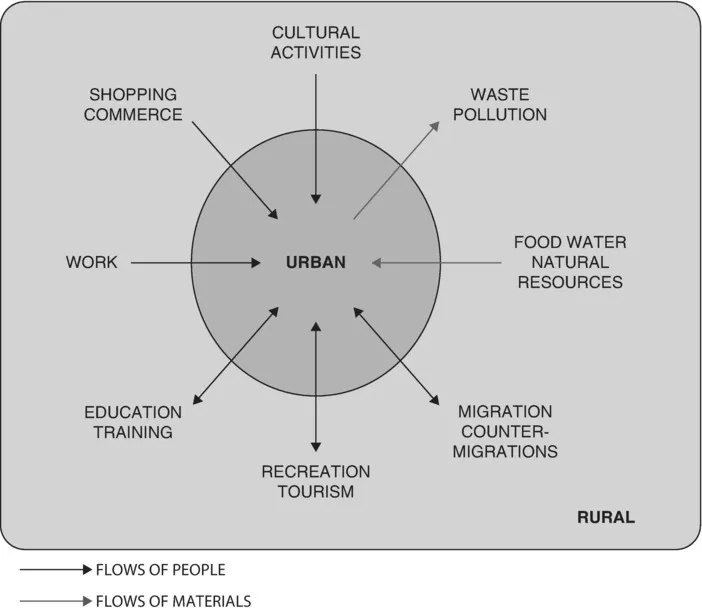
Fig. 1.1. Flows of people and materials, between urban and rural. (Adapted from: Nadin and Stead, 2000.)
Furthermore, tourism, leisure and recreation have been recognized as one of the urban–rural interaction sub-types within the OECD classification (Copus, 2013). The European development strategy, aiming to balance the development between urban and rural areas, has promoted urban–rural functional linkages and partnerships. In the OECD publication (2013) some empirical cases on partnerships in tourism are presented, where firms, public institutions and other associations cooperated to offer integrated tourist services and products related to agriculture and the landscape (e.g. Wine and Flavours Route in Emilia-Romagna, Italy), culture and heritage, inland and coastal areas (e.g. product unions in Emilia-Romagna, Italy), and promoting the whole territory based on mutual dependence and interconnections. Most urban–rural interactions, especially in the tourism sector, are shaped by physical proximity as much as by organizational proximity (Copus, 2013), which expands the concept from an Euclidean geographical localization towards a wider network of socio-economic relations, between firms and different actors, as well as other forms of institutional collaboration.
Particular forms of touris...
Table of contents
- Cover
- Half Title
- Title
- Copyright
- Contents
- List of Contributors
- Introduction
- Part I Urban Rural Linkages
- Part II Fringe Tourism
- Part III Strategies in Sustainability
- Index
- Back Cover
Trusted by 375,005 students
Access to over 1.5 million titles for a fair monthly price.
Study more efficiently using our study tools.
Frequently asked questions
Yes, you can cancel anytime from the Subscription tab in your account settings on the Perlego website. Your subscription will stay active until the end of your current billing period. Learn how to cancel your subscription
No, books cannot be downloaded as external files, such as PDFs, for use outside of Perlego. However, you can download books within the Perlego app for offline reading on mobile or tablet. Learn how to download books offline
Perlego offers two plans: Essential and Complete
- Essential is ideal for learners and professionals who enjoy exploring a wide range of subjects. Access the Essential Library with 800,000+ trusted titles and best-sellers across business, personal growth, and the humanities. Includes unlimited reading time and Standard Read Aloud voice.
- Complete: Perfect for advanced learners and researchers needing full, unrestricted access. Unlock 1.5M+ books across hundreds of subjects, including academic and specialized titles. The Complete Plan also includes advanced features like Premium Read Aloud and Research Assistant.
We are an online textbook subscription service, where you can get access to an entire online library for less than the price of a single book per month. With over 1.5 million books across 990+ topics, we’ve got you covered! Learn about our mission
Look out for the read-aloud symbol on your next book to see if you can listen to it. The read-aloud tool reads text aloud for you, highlighting the text as it is being read. You can pause it, speed it up and slow it down. Learn more about Read Aloud
Yes! You can use the Perlego app on both iOS and Android devices to read anytime, anywhere — even offline. Perfect for commutes or when you’re on the go.
Please note we cannot support devices running on iOS 13 and Android 7 or earlier. Learn more about using the app
Please note we cannot support devices running on iOS 13 and Android 7 or earlier. Learn more about using the app
Yes, you can access Linking Urban and Rural Tourism by Susan L Slocum, Carol Kline, Carol Kline in PDF and/or ePUB format, as well as other popular books in Business & Hospitality, Travel & Tourism Industry. We have over 1.5 million books available in our catalogue for you to explore.