This guide brings together the varied and multiple skills and activities required of pest control practitioners, including biology, chemistry, architecture, engineering, sales, logistics, legal and accounting, presented with a primary emphasis on pest organisms at its core. This book provides information and tips on all of these aspects and: explores the business of controlling pests (including trends in the industry, pest control tools, and sustainable pest control); covers biological information on each pest in addition to information on control and management, monitoring and follow-up; focusses particularly on globally significant pests with internationally-applicable use and guidance; and provides practical and hands-on experience, drawing on original case studies This is a key resource for pest control practitioners, as well as in-house staff of companies or buildings involved in household or urban pest control. It is also a valuable reference for researchers, and sanitation and building managers.
- English
- ePUB (mobile friendly)
- Available on iOS & Android
eBook - ePub
About this book
Information
1 Understanding the Business of Controlling Pests
1.1 Introduction
Urban pests are common all over the world. These include cockroaches, flies, mosquitoes, bed bugs, ticks, fleas, ants, termites, rodents and a few more. These pests thrive in dark, warm and moist conditions in structures, particularly in places where there is food, warmth and places to hide. Moreover, a number of human activities and habits such as living in homes with insufficient ventilation, creating clutter, poor lighting, temperature control, poor recycling of rubbish, improper composting methods, poor water storage and use of wood in construction attract pests. Also, community and public areas in cities such as parks, recreation centres, wastelands, rivers, canals, sewer drains, storm-water drains, dump sites, flea markets and recycling plants often serve as ideal breeding grounds and habitats for pests.
• A city is never free of pests, and urban pests are among the prime sources of damage and many human illnesses and injuries.
Urban pests are the leading causes of illnesses due to allergies, bites, food contamination and phobia. They also harm humans by causing significant damage to property and structure. Consequently, the pest control industry has flourished because of the human need to eliminate them, generating billions of dollars annually. Today we have global pest control companies such as Rentokil, Terminix and Orkin, in addition to many local ones, who have synonymized their brands with the very act of pest control.
1.2 Trading Pest Control Business
Pest control is becoming a necessity for humans (Figs 1.1–1.4). The sight of a pest triggers various types of negative behaviour, such as anger and disgust, and the choice to use a toxic chemical spray is almost involuntary. This human behaviour has made pest control a burgeoning business area. However, the degree of trade is dependent on the nature of the service the practitioner is offering and the environment where the service is required. An occasional trail of ants in the home may be merely a nuisance; in contrast a single ant in a hospital can have serious consequences. The tolerance for pest infestations varies from situation to situation. Institutional kitchens, health care facilities and critical manufacturing facilities demand detailed and careful design and planning to exclude pests compared to homes or shopping centres.
• Pest control is becoming a necessity for humans. The sight of a pest triggers various types of negative behaviour, such as anger and disgust, and the choice to use a toxic chemical spray is almost involuntary.

Fig. 1.1. A museum artefact destroyed by powderpost beetles. (Courtesy of Josielyn Trinidad.)
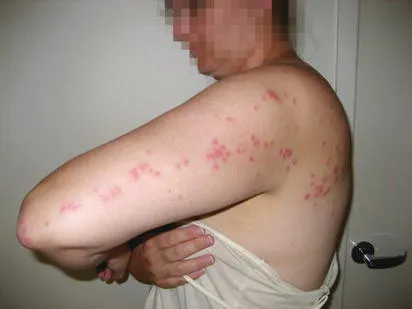
Fig. 1.2. A resident bitten by bed bugs. (Courtesy of Dr Stephen Doggett.)
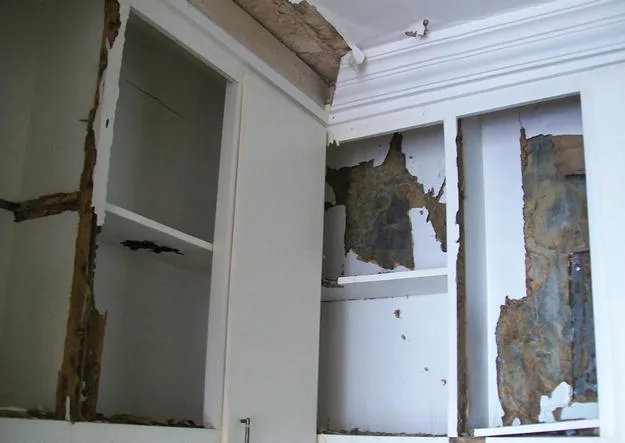
Fig. 1.3. A house cabinet destroyed by termites. (Author’s photo.)
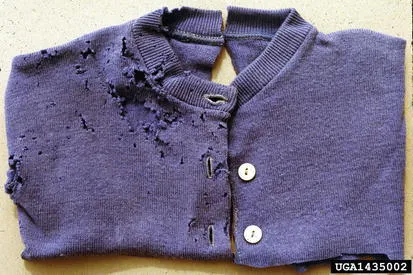
Fig. 1.4. A textile item damaged by stored product beetle. (Courtesy of Clemson University – USDA Cooperative Extension Slide Series, Bugwood.org.)
The information disparity with regards to pests, between the client (such as a homeowner) and the pest controller has been utilized to make pest control services a successful business. Practitioners often help to bridge the knowledge gap by providing information, printed literature, client references and web reviews. Practitioners often introduce the products they use in order to gain the confidence of the client. In addition, manufacturers continuously update their product pages with research and findings to help clients gather reassuring information. Another way of getting around this information asymmetry and making pest control businesses more profitable is to offer warranties to gain the client’s trust. Pest control companies often provide various types of service and product warranties. Such warranties can be in many forms, such as retreatment without incurring extra cost in the case of the pest resurfacing. Practitioners have even experimented with offers to replace damaged property to increase their business.
• The information disparity with regard to pests and pesticides between the client and practitioners has been utilized very well to make pest control services a profitable business.
1.3 Trends in the Pest Control Industry
Current trends indicate that pest control has deviated from a dynamic activity to become more of a ritualistic operation and one that is partly product marketing. Industry-formalized practice is focused on products and their usage. Exhibitions, magazines and journals dedicate vast resources and space to products in comparison to that devoted to knowledge and practices. This forces pest control practitioners to become more product addicted than skill oriented.
• There is a current trend of overreliance on products, and industry-designed practices have prevented development of skills among practitioners.
Application of chemicals by sprayers remains the most dominant activity in pest control work. The act is less skilful and less time consuming than other methods of pest control. Sprayers help achieve easy spread of the chemical over a large area in less time. Sprayers cover solid surfaces and water bodies, help treat cracks and crevices and even take care of room space. Their ease of use and the lack of technical skills required to operate sprayers in turn have promoted liquid formulations of pesticides. Formulations are designed to have the broadest possible use, which will cover a variety of insect pests occurring in a habitat. A crack and crevice treatment formulation covers almost all indoor insects that inhabit cracks and crevices. Overall, controlling pests has become a simple act requiring minimal specialized training and knowledge.
Likewise termite management continues to operate under an age-old soil treatment-based business model that has little relevance to actual knowledge. Both consumers and regulatory agencies are largely unaware of the gulf between knowledge and practice. Industry acceptance of a knowledge-based practice model is hindered by a business practice based on insecticide treatment and offers of questionable warranties.
Pest management professionals often choose products based on the treatment cost, and sprayable formulations are often the cheapest. A number of studies, as well as jobs done, have shown the relative ineffectiveness of conventional sprays compared to knowledge-based intervention methods (Dhang, 2014).
• Pest management professionals who understand the behaviour and biology of their target pest species are more efficient and effective in controlling pests than those who lack this knowledge.
It is clearly evident that the act of spraying pesticides in an indiscriminate and unplanned fashion has resulted in control failures. This has led to the realization that judicious use of pesticides is needed to overcome control failures and, to sustain growth, new avenues have to be opened up in terms of application methods. As a consequence of this, dramatic changes in pest control strategies have taken place, which is noticeable globally. Conventional sprayers and indiscriminate sprays have been replaced by precise and targeted delivery systems. Even in cases where spraying is a must, long-lasting residual formulations are used so that the number of sprays is reduced. The advent of baits for a variety of pests has further reduced regular insecticide sprays as residuals. Baits have also, to a large extent, reduced the use of sprayers in the indoor environment.
1.4 Pest Control Tools
Inspection and monitoring are critical tools in pest control. These help make pest control operations sustainable. Both help practitioners determine the right strategy for a job. The knowledge obtained from an inspection is important in making the pest control programme successful. Pest management professionals who understand the behaviour of their target pest species are more efficient and effective at controlling pests than those who lack this knowledge. Knowing common travel routes and typical breeding, hiding and feeding places helps the professional conduct a focused inspection. Instead of wasting time looking where the pest probably is not, time is better spent looking where the pest most likely is. Understanding the harbourage and passage make the work of pest control effective. This helps reduce the cost of treatment and the time spent on the job – each important in making the work sustainable.
• Even though pest control remains chemical dependent, the nature and mode of action of current chemicals are safer and more target-specific than before. Non-toxic insect growth regulators and physical action products have taken over from contact poisons.
Use of pest monitoring or intercepting devices is critical in designing a pest control programme. These devices help detect the presence of a pest, determine the location or active areas of infestation and also indicate the pest population. Each piece of this information is a critical determinant in deciding a suitable pest control strategy. Several active and passive monitors/interceptors are commercially available to assist practitioners.
1.5 Sustainable Pest Control
The market presents various choices of pest control products; however, none permanently eliminate pest problems or makes a structure foolproof against pest attack. This often necessitates the use of multiple methods, including chemical, physical, mechanical and cultural methods, rendering pest control jobs time consuming, laborious and expensive. Thus, long-term pest management has to rely on sustainable methods, such as adoption of integrated pest management (IPM), which combines pest elimination, cost-effectiveness and environmental concerns.
• Conventional sprayers and indiscriminate sprays have been replaced by innovative and precise targeted delivery systems, such as insecticide baits. Adoption of IPM has further in...
Table of contents
- Cover
- Half Title
- Title
- Copyright
- Contents
- Acknowledgements
- Preface
- 1 Understanding the Business of Controlling Pests
- 2 Household Pests and Their Control – Cockroaches
- 3 Household Pests and Their Control – Flies
- 4 Household Pests and Their Control – Mosquitoes
- 5 Household Pests and Their Control – Bed Bugs
- 6 Household Pests and Their Control – Termites
- 7 Sporadic Pests and Their Control
- 8 Stored Product Pests
- 9 Vertebrate Pests and Their Control
- 10 Methodology in Pest Control – Insecticide Formulations
- 11 Methodology in Pest Control – Insecticide Baits and Baiting
- 12 Shift to Integrated Pest Management (IPM)
- 13 Handling Pesticides
- Appendix
- References
- Index
- Back Cover
Trusted by 375,005 students
Access to over 1.5 million titles for a fair monthly price.
Study more efficiently using our study tools.
Frequently asked questions
Yes, you can cancel anytime from the Subscription tab in your account settings on the Perlego website. Your subscription will stay active until the end of your current billing period. Learn how to cancel your subscription
No, books cannot be downloaded as external files, such as PDFs, for use outside of Perlego. However, you can download books within the Perlego app for offline reading on mobile or tablet. Learn how to download books offline
Perlego offers two plans: Essential and Complete
- Essential is ideal for learners and professionals who enjoy exploring a wide range of subjects. Access the Essential Library with 800,000+ trusted titles and best-sellers across business, personal growth, and the humanities. Includes unlimited reading time and Standard Read Aloud voice.
- Complete: Perfect for advanced learners and researchers needing full, unrestricted access. Unlock 1.5M+ books across hundreds of subjects, including academic and specialized titles. The Complete Plan also includes advanced features like Premium Read Aloud and Research Assistant.
We are an online textbook subscription service, where you can get access to an entire online library for less than the price of a single book per month. With over 1.5 million books across 990+ topics, we’ve got you covered! Learn about our mission
Look out for the read-aloud symbol on your next book to see if you can listen to it. The read-aloud tool reads text aloud for you, highlighting the text as it is being read. You can pause it, speed it up and slow it down. Learn more about Read Aloud
Yes! You can use the Perlego app on both iOS and Android devices to read anytime, anywhere — even offline. Perfect for commutes or when you’re on the go.
Please note we cannot support devices running on iOS 13 and Android 7 or earlier. Learn more about using the app
Please note we cannot support devices running on iOS 13 and Android 7 or earlier. Learn more about using the app
Yes, you can access Urban Pest Control by Partho Dhang in PDF and/or ePUB format, as well as other popular books in Technology & Engineering & Environmental Management. We have over 1.5 million books available in our catalogue for you to explore.