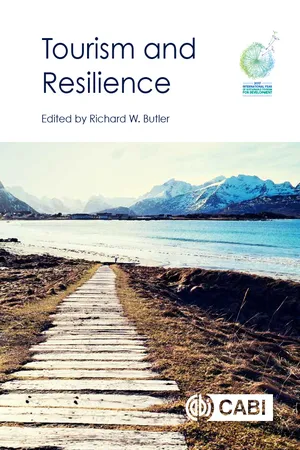
This is the first book to address the concept of resilience and its specific application and relevance to tourism, in particular tourism destinations. Resilience relates to the ability of organisms, communities, ecosystems and populations to withstand the impacts of external forces while retaining their integrity and ability to continue functioning. It is particularly applicable to tourism destinations and attractions which are exposed to the potentially harmful and sometimes severe effects of tourism development and visitation, but which also can experience increased resilience from the economic benefits of tourism. Phenomena such as destination communities, wildlife populations and ecosystems are discussed, as well as the ability of places and communities to use tourism and its infrastructure to recover from disasters such as tsunamis, earthquakes, unrest and disease. This book: · Compares the relevance of resilience to sustainability· Contains contributions from many of the leading international authors· Brings together varying viewpoints of both conceptual and applied issues· Includes example case studies from Whistler, western Canada; Sri Lanka; Purnululu National Park, Australia; and the remote Pitcairn Island in the Pacific Tourism and Resilience is relevant for researchers, students and practitioners in tourism and related fields such as development studies, geography, sociology, anthropology, economics and business/management.
- English
- ePUB (mobile friendly)
- Available on iOS & Android
eBook - ePub
Tourism and Resilience
About this book
Information
Topic
Negocios y empresaSubtopic
Hostelería, viajes y turismoIntroduction
1 Introduction
Richard Butler*
Strathclyde University, Glasgow, UK
1.1 Sustainability, Capacity and Resilience
1.1.1 Introduction
As tourism has developed into an important academic field of study over the last century, researchers in the field have adopted and adapted a number of concepts and frameworks from other fields and disciplines to use as conceptual hooks for their research. Contributions have been made from all the major social science disciplines and, although fewer in number, of equal importance, from the physical sciences also. The following sections review briefly two of those which have been of particular relevance to the concept of resilience and which have preceded this in terms of their application to tourism research and development.
1.1.2 Sustainable development
Since the publication of Our Common Future in 1987 (WCED, 1987) the last three decades have been dominated by the concept of sustainable development. This concept has been adopted by many actors involved in tourism at all levels, from individual companies and communities to national governments and international agencies such as the United Nations World Tourism Organisation (UNWTO). Countless academic articles and books have been written on the concept and its application to tourism, disregarding the fact that tourism as such can never become truly sustainable because of the inescapable reliance upon travel, the vast bulk of which involves non-renewable, and thus unsustainable, energy sources. While individual enterprises such as ecolodges can become sustainable or very close to that state, the industry as a whole cannot achieve such a state. It may seem peculiar, therefore, that sustainable development has been so enthusiastically incorporated into tourism, yet the very beguiling appeal of the concept lies in its vagueness and impreciseness. Moisey and McCool (2001: 342) summarized this problem neatly: ‘without shared meanings, sustainability does indeed become nothing more than a “guiding fiction”, leaving the participants with a moving target of an idealized end state, yet paralysed when it comes to taking action’.
To discuss the needs of the present, let alone the future, when such needs are neither definable nor achievable, has resulted in almost as many definitions of the concept as there are users, with each containing different ideas of what is meant by the term and how it should be implemented. The result has been a situation in which the term is used in multiple contexts with many implications and overall, with little effect on tourism in general. This is not to denigrate the original concept or its goals. Reduction in the use of non-renewable resources, avoidance or the mitigation of environmental damage by actions such as maintaining biodiversity or reducing pollution, ensuring the quality of life for future generations of all living species, and improving the quality of life for present generations are all laudable goals, but difficult, if not impossible, to achieve in many situations.
Tourism is one form of economic activity in which the application of sustainability principals is desirable but impractical. It would require fundamental shifts in human preferences and desires, a process which even supporters of the concept acknowledge is not accepted by most tourists:
Current leisure mobility patterns are not sustainable. Because energy efficiency measures appear insufficient to accommodate predicted future volume growth, changes in transportation modes and volume are needed. Short-haul should be the preferred distance, public transportation the preferred mode and length of stay should increase rather than trip frequency. However, tourists are unwilling to adopt these measures. [emphasis added]
(Ram et al., 2013: 1017)
If the required changes in behaviour are not acceptable to the majority of tourists, there is little hope for a major shift towards the implementation of sustainable development principals to tourism developments and the industry at large.
Thus while sustainability principals can and are being applied to many specific aspects of tourism, particularly in infrastructure and facilities, they run into the stumbling block of transportation, as so much tourism involves medium- to long-haul travel. While tourists may stay in a sustainable operation and behave in an appropriate manner when on holiday, their travel to and from their destinations remains unsustainable. This is not a reason to abandon the concept of sustainability in the context of tourism, but it is justification to seek out and adopt additional principals which may assist tourism destinations in particular to survive the impacts of tourism, both positive and negative, which may alter those places irreparably when such a process is not wanted by the residents of those communities at least.
Tourism is very much a two-edged sword. In many cases tourism has proved to be the major, or in some cases, the only economic development opportunity in many locations, allowing communities to share in improvements in the quality of life and move out of poverty and underdevelopment, albeit with changes in the nature and environment of those communities. In other situations, tourism has been developed to such an extent that the communities affected have changed beyond what they perceive to be acceptable levels and tourism is seen as a problem which has not been beneficial in the manner that was anticipated. Similarly, if tourism declines, especially quickly as a result of disaster or conflict, then affected communities may be deprived of their main source of income and employment and face considerable difficulty in regaining their tourism market and associated economic benefits. There is a need, therefore, to enable communities to become better able to deal with the stresses and effects of tourism development when tourism is growing and has been established, and also more capable of recovering from a loss of tourism should unforeseen or unmanageable problems arise.
1.1.3 Carrying capacity
The concept of carrying capacity was promoted as a way of controlling and mitigating some of the problems of over-use of recreation areas some decades ago (Lucas, 1964; Wagar, 1964), but has long fallen out of favour, particularly in the context of tourism (Butler, 1996, 2010), primarily because of the difficulty of establishing a specific number of visitors that would be acceptable and appropriate to a destination, to the visitors themselves, and to the natural environment involved (McCool and Lime, 2001) The early studies of carrying capacity allowed a ‘magic number’ of users to be identified, but in those studies the users were all of one type (wilderness recreationists), and the environment in which they were studied was relatively homogeneous (protected wilderness areas), thus the analogy with rangeland carrying capacity was valid. However, it is clear that the original principles of carrying capacity, the number of animals capable of being sustained in a given area without causing irreparable damage, do not fit easily with tourism, which is almost never a homogenous activity (being made up of many different types of people engaged in many different activities) and rarely takes place in a homogeneous environment (see Cochrane, Chapter 10, this volume, for a comparison with a similar definition of resilience in the UK). Thus while many managers in the field in recreation and tourist sites may believe that numbers matter and that it is clearly possible to have too many visitors for the well-being and maintenance of a specific site, they have moved in recent decades to adopting concepts such as Limits of Acceptable Change (Stankey et al., 1985), Recreation Opportunity Spectrum (Clark and Stankey, 1979) and Tourism Opportunity Spectrum (Butler and Waldbrook, 2003), in which actual numbers are replaced by measures of change and desired outcomes are defined and maintained.
The comparisons between sustainable development and carrying capacity remain obvious and inescapable, however, with the main feature in common being the underlying need for limits. As Hardin (1968) argued in the context of ‘the tragedy of the commons’, without limit and responsibility, ruination of a shared resource is inevitable. While most tourism destinations are not commons, the landscapes and environments (physical and cultural) which form the basis of tourism in many regions are commons, whether owned and managed as such or not, and their maintenance is necessary if the tourism appeal of such places, let alone their intrinsic natural values, is to be conserved and kept for present and future generations as Brundtland argued (WCED, 1987).
Accepting that a single number is unlikely to ever be identifiable or acceptable to users and residents alike, let alone implementable, alternatives must be derived. One approach would be to identify critical limits to one or more essential features, natural and manufactured, such as water quality or consumption, land price, access, or accommodation and limit visitation according to the ‘weakest link’ in the system. In recent years communities and organizations have begun to take steps to implement such arrangements. In many cases this has been expressed in terms of simple numbers, with the argument that excessive numbers at some point become unacceptable to residents and reduces their quality of life. One example of this is ‘Venexodus’, a series of demonstrations by permanent residents of Venice against the 25 million annual visitors and the impacts this number has had on the quality of life and range of services in the city (The Times, 2016), exemplified by the fact that the permanent population of the city has dropped from 190,000 last century to 55,000 today. Other examples of the pressure of numbers are found in the increasing tendency of many tourist attractions in the cultural sector to institute timed pre-booking arrangements in order to reduce over-crowding, particularly when major exhibitions are hosted. The increasing occurrence of such measures and protests indicates clearly the problem with the impact of apparently ever-increasing numbers of visitors to popular tourist destinations, a situation predicted to continue steadily in the future (UNWTO, 2016).
If the now discredited concept of carrying capacity is unlikely to be re-adopted and instituted, then some alternative is obviously required. Sustainable development of mass tourism equally clearly is not taking place and mass tourism is showing no signs of being replaced by a more sustainable form, however much proponents of sustainability may argue to that effect. To tackle this problem, then, what is needed is a means of improving the ability of tourism destinations to withstand the effects of tourism, or, in other words, to make them more resilient to the impacts of use, and thus we come to the concept of resilience.
1.1.4 Resilience
This term, like sustainable, has a long history of use, generally meaning, as dictionaries state, ‘Resilient: adjective (of an object) capable of regaining its original shape or position after bending, stretching or other deformation’ (Collins, 1988: 988). The term has often been used to describe the ability of communities to survive in difficult circumstances; small remote or insular communities are often so described as Alberts and Baldachinno note in Chapter 12, this volume. In recent years, however, the term to some degree has been reinvented, first in the natural sciences (Holling, 1973) and then in the social sciences, and most recently in tourism. This process, of taking concepts and terms from natural science and applying them in social science is not new; in the tourism context, both carrying capacity and chaos theory are good examples of such actions. Their transformations have had mixed success, carrying capacity, as noted above, has not been successfully applied in modern tourism settings. Chaos theory appeared in the tourism literature in the 1990s (McKercher, 1999; Russell, 2006) and while it received considerable attention for a while, appears to have lost emphasis and is little cited in research today.
Resilience, however, is a concept more likely to receive ongoing attention and application in tourism in the future. In the first case it is a term with which people are familiar, even if only in a traditional form of use, and thus already has a meaning and implications. Secondly, it would appear to fit what is needed in tourism, namely, a way to improve the ability of tourism destinations to cope with tourism development, and also to cope with disasters and conflicts that may eliminate or drastically reduce tourism very suddenly. Clearly the concept also applies to many communities and to other economic activities far beyond tourism, but the focus in this volume is on the application and relevance to tourism in particular.
1.2 Resilience in a Tourism Context
The chapters which follow begin by discussing the original definitions and applications of the concept in the natural sciences and its being adopted and adapted in the social sciences. Berbés-Blázquez and Scott (Chapter 2) explain the development of the concept by Holling and others and provide examples of the way the concept has been modified in the social science context. Lew et al. (Chapter 3) continue this discussion with further focus on the tourism application of the concept, and these two chapters provide an excellent introduction, both to the concept and to the chapters which follow.
It is in the social sciences that resilience has found its most common application to tourism to date, and thus the second section of the book examines resilience in a socio-ecological setting, whereby the concept is used to bring together the relevant ecological issues and the social science counterparts in terms of the way the concept could be applied in tourism destination communities. Ruiz-Ballesteros (Chapter 4) was one of the first researchers in tourism to demonstrate the way in which resilience could be utilized in the context of community-based tourism. The focus on community preferences, desires and needs is also a key component of the concept of sustainable development, implying the importance of local input into development decision making on matters such as the rate, scale and type of development to be allowed in a community. Sheppard (Chapters 5 and 6) applies some of these concepts in the context of a specific destination, Whistler, in western Canada. Whistler, well established as one of the premier ski destinations in North America, was also the location of the Winter Olympics in 2010. This required a more detailed planning procedure than had been applied previously with additional participants becoming involved (Williams and Gill, 2017) and Sheppard records the attitudes and perceptions of residents about tourism development related to the expansion of the resort and ways to improve its resilience.
As noted earlier, the sudden loss of tourism (and other features) in a community following disasters and conflicts is also a suitable situation for the use of resilience measures and the third section of the volume explores ways to deal with post-conflict and post-disaster situations. Chapter 7 considers the use of resilience measures in the context of conflict, while Chapter 8 considers their use in the preparation for disaster recovery, and Chapter 9 examines the perceptions of impending problems and mitigating measures being taken in tourism destinations. The importance of the cooperation of all players in affected regions is a common t...
Table of contents
- Cover
- Title Page
- Copyright Page
- Table of Contents
- Figures
- Tables
- Contributors
- About the Editor
- Acknowledgements
- Part 1 Introduction
- Part 2 Socio-ecological Resilience
- Part 3 Resilience and Response to Disasters
- Part 4 Resilience in Protected Natural Areas and Insular Locations
- Part 5 Resilience and the Tourism Industry
- Part 6 Conclusions
- Index
- Footnotes
Trusted by 375,005 students
Access to over 1.5 million titles for a fair monthly price.
Study more efficiently using our study tools.
Frequently asked questions
Yes, you can cancel anytime from the Subscription tab in your account settings on the Perlego website. Your subscription will stay active until the end of your current billing period. Learn how to cancel your subscription
No, books cannot be downloaded as external files, such as PDFs, for use outside of Perlego. However, you can download books within the Perlego app for offline reading on mobile or tablet. Learn how to download books offline
Perlego offers two plans: Essential and Complete
- Essential is ideal for learners and professionals who enjoy exploring a wide range of subjects. Access the Essential Library with 800,000+ trusted titles and best-sellers across business, personal growth, and the humanities. Includes unlimited reading time and Standard Read Aloud voice.
- Complete: Perfect for advanced learners and researchers needing full, unrestricted access. Unlock 1.5M+ books across hundreds of subjects, including academic and specialized titles. The Complete Plan also includes advanced features like Premium Read Aloud and Research Assistant.
We are an online textbook subscription service, where you can get access to an entire online library for less than the price of a single book per month. With over 1.5 million books across 990+ topics, we’ve got you covered! Learn about our mission
Look out for the read-aloud symbol on your next book to see if you can listen to it. The read-aloud tool reads text aloud for you, highlighting the text as it is being read. You can pause it, speed it up and slow it down. Learn more about Read Aloud
Yes! You can use the Perlego app on both iOS and Android devices to read anytime, anywhere — even offline. Perfect for commutes or when you’re on the go.
Please note we cannot support devices running on iOS 13 and Android 7 or earlier. Learn more about using the app
Please note we cannot support devices running on iOS 13 and Android 7 or earlier. Learn more about using the app
Yes, you can access Tourism and Resilience by Richard Butler, Richard W Butler in PDF and/or ePUB format, as well as other popular books in Negocios y empresa & Hostelería, viajes y turismo. We have over 1.5 million books available in our catalogue for you to explore.