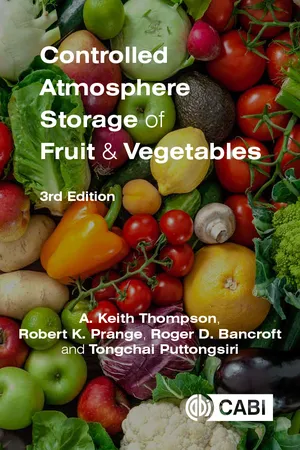
The third edition of this successful title presents current research and commercial uses of controlled atmosphere storage and modified atmosphere packaging of fresh fruit and vegetables to provide a comprehensive and up-to-date overview. New and developed technologies for the transportation and storage of horticultural products are essential to ensure that produce reaches consumers in the best possible condition, and have the potential to reduce the postharvest use of chemicals, reduce losses and maintain nutritional quality and organoleptic characteristics.Covering the increasingly used science and technology of preserving the freshness of fruit and vegetables in all aspects of their postharvest life, this book puts the subject in the context of its history and current practices, in addition to future prospects. The new edition: - Explores the large volume of research that is continuously being published on the topic.- Reviews and evaluates the adaptation and improvement of commercial technologies.- Considers the effects of techniques and technologies on flavour, quality and physiology, in addition to the damage inflicted by pests, diseases and disorders.- Contains 5 new chapters covering genetics and CA storage, dynamic CA storage, hyperbaric storage, hypobaric storage and fruit ripening.Fully revised and presented in full colour throughout, this book is a readily accessible resource for researchers, scientists, growers, students and industry personnel.
eBook - ePub
Controlled Atmosphere Storage of Fruit and Vegetables
- English
- ePUB (mobile friendly)
- Available on iOS & Android
eBook - ePub
Controlled Atmosphere Storage of Fruit and Vegetables
About this book
Information
1
Introduction
The maintenance or improvement of the postharvest life and quality of fresh fruit and vegetables is becoming increasingly important. This has been partly as a response to a free market situation where the supply of good quality fruit and vegetables constantly exceed demand. Therefore to maintain or increase market share there is increasing emphasis on quality. Also consumer expectation in the supply of all types of fresh fruit and vegetables throughout the year is often taken for granted. This latter expectation is partly supplied by long-distance transport but also long-term storage of many crops. With growing awareness and concern for climate change, long-distance transport of fruit and vegetables is being questioned.
Controlled atmosphere (CA) storage has been shown to be a technology that can contribute to these consumer requirements in that in certain circumstances, with certain cultivars of crop and appropriate treatments, the marketable life can be greatly extended. An enormous amount of interest and research has been reported on CA storage and modified atmosphere (MA) packaging of fruit and vegetables to prolong their availability and retain their quality for longer. This book seeks to evaluate the history and current technology reported and used in CA storage and MA packaging and its applicability and restrictions for the use in a variety of crops in different situations. While it is not exhaustive in reviewing the enormous quantity of science and technology that has been developed and published on the subject, it will provide an access into CA and MA for those applying the technology in commercial situations. The book can also be used as a basis for determination of researchable issues in the whole area of CA storage and MA packaging.
The scientific basis for the application of CA technology to the storage of fresh fruit and vegetables has been the subject of considerable research, which seems to be progressively increasing. Some of the science on which it is based has been known for over 200 years but was refined and applied commercially for the first time in the first half of the 20th century.
History of the Effects of Gases on Crops
The effects of gases on harvested crops have been known for centuries. In eastern countries some types of fruit were taken to temples, where incense was burned, to improve ripening. Bishop (1996) indicated that there was evidence that Egyptians and Samarians used sealed limestone crypts for crop storage in the second century BCE. He also quoted from the Bible suggesting that the technology might have been used in Old Testament Egypt when Joseph prevented famine by storing grain for 7 years. Dilley (1990) mentioned the storage of fresh fruit and vegetables in tombs and crypts. This was combined with the gas-tight construction of the inner vault so that the fruit and vegetables would consume the oxygen (O2) and thus help to preserve the crops. An interpretation of this practice would indicate that knowledge of the respiration of fruit pre-dates the work described in the 19th century (Dalrymple, 1967). Wang (1990) quotes a Tang dynasty 8th century poem which described how litchis were shown to keep better during long-distance transport when they were sealed in the hollow centres of bamboo stems with some fresh leaves. Burying fruit and vegetables in the ground to preserve them is a centuries-old practice (Dilley, 1990). In Britain crops were stored in pits, which would have restricted ventilation and may have improved their storage life. Currently CA research and commercial CA storage is used in many countries, some of which are described in this chapter.
France
The earliest documented scientific study of CA storage was by Jacques Etienne Berard at the University of Montpellier in 1819 (Berard, 1821), who found that harvested fruit absorbed O2 and gave out carbon dioxide (CO2). He also showed that certain types of fruit stored in atmospheres containing no O2 did not ripen, but if they were held for only a short period and then placed in air they continued to ripen. These experiments showed that storage in zero O2 gave a shelf-life of about 1 month for peaches, prunes and apricots and about 3 months for apples and pears. Zero O2 was achieved by placing a paste composed of water, lime and iron sulfate in a sealed jar which, as Dalrymple (1967) pointed out, would also have absorbed CO2. Considerable CA research has been carried out over the intervening period in France. Berard’s method of achieving an atmosphere that had no O2 and likely had CO2 absorbed as well is still in use today. There are commercial sources of ‘oxygen absorbers’ available on e-commerce sites that will absorb virtually all O2 in a sealed container. The product consists of food-safe sachets containing iron powder which consumes O2 to form iron oxides. At least one of the products contains activated carbon, which can serve to absorb CO2 (though the supplier does not make this claim) (Robert Prange, personal communication).
USA
In 1856 Benjamin Nyce built a commercial cold store in Cleveland, Ohio, using ice to keep it below 34°F. In the 1860s he experimented with modifying the CO2 and O2 in the store by making it airtight. This was achieved by lining the store with casings made from iron sheets, thickly painting the edges of the metal and having tightly fitted doors. It was claimed that 4000 bushels (about 72.6 t; see Glossary) of apples were kept in good condition in the store for 11 months. However, he mentioned that some fruits were injured in a way that Dalrymple (1967) interpreted as possibly being CO2 injury. The carbonic acid level was so high in the store (or the O2 level was so low) that a flame would not burn. He also used calcium chloride to control the moisture level in the mistaken belief that low humidity was necessary.
Dalrymple (1967) stated that R.W. Thatcher and N.O. Booth working in Washington State University around 1903 studied fruit storage in jars containing different gases. They found that ‘the apples which had been in CO2 were firm of flesh, possessed the characteristic apple colour, although the gas in the jar had a slight odour of fermented apple juice, and were not noticeably injured in flavour’. The apples stored in hydrogen, nitrogen (N2), O2 and sulfur dioxide (SO2) did not fare so well. They subsequently studied the effects of CO2 on raspberries, blackberries and loganberries and ‘found that berries which softened in three days in air would remain firm for from 7 to 10 days in CO2.
Fulton (1907) observed that fruit could be damaged where large amounts of CO2were present in the store, but strawberries were ‘damaged little, if any . . . by the presence of a small amount of CO2 in the air of the storage room’. Thatcher (1907) published a paper describing work in which he experimented with apples sealed in boxes containing different levels of gases and concluded that CO2 greatly inhibited ripening.
G.R. Hill Jr reported work carried out at Cornell University in 1913 in which the firmness of peaches had been retained by storage in inert gases or CO2. He also observed that the respiration rate of the fruit was reduced and did not return to normal for a few days when removed from storage in a CO2 atmosphere to air. C. Brooks and J.S. Cooley, working for the US Department of Agriculture, stored apples in sealed containers in which the air was replaced three times each week with air plus 5 kPa CO2. After 5 weeks storage they noted that the apples were green, firm and crisp, but were also slightly alcoholic and had ‘a rigor or an inactive condition from which they do not entirely recover’ (Brooks and Cooley, 1917). J.R. Magness and H.C. Diehl in 1924 described a relationship between apple softening and CO2 concentration in that an atmosphere containing 5 kPa CO2 slowed the rate of softening with a greater effect at higher concentrations, but at 20 kPa CO2 the flavour was impaired. Work on CA storage that had been carried out at the University of California at Davis was reported by Overholser (1928). This work included a general review and some preliminary results on Fuerte avocados. In 1930 Overholser left the University and was replaced by F.W. Allen, who had been working on storage and transport of fresh fruit in artificial atmospheres. Allen began work on CA storage of ‘Yellow Newtown’ apples. ‘Yellow Newtown’, like ‘Cox’s Orange Pippin’ and ‘Bramley’s Seedling’ grown in England, was subject to low-temperature injury at temperatures higher than 0°C. These experiments (Allen and McKinnon, 1935) led to a successful commercial trial on Yellow Newtown apples in 1933 at the National Ice and Cold Storage Company in Watsonville. Thornton (1930) carried out trials where the concentration of CO2 tolerated by selected fruit, vegetables and flowers was examined at six temperatures over the range of 0–25°C. To illustrate the commercial importance of this type of experiment the project was financed by the Dry Ice Corporation of America.
From 1935 Robert M. Smock worked in the University of California at Davis on apples, pears, plums and peaches (Allen and Smock, 1938). In 1936 and 1937 F.W. Allen spent some time with Franklin Kidd and Cyril West at the Ditton laboratory in England and then continued his work at Davis, while in 1937 Smock moved to Cornell University. Smock and his PhD student, Archie Van Doren, conducted CA storage research on apples, pears and stone fruit (Smock, 1938; Smock and Van-Doren, 1938, 1939). New England farmers in the USA were growing a number of apple cultivars, particularly ‘McIntosh’. ‘McIntosh’ is subject to chilling injury and cannot be stored at or below 0°C. It was thought that if the respiration rate could be slowed, storage life could be extended, lengthening the marketing period, and CA storage was investigated to address this problem (Smock and Van-Doren, 1938). Sharples (1989a) credited Smock with the ‘birth of CA storage technology to North America’. In fact it was apparently Smock who coined the term ‘controlled atmosphere storage’ as he felt it better described the technology than the term ‘gas storage’ which was used previously by Kidd and West. Smock and Van-Doren (1941) stated: ‘There are a number of objections to the use of the term gas storage as the procedure is called by the English. The term controlled atmosphere has been substituted since control of the various constituents on the atmosphere is the predominant feature of this technique. A substitute term or synonym is modified atmosphere.’ The term ‘controlled atmosphere storage’ was not adopted in Britain until 1960 (Fidler et al., 1973). Smock also spent time with Kidd and West at the Ditton laboratory. The CA storage work at Cornell included strawberries and cherries (Van Doren et al., 1941). A detailed report of the findings of the Cornell group was presented in a comprehensive bulletin (Smock and Van Doren, 1941) which gave the results of research on atmospheres, temperatures and varietal response of fruit as well as store construction and operation. In addition to the research efforts in Davis and Cornell in the 1930s, several other groups in the USA were carrying out research into CA storage. CA storage research for a variety of fruit and vegetables was described by Miller and Brooks (1932) and Miller and Dowd (1936). Work on apples was described by Fisher (1939) and Massachusetts Agricultural Experiment Station (1941), work on citrus fruit by Stahl and Cain (1937) and Samisch (1937) and work on cranberries by Massachusetts Agricultural Experiment Station (1941). Smock's research in New York State University was facilitated in 1953 with the completion of large new storage facilities designed specifically to accommodate studies on CA storage. During the intervening years the work at Davis has been prolific, with an enormous number of publications (many are referred to in subsequent chapters), and the campus has become a widely recognized world leader in CA science and technology.
Commercial CA storage of apples in the USA began in New York State with ‘McIntosh’. The first three CA rooms with a total capacity of 24,000 bushels were put into operation in 1940 with Smock and Van Doren acting as consultants. This had been increased to 100,000 bushels by 1949, but the real expansion in the USA began in the early 1950s. In addition to a pronounced growth in commercial operation in New York State, CA stores were constructed in New England in 1951, in Michigan and New Jersey in 1956, in Washington, California and Oregon in 1958, and in Virginia in 1959 (Dalrymple, 1967). According to Love (1988) the delayed adoption in Washington State in the 1940s and early 1950s may have been due to the high cost of CA installation and management coupled with a certain scepticism among USDA postharvest researchers. But after 1957, the Washington apple industry increased CA technology at a rapid rate. Washington’s initial reluctance to adopt CA technology changed with new economic developments and new USDA scientific leadership in postharvest horticulture. A CA store for ‘Red Delicious’ was set up in Washington State in the late 1950s in a Mylar tent where some 1000 bushels were stored with good results. By the 1955–1956 season the total CA storage holdin...
Table of contents
- Cover
- Half Title
- Title
- Copyright
- Contents
- About the Authors
- Preface
- Acknowledgements
- Glossary
- Units of Measurement
- Abbreviations
- 1 Introduction
- 2 Harvest and Pre-harvest Factors
- 3 Effects and Interactions
- 4 Quality
- 5 Physiology, Ripening and Genetics
- 6 Pests, Diseases and Disorders
- 7 Pre-storage Treatments
- 8 CA Technology
- 9 Dynamic CA Storage
- 10 Hyperbaric and High-oxygen Storage
- 11 Hypobaric and Low-oxygen Storage
- 12 Recommended CA Conditions
- 13 Transport
- 14 MA Packaging
- References
- Index
- Back
Trusted by 375,005 students
Access to over 1.5 million titles for a fair monthly price.
Study more efficiently using our study tools.
Frequently asked questions
Yes, you can cancel anytime from the Subscription tab in your account settings on the Perlego website. Your subscription will stay active until the end of your current billing period. Learn how to cancel your subscription
No, books cannot be downloaded as external files, such as PDFs, for use outside of Perlego. However, you can download books within the Perlego app for offline reading on mobile or tablet. Learn how to download books offline
Perlego offers two plans: Essential and Complete
- Essential is ideal for learners and professionals who enjoy exploring a wide range of subjects. Access the Essential Library with 800,000+ trusted titles and best-sellers across business, personal growth, and the humanities. Includes unlimited reading time and Standard Read Aloud voice.
- Complete: Perfect for advanced learners and researchers needing full, unrestricted access. Unlock 1.5M+ books across hundreds of subjects, including academic and specialized titles. The Complete Plan also includes advanced features like Premium Read Aloud and Research Assistant.
We are an online textbook subscription service, where you can get access to an entire online library for less than the price of a single book per month. With over 1.5 million books across 990+ topics, we’ve got you covered! Learn about our mission
Look out for the read-aloud symbol on your next book to see if you can listen to it. The read-aloud tool reads text aloud for you, highlighting the text as it is being read. You can pause it, speed it up and slow it down. Learn more about Read Aloud
Yes! You can use the Perlego app on both iOS and Android devices to read anytime, anywhere — even offline. Perfect for commutes or when you’re on the go.
Please note we cannot support devices running on iOS 13 and Android 7 or earlier. Learn more about using the app
Please note we cannot support devices running on iOS 13 and Android 7 or earlier. Learn more about using the app
Yes, you can access Controlled Atmosphere Storage of Fruit and Vegetables by Anthony Keith Thompson,Robert K. Prange,Roger D Bancroft,Tongchai Puttongsiri in PDF and/or ePUB format, as well as other popular books in Biological Sciences & Horticulture. We have over 1.5 million books available in our catalogue for you to explore.