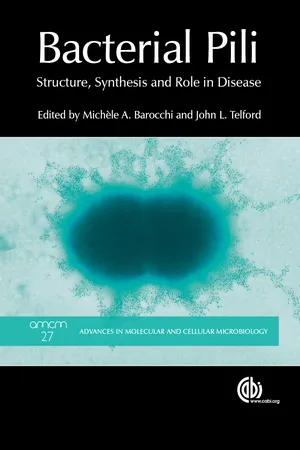
Bacterial pili play important roles as environmental sensors, in host colonization and in biofilm formation, enabling bacteria to interact with the environment, with surfaces and with other bacteria and host cells. Most bacteria, both Gram positive and Gram negative, and almost all bacterial pathogens, are piliated. This book discusses the synthesis, structure, evolution, function and role in pathogenesis of these complex structures, and their basis for vaccine development and therapeutics for Streptococcus pathogens. It is an invaluable resource for researchers and students of medical microbiology.
eBook - ePub
Bacterial Pili
Structure, Synthesis and Role in Disease
- English
- ePUB (mobile friendly)
- Available on iOS & Android
eBook - ePub
Bacterial Pili
Structure, Synthesis and Role in Disease
About this book
Information
Topic
Medicine1 The Vibrio cholerae Toxin Coregulated Pilus: Structure, Assembly and Function with Implications for Vaccine Design
1Department of Molecular Biology and Biochemistry, Simon Fraser University, Burnaby, Canada 2Department of Microbiology and Immunology, Geisel School of Medicine at Dartmouth, Hanover, USA
1.1 Introduction
The aquatic Gram-negative bacterium Vibrio cholerae causes the deadly gastrointestinal disease cholera, which has wreaked havoc on civilizations throughout history. Seven cholera pandemics have been recorded since the 1800s, the most recent of which affects millions of people per year, with more than 100,000 deaths (Harris et al., 2012). Cholera devastated parts of London the 18th century and was a driving force in the introduction of public health programmes and policy after John Snow, widely considered the father of modern epidemiology, applied statistical mapping methods to track deaths from cholera, ultimately linking them to specific drinking water supplies. V. cholerae most commonly enters the body through ingestion of contaminated water. It colonizes the small intestine without invading the intestinal epithelial cells, establishes microcolonies, reproduces and releases cholera toxin, an ADP-ribosylating enzyme that enters the epithelial cells and stimulates constitutive activation of adenylate cyclase. This causes water and ion channels in the epithelial cells and surrounding tissues to open, resulting in a massive efflux of fluids and electrolytes in the form of voluminous ‘rice-water stools’ that are characteristic of cholera disease (Kaper et al., 1995). An afflicted person can lose as much as 20 litres of water in a single day, which rapidly leads to death from dehydration and organ failure. Not all V. cholerae cause cholera disease – there are hundreds of harmless V. cholerae serogroups living in salt and fresh water estuaries and in the ocean. However, two serogroups, O1 and O139, classified by their lipopolysaccharide O antigens, acquired a set of genetic elements, endowing them with the ability to colonize the human intestine and produce cholera toxin. These features allow V. cholerae O1 and O139 to exploit the human host, attaching in protective niches in the gut and reproducing in the tens of millions, and then inducing the host to expel their massive numbers into the environment to prey upon new human hosts.
The first genetic element pathogenic V. cholerae acquired was the Vibrio pathogenicity island 1 (VPI-1), which includes a large tcp operon encoding all of the proteins necessary to assemble a type IV pilus called the toxin coregulated pilus (TCP) (Taylor et al., 1987). These hair-like filaments are several microns in length but less than 10 nm in diameter (Li et al., 2012). They are displayed on the V. cholerae surface where they self-associate to hold the bacteria in microcolonies – tight bacterial aggregates that protect them from host defences (Kirn et al., 2000; Lim et al., 2010; Krebs and Taylor, 2011). This feature is essential for V. cholerae to survive in the human gut. But TCP serve another purpose that has been integral to the evolution of toxigenic V. cholerae: they are the primary receptors for a filamentous bacteriophage, CTXφ (Waldor and Mekalanos, 1996). This phage attaches to the pili and is somehow brought into the cell where its single-stranded DNA is duplicated. The CTXφ phage genome represents the second genetic element, which integrates into and is replicated with the large chromosome, or sometimes both chromosomes, of V. cholerae O1 and O139. Phage proteins are synthesized along with the V. cholerae proteins. Two of these phage proteins are not required for phage assembly. They are the cholera toxin A and B subunits, which assemble into an AB5 toxin that binds to intestinal epithelial cells via the B subunit pentamer and ADP-ribosylates the cellular adenlyate cyclase via the catalytic A subunit. Thus, V. cholerae became an important human pathogen by horizontally acquiring the virulence factors TCP and cholera toxin. Importantly, expression of both virulence factors is controlled by a single transcriptional activator, ToxT, which is why TCP are called toxin coregulated pili. A third, less wellunderstood virulence factor is TcpF, a soluble protein encoded on the tcp operon and secreted by the TCP biogenesis apparatus. TcpF is critical for V. cholerae colonization in the infant mouse infection model but its mode of action is not known (Kirn et al., 2003; Megli et al., 2011). Here we present our current understanding of V. cholerae TCP with respect to its gene arrangement, subunit structure and filament architecture. We will present a theoretical mechanism by which these pili are assembled from thousands of copies of a single TcpA pilin subunit into a multifunctional helical filament that is critical for V. cholerae pathogenesis, and explain how dynamic assembly and disassembly may be intricately linked with pilus functions in microcolony formation, TcpF secretion and CTXφ uptake. Finally, we will discuss progress towards TCP- and TcpF-based multicomponent cholera vaccines.
1.2 Evolution of TCP-positive V. cholerae
The expression of the genes that encode components for TCP biogenesis and function as well as those that encode the cholera toxin are coordinately controlled in response to many environmental signals that act on regulators encoded in both the ancestral genome and VPI-1 to orchestrate a regulatory cascade that exquisitely optimizes virulence factor expression in the small intestine (for a comprehensive review see Skorupski and Taylor, 2013). The genes encoding all of the components necessary for TCP assembly are clustered in a single operon, the tcp operon (Fig. 1.1A). These genes encode proteins that are directly involved in pilus biogenesis (the major pilin protein TcpA, outer membrane proteins TcpQ and TcpC, inner membrane accessory proteins TcpR and TcpD, periplasmic protein TcpS, the assembly ATPase TcpT, the inner membrane core protein TcpE and the prepilin signal peptidase TcpJ) as well as proteins of unknown function, which are not required for TCP assembly (the minor pilin TcpB and the secreted colonization factor TcpF). The master regulator of pilus and toxin gene expression, ToxT, is also encoded within the operon. The tcp operon is very similar in nucleotide sequence and gene synteny to two type IV pilus operons in enterotoxigenic E. coli (ETEC), cof and lng, which encode the CFA/III and longus pilus, respectively, and less similar to the bfp operon encoding the bundle forming pilus of enteropathogenic E. coli (EPEC) (Fig. 1.1A). All four pili belong to a subclass of type IV pili, the type IVb pili, which are present on enteric pathogens. Type IVb pili are classified based on the primary sequence of their major pilin. These pilins have a long signal sequence (in some cases 25 or more residues) and a variable amino acid at position 1 of the mature protein. In contrast, the type IVa pilins have a short signal peptide (6–8 residues) and an invariant phenylalanine at position 1. Type IVa pili are found on a diverse range of bacteria, including the pathogenic Neisseria, Pseudomonas aeruginosa and Francisella tularensis.
Genes encoding type IV pili are also present in Gram-positive bacteria, with the Clostridium perfringens pili being the most well-characterized (Varga et al., 2006; Rodgers et al., 2011). Type IV pilus genes are ubiquitous among Clostridia (Melville and Craig, 2013), one of the most ancient types of Eubacteria, suggesting they may have been acquired by Gram-negative bacteria by horizontal gene transfer. Although the gene synteny differs between the clostridial and V. cholerae type IV pilus operons, these systems are among the few examples in which all of the genes necessary for assembling type IV pili are encoded within a single cluster. In contrast, genes encoding type IVa pili are distributed in small clusters on distant regions of the bacterial chromosome (Pelicic, 2008). The relative simplicity of the tcp operon, with its small number of assembly proteins (nine, compared with 40 or more for some type IVa pili; Ayers et al., 2010) suggests that it may be one of the most primitive type IV pilus systems in Gram-negative bacteria. The type IV pilus systems of V. cholerae and ETEC are unique in having only a single minor pilin and no retraction ATPase. In contrast, most other systems, including Clostridia and the closely related type IVb bundle forming pilus of EPEC, have multiple minor pilins and possess a retraction ATPase (Fig. 1.1A, B). Thus, the V. cholerae and ETEC systems represent the simplest and possibly most tractable systems in which to study type IV pilus assembly and functions.
1.3 TcpA, the Major Pilin of the Toxin Coregulated Pilus
The TCP building block is the pilin subunit, TcpA, a small protein of 199 amino acids with a molecular mass of ~20 kDa. TcpA are synthesized in the cytoplasm but presumably adjacent to the inner membrane as they possess no chaperone protein to escort them to the membrane. They are synthesized with a positively charged 26-residue signal peptide that looks nothing like the short hydrophobic sequences recognized by the Sec apparatus. Indeed, this N-terminal peptide is cleaved after a glycine at the –1 position by a dedicated inner membrane signal peptidase, TcpJ, also encoded in the tcp operon (Fig. 1.1). The N-terminal Met1 of the mature protein is part of a 25-amino acid segment that is hydrophobic, with the exception of a glutamate at position 5. These N-terminal features – a positively charged signal peptide with Gly(–1), a 25-residue hydrophobic segment with a Glu5 for the mature protein – are characteristic of all type IV pilin proteins. In addition, type IV pilins are N-methylated on the N-terminal residue of the mature protein, a post-translational modification that is catalysed by the dual-function prepilin peptidase (Strom et al., 1993). These characteristics are also shared with the pseudopilins of the type II secretion system, which is responsible for exporting a variety of hydrolases and toxins, including cholera toxin, from the periplasm across the outer membrane. Pseudopilins do not form surface-displayed filaments under normal expression conditions, but instead are thought to form short ‘pseudopili’ that act as pistons to extrude substrate (Hobbs and Mattick, 1993). The type IV pili and type II secretion pseudopili utilize a homologous set of biogenesis components and appear to have similar filament architectures. As further evidence of their relatedness, some type IV pilus systems have a secretory function (Kirn et al., 2003; Kennan et al., 2001), and T2S systems can be induced to form surface-displayed pseudopili when their major pseudopilin is overexpressed (Sauvonnet et al., 2000; Vignon et al., 2003).
The V. cholerae prepilin peptidase, TcpJ, is an aspartic acid protease with a predicted 8-transmembrane topology and an active site near the cytoplasmic side of the inner membrane (LaPointe and Taylor, 2000). Removal of the signal peptide from TcpA leaves it anchored in the membrane via its N-terminal hydrophobic segment, with its C-terminal ~170 amino acids exposed to the periplasm. The x-ray crystal structure of the periplasmic portion of TcpA (residues 29–199) reveals a globular domain comprised of an α-helical spine (α1C) and a twisted antiparallel β-sheet that packs against this helix for three of its five strands (Craig et al., 2003; Fig. 1.2A). This α-helix/β-sheet core is seen in all type IV pilin structures solved thus far. The segment between α1C and the β-sheet, called the αβ-loop, is an extended loop with a central 4-turn α-helix, α2, that crosses over α1C at right angles on one edge of the globular domain. The first two strands of the β-sheet are anti-parallel, after which the polypeptide chain exits the β-sheet to form another 4-turn α-helix, α3, that packs against both the β-sheet and α1C and then feeds into β3 which is followed by a meandering loop with a 1.5-turn α-helix at the edge of the globular domain opposite the αβ-loop. This loop is stabilized by a disulfide bond between Cys186 near its C-terminus and Cys120 in the first turn of α3. Finally, the chain re-enters the β-sheet as its central strand, β5, which is the most C-terminal segment of the protein. The topology of the TcpA globular domain is typical of the type IVb pilins and differs from the type IVa pilins, which have nearest-neighbour connectivity for the globular domain β-sheet, followed by a conserved C-terminal loop that is stabilized by a disulfide bond. The disulfide bond is a conserved feature of most type IV pilins, but its intervening segment, called the D-region, differs substantially in length and amino acid composition between the two pilin subtypes. Crystal structures of full-length type IVa pilins show that the N-terminal segment, which is conserved among all type IV pilin is an extended α-helix, α1N, that is continuous with α1C but protrudes from the globular domain. This segment has been modelled onto the TcpA globular domain crystal structure in Fig. 1.2A using the x-ray coordinates for Va1N in the P. aeruginosa PAK pilin structure (Craig et al., 2003). This hydrophobic N-terminal ‘stalk’ anchors the pilin subunit in the inner membrane prior to pilus assembly, but also serves as the polymerization domain, holding subunits together in the helical pilus filament (Fig. 1.2A, B).

Fig. 1.1. Type IVb pilus operons and schematic of the Type IV pilus assembly apparatus. (A) Organization of the Type IVb pilus operons for V. cholerae TCP, ETEC CFA/III and longus, and EPEC bfp. Genes with the same pattern are homologous in sequence and their protein products have similar cellular localization and functions. The exception is V. cholerae TcpF and ETEC CofJ, which have no sequence or structural similarity but are both secreted by their respective Type IV pilus systems (Kern et al., 2003, Yenn et al., 2013). EPEC has a gene encoding a retraction ATPase syntenic to tcpF and cofJ/lngJ genes. IMAPs, inner membrane accessory proteins; IMCP, inner membrane core protein; RP, regulatory protein. The major pilin forms the pilus filament. The minor pilins have the conserved hydrophobic N-terminus seen in the major pilin but their functions have yet to be established. (B) Schematic of the core proteins conserved in Type IV pilus systems. Protein names are provide for the TCP system. TCP and the ETEC Type IVb pili do not possess a retraction ATPase.
TCP is only one of two type IV pilus structures that have been determined by electron microscopy, which provides a medium-resolution molecular envelope in which to dock atomic resolution crystal structures of the pilin subunits, giving a ‘pseudoatomic resolution’ filament structure. The 20 Å resolution TCP reconstruction shows a helical filament in which the N-terminal α-helices of each of the pilin subunits taper to form a solid filament core and the globular domains are loosely packed on the filament surface (Fig. 1.2B, C) (Li et al., 2012). Pilin subunits are related by an axial rise of 8.5 Å and an azimuthal rotation of 96.8°, which places the conserved Glu5 of each subunit in a position to neutralize the positively charged N-terminal amine (N1+) of the neighbouring subunit (Fig. 1.2D). Although TcpA has a larger globular domain and different topology than that of PilE, the type IVa pilin subunit from Neisseria gonorrhoeae, their pilus architectures are very similar. PilE is also arranged with its N-terminus in the gonococcus (GC) pilus filament core, positioned such that Glu5 can neutralize N1+ of its adjacent subunit, and the globular domains form the outer shell of the filament (Craig et al., 2006). The helical symmetry of the VGC pilus filament is similar to that of TCP, with a subunit rise of 10.5 Å and a rotation of 100.5°. This common architecture for the type IVa ...
Table of contents
- Cover Page
- Title Page
- Copyright Page
- Contents
- Contributors
- Foreword
- 1 The Vibrio cholerae Toxin Coregulated Pilus: Structure, Assembly and Function with Implications for Vaccine Design
- 2 Conjugative Pili
- 3 Pilus Biogenesis by the Chaperone–Usher Pathway
- 4 Type 1 and P Pili of Uropathogenic Escherichia coli
- 5 Type IV Pili: Functions and Biogenesis
- 6 The Pseudomonas aeruginosa Type IV Pilus Assembly System in Three Dimensions
- 7 Corynebacterium diphtheriae Pili: Assembly, Structure and Function
- 8 Three-dimensional Structures of Pilin Subunits and their Role in Gram-positive Pilus Assembly and Stability
- 9 Sortase Structure and Specificity in Streptococci
- 10 Pili of Streptococcus pyogenes
- 11 The Role of Pili in the Formation of Biofilm and Bacterial Communities
- 12 Fimbriae/Pili from Oral Bacteria
- 13 Pilus-based Vaccine Development in Streptococci: Variability, Diversity and Immunological Responses
- Index
Trusted by 375,005 students
Access to over 1.5 million titles for a fair monthly price.
Study more efficiently using our study tools.
Frequently asked questions
Yes, you can cancel anytime from the Subscription tab in your account settings on the Perlego website. Your subscription will stay active until the end of your current billing period. Learn how to cancel your subscription
No, books cannot be downloaded as external files, such as PDFs, for use outside of Perlego. However, you can download books within the Perlego app for offline reading on mobile or tablet. Learn how to download books offline
Perlego offers two plans: Essential and Complete
- Essential is ideal for learners and professionals who enjoy exploring a wide range of subjects. Access the Essential Library with 800,000+ trusted titles and best-sellers across business, personal growth, and the humanities. Includes unlimited reading time and Standard Read Aloud voice.
- Complete: Perfect for advanced learners and researchers needing full, unrestricted access. Unlock 1.5M+ books across hundreds of subjects, including academic and specialized titles. The Complete Plan also includes advanced features like Premium Read Aloud and Research Assistant.
We are an online textbook subscription service, where you can get access to an entire online library for less than the price of a single book per month. With over 1.5 million books across 990+ topics, we’ve got you covered! Learn about our mission
Look out for the read-aloud symbol on your next book to see if you can listen to it. The read-aloud tool reads text aloud for you, highlighting the text as it is being read. You can pause it, speed it up and slow it down. Learn more about Read Aloud
Yes! You can use the Perlego app on both iOS and Android devices to read anytime, anywhere — even offline. Perfect for commutes or when you’re on the go.
Please note we cannot support devices running on iOS 13 and Android 7 or earlier. Learn more about using the app
Please note we cannot support devices running on iOS 13 and Android 7 or earlier. Learn more about using the app
Yes, you can access Bacterial Pili by Michele A Barocchi, John Telford, Michele A Barocchi,John L Telford in PDF and/or ePUB format, as well as other popular books in Medicine & Medical Microbiology & Parasitology. We have over 1.5 million books available in our catalogue for you to explore.