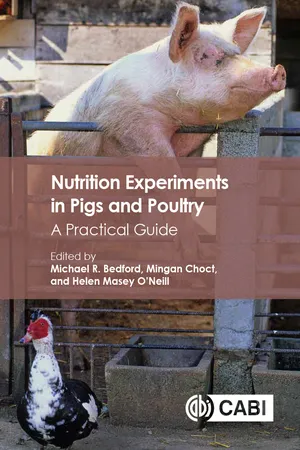
This practical research text provides an invaluable resource for all animal and veterinary scientists designing, analysing and interpreting results from nutrition and feed experiments in pigs and poultry.The emphasis throughout is on practical aspects of designing nutrition experiments. The book builds on the basics and proceeds to describe the limitations of experiment design involving different ingredients. It goes on to describe the characterization of experimental diets including ingredient selection, composition and the minimum proximate analysis required. The text details measurements and the tools available for understanding diverse data sets, data analysis and eventual publication of the research.This fully balanced and extensively referenced, yet practical, text is an invaluable resource to all animal, veterinary and biomedical scientists involved in the designing of nutrition experiments in pigs and poultry, and the publication of their research.
eBook - ePub
Nutrition Experiments in Pigs and Poultry
A Practical Guide
- English
- ePUB (mobile friendly)
- Available on iOS & Android
eBook - ePub
Nutrition Experiments in Pigs and Poultry
A Practical Guide
About this book
Information
1 General Principles of Designing a Nutrition Experiment
AB Vista Feed Ingredients Ltd, Marlborough, UK
1.1 Introduction
The clear goal of animal nutrition is to facilitate the optimal use of resources for production of a desired trait. Animals are produced for meat, eggs, milk, wool, leather and many other outputs that have significant economic value. The cost of producing these outputs largely depends on the cost of the feed employed and the concomitant efficiency of that feed to produce the output of interest. Commercial least-cost formulation programmes are routinely employed to establish the lowest cost route for meeting these needs. The success of such programmes is dependent upon both the accuracy of the requirement and ingredient nutrient content data employed. Nutrition experiments are central to this process as they provide the very information that drives this optimization. As a result, it is important to ensure that when an experiment is conducted, the data generated are both accurate and relevant to the intended application. There should also be a minimum requirement for reporting of methods and data, so that the context in which the data are reported is known. This is important not only for the data at hand, but also for retrospective analysis where data from multiple publications can be combined to determine if a holistic model can more accurately predict the optimum nutrient content for a given output of interest. Clearly, the success of such reviews in deriving a satisfactory model is dependent upon the consistency of reporting of the relevant independent variable in the publications considered. Sadly, in many works, that reporting is far from consistent and, as a result, considerable opportunity for discovery is lost (Rosen, 2001). The focus of this chapter is to highlight the multiple considerations that need to be taken into account if the data generated are to be of value to academia and industry at large. It is split into the two areas of interest to the commercial feed manufacturer: nutrient requirements research and ingredient nutrient contents research.
1.2 Nutrient Requirements Research
The hypothesis of any nutrition trial must be that the animal will respond in some manner to the nutrient in question and nothing else. Setting such a hypothesis at the outset then drives the design of the trial. The aim is usually to determine the relationship between a given nutrient (with or without additional factors such as environmental or husbandry related factors, breed, age, sex, etc.) and a variable of interest. Such a variable may be weight gain or feed conversion ratio (FCR) or an index of interest (e.g. a digestibility, physiological or metabolic indicator). In its simplest form an experiment may, for example, examine the effects of a single nutrient on growth rate. In this case, the goal is to isolate and control all other sources of variation so that any change in performance is clearly attributable to the dose of the nutrient investigated. Provided growth rate is limited at all times by the nutrient investigated, then the experiment can be considered a success and the data can be used to estimate the requirement for that nutrient for any desired rate of growth up to the point where growth rate is no longer limited by the nutrient under test. It is at this point that the ‘requirement’ for that nutrient for maximum growth rate is established. There are, however, multiple caveats that need to be considered even in such simple experiments when ‘requirements’ are being determined. These are:
1. Environment.
2. Cage versus pen.
3. Feed form.
4. Energy – amino acids, carbohydrates and fat.
5. Fibre.
6. Other nutrients.
7. Age.
8. Breed and sex.
9. Disease status.
In all cases, the reader should consider whether the conditions of the experiment reflect the conditions under which the data are to be applied. If the experimental conditions and those under which the data are applied differ significantly, then the relevance of the information, whether it is requirements or nutrient contents of ingredients, needs to be considered. Clearly, no single set of experimental conditions will replicate all potential commercial applications and, as a result, commercial nutritionists have to consider the data available along with knowledge of the conditions under which their animals are raised. As a result, almost all nutritionists will formulate diets with significant ‘safety margins’ employed for critical nutrients to prevent significant losses in performance. Such ‘safe’ nutrient specifications are based on multiple data sets and types of experiments, tempered by personal experience. Thus, a great opportunity exists to improve feed efficiency through more accurate and relevant determination of nutrient requirements and ingredient nutrient contents. This chapter will alert both research scientists and commercial nutritionists to the factors that must be considered when estimating nutrient contents of ingredients and requirements of the animal.
1.2.1 Environment
Temperature
Commercial animals are grown under a variety of conditions that influence the requirement for many nutrients. It is well known, for example, that in hot climates most animals will restrict intake and, as a result, requirements for some nutrients on a g/100 g basis will increase (Dale and Fuller, 1979). High temperatures also alter the metabolism of the animal so that processes that were not apparent in an animal at thermoneutral temperatures will now need resourcing. Synthesis of heat shock proteins is one such example. Heat shock proteins have been shown to have significant and far-reaching benefits on intestinal integrity and oxidative status as well as secretion of digestive enzymes, and as a result modify digestive efficiency (Gu et al., 2012; Hao et al., 2012). The synthesis of such reactive proteins can be moderated by many other nutrients, e.g. ascorbic acid (Mahmoud et al., 2004; Gu et al., 2012; Hao et al., 2012), resulting in the performance of the animal being moderated by nutrients other than that under test. Thus the determined nutrient requirement for optimum growth rate may be dependent not only on the temperature under which the animal was raised, but also on the concentration of heat shock mitigating and exacerbating nutrients/conditions that subsequently modify the severity of the thermal stress endured. The entire diet should thus be reviewed carefully when considering data from heat-stressed animals. Conversely, if animals are to be grown commercially under high temperature stress then such nutrients/conditions should be considered.
Similarly, as temperatures fall below the thermoneutral zone, the animal has to commit resources in order to maintain body heat. Such activities clearly consume additional nutrients, which will increase the requirement for these same nutrients if maximum gain is to be achieved (Ahmad et al., 1974). As the temperature at which an experiment is conducted can have profound effects on the determined requirements, it needs to be accurately documented if the reader is to be aware of the implications of the conditions of the test for their application.
While most thermal stresses modelled are chronic rather than acute, and are more often than not routinely reported, there are significant effects noted when birds are exposed to an acute stress in what would otherwise be considered a normal, thermoneutral environment. This is especially true for young animals exposed to acute cold stress as it can severely influence the health status of the animal (Lubritz, 1994) in a manner that compromises the value of the data derived. Cycling heat or cold stress is also different from chronic effects, as animals adapt and alter intake patterns accordingly. Birds exposed to cycling heat stress, for example, learn to eat less during the cooler periods in anticipation of the impending temperature rise (Teeter et al., 1992). Clear reporting of not only the average daily temperatures to which the animal is exposed, but also the daily minimum and maximums and the age at which such events took place, is essential if value is to be extracted from the work. Moreover, the application of such data needs to consider if the birds grown commercially have been or will be exposed to acute, chronic or cycling thermal stresses, as this will influence the success of the application of a nutritional strategy.
Lighting
Light intensity and day length and/or length of dark periods influence several aspects of metabolism and hence nutrient requirements. Higher light intensity (particularly red light) encourages activity and feed intake but also aggression in poultry (Prayitno et al., 1997) and, as a result, energy and nutrient recovery and expenditure are altered, and thus requirements will be adjusted accordingly.
Day length influences not only locomotion and skeletal integrity, but also intake. Longer dark periods tend to reduce intake, gain, yield and leg problems (Brickett et al., 2007; Lien et al., 2007, 2009). Day length can also influence the efficiency of the intestinal tract. In birds, it is suggested that long dark periods encourage more of a meal feeding pattern which results in greater use of the crop. This use extends the time available for wetting of the feed, allowing for more efficient subsequent digestion and thus may contribute to reduced nutrient needs to achieve optimum performance. Longer dark periods have also been associated with increased rates of retro-peristalsis from the caecum (Godwin and Russell, 1997). This can increase mineral and nutrient recovery from the diet as a significant amount of fibre digestion takes place in the caecum. Not only does the reflux of caecal volatile fatty acids (VFAs) and enzymes (bacterial phytases, NSPases) provide energy and minerals for the host, but it is also proposed that the refluxed VFAs stimulate entero-hormonal pathways, which result in digesta being held in the stomach for longer, potentially improving gastric and hence overall digestive efficiency as a result (Masey O’Neill et al., 2012; Singh et al., 2012).
Fluorescent lighting can contribute to synthesis of vitamin D, which will clearly influence the dietary requirement for this vitamin, and also impinge on the calcium (Ca) and phosphorus (P) metabolism of the animal, which may alter the determined requirement (Willgeroth and Fritz, 1944). Thus the lighting source, as well as intensity and day length, should be reported as a minimum for nutrient requirement studies.
Humidity
While very often overlooked, and hardly ever reported, high humidity when combined with temperature can result in heat stress and the concomitant problems noted above.
Air quality
The concentration of carbon dioxide (CO2) and ammonia has a remarkable influence on the wellbeing and performance of the animal. Unfortunately, reporting of air quality is commonly overlooked in many trials. CO2 in excess of 4000–6000 ppm can lead to lethargy, poor performance and perhaps increased mortality in young animals (Reece and Lott, 1980; Donaldson et al., 1995). Environmental ammonia concentrations above 30 ppm can lead to poor feed conversions, lower weight gains and increased susceptibility to disease (Johnson et al., 1991; Beker et al., 2004). Particulates can provoke considerable respiratory health problems in animals. All of these factors have a significant impact on the partition of nutrients to growth and hence the nutrient requirements of the animal. Thus, measurements of air quality should be reported, especially when larger-scale floor pen trials are conducted and such quality issues are most likely to arise.
Feeder type and space
Research trials often provide significantly more feeder space per animal compared with space allocations used in commercial practice. Evidence exists to suggest that restricting the space per animal at the feed and water trough can reduce subsequent performance, particularly if the diet has more fines than pellets (Lemons and Moritz, 2015). When space is more than adequate, the intake of both water and feed is limited only by the animal’s appetite, and the results obtained could be considered relevant for all unstressed conditions. If the trial presents results where the feeder space is not adequate for all animals to achieve ad libitum intake, not only will this create greater variation in individual intakes (as the more dominant animals will secure a greater proportion of intake compared with subservient animals), but also the nutrient densities determined necessary for optimum performance will relate to what is essentially a partial restriction on intake. Water availability sits in the same arena as feed, since a restriction on water availability will limit intake as the animal strives to balance one with the other. Removal of availability of water rapidly precipitates a very rapid drop in intake. Importantly, it is not only chronic but also acute shortages that need to be avoided in the design of a trial.
A key consideration with both water and feed availability is not just the number of drinkers or feeder space provided per animal, but also whether these nominal spaces are physically accessible to the experimental animals. Incorrect positioning, whether it be placing the feeder in a corner or raising a nipple drinker too high for smaller animals to reach, effectively restricts intake. Furthermore, behavioural studies have shown that some individuals in group housing situations develop a preference for specific feeders/drinkers, and if access to their favoured route is blocked or restricted, then these individuals will be feed restricted even though there may be more than adequate feed available elsewhere in the pen from alternative feeders/drinkers (Marini, 2003).
The relevance of the above points relates to the fact that most papers state ‘feed and water were available ad libitum’. Clearly, there are many factors that need to be considered to ensure that this is actually the case and that both were indeed available to all animals on an ad libitum basis. Unfortunately, very few papers report feeder space per animal along with water drinker space/number, which prevents the critical reviewer determining whether this may or may not have influenced the responses observed.
1.2.2 Cage versus pen and stocking density
Animals group-housed in pens, depending upon stocking density, clearly have greater opportunity for locomotion, social interaction and copraphagy compared with their caged counterparts. Thus the energy needs, and the potential for recycling of nutrients and utilization of bacterial metabolites present in the faeces, will differ and so influence the results obtained. Furthermore, the size of the group in which each individual is housed will influence social interaction and hierarchical effects on the ability of the individual to reach feed and water, which is compounded by available feeder and drinker space. The nuances of social hierarchy can lead to stress for those at the bottom of the pecking order. Such stresses, often observed both behaviourally and hormonally, alter the metabolism of the sufferer and, as a result, their nutrient needs. Indeed, high stocking densities have been shown to radically increase the optimum dietary density of some nutrients (e.g. tryptophan) that play a role in the alleviation of stress. The National Research Council (NRC) requirements for tryptophan for 3–7-week-old ducks is estimated to be 0.17%, but when they were stocked at 11 birds/m2 (much higher than the optimal 5–7 birds/m2), optimum growth rates and efficiency, liver levels of antioxidants and muscle quality parameters were achieved at 0.78%, four times the nominal requirement level (Liu et al., 2015).
1.2.3 Feed and water form and quality
Commercial animals are fed specific diets for specific growth periods. Usually, a crumble is fed as the starter with smaller then perhaps larger pellets as the bird ages. It is well known that feed form influences intake, feed wastage and feed efficiency (Abdollahi et al., 2013) and in some cases the effects observed with mash diets are not replicated in pelleted diets (Rosen, 2002a; Pirgozliev et al., 2016). The grist size of the ingredients used and the pelleting conditions employed will all influence the hardness of the pellet – which can directly influence performance and the subsequent digestibility of the diet (Amerah et al., 2007; Abdollahi et al., 2009, 2013). Pelleted diets containing wheat are more viscous than mash (see soluble fibre, below), which can reduce fat digestibility and subsequently reduce availability of the fat-soluble vitamins. If diets are fed in mash form, the grist size has a significant impact on the length of time the feed spends in the gizzard, which markedly influences the digestibility of the whole diet (Amerah et al., 2007; Svihus et al., 2008). As a result, the form of the feed employed and its grist following grinding should be relevant to the commercial application it is representing. A caveat with regards to commercial practice relates ...
Table of contents
- Cover Page
- Title Page
- Copyright Page
- Contents
- Contributors
- Acknowledgements
- Foreword
- 1 General Principles of Designing a Nutrition Experiment
- 2 Most Common Designs and Understanding Their Limits
- 3 Practical Relevance of Test Diets
- 4 Characterization of the Experimental Diets
- 5 Measurements of Nutrients and Nutritive Value
- 6 Designing, Conducting and Reporting Swine and Poultry Nutrition Research
- 7 Extending the Value of the Literature: Data Requirements for Holo-analysis and Interpretation of the Outputs
- 8 Presentation and Publication of Your Data
- Index
- Footnotes
Trusted by 375,005 students
Access to over 1.5 million titles for a fair monthly price.
Study more efficiently using our study tools.
Frequently asked questions
Yes, you can cancel anytime from the Subscription tab in your account settings on the Perlego website. Your subscription will stay active until the end of your current billing period. Learn how to cancel your subscription
No, books cannot be downloaded as external files, such as PDFs, for use outside of Perlego. However, you can download books within the Perlego app for offline reading on mobile or tablet. Learn how to download books offline
Perlego offers two plans: Essential and Complete
- Essential is ideal for learners and professionals who enjoy exploring a wide range of subjects. Access the Essential Library with 800,000+ trusted titles and best-sellers across business, personal growth, and the humanities. Includes unlimited reading time and Standard Read Aloud voice.
- Complete: Perfect for advanced learners and researchers needing full, unrestricted access. Unlock 1.5M+ books across hundreds of subjects, including academic and specialized titles. The Complete Plan also includes advanced features like Premium Read Aloud and Research Assistant.
We are an online textbook subscription service, where you can get access to an entire online library for less than the price of a single book per month. With over 1.5 million books across 990+ topics, we’ve got you covered! Learn about our mission
Look out for the read-aloud symbol on your next book to see if you can listen to it. The read-aloud tool reads text aloud for you, highlighting the text as it is being read. You can pause it, speed it up and slow it down. Learn more about Read Aloud
Yes! You can use the Perlego app on both iOS and Android devices to read anytime, anywhere — even offline. Perfect for commutes or when you’re on the go.
Please note we cannot support devices running on iOS 13 and Android 7 or earlier. Learn more about using the app
Please note we cannot support devices running on iOS 13 and Android 7 or earlier. Learn more about using the app
Yes, you can access Nutrition Experiments in Pigs and Poultry by Michael R Bedford, Mingan Choct, Helen Masey O'Neill, Michael R Bedford,Mingan Choct,Helen Masey O'Neill in PDF and/or ePUB format, as well as other popular books in Technology & Engineering & Animal Husbandry. We have over 1.5 million books available in our catalogue for you to explore.