Antimicrobial peptides (AMPs) have attracted extensive research attention worldwide. Harnessing and creating AMPs synthetically has the potential to help overcome increasing antibiotic resistance in many pathogens. This new edition lays the foundations for studying AMPs, including a discovery timeline, terminology, nomenclature and classifications. It covers current advances in AMP research and examines state-of-the-art technologies such as bioinformatics, combinatorial libraries, high-throughput screening, database-guided identification, genomics and proteomics-based prediction, and structure-based design of AMPs.Thoroughly updated and revised, this second edition contains new content covering: defensins; cathelicidins; anti-MRSA, antifungal, antiviral, anticancer and antibiofilm strategies; combined treatments; adjuvants in vaccines; advances in AMP technologies that cover surface coating to prevent biofilm formation; nanofiber encapsulation technologies for delivery and sustained release; and understanding innate immunity and the basis for immune boosting to overcome obstacles in developing AMPs into therapeutic agents.Written and reviewed by a group of established investigators in the field, Antimicrobial Peptides is a valuable resource for postgraduate students, researchers, educators, and medical and industrial personnel.
- English
- ePUB (mobile friendly)
- Available on iOS & Android
eBook - ePub
About this book
Information
1 Discovery, Classification and Functional Diversity of Antimicrobial Peptides
Guangshun Wang*
Department of Pathology and Microbiology, College of Medicine,
University of Nebraska Medical Center, Omaha, NE 68198-6495, USA
University of Nebraska Medical Center, Omaha, NE 68198-6495, USA

Abstract
Antimicrobial peptides and proteins (AMPs), first discovered in 1922, have attracted much research attention since the 1980s. These innate immune molecules are universal and over 2700 have been discovered in all life forms, ranging from bacteria to humans. AMPs can have antibacterial, antiviral, antifungal and antiparasitic activities. The term ‘host defence peptide’ emphasizes immune modulatory functions such as chemotactic, apoptotic and wound healing properties. With further expansion in the known AMP functions beyond host defence, a natural and general term, ‘innate immune peptides’, may be used to cover antimicrobial, immune modulation and other functional roles of these molecules. Efforts have also been made in unifying nomenclature and classification of AMPs. While AMPs are normally named based on peptide properties, source organisms, or a combination of both, they can be classified based on source kingdoms, peptide chemical and physical properties, biological functions and mechanisms of action. Importantly, bacterial AMPs, including nisin, gramicidin A, gramicidin S, polymyxin and daptomycin, have been successfully utilized either clinically or as food preservatives. The multiple functions of AMPs provide a basis for developing other potential applications in the future.
Antimicrobial peptides and proteins, biopolymers of amino acids, are universal defence molecules of innate immune systems. In invertebrates, they are the major innate defence molecules of innate immunity, whereas in vertebrates they serve as both effectors in the innate immune system and modulators in the adaptive immune system (Epand and Vogel, 1999; Tossi and Sandri, 2002; Zasloff, 2002; Boman, 2003; Brogden et al., 2005; Zanetti, 2005; Amiche et al., 2008; Conlon, 2008; Gallo, 2013; Nuri et al., 2015; Wang et al., 2015; Hancock et al., 2016). The diversity of AMPs in terms of sequence, structure and function continues to expand. Broadly, AMPs include gene-encoded antimicrobial peptides (<100 amino acids), antimicrobial proteins, and non-gene encoded peptide antibiotics. This chapter provides an overview on peptide discovery, nomenclature, classification and functional diversity. Section 1.1 highlights the discovery of important AMPs with a focus on those that have already found medical and industrial applications. Section 1.2 summarizes the main methods for peptide nomenclature. Section 1.3 discusses the classification of AMPs, including a unified and systematic classification, which is independent of peptide biological source, activity and three-dimensional structure. Finally, Section 1.4 describes a variety of functional roles of these innate immune peptides.
1.1 A Brief Timeline of Discovery
The majority of natural antimicrobial peptides are isolated chromatographically from bacteria, fungi, plants and animals. Table 1.1 lists selected AMPs based on the year of discovery. Prior to the 1980s, the first wave of AMP research led to the discovery of several non-gene encoded peptide antibiotics. The second wave, started in the 1980s, stimulated the research interest in innate immunity and mechanisms of action of gene-encoded AMPs as potential antimicrobials. Subsequently, other functional properties of AMPs, such as immune modulation, have been reported since around 2000. Due to limited space, I highlight here only a few examples of AMPs that have been used successfully, either clinically or in the food industry. A more detailed list can be consulted at the website for the antimicrobial peptide database (APD) provided in the footnote of Table 1.1.
The human lysozyme, discovered in 1922 by Sir Alexander Fleming, is now recognized as the first antimicrobial protein (Robert Lehrer, personal communication, 2013) and the beginning of innate immunity (Gallo, 2013). The discovery of lysozyme did not stir up much interest at that time, perhaps due to the subsequent discovery of penicillin in 1928 (ACS, 2016). Lysozyme inhibits bacteria by cleaving saccharides on the cell wall. This small protein may be used topically as its size makes it unsuitable for systemic use (Berman et al., 2000).
Bacterial nisin was the first of the lantibiotics and it has been thoroughly studied. Rogers (1928) initially noticed its ability to inhibit bacteria. After many years of study, its chemical structure was discovered to contain multiple thioether rings (Gross and Morell, 1971). Nisin is the only bacteriocin approved by the US Food and Drug Administration (FDA) as a food preservative. It is used to preserve meat and dairy products (<12.5 mg/kg food) in over 50 countries. Nisin has an inhibitory effect on food-borne pathogens such as Gram-positive Listeria monocytogenes through attack on the cell wall. Nisin also inhibits Gram-negative pathogens such as Escherichia coli and Salmonella spp. when used in combination with chelators or heat treatment (Gharsallaoui et al., 2016). In addition, pediocin PA-1 is also available commercially as a food preservative (Henderson et al., 1992; Makhloufi et al., 2013).
Dubos (1939) discovered gramicidin from a soil bacterium Bacillus brevis. Gramicidin A consists of alternating L and D-amino acids. The N-terminus of this peptide is formylated. In addition, essentially all amino acids are hydrophobic. Such sequence features are vital for the formation of a head-to-head dimer as a membrane channel (Urry, 1971). This is the first peptide antibiotic used clinically as a topical treatment.
Gramicidin S was isolated from bacteria and used to treat infectious wounds (Gauss and Brazhnikova, 1944). This small peptide is cyclic via a peptide bond formation between the termini (Synge, 1945). It deters both Gram-positive and Gram-negative bacteria. Gramicidin S is still used in topical ointments and eye drops (Greenwood, 2008).
Polymyxin E (colistin) is also a bacteriocin still in use clinically as the last resort to treat infections caused by Gram-negative pathogens. It has a cyclic peptide structure followed by a lipid tail (Stansly et al., 1947). Daptomycin has a similar overall peptide design. With a net negative charge, daptomycin (cubicin) needs the presence of Ca2+ to show its full activity (Eliopoulos et al., 1986). This lipopeptide was approved by the FDA in 2003 to treat Gram-positive bacterial infections.
Alamethicin is a peptide antibiotic isolated from the fungus Trichoderma viride. It is the founding member of the peptaibol family. This peptide contains seven α-aminoisobutyric acids (Aib), which prefer a helical conformation. Alamethicin is active against Gram-positive bacteria and fungi. This is perhaps the only AMP with evidence to support a barrel-stave pore in membranes (Fox and Richards, 1982; Leitgeb et al., 2007).
Table 1.1. Discovery timeline of important antimicrobial peptides.a


Plant kalata B1 was isolated from Oldenlandia affinis, the African herb used by women to assist in childbirth (Gran, 1973). This peptide is the prototype member for plant cyclotides. Its cyclic structure and antimicrobial activity was not established until 1999 (Tam et al., 1999).
In the 1980s, Boman et al. discovered cecropins from the moth Hyalophora cecropia (Steiner et al., 1981) and initiated a wave of innate immunity research, leading to the later discovery of the Toll signalling pathway by the Jules Hoffman laboratory (Lemaitre, 2004). Zasloff (1987) discovered magainins from the African clawed frog. These are linear peptides that adopt an amphipathic helical structure upon association with membranes. Meanwhile, Lehrer and his colleagues identified the first α-defensins from human neutrophils (Selsted et al., 1985). Subsequently, the first β-defensin was discovered from cattle (Diamond et al., 1991). The discovery of cyclic θ-defensins, a third type of defensins, was made by Tang et al. (1999). All of these defensins contain three pairs of disulfide bonds. Due to their small size and stability, there is substantial interest in developing therapeutic uses for θ-defensin miniproteins (Conibear and Craik, 2014).
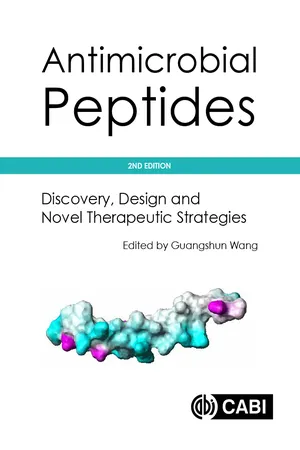
In 1988, bovine bactenecin, the first member from the cathelicidin family, was identified (Romeo et al., 1988). The word cathelicidin was coined from the well-conserved ‘cathelin’ domain of the precursor proteins (Zanetti, 2005). Based on a homologous gene search, the only human cathelicidin was discovered in 1995 (Gudmundsson et al., 1996). Remarkably, the antimicrobial ability of human LL-37 can be linked to light therapy. Light induces hydroxylation of vitamin D, which then binds to the receptor, triggering the expression of the human cathelicidin LL-37 (3D structure on the book cover) that can kill tuberculosis (TB) (Zasloff, 2005). Since around 2000, human LL-37 has become a popular peptide for studying skin host defence and immune modulation (Lai and Gallo, 2009; Hancock et al., 2016).
Lucifensin was discovered in 2010 from insects (Cerovsky et al., 2010). This defensin is probably a key antimicrobial element for traditional maggot therapy. Future research will verify whether this single compound is sufficient to achieve the insect treatment effects on certain types of wounds. Recent development experience with plectasin (Mygind et al., 2005) may be useful to further enhance lucifensin.
In 2015, Lewis and co-workers discovered teixobactin, a new peptide antibiotic that did not develop resistance in a multiple passage experiment. They cultivated the bacteria (previously thought uncultivatable) via I-chip technology (Ling et al., 2015). This bacteriocin may find medical use to combat Gram-positive pathogens in the near future.
In summary, all of the peptide antibiotics currently in use originate from bacteria (Table 1.1). These bacterial AMPs (bacteriocins) have preferred topologies owing to a head-tail backbone (e.g. gramicidin S) or sidechain-backbone connection (colistin and daptomycin). It is anticipated that other AMPs under development or clinical trials will reach the market (Zasloff, 2002). In addition, the induction of AMP expression, at a needed site and time, provides a new avenue for antimicrobial development (reviewed by Wang, 2014).
1.2 Nomenclature of Antimicrobial Peptides
Although various methods are employed to name a newly identified peptide, the most commonly used methods are listed below:
Source-based method
The most common approach is to derive the peptide name from the name of its source species. Usually, either the genus or the species name is taken. For example, sesquin is derived from Vigna sesquipedalis and palicourein is taken from Palicourea condensata. Sometimes, a combination of the scientific name is adopted. For instance, Hs-1 is derived from Hypsiboas semilineatus. In other cases, the peptide name is based on the common name of an organism (e.g. termicin from termites). Abbreviations of animal names are utilized to name homologous AMPs. The name of bBD-1 (bovine beta defensin-1) is analogous to hBD-1 (human beta defensin-1). Other animal-source abbreviations include p (pigs, e.g. PMAP-36), e (equine, e.g. e-CATH-1), s (sheep, e.g. SMAP-29), and oa (ovine, e.g. OaBac5). The sex of an organism is also implied in the name of insect andropin (male-specific). Sometimes, the names of organs or tissues are also used. Some examples are human neutrophil peptide-1 (HNP-1), liver-expressed antimicrobial peptide-2 (LEAP-2), dermcidin from skin, and human salvic from salivary glands.
Peptide-based method
AMPs are named based on a variety of peptide properties. Firstly, the name of magainin is derived from the Hebrew word for shield and that of defensin is derived from ‘defence’, implying the functional role of this family of peptides. Thanatin derives its name from the Greek word for death. Secondly, many AMPs are named after their amino acid sequences. Human histatins are rich in histidine residues, whereas PR-39 is a 39-residue peptide rich in proline and arginine residues. For plant cyclotides and cyclic dodecapeptide, ‘cyclo’ or ‘cyclic’ means polypeptide circularization. Thirdly, the word cathelicidin is coined from the well-conserved ‘cathelin’ domain of the precursor proteins (Zanetti, 2005). Therefore, cathelicidins represent a family of AMPs whose precursors share a common cathelin domain. Three antimicrobial peptides have been discovered from the precursor hCAP-18 (18-kDa human antimicrobial protein) encoded by the only human cathelicidin gene: LL-37 (a 37-aa peptide starting with two leucines), ALL-38 (Sorensen and Borregaard, 2005), and TLN-58 (Murakami et al., 2016). Fourthly, peptide targets are also included in AMP names. For instance, AFP1 stands for antifungal protein 1. Sometimes, both the structure and activity of the peptide are implicit in the name. For example, in the name of θ-defensin, θ reflects the cyclic, cysteine-bridged structure and defensin the activity.
Source and peptide combined method
In many cases, source organisms and peptide features are combined to assign a unique name. For instance, Ib-AMP is abbreviated from Impatiens balsamina antimicrobial peptide. When there are multiple similar peptides, they are named by appending numbers (e.g., Ib-AMP1 to Ib-AMP4). Furthermore, the peptide part can also represent peptide family or peptide activity. While So-D1 is abbreviated from Spinacia oleracea defensin 1 (peptide family), Ee...
Table of contents
- Cover Page
- Title Page
- Copyright Page
- Contents
- Contributors
- Preface
- Introduction to the Second Edition
- PART I: OVERVIEW OF ANTIMICROBIAL PEPTIDES
- PART II: NATURAL TEMPLATES FOR PEPTIDE ENGINEERING
- PART III: EXPANDING PEPTIDE SPACE: COMBINATORIAL LIBRARY, GENOME-BASED PREDICTION AND DE NOVO DESIGN
- PART IV: MECHANISMS OF ACTION: BIOPHYSICS AND STRUCTURAL BIOLOGY
- PART V: NOVEL THERAPEUTIC STRATEGIES: SYNERGY, IMMUNE MODULATION, SURFACE COATING AND DELIVERY
- Index
Trusted by 375,005 students
Access to over 1.5 million titles for a fair monthly price.
Study more efficiently using our study tools.
Frequently asked questions
Yes, you can cancel anytime from the Subscription tab in your account settings on the Perlego website. Your subscription will stay active until the end of your current billing period. Learn how to cancel your subscription
No, books cannot be downloaded as external files, such as PDFs, for use outside of Perlego. However, you can download books within the Perlego app for offline reading on mobile or tablet. Learn how to download books offline
We are an online textbook subscription service, where you can get access to an entire online library for less than the price of a single book per month. With over 1.5 million books across 990+ topics, we’ve got you covered! Learn about our mission
Look out for the read-aloud symbol on your next book to see if you can listen to it. The read-aloud tool reads text aloud for you, highlighting the text as it is being read. You can pause it, speed it up and slow it down. Learn more about Read Aloud
Yes! You can use the Perlego app on both iOS and Android devices to read anytime, anywhere — even offline. Perfect for commutes or when you’re on the go.
Please note we cannot support devices running on iOS 13 and Android 7 or earlier. Learn more about using the app
Please note we cannot support devices running on iOS 13 and Android 7 or earlier. Learn more about using the app
Yes, you can access Antimicrobial Peptides by Guangshun Wang in PDF and/or ePUB format, as well as other popular books in Medicine & Medical Microbiology & Parasitology. We have over 1.5 million books available in our catalogue for you to explore.