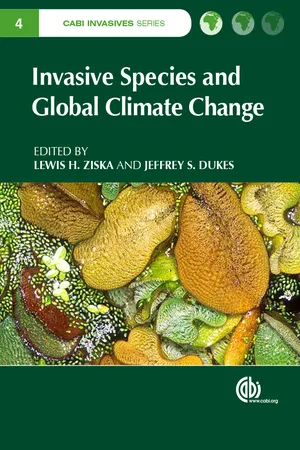
This book examines what will happen to global invasive species, including plants, animals and pathogens with current and expected man-made climate change. The effects on distribution, success, spread and impact of invasive species are considered for a series of case studies from a number of countries. This book will be of great value to researchers, policymakers and industry in responding to changing management needs.
- English
- ePUB (mobile friendly)
- Available on iOS & Android
eBook - ePub
Invasive Species and Global Climate Change
About this book
Information

1 Introduction
As we write this, the global population has reached 7.1 billion. At present rates, approximately 5 million new individuals will be added each month, every month, for the foreseeable future. (www.census.gov/popclock).
Ultimately, it is our rapidly increasing population and our need to increase the production of food, feed, fibre and fuel from a finite set of natural resources that are driving the environmental issues in this book, and that give these issues urgency. We need to transition to a sustainable society if we are to provide for this population (or even a smaller one) into the future. Such sustainability is necessary if we are to preserve our planet’s ecosystem services, maintain its capacity to produce food and protect its biodiversity.
However, at present, our population needs, and the unprecedented transportation of biota into new regions to achieve these needs, are occurring on a scale that threatens the planet’s natural resource capacity. This book is a collective attempt from ecologists around the world to describe the interaction between two of the resulting consequences. Specifically, to examine the nexus of climate change and biological invasions, and the resulting impacts, and to identify means to reduce the vulnerability and increase the resiliency of managed and unmanaged ecosystems.
Such a complex global topic is best addressed from a variety of perspectives. We thank the many people who have contributed and commented on the chapters in this book. The individual chapter authors and the anonymous reviewers of those chapters are world experts, and very busy people. We appreciate their willingness to commit to this project and their faith that a contribution to this book would be a worthy use of their time. There is no question that their contributions have enabled this book to convey a detailed, globally relevant, and sometimes provocative, portrait of what is known and what is unknown regarding climate change and invasive species. In addition, their contributions present a valuable overview of strategies for managing natural and agricultural systems on a rapidly changing planet.
In examining a complex set of issues, it also helps to have common definitions. This book considers ‘climate change’ in a broad sense; that is, both the disruption of Earth’s relatively stable recent climate and the ongoing increase in atmospheric CO2 concentrations that are largely responsible for that disruption. The book also considers biological invasions broadly, including many taxa. We recognize that ‘invasive species’ can have a variety of meanings (and these, in turn, can be complicated by climate change, as noted by Webber and Scott, 2012). Biologists alternately refer to these species as ‘biological invaders’, ‘alien species’, ‘exotic species’ or simply as ‘invasives’. Regardless of the term, biologists are characterizing species that have crossed a major biogeographic barrier (e.g. an ocean), usually with the assistance of humans, and whose introduction has, or will, result in significant negative economic or environmental impacts.
Given the complexity, we recognize that not all chapters will appeal to an individual reader; rather, the book is intended to be accessible to a range of interested parties, not only the academic specialist. We do hope the book can educate broadly and provide a means for understanding the consequences of invasive species and climate change, not in isolation (such efforts are already well documented) but in a synergistic context. Still, for most readers, to understand the synergism it is important to appreciate the components of the problem, and we attempt to provide some background here.
The Problem and Its Components
The desire for food and fuel has been endemic since the dawn of human civilization and the commencement of cultivated agriculture. As populations grew, and land/ energy needs increased, the incorporation of fossil fuels, or energy captured from sunlight over millennia by plants, became an integral part of the Industrial Revolution, a revolution that, for billions of people, has provided ample food, water and an improved standard of living.
Use of natural resources to meet these human needs has also, since its inception, had some impact on climate. For example, by removing forests and native plants, early agriculture altered hydrologic cycles and changed surface albedo, with consequences for regional climate (Pielke et al., 2007). In addition, the burning of fossil fuels has jolted Earth’s atmosphere with a 40+% increase in carbon dioxide (CO2) since the onset of the Industrial Revolution.
That CO2 generated by the Industrial Revolution could influence climate is not a new concept. In the 19th century, two scientists, Fourier and Arrhenius, suggested that industrial pollutants, notably carbon dioxide, were building up in Earth’s atmosphere and could, potentially, result in increased surface temperatures (Fourier, 1827; Arrhenius, 1896). Quantitative measurements by Keeling in the 1950s confirmed that CO2 was, in fact, increasing globally (Revelle and Suess, 1957).
One of the properties of the CO2 molecule is that it absorbs energy in the infrared portion of the electromagnetic spectrum (making it a ‘greenhouse gas’). Adding carbon dioxide to the air causes the atmosphere to trap more of the heat radiated up from Earth’s surface that would otherwise escape to space. The atmosphere warms up more, the rest of the planet heats up a bit to follow, and more water evaporates from the warmer seas into the warmer skies. Water vapour itself traps heat and further warms the planet, in what is known as a positive feedback loop.
Overall, model projections based on future emissions of greenhouse gases suggest a marked warming of Earth’s surface and changes in precipitation patterns in many regions. Model projections also indicate clearly that the rate and degree of climate disruption over the coming decades will depend on how quickly we continue to release heat-trapping gases to the atmosphere (Solomon et al., 2007). It is worth acknowledging that, given the lifespan and ongoing release of carbon dioxide and other greenhouse gases, there is sufficient momentum at present so that a significant change in Earth’s climate is essentially guaranteed. Therefore, as we prepare for warmer, uncertain climatic conditions, it is important to consider the consequences of these conditions for the utility and health of managed and unmanaged ecosystems.
In considering the importance of carbon dioxide and climatic change on ecosystems, it is also important to consider carbon dioxide as an essential substrate in plant biology, providing a primary building block for photosynthesis. The recent rapid increase in atmospheric CO2 has been felt directly by plants, some of which are growing faster, with less water consumption, in response (e.g. Keenan et al., 2013). Reports on climate change in the media only infrequently discuss the direct effects of this CO2 increase, which has been much larger, with much stronger effects on plants, than any changes in climate experienced to date (and indeed, this may remain the case for many decades).
From a human perspective, such direct effects of CO2 may be of benefit, providing more food and faster fibre production, and potentially even helping to slow climate change by storing carbon more quickly. However, CO2 is indiscriminate with respect to which plant species may be favoured. For example, each of us has demonstrated that unwanted plant species such as yellow starthistle and poison ivy can have very strong responses to rising CO2 levels (Ziska, 2003; Mohan et al., 2006; Dukes et al., 2011). Clearly, how plant species and ecosystems respond, not only to climate but also to rising CO2 directly, will have significant biological consequences. Several of the chapters in this book help to examine these consequences in the context of invasive species biology.
In addition to the build-up of greenhouse gases, other human activities associated with the need for increased feed and fuel have contributed to large-scale environmental perturbation. Especially relevant has been the transportation, on a massive scale, of organisms that had been restricted to certain biogeographic zones but which are now distributed globally. Many of these species, such as soybean, are important for human welfare and a strong economy, but forced reallocation of thousands of species outside of their native habitats can also result in the distribution of extraordinarily aggressive species, with severe economic and environmental consequences.
Invasive species come in many shapes and sizes; they can be hard to recognize since their only common feature is biological domination outside of their native range. This book includes discussion of invasive weeds, insects and pathogens in many disparate taxa, from the poles to the tropics. These species disrupt a wide variety of ecosystem processes (Dukes and Mooney, 2004; Vilá et al., 2011), threaten biodiversity (Powell et al., 2013), the provision of ecosystem services (Charles and Dukes, 2007; Pejchar and Mooney, 2009) and food (Oerke, 2006) and cause economic damage estimated to be around US$120 billion per year in the USA alone (Pimentel et al., 2005).
Why This Book?
In addition to affecting the basic aspects of biology on a global scale, both climate change and invasive species pose existential threats to the basic ecosystem services necessary for human life. Furthermore, it should not be assumed that each threat acts independently of the other. The synergy between these issues is becoming increasingly evident. For example, changing climatic conditions (e.g. polar melting and the opening of new trade routes) will alter global commerce in the near future, with the subsequent introduction of unwanted species into new geographical regions (Hellmann et al., 2008; Bradley et al., 2012). Once they are introduced, climate change – either through changes in means or extremes – may then facilitate the establishment and spread of such species; or alternatively, may allow other species that are currently established to become invasive as environmental constraints (e.g. cold winters) are eased (Dukes and Mooney, 1999; Walther et al., 2009, Bradley et al., 2010; Diez et al., 2012). Recent work also suggests that invasive species management, particularly chemical applications, may further exacerbate greenhouse gas emissions (Heimpel et al., 2013).
While there have been many separate books documenting the impact of climate change or invasive species, only one has broadly linked these aspects of environmental transformation. In 2000, when Hal Mooney and Richard Hobbs published Invasive Species in a Changing World, very few researchers had thought about the combined implications of these two environmental changes (Mooney and Hobbs, 2000). Since then, the field has grown rapidly, but has not been reviewed comprehensively.
Here, we take a global look at what is currently known about the synergistic nature of these environmental changes. Such synergism is explored by David Pimentel, among the world’s foremost invasive species experts, in the Foreword and is exemplified across the book’s four parts. These parts, in turn, provide an overview of the current state of understanding in this field, the tools available to manage the problem and the challenges for future research. The first part of the book outlines the dimensions of the problem. In Chapter 2, John Peter Thompson and Lewis H. Ziska present a brief overview of the science of climate change and invasion biology, but also examine how we can communicate the science more effectively to policy makers. The next three chapters lay out the science with respect to three classes of invasive species in the context of changing climate and carbon dioxide levels: Karen Garrett and colleagues discuss pathogens; Andrew Gutierrez and Luigi Ponti examine insects; and Dana Blumenthal and Julie Kray look at plants.
The second part of the book highlights the global synergy between climate change and invasive species with ‘case studies’ from around the world. We begin in Antarctica, where Kevin Hughes and Peter Convey provide an overview of climate and invasives; we segue to aquatic environments, where Cascade Sorte appraises how invasives respond; then to eastern Europe, for a more specific examination of the implications of changing CO2 and temperature for ragweed by László Makra et al., followed by a consideration of climate and invasives in South Africa by Ulrike Irlich and colleagues. Tom Stohlgren et al. next scrutinize invasives in national parks in the USA; Bruce Webber and colleagues examine how climate is affecting invasive species in Australia; and Bo Li et al. survey the current and future climate for invasives in China.
In Part III, we turn to the issue of managing new invasive threats in a changing climate. We begin by emphasizing that early detection, which has the best hope for allowing problem species to be stopped in their tracks, is critical, in a chapter by Rebekah Wallace and Chuck Bargeron focusing on tools for early detection and mapping. Hilda Diaz-Soltero and Peter Scott present information about the new CABI compendium on invasive species; Bethany Bradley examines approaches to modelling the current and future distributions of invasives; Toni DiTommaso et al. assess the implications of climate change for new invasive weeds in agriculture; and Andy Gutierrez and Luigi Ponti present a new approach for modelling the impact of climate change on invasive species.
Finally, we address the issue of what can be done when invasive species do show up on your doorstep. Lewis Ziska examines how chemical control of invasive weeds is likely to be impacted by climate and CO2; Randy Westbrooks et al. examine whether the Early Detection and Rapid Response (EDRR) paradigm can be configured to cope with climate change. Finally, if all else fails, Matthew Barnes et al. ask whether invasive species can actually serve as an economic resource (i.e. it’s not Asian carp, it’s Kentucky tuna!).
What Do We Hope To Accomplish?
In the Twitter/Facebook/Instagram age, when visual overload can occur each time you stare at a flat screen, books may feel like an anachronism. But books – this one included – are not designed to provide you with information in 5-min increments. Rather, books function as a period in a long stream of text messaging – a chance to stop, re-read and reassess what we currently know.
And, as it turns out, we know quite a bit. We know the climate is changing, and that this change is due primarily to human activity. We also know that the extent of this change is likely to further alter the transport and biology of invasive species – species whose introduction, establishment and spread are likely to disrupt the world’s ecosystems in unpredictable and undesirable ways. We know that this disruption, in turn, will almost certainly alter human welfare, with consequences that range from food security to ocean ecology to forest dynamics.
But while the general outline is known, the details remain elusive. Sadly, part of this is because climate change is still viewed through a political lens and not a scientific glass. Consequently, the resources (students, scientists, equipment, laboratories, etc.) needed to addres...
Table of contents
- Cover Page
- Title Page
- Copyright Page
- Contents
- Contributors
- Foreword
- 1 Introduction
- Part I The Dimensions of the Problem: Background and Science
- Part II Case Studies
- Part III Management: Detection and Prevention
- Part IV Management: Control and Adaptation
- Index
- Footnote
Trusted by 375,005 students
Access to over 1.5 million titles for a fair monthly price.
Study more efficiently using our study tools.
Frequently asked questions
Yes, you can cancel anytime from the Subscription tab in your account settings on the Perlego website. Your subscription will stay active until the end of your current billing period. Learn how to cancel your subscription
No, books cannot be downloaded as external files, such as PDFs, for use outside of Perlego. However, you can download books within the Perlego app for offline reading on mobile or tablet. Learn how to download books offline
Perlego offers two plans: Essential and Complete
- Essential is ideal for learners and professionals who enjoy exploring a wide range of subjects. Access the Essential Library with 800,000+ trusted titles and best-sellers across business, personal growth, and the humanities. Includes unlimited reading time and Standard Read Aloud voice.
- Complete: Perfect for advanced learners and researchers needing full, unrestricted access. Unlock 1.5M+ books across hundreds of subjects, including academic and specialized titles. The Complete Plan also includes advanced features like Premium Read Aloud and Research Assistant.
We are an online textbook subscription service, where you can get access to an entire online library for less than the price of a single book per month. With over 1.5 million books across 990+ topics, we’ve got you covered! Learn about our mission
Look out for the read-aloud symbol on your next book to see if you can listen to it. The read-aloud tool reads text aloud for you, highlighting the text as it is being read. You can pause it, speed it up and slow it down. Learn more about Read Aloud
Yes! You can use the Perlego app on both iOS and Android devices to read anytime, anywhere — even offline. Perfect for commutes or when you’re on the go.
Please note we cannot support devices running on iOS 13 and Android 7 or earlier. Learn more about using the app
Please note we cannot support devices running on iOS 13 and Android 7 or earlier. Learn more about using the app
Yes, you can access Invasive Species and Global Climate Change by Lewis Ziska, Jeffery Dukes in PDF and/or ePUB format, as well as other popular books in Biological Sciences & Environmental Science. We have over 1.5 million books available in our catalogue for you to explore.