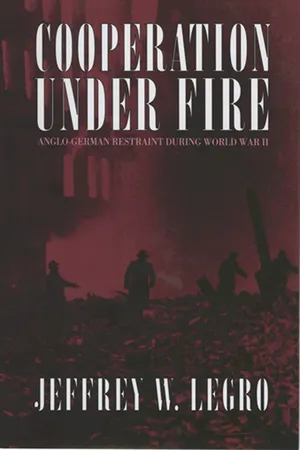
Why do nations cooperate even as they try to destroy each other? Jeffrey Legro explores this question in the context of World War II, the "total" war that in fact wasn't. During the war, combatant states attempted to sustain agreements limiting the use of three forms of combat considered barbarous—submarine attacks against civilian ships, strategic bombing of civilian targets, and chemical warfare. Looking at how these restraints worked or failed to work between such fierce enemies as Hitler's Third Reich and Churchill's Britain, Legro offers a new understanding of the dynamics of World War II and the sources of international cooperation.While traditional explanations of cooperation focus on the relations between actors, Cooperation under Fire examines what warring nations seek and why they seek it—the "preference formation" that undergirds international interaction. Scholars and statesmen debate whether it is the balance of power or the influence of international norms that most directly shapes foreign policy goals. Critically assessing both explanations, Legro argues that it was, rather, the organizational cultures of military bureaucracies—their beliefs and customs in waging war—that decided national priorities for limiting the use of force in World War II.Drawing on documents from Germany, Britain, the United States, and the former Soviet Union, Legro provides a compelling account of how military cultures molded state preferences and affected the success of cooperation. In its clear and cogent analysis, this book has significant implications for the theory and practice of international relations.
- 272 pages
- English
- ePUB (mobile friendly)
- Available on iOS & Android
eBook - ePub
About this book
Information
[1]
Theories of Cooperation
Even enemies can cooperate. Churchill and Hitler were bitter opponents, and their countries fought an unforgiving fight. Nonetheless, Britain and Germany reached accords on the use of force, and some of those agreements endured the bloodshed of the Second World War. This cooperation involved three means of warfare—submarine attacks against merchant ships, aerial bombing of nonmilitary targets, and use of poison gas—that in the interwar years were denigrated as especially inhumane, illegitimate, and “unthinkable.”1 At the start of World War II, countries explicitly wanted a firebreak between restraint and escalation in each of these three militarily significant means of warfare. Shortly after fighting broke out, however, submarine warfare escalated beyond restrictions. Strategic bombing was restrained for only a year and then employed extensively. Yet chemical weapons, despite expectations and preparations, were never used. How can we explain this variation? Why do states cooperate in some areas but not in others? And, more generally, how can we best understand international cooperation?2
Much of the literature of the social sciences, particularly on international relations, provides unsatisfactory answers. Cooperation is generally conceptualized as the product of a two-step process: first, actors form their preferences; second, they interact until they reach an outcome. As Gordon Tullock has argued, this model suggests that both a science of preferences and a science of interaction are necessary for understanding results.3 Yet frequently cooperation—whether the parties are legislators, business firms, or sovereign states—is explained primarily in terms of the second step, the characteristics of interaction, which include the number of players, whether contracts are enforceable, time horizons, communication and information asymmetries. The first step, preference formation, is typically not the focus: preferences are posited and assumed to be stable. This is a problem when preference formation or change is central to understanding outcomes. Still another problem is that many studies examine only events ending in cooperation and disregard instances when cooperation does not occur. I argue that preference formation and change are central to cooperation—and its absence—even in war where strategic interaction would seem likely to play the decisive role in policy choices. In World War II, interaction between states was similar across the cases of submarine, aerial, and chemical warfare. But mutual restraint in the use of these three types of warfare varied because of changes in preferences.
What, then, shapes preferences? In this book I develop and test an alternative explanation of state preferences that is unorthodox in the study of international cooperation. The organizational-culture approach, an important variation on traditional organization theory, asserts that the beliefs and customs of national bureaucracies determine state desires for collaboration. I argue that organizational culture most convincingly explains why states did, and did not, cooperate in war even while trying to eliminate one another. Within military bureaucracies, collective philosophies of war fighting—a type of culture—shaped how soldiers thought about themselves, perceived the world, formulated plans, advised leaders, and went into action. Despite international constraints, and the desire of top civilian leaders for change, military cultures often endured. Culture decisively defined organizational preferences on the use of the different types of unthinkable weapons. And these preferences, with surprising frequency, guided nations’ preferences on the use of force during World War II.
The organizational-culture approach does more than simply clear up insignificant variance that other explanations miss. I have found that in a head-to-head test with the two dominant approaches in contemporary international relations theory—realism and liberal institutionalism—organizational culture explains cooperation better and more comprehensively. Realism contends that state actions are a product of calculations shaped by the power asymmetries of a particular international situation. Yet in World War II the decisions of states usually did not match realism’s predictions because states either misinterpreted the situation, chose to ignore the evidence that was available, or were limited in their choices by existing capabilities that made little strategic sense. Institutionalism argues that the rules, norms, and conventions that characterize the international system are crucial to cooperation. But states did not make decisions in line with the varying power of the different norms as institutionalism would predict. Given the involvement of force and international norms, both realism and institutionalism should provide reasonable accounts of restraint in World War II. Yet although each illuminates key elements, neither school explains the variation in cooperation as well as organizational culture does.
This argument is important for theory and policy. In terms of theory the implications are threefold. First, the centrality of preference formation indicates the need to rethink the existing foci in the study of cooperation. Although strategic interaction is certainly not to be ignored, I argue that preference formation is more consequential than has generally been recognized. The most important advances in understanding cooperation might well be realized by supplementing the existing focus on interaction with more attention to the “science” of preferences.
Second, my thesis corrects the prevailing view that systemic forces will shape the preferences and/or behavior of states, particularly when national security is threatened.4 In World War II, when international pressures should have dominated, I demonstrate that organizational culture, an internal force, was most influential in shaping how states perceived, anticipated, and reacted to their circumstances. The traditional distinction that internal considerations drive economic affairs, but external factors drive security matters, is put in doubt. Clearly, we need a better understanding of the domestic development of state desires and how international factors affect or supersede that process. In the conclusion, I offer a conceptual synthesis to address this need.
Third, my results strongly assert the relevance of a much denigrated variable in political analysis: culture.5 To the extent accounts of international politics based on variations within states exist, they emphasize formal structures such as constitutional arrangement (democracy vs. authoritarianism), policy networks (the strength or weakness of the state), and bureaucratic organization.6 I maintain, however, that formal structure is inadequate, that one must also take account of culture, the hierarchy of beliefs, that characterize structures. For example, based as it is on the notion that similar bureaucratic structures will lead to similar behavior, traditional organization theory cannot explain the different outcomes of World War II.7 It is only by bringing in a well-specified notion of culture that we are able to see why states choose escalation in some circumstances and not in others. This conclusion suggests an explanatory role for culture in a range of subject-matter areas studied primarily in terms of formal structure, be it organizational design, constitutional type, or the distribution of international power.
Finally, the argument also has practical relevance for policy and policy making. Restraint will be a central concern of states in future conflicts in which there is a risk that “illegitimate” means of warfare will be resorted to. How should nations ensure such restraint? In the past, countries seeking limitations on force have tended to pay great attention to their own capabilities, deterrence dynamics, and even the pursuit of international agreements and principles. I suggest that leaders desiring limitation must also look inward. The cultures of bureaucracies can lead to policies ill-suited to strategic aims or international conditions. In formulating strategy, states must understand and influence, not only the opponent and the environment, but also the idiosyncratic beliefs of their internal strategy-making community. In military policy this suggests the need for a new system of civil-military relations, one that is about not formal control but the very ideas and customs that guide national policy.
In the rest of this chapter I develop the theoretical foundations of the study. Three tasks are involved. First, in a brief overview of the existing literature on international cooperation I indicate its shortcomings for the task at hand and the need for an understanding of preference formation. Second to address this need, I develop propositions on cooperation in war based on three broad perspectives: realism, institutionalism, and organizational culture. Finally, I discuss the logic of testing these perspectives against cases from World War II.
A necessary starting point for generating propositions on cooperation is the extant literature. These writings contain powerful insights into international collaboration, but they are limited by two traits that have inherently biased our understanding of that phenomenon.
First, cooperation among states is evaluated mainly as a problem of strategic interaction.8 These studies, based largely on a type of game-theory analysis that takes states as unitary actors, emphasize characteristics of strategic interaction such as the number of players, the discount rate, strategy selection, and a variety of transactions concerns (such as signaling, information, and commitment).9 This focus follows the classic game-theory model in which preferences are taken as given (and stable). Of course, few would assert preferences are irrelevant or even unimportant. Preferences produce the payoff matrix that decides what “game” is being played and whether the “players” have compatible interests. The nature of the model, however, tacitly pushes preferences to the background by assuming them.10 The prevalence of this methodological tendency contains an orientation toward international politics: variations in cooperation are seen as a function of variations in strategic interaction. The possibility that they might also be caused by changing preferences is rarely considered.11
An analysis of restraint and escalation in World War II that focuses exclusively on interaction while assuming stable preferences is limited. In that conflict, the most prominent conditioning elements of state relations were consistent across the three types of warfare, yet outcomes varied. For example, the number of players, the “shadow of the future,” and the ability to make commitments and signal intentions were uniform for all three types of warfare.12 On the brink of conflict states were in agreement in each of the three areas that cooperation was desirable. Thus the question of interest is why preferences changed, leading to escalation, or persisted, maintaining restraint.
A second bias in studies of international cooperation is that if preference formation is considered, it is typically seen as a product of the international system.13 Factors internal to states are generally ignored or played down. Systemic causes are thought to be particularly dominant in issues involving security; that is, when a nation’s existence is at stake, domestic politics, class disputes, and interest-group politics are likely to be put on hold as countries unite to protect their well-being. Deviations from the national interest produced by dissident organizations or other such forces will be corrected by the intervention of statesmen responding to the unavoidable external challenge. The central theme is that states will behave more like unitary actors when responding to international circumstances. The largest body of literature that addresses restraint directly—the “classical” limited-war studies of the 1950s and 1960s—reflects this bias. In this literature it is assumed that nations show restraint in order to avoid nuclear war.14 Of course, because we have not had a nuclear war, this answer seems unassailable, but it is also unsupported, and these theorists rarely examined their ideas against other historical cases.15 Like the cooperation literature overall, the limited-war studies give less attention to factors within countries.
More recently, several...
Table of contents
- Preface
- 1. Theories of Cooperation
- 2. Submarine Warfare
- 3. Strategic Bombing
- 4. Chemical Warfare
- 5. Explaining Cooperation
- Epilogue: The Future of Restraint
- Appendix: The Laws and Rules of Warfare
Trusted by 375,005 students
Access to over 1.5 million titles for a fair monthly price.
Study more efficiently using our study tools.
Frequently asked questions
Yes, you can cancel anytime from the Subscription tab in your account settings on the Perlego website. Your subscription will stay active until the end of your current billing period. Learn how to cancel your subscription
No, books cannot be downloaded as external files, such as PDFs, for use outside of Perlego. However, you can download books within the Perlego app for offline reading on mobile or tablet. Learn how to download books offline
Perlego offers two plans: Essential and Complete
- Essential is ideal for learners and professionals who enjoy exploring a wide range of subjects. Access the Essential Library with 800,000+ trusted titles and best-sellers across business, personal growth, and the humanities. Includes unlimited reading time and Standard Read Aloud voice.
- Complete: Perfect for advanced learners and researchers needing full, unrestricted access. Unlock 1.5M+ books across hundreds of subjects, including academic and specialized titles. The Complete Plan also includes advanced features like Premium Read Aloud and Research Assistant.
We are an online textbook subscription service, where you can get access to an entire online library for less than the price of a single book per month. With over 1.5 million books across 990+ topics, we’ve got you covered! Learn about our mission
Look out for the read-aloud symbol on your next book to see if you can listen to it. The read-aloud tool reads text aloud for you, highlighting the text as it is being read. You can pause it, speed it up and slow it down. Learn more about Read Aloud
Yes! You can use the Perlego app on both iOS and Android devices to read anytime, anywhere — even offline. Perfect for commutes or when you’re on the go.
Please note we cannot support devices running on iOS 13 and Android 7 or earlier. Learn more about using the app
Please note we cannot support devices running on iOS 13 and Android 7 or earlier. Learn more about using the app
Yes, you can access Cooperation under Fire by Jeffrey W. Legro in PDF and/or ePUB format, as well as other popular books in History & World War II. We have over 1.5 million books available in our catalogue for you to explore.